
Detailed explanation of spaces of hand, easy explanation with mnemonics if possible for MS1 level
Reading File
Now let me search the library for spaces of the hand content.
Finding Sources
Finding Sources
Reading File
Finding Sources
Excellent sources found. Let me read all of them in parallel.
Reading File
Reading File
Reading File
Now let me get more detailed content from Campbell's and also get the cross-sectional anatomy images.
Reading File
Loading Image
Loading Image
I now have excellent material from multiple authoritative sources plus two cross-sectional anatomy diagrams. Let me compile the comprehensive MS1-level explanation.
Spaces of the Hand - MS1 Complete Guide
The Big Picture First
The hand is full of fascial septae that create well-defined compartments (spaces). These spaces matter because:
- They confine and direct the spread of infection
- Surgical drainage must target the right space
- Spaces can communicate - infection spreads in predictable patterns
Quick mnemonic for the 6 spaces: "The Middle Hippo Does Wonderful Palmar Parties"
- Thenar space
- Midpalmar space
- Hypothenar space (less defined)
- Dorsal subaponeurotic space
- Web (interdigital) spaces x3
- Parona's space (forearm - 6th space)
Cross-Sectional Anatomy
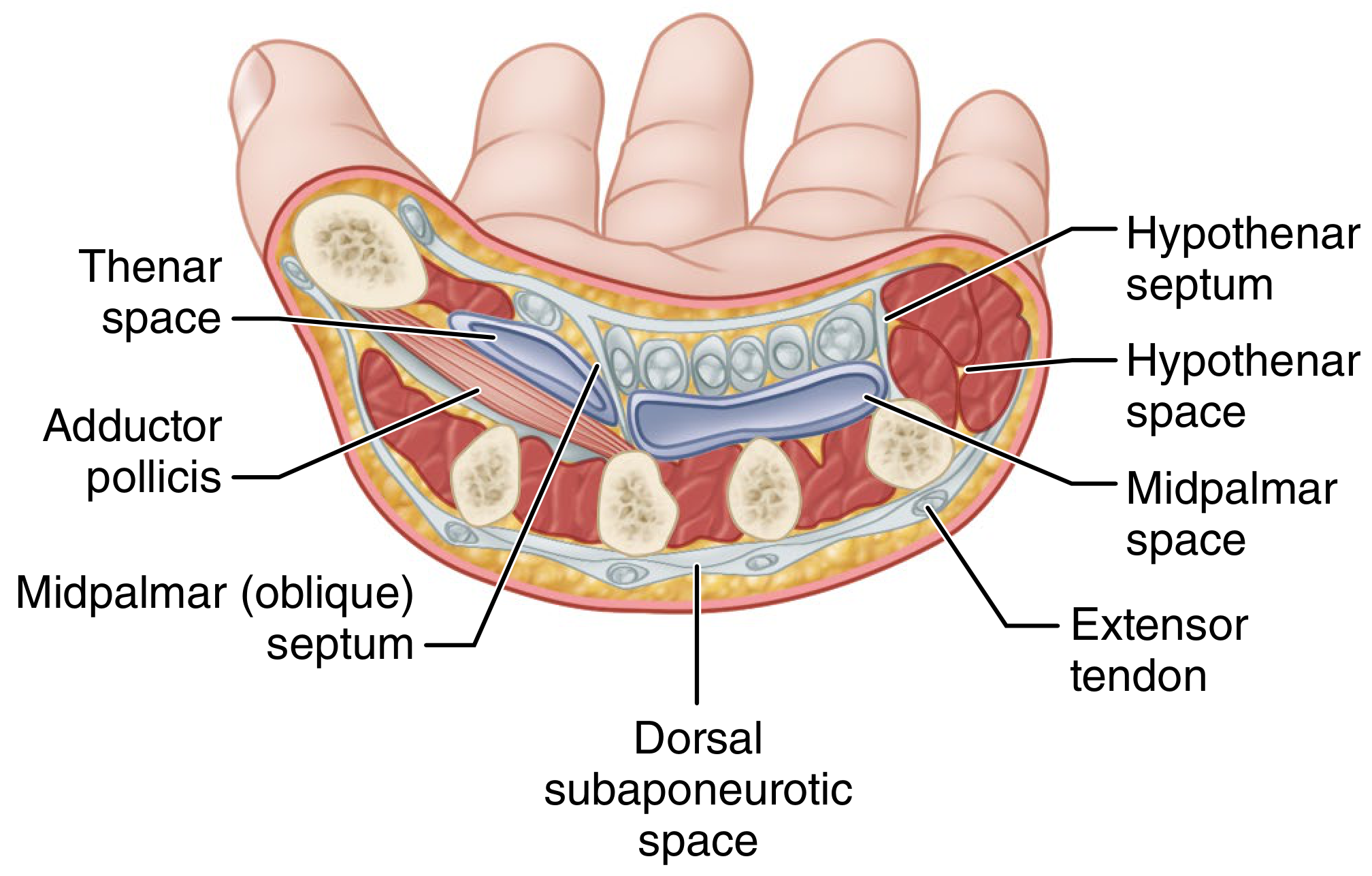
Campbell's Operative Orthopaedics - Cross-sectional anatomy of the hand showing all deep spaces
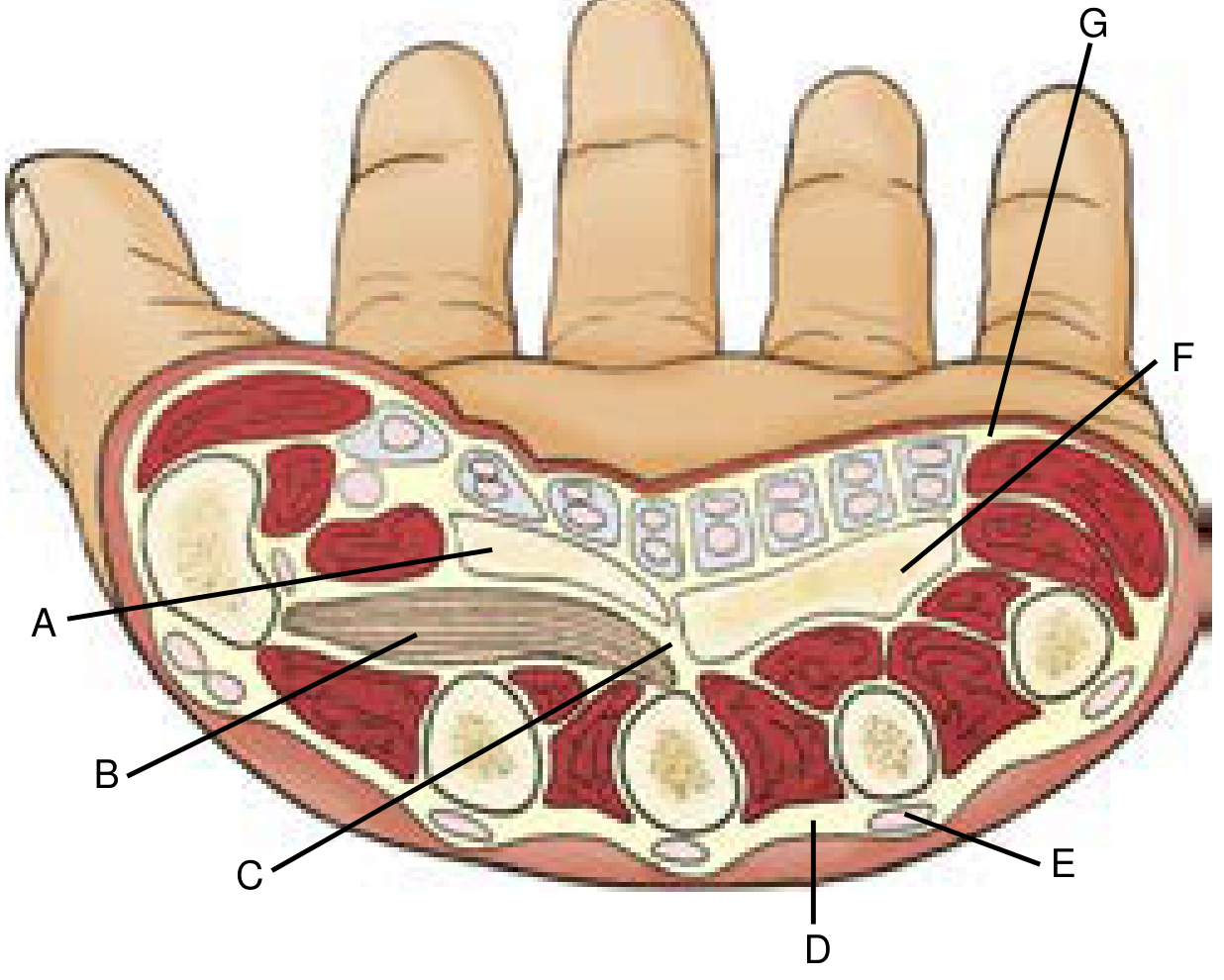
Current Surgical Therapy - Labeled cross-section: A=Thenar space, C=Midpalmar septum, D=Dorsal subaponeurotic space, F=Midpalmar space, G=Palmar aponeurosis
The Key Dividing Septum - The "Gatekeeper"
Before diving into each space, understand the Septum of Legueu and Juvara (also called the midpalmar oblique septum). This single fascial septum runs from the palmar aponeurosis to the 3rd metacarpal and divides the entire deep palmar space into radial (thenar) and ulnar (midpalmar) halves.
Mnemonic: "Legueu's Line = Left-Right Divider" (radial thenar vs. ulnar midpalmar)
Space 1: Thenar Space (Radial)
| Feature | Detail |
|---|---|
| Location | Radial/lateral palm, beneath thenar muscles |
| Volar border | Flexor tendon sheath of index finger + volar fascia |
| Dorsal border | Adductor pollicis muscle + 1st dorsal interosseous fascia |
| Ulnar border | Midpalmar (oblique) septum of Legueu & Juvara |
| Radial border | Adductor pollicis insertion at thumb proximal phalanx |
Clinical Presentation
- Severe pain with thumb motion (active and passive)
- Thumb held in abduction (space is filling with pus, spreading thumb away)
- Massive thenar eminence and first web space swelling
- A "pantaloon abscess" = infection bulges both through the thenar space AND the dorsal first web space (Burkhalter sign)
Easy Memory Aid
"Thenar = Thumb's Territory" - radial side, index finger tendon as the floor, adductor pollicis as the roof
Drainage
Dual incision: longitudinal volar incision along thenar crease (protect median nerve's palmar cutaneous branch!) + small dorsal incision over first web space.
Space 2: Midpalmar Space (Ulnar)
| Feature | Detail |
|---|---|
| Location | Central/ulnar palm, deep to flexor tendons |
| Volar border | Flexor tendons to middle, ring, small fingers + lumbricals |
| Dorsal border | 2nd and 3rd palmar interosseous muscles + middle and ring metacarpals |
| Radial border | Midpalmar septum of Legueu & Juvara |
| Ulnar border | Hypothenar muscles |
Clinical Presentation
- Loss of normal palmar concavity (palm looks full/flat instead of concave - classic sign!)
- Painful passive flexion of middle and ring fingers (these fingers' tendons ride over this space)
- Dorsal hand swelling (pus pressure tracks dorsally - do not mistake the dorsal swelling for the infection site!)
Easy Memory Aid
"Midpalmar = Middle fingers Mourn" - pain with middle + ring finger flexion, loss of palm concavity
Drainage
Transverse incision along distal palmar crease or a curvilinear incision along the thenar crease.
Space 3: Hypothenar Space
| Feature | Detail |
|---|---|
| Location | Ulnar palm, beneath hypothenar muscles |
| Contents | Hypothenar muscles (abductor digiti minimi, flexor digiti minimi, opponens digiti minimi) |
| Note | Less well-defined; rarely infected in isolation |
Clinical Presentation
- Pain and swelling over the hypothenar eminence
- Pain worsened by flexion of the small finger
Easy Memory Aid
"Hypo = Little Pinky's Home" - hypothenar = small finger side
Space 4: Dorsal Subaponeurotic Space
| Feature | Detail |
|---|---|
| Location | Dorsum of hand (back of hand) |
| Volar border | Metacarpal bones + dorsal interosseous muscles |
| Dorsal border | Extensor tendons surrounded by dorsal aponeurosis |
| Note | Deep to extensor tendons but superficial to metacarpals |
Clinical Presentation
- Dorsal hand swelling and fluctuance (this space is on the dorsum, so swelling here is directly at the infection site)
- IMPORTANT: Dorsal swelling in palmar space infections is a red herring - it's due to venous/lymphatic congestion, not direct infection!
Easy Memory Aid
"Dorsal = Directly Dorsal" - the one space where dorsal swelling = dorsal infection
Drainage
Longitudinal incisions over the index and ring metacarpals - do NOT incise directly over the extensor tendons.
Space 5: Interdigital (Web) Spaces - "Collar Button Abscess"
| Feature | Detail |
|---|---|
| Location | Between the fingers, just proximal to the superficial transverse ligament at MCP level |
| Number | 3 web spaces (between index-middle, middle-ring, ring-small) |
| Shape | "Collar button" or "dumbbell" shaped - the abscess has a volar component AND a dorsal component connected by a narrow neck through the transverse ligament |
Clinical Presentation
- Adjacent fingers held in abduction (pushed apart by swelling between them)
- Swelling is BOTH volar (palmar) AND dorsal at the web space
- Infection may start beneath palmar calluses in laborers
- Can spread through lumbrical canals to the midpalmar space!
Why "Collar Button"?
The abscess looks like an old-fashioned collar button - wide on both ends (volar + dorsal), narrow in the middle (neck through the ligament). You must drain BOTH components or it will reaccumulate.
Drainage
Two incisions - one dorsal, one volar - do NOT incise the web skin itself (risk of contracture and scar).
Space 6: Space of Parona (Forearm Space)
| Feature | Detail |
|---|---|
| Location | Distal forearm (NOT in the hand itself) |
| Volar border | Pronator quadratus muscle |
| Dorsal border | Digital flexor tendons |
| Radial border | Flexor pollicis longus |
| Ulnar border | Flexor carpi ulnaris |
Why It Matters
- Usually infected by spread from the midpalmar space or from the radial/ulnar bursae
- When the radial bursa (around FPL/thumb) + ulnar bursa (around FDP to small finger) are both infected and communicate via Parona's space = HORSESHOE ABSCESS
Clinical Presentation
- Swelling, tenderness, fluctuation in the distal volar forearm
- Painful active digital flexion
- Passive finger extension is painful
- May cause acute carpal tunnel syndrome (median nerve compression)
Easy Memory Aid
"Parona = Pronator Quadratus Pocket" - sits right on top of pronator quadratus in the forearm
Infection Spread Map
Web Space  ──(lumbrical canal)──►  Midpalmar Space
                                         │
                              (spread)   ▼
Radial bursa (thumb FPL)  ──────►  Space of Parona  ◄──── Ulnar bursa (small finger FDP)
                                    (Horseshoe Abscess when both bursae communicate)
Thenar Space ◄──(septum of Legueu & Juvara)──► Midpalmar Space
Horseshoe Abscess mnemonic: "The Horse Has Two Hooves" - Radial bursa + Ulnar bursa meet in Parona's space forming a U/horseshoe shape.
Master Summary Table
| Space | Side | Key Borders | Classic Presentation | "The Clue" |
|---|---|---|---|---|
| Thenar | Radial | AP dorsal, index tendon volar | Thumb abducted, thenar swelling | Thumb abduction |
| Midpalmar | Ulnar | Flexors volar, interossei dorsal | Flat palm, middle+ring finger pain | Flat palm |
| Hypothenar | Ulnar | Hypothenar muscles | Small finger pain | Pinky pain |
| Dorsal subaponeurotic | Dorsal | Extensors, metacarpals | Dorsal fluctuance | Real dorsal |
| Web spaces (x3) | Interdigital | Between MCPs | Fingers abducted, collar button | Collar button |
| Parona | Forearm | Pronator quadratus | Forearm swelling, horseshoe | Forearm + horseshoe |
All-in-One Mnemonic: "THWDMP"
"Tough Hands Work Despite Major Pain"
- Thenar
- Hypothenar
- Web (interdigital)
- Dorsal subaponeurotic
- Midpalmar
- Parona
Common Organisms & Treatment Principle
- Most common bugs: S. aureus and Streptococcus species
- All deep space infections require surgical I&D - antibiotics alone are not sufficient
- Cultures always at time of drainage
- IV antibiotics are adjunctive
Sources: Campbell's Operative Orthopaedics 15e, Current Surgical Therapy 14e, Sabiston Textbook of Surgery, Miller's Review of Orthopaedics 9e
Also explain their related clinicals
Your credits are exhausted. You can purchase a top-up or subscribe to a plan to continue using Orris. If you're already subscribed, your daily credits will reset tomorrow.
This is a shared conversation. Sign in to Orris to start your own chat.