
Mood disorder definition
Mood Disorder - Definition
Core Definition
- Rosen's Emergency Medicine, p. 5073
- Stahl's Essential Psychopharmacology, p. 260
Key Conceptual Points
Mood vs. Affect
More Than Just Mood
The Spectrum Concept
- Stahl's Essential Psychopharmacology, p. 264
DSM-5 Classification
| Category | Description |
|---|---|
| Depressive disorders | Unipolar depression; includes major depressive disorder, persistent depressive disorder (dysthymia), premenstrual dysphoric disorder, disruptive mood dysregulation disorder, and others |
| Bipolar disorders | Bipolar I (full manic episodes), Bipolar II (hypomanic + depressive episodes), cyclothymic disorder |
- A general medical condition (e.g., hypothyroidism, stroke, Parkinson's disease)
- Substance/medication-induced causes
- Rosen's Emergency Medicine, p. 5075
The Unipolar-Bipolar Distinction
- Unipolar depression: patients experience only the "down" depressed pole
- Bipolar disorder: patients experience both the "up" pole (mania or hypomania) and the "down" pole (depression)
- Bipolar I: full-blown manic episodes, usually followed by depressive episodes
- Bipolar II: at least one hypomanic episode + one major depressive episode
Epidemiology
-
Major depressive disorder (MDD): 12-month prevalence ~5%, lifetime prevalence ~13% - ranked by the WHO as one of the most prevalent and disabling diseases in the world
-
Bipolar spectrum disorders: lifetime prevalence ~4%
-
Approximately one-quarter to one-third of emergency department patients screen positive for mood disorders
-
Up to 80% of bipolar disorder patients exhibit suicidal behavior
-
Rosen's Emergency Medicine, pp. 5080-5086
Neurobiological Basis
-
Monoamines: serotonin, norepinephrine, dopamine (the classical monoamine hypothesis)
-
Glutamate and GABA: more recently implicated
-
Neurotrophic factors (e.g., BDNF) and neuroinflammation: emerging targets
-
Brain reward circuitry: functional abnormalities in reward pathways contribute to depressive symptoms
-
Stahl's Essential Psychopharmacology, p. 260; Kandel's Principles of Neural Science
Mood disorder definition 2 marks mental health nursing gnm 2nd years. Answer Marathi aani english mix krun de
Mood Disorder – Definition (2 Marks)
GNM 2nd Year – Mental Health Nursing
Definition (English + Marathi Mix):
Simple Points (exam साठी):
-
Mood = व्यक्तीची आतील भावनिक अवस्था (internal emotional state)
-
Mood disorder मध्ये mood खूप जास्त कमी (depressed) किंवा खूप जास्त जास्त (elevated/manic) होतो
-
हे disturbance prolonged (दीर्घकाळ) असते — normal life events मुळे नाही
-
DSM-5 नुसार दोन main categories आहेत:
- Depressive Disorders – उदा. Major Depressive Disorder
- Bipolar Disorders – उदा. Bipolar I & II
One-line Definition (exam मध्ये लिहायला):
"Mood disorder is a group of psychiatric conditions characterized by persistent and pathological disturbance in mood — either depression or mania — which significantly impairs the individual's daily functioning."
Difference between mania and depression.. chat format nusar de
| Feature | 😄 Mania (UP Pole) | 😔 Depression (DOWN Pole) |
|---|---|---|
| Mood | Elevated, expansive, irritable - खूप जास्त आनंद किंवा चिडचिड | Depressed, sad - खूप उदासीनता |
| Energy | खूप जास्त energy, hyperactive | खूप कमी energy, थकलेलं वाटणं |
| Sleep | Decreased need for sleep - कमी झोप तरी fresh वाटतं | Insomnia किंवा hypersomnia - खूप कमी किंवा खूप जास्त झोप |
| Speech | Pressured speech - खूप जोराने, लवकर बोलणं | Slow speech - हळू, कमी बोलणं |
| Thoughts | Racing thoughts, flight of ideas - विचार खूप वेगाने येतात | Negative thoughts, hopelessness - निराशावादी विचार |
| Self-esteem | Inflated - grandiosity, "मी सर्वात श्रेष्ठ आहे" | Worthlessness - "मी कुचकामी आहे" |
| Activity | Increased goal-directed activity - खूप plans, खूप काम | Decreased activity - काहीच करावंसं वाटत नाही |
| Appetite | Generally increased किंवा ignore करतात | Decreased appetite - खाण्याची इच्छा नाही |
| Suicidal thoughts | Generally नाही (पण risky behavior असतो) | Present - मृत्यूचे विचार, suicide ideation |
| Duration (DSM-5) | कमीत कमी 1 week | कमीत कमी 2 weeks |
| Insight | Poor - "मला काहीच problem नाही" वाटतं | Sometimes present - स्वतःला आजारी वाटतं |
MANIA = सगळं "जास्त" - energy जास्त, बोलणं जास्त, झोप कमी, confidence जास्तDEPRESSION = सगळं "कमी" - energy कमी, बोलणं कमी, interest कमी, self-worth कमी
Nit explanation de difference between ch
तुम्हाला कशाचा difference हवा आहे?
Difference between mania and depression.. chat format nusar de
- Mood खूप elevated (उंचावलेला) असतो
- व्यक्ती खूप जास्त आनंदी, excited किंवा irritable (चिडचिडी) असते
- "मला सगळं जमतं!" असं वाटतं
- Mood खूप low (खालावलेला) असतो
- व्यक्ती sad, hopeless, empty वाटते
- "माझ्याने काहीच होणार नाही" असं वाटतं
- Energy खूप जास्त असते
- सतत काहीतरी करत राहतो, थकत नाही
- रात्री झोप कमी लागते तरी fresh वाटतं
- Energy खूप कमी असते
- अंथरुणातून उठावंसंच वाटत नाही
- सतत थकलेलं, जड वाटतं
- झोप खूप जास्त किंवा खूप कमी होते
- Pressured speech - खूप वेगाने, जोरात बोलतो
- थांबवता येत नाही
- एका विषयावरून दुसऱ्यावर उडी मारतो (Flight of ideas)
- विचार racing असतात - मनात विचारांचं काहूर
- बोलणं मंद, हळू होतं
- कमी बोलतो, mono-syllable answers देतो
- विचार slow होतात, concentrate करता येत नाही
- Negative, hopeless विचार येतात
- Grandiosity - "मी खूप special आहे, मला सगळं माहित आहे"
- Inflated self-esteem - स्वतःबद्दल खूप जास्त उच्च मत
- Risky गोष्टी करतो - पैसे उधळतो, risky decisions घेतो
- Insight नसते - "मला काहीच problem नाही" असं वाटतं
- Worthlessness - "मी कुचकामी आहे"
- Guilt - स्वतःला दोष देतो
- Hopelessness - भविष्याबद्दल निराशा
- Suicidal thoughts येऊ शकतात ⚠️
| Mania | Depression | |
|---|---|---|
| Duration | कमीत कमी 1 आठवडा | कमीत कमी 2 आठवडे |
| Hospitalization | लागू शकते | Severe असेल तर |
| Psychosis | येऊ शकते | येऊ शकते |
🔺 MANIA = M-A-N-I-A
- M - Mood elevated
- A - Activity increased
- N - No sleep needed
- I - Inflated self-esteem
- A - Agitation / racing thoughts
🔻 DEPRESSION = D-E-P
- D - Down mood / Decreased energy
- E - Empty / worthless feeling
- P - Poor sleep, Poor appetite, Poor concentration
Chart bnvun de
A clear educational comparison chart titled "Difference Between Mania and Depression" for nursing students. Two columns side by side - left column header "MANIA" with a sun/up arrow symbol in yellow/orange color, right column header "DEPRESSION" with a down arrow/rain cloud symbol in blue/grey color. Rows comparing: Mood, Energy, Sleep, Speech, Thoughts, Self-esteem, Activity, Appetite, Duration, Insight. Each row has a feature label in the middle. Clean, professional medical chart style with white background, easy to read fonts, color coded - warm yellow/orange for mania side, cool blue/grey for depression side. Include Marathi and English mixed labels.
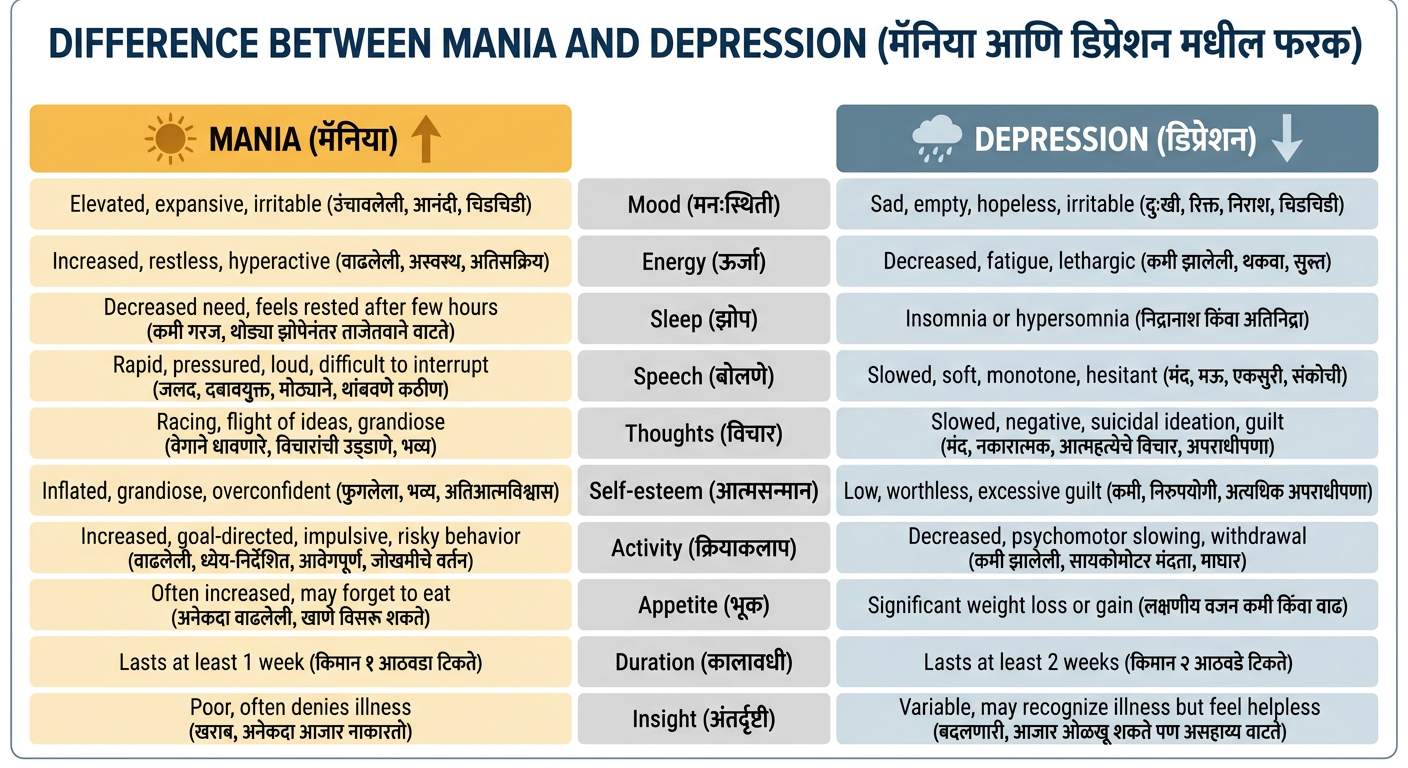
- 🟡 Mania = सगळं "जास्त" - energy, mood, speech, activity
- 🔵 Depression = सगळं "कमी" - energy, mood, interest, self-worth