
explain osteo of norma verticalis
Reading File
Now let me search the library for norma verticalis content:
Finding Sources
Finding Sources
Finding Sources
Finding Sources
Finding Sources
Finding Sources
Gray's Anatomy for Students has a "Superior view" section. Let me read that and also check the Color Atlas of Human Anatomy:
Reading File
Reading File
Now let me fetch the superior view diagram from Gray's and also search for more detailed norma verticalis content:
Loading Image
Finding Sources
Searching Images
norma verticalis skull superior view bones sutures
Loading Image
Reading File
Loading Image
I have all the information needed. Here is a comprehensive explanation of the osteology of Norma Verticalis (the superior/top view of the skull):
Osteology of Norma Verticalis (Superior View of the Skull)
Norma verticalis is the view of the skull as seen from directly above. It shows the calvaria (skullcap/calva) — the roof of the cranium.
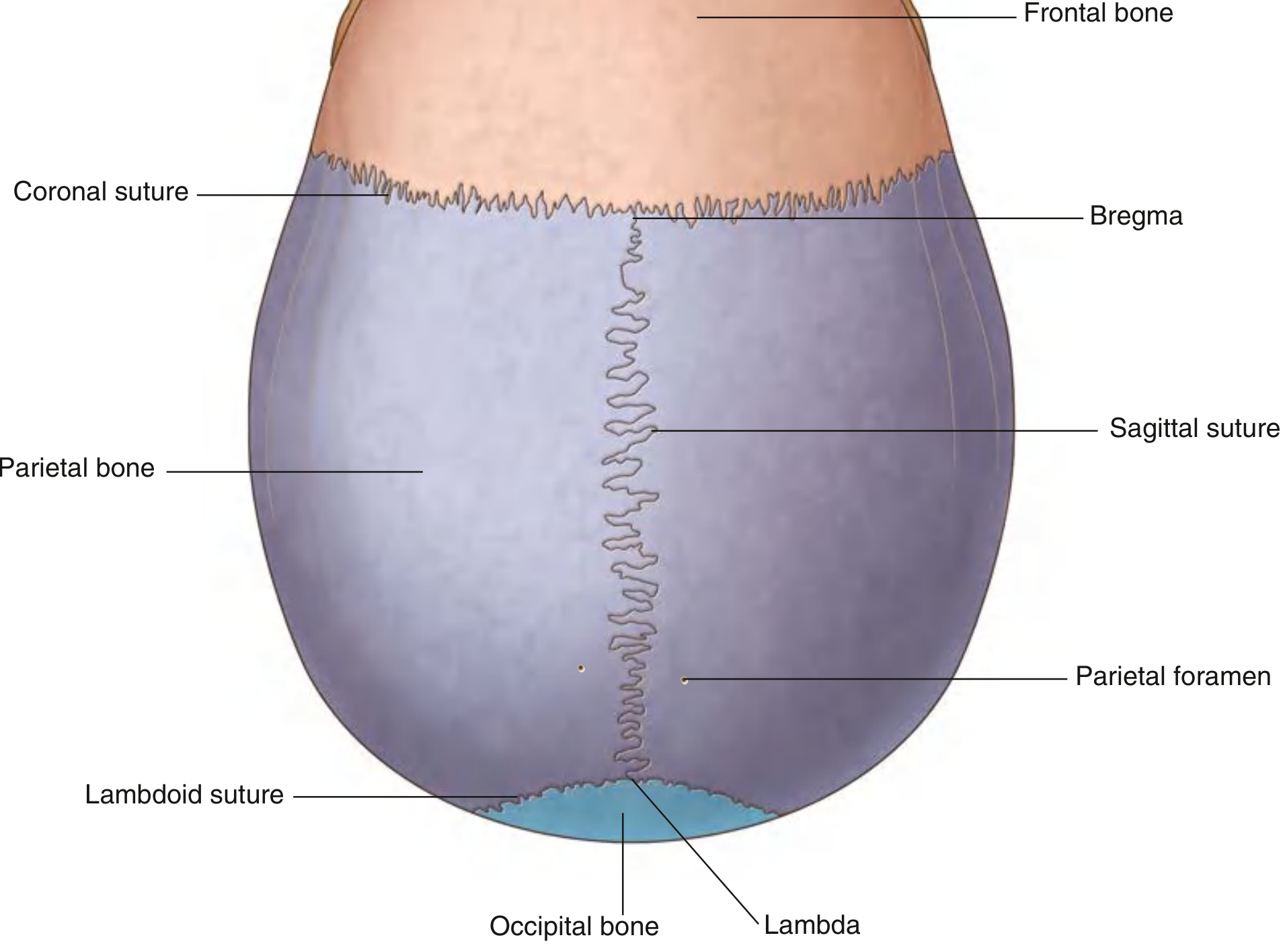
Bones Visible
From anterior to posterior, three bones are seen:
| Bone | Type | Position |
|---|---|---|
| Frontal bone | Unpaired | Anterior |
| Parietal bones (×2) | Paired | Central (dominant view) |
| Occipital bone | Unpaired | Posterior (only a small portion) |
The parietal bones dominate this view and give the skull its characteristic ovoid shape from above.
Sutures
Three major sutures are visible:
1. Coronal Suture
- Runs transversely across the skull
- Articulation between the frontal bone (anteriorly) and the two parietal bones (posteriorly)
- Type: serrated/denticulate fibrous joint
2. Sagittal Suture
- Runs in the midline from front to back
- Articulation between the two parietal bones with each other
- Type: serrated fibrous joint
3. Lambdoid Suture
- Runs posteriorly in a lambda (Λ) shape
- Articulation between the parietal bones (anteriorly) and the occipital bone (posteriorly)
- Small sutural (Wormian) bones may be found along this suture — islands of extra ossification
Key Craniometric Points (Landmarks)
Bregma
- Junction of the sagittal and coronal sutures
- Located anteriorly in the midline
- In the fetus/newborn, this corresponds to the anterior fontanelle (diamond-shaped gap that closes by ~18 months of age)
- Clinically used as a reference point in neurosurgery and anthropology
Lambda
- Junction of the sagittal and lambdoid sutures
- Located posteriorly in the midline
- Corresponds to the posterior fontanelle in the fetus (closes by 2–3 months)
Foramina
The only foramina visible in this view are the:
- Paired parietal foramina — small foramina on each parietal bone, just lateral to the sagittal suture in the posterior part
- They transmit emissary veins (connecting the superior sagittal sinus to the scalp veins) and sometimes a small branch of the occipital artery
- May be absent in some individuals (a normal variant)
Structure of the Calvaria
The bones of the calvaria have a unique three-layered structure:
Outer surface → External table (compact bone)
                       ↓
              Diploë (cancellous/spongy bone)
                       ↓
Inner surface → Internal table (compact bone)
- The diploë contains red bone marrow and diploic veins
- The internal table is thinner and more brittle — fractures here are more dangerous (can damage the dural venous sinuses or meningeal vessels)
Shape of the Skull (as seen from above)
The shape can be described using the cephalic index (maximum breadth ÷ maximum length × 100):
| Shape | Index | Description |
|---|---|---|
| Dolichocephalic | < 75 | Long and narrow |
| Mesocephalic | 75–80 | Intermediate |
| Brachycephalic | > 80 | Short and broad |
Clinical Correlates
- Craniosynostosis (premature fusion of sutures) changes the shape of the skull as seen in norma verticalis:
- Sagittal synostosis → Scaphocephaly (boat-shaped, long narrow skull)
- Coronal synostosis → Brachycephaly or Plagiocephaly (asymmetric skull)
- All sutures → Microcephaly
- Wormian bones along the lambdoid suture are associated with osteogenesis imperfecta, hypothyroidism, and Down syndrome
- The parietal foramina can be mistaken for fractures on skull X-rays
Sources: Gray's Anatomy for Students; Color Atlas of Human Anatomy Vol. 1 — Head and Neck
This is a shared conversation. Sign in to Orris to start your own chat.