
Tpp acts as a coenzyme in pdh and alpha kgdh .
Reading File
TPP (thiamine pyrophosphate) acts as a coenzyme in both pyruvate dehydrogenase (PDH) and alpha-ketoglutarate dehydrogenase (alpha-KGD), helping decarboxylate alpha-keto acids. Its reactive carbon on the thiazole ring attacks the substrate, facilitating oxidative decarboxylation.
Searching sources...
Finding Sources
Finding Sources
Finding Sources
Finding Sources
Reading File
Reading File
Reading File
Loading Image
Finding Sources
Finding Sources
Finding Sources
Reading File
Reading File
Here is a thorough, textbook-grounded explanation of TPP as a coenzyme in PDH and alpha-KGD:
TPP (Thiamine Pyrophosphate) as a Coenzyme
What is TPP?
TPP is the biologically active form of Vitamin B1 (thiamine). It is formed by transfer of a pyrophosphate group from ATP to thiamine. The key reactive site is the C2 carbon of the thiazole ring, which is acidic and easily ionized to form a carbanion (ylide) that attacks electrophilic carbonyl groups on alpha-keto acids.
Role in PDH (Pyruvate Dehydrogenase Complex)
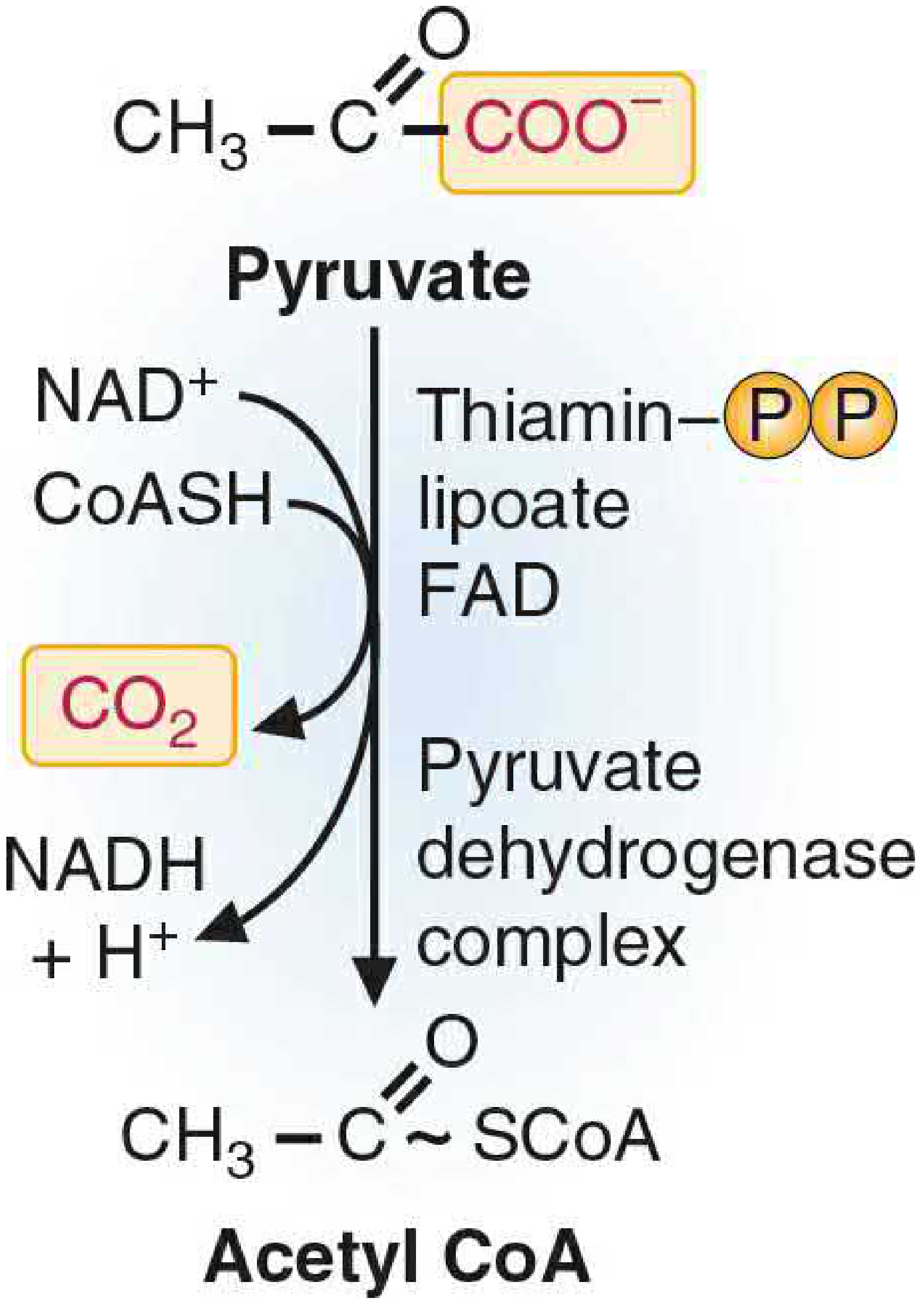
The PDH complex converts pyruvate (from glycolysis) into acetyl-CoA, linking glycolysis to the TCA cycle. It is a multienzyme complex with 5 coenzymes:
| Enzyme subunit | Coenzyme |
|---|---|
| E1 - Pyruvate decarboxylase | TPP |
| E2 - Dihydrolipoyl transacetylase | Lipoic acid (lipoamide) |
| E3 - Dihydrolipoyl dehydrogenase | FAD |
| Electron carrier | NAD+ |
| Acyl carrier | CoA |
Step-by-step mechanism in PDH (E1 step):
- The C2 carbanion of TPP attacks the carbonyl carbon of pyruvate.
- CO2 is released (decarboxylation).
- The remaining 2-carbon hydroxyethyl group stays covalently attached to TPP as a hydroxyethyl-TPP intermediate.
- This 2-carbon unit is then transferred to lipoamide on E2, becoming an acetyl group.
- The acetyl group is transferred to CoA, producing acetyl-CoA.
- E3 reoxidizes lipoamide using FAD, and then FAD is reoxidized by NAD+ to produce NADH.
Overall reaction:
Pyruvate + NAD+ + CoA → Acetyl-CoA + NADH + H+ + CO2
Role in alpha-KGD (Alpha-Ketoglutarate Dehydrogenase Complex)
The alpha-KGD complex is a TCA cycle enzyme that converts alpha-ketoglutarate → succinyl-CoA. It is structurally and mechanistically analogous to the PDH complex and uses the exact same 5 coenzymes (TPP, lipoic acid, FAD, NAD+, CoA).
| Enzyme subunit | Coenzyme |
|---|---|
| E1 - Alpha-ketoglutarate decarboxylase | TPP |
| E2 - Dihydrolipoyl transsuccinylase | Lipoic acid |
| E3 - Dihydrolipoyl dehydrogenase | FAD |
| Electron carrier | NAD+ |
| Acyl carrier | CoA |
Mechanism (same logic as PDH):
- TPP attacks the carbonyl of alpha-ketoglutarate (a 5-carbon alpha-keto acid).
- CO2 is released.
- The succinyl group is shuttled via lipoamide to CoA, forming succinyl-CoA.
- NAD+ is reduced to NADH.
Overall reaction:
Alpha-ketoglutarate + NAD+ + CoA → Succinyl-CoA + NADH + H+ + CO2
Why TPP is Specifically Needed
TPP's thiazole ring has a C2 carbon with an unusually acidic proton. When this proton dissociates, a stabilized carbanion forms that is an excellent nucleophile for attacking alpha-keto acid carbonyl groups. This mechanism allows:
- Cleavage of the C-C bond adjacent to the carbonyl (decarboxylation)
- Stabilization of the acyl carbanion intermediate
No other coenzyme can perform this oxidative decarboxylation of alpha-keto acids.
Third Enzyme Using TPP: Branched-Chain Alpha-Keto Acid Dehydrogenase (BCKADH)
TPP is also required by BCKADH in muscle, which catabolizes branched-chain amino acids (leucine, isoleucine, valine). The mechanism is identical. Deficiency of this complex causes Maple Syrup Urine Disease (MSUD).
Consequences of TPP Deficiency
Since TPP is essential for both PDH and alpha-KGD, thiamine deficiency impairs oxidative energy metabolism - especially in high-demand tissues like the CNS and heart:
| Clinical Syndrome | Features |
|---|---|
| Wernicke-Korsakoff (alcoholism) | Mental confusion, ophthalmoplegia, ataxia, nystagmus, memory loss (Korsakoff dementia) |
| Dry beriberi | Peripheral neuropathy, especially legs |
| Wet beriberi | Dilated cardiomyopathy, edema |
Diagnosis: Erythrocyte transketolase activity increases >25% upon addition of exogenous TPP (TPP stimulation test).
Key point: TPP binds to the E1 (decarboxylase) subunit specifically in both PDH and alpha-KGD. The E3 subunit (dihydrolipoyl dehydrogenase) is actually the same protein shared by all three alpha-keto acid dehydrogenase complexes (PDH, alpha-KGD, BCKADH).
- Biochemistry, 8th ed Lippincott Illustrated Reviews, p. 1064
- Basic Medical Biochemistry - A Clinical Approach, 6e, p. 844
- Harper's Illustrated Biochemistry, 32th Ed
- Fitzpatrick's Dermatology
They have mentioned that tpp helps in atp production but rather it aids production of ribose 5 p instead of atp explain very breifly
The statement is a bit nuanced - both are partially correct, but context matters. TPP does aid ATP production indirectly (via PDH/alpha-KGD feeding the TCA cycle), but in the pentose phosphate pathway, TPP helps produce ribose-5-phosphate, not ATP.
Searching sources...
Finding Sources
Reading File
Here is the brief clarification:
Two Separate Roles of TPP - Easy to Confuse
The confusion comes from mixing up two different pathways where TPP works:
1. PDH + alpha-KGD (what we discussed) - Helps ATP production indirectly
TPP here assists oxidative decarboxylation → produces acetyl-CoA and NADH → these feed the TCA cycle and electron transport chain → ATP is generated.
So saying "TPP aids ATP production" is not wrong for this context - it is just indirect.
2. Transketolase in the Pentose Phosphate Pathway - Directly produces Ribose-5-P
This is where "ribose-5-phosphate, not ATP" is the correct statement.
TPP is the coenzyme for transketolase, which transfers 2-carbon units between sugar phosphates in the non-oxidative phase of the pentose phosphate pathway. When the cell needs more ribose-5-phosphate (for nucleotide/nucleic acid synthesis) than NADPH, transketolase runs the reaction in reverse - converting glyceraldehyde-3-phosphate and fructose-6-phosphate (glycolytic intermediates) into ribose-5-phosphate, bypassing the oxidative steps entirely.
No ATP is produced here. The direct product is ribose-5-phosphate, used for DNA/RNA and nucleotide synthesis.
Bottom line
| Context | TPP enzyme | Direct product |
|---|---|---|
| PDH / alpha-KGD | Decarboxylase (E1) | Acetyl-CoA / Succinyl-CoA → ATP (indirect) |
| Pentose phosphate pathway | Transketolase | Ribose-5-phosphate (no ATP) |
So the statement "TPP aids ribose-5-P production, not ATP" is specifically true for transketolase, and whoever said it was likely distinguishing this role from the ATP-linked roles of PDH and alpha-KGD. Both are correct - just in different pathways.
- Biochemistry, 8th ed Lippincott Illustrated Reviews, p. 428-429
Is pdh and alpha kgd a part of tca
Short answer: PDH is NOT part of the TCA cycle. Alpha-KGD IS part of the TCA cycle.
PDH - The Gateway TO the TCA Cycle
PDH sits before the TCA cycle. It converts pyruvate (from glycolysis) into acetyl-CoA, which then enters the TCA cycle by condensing with oxaloacetate.
Glycolysis → Pyruvate → [PDH] → Acetyl-CoA → enters TCA cycle
PDH is a preparatory/linking step - it is not counted as one of the 8 steps of the TCA cycle itself.
Alpha-KGD - Step 4 OF the TCA Cycle
Alpha-KGD is a proper TCA cycle enzyme. It catalyzes step 4:
Alpha-ketoglutarate → Succinyl-CoA + CO2 + NADH
The 8 steps of the TCA cycle in order:
| Step | Reaction | Enzyme |
|---|---|---|
| 1 | Oxaloacetate + Acetyl-CoA → Citrate | Citrate synthase |
| 2 | Citrate → Isocitrate | Aconitase |
| 3 | Isocitrate → Alpha-ketoglutarate | Isocitrate dehydrogenase |
| 4 | Alpha-ketoglutarate → Succinyl-CoA | Alpha-KGD |
| 5 | Succinyl-CoA → Succinate | Succinyl-CoA synthetase |
| 6 | Succinate → Fumarate | Succinate dehydrogenase |
| 7 | Fumarate → Malate | Fumarase |
| 8 | Malate → Oxaloacetate | Malate dehydrogenase |
Why They Are Often Grouped Together
PDH and alpha-KGD are discussed together because:
- Both are alpha-keto acid dehydrogenase complexes
- Both use the same 5 coenzymes (TPP, lipoic acid, FAD, NAD+, CoA)
- Both perform oxidative decarboxylation
- Both produce NADH + CO2
- They even share the same E3 subunit (dihydrolipoyl dehydrogenase)
But PDH is technically a pre-TCA enzyme, while alpha-KGD is inside the TCA cycle.
Does alpha keto oxidative decarboxylation produces atp
No. Oxidative decarboxylation by alpha-keto acid complexes does NOT directly produce ATP.
What It Actually Produces
Both PDH and alpha-KGD produce:
| Product | How it contributes to ATP |
|---|---|
| NADH | Goes to ETC → produces ~2.5 ATP each (indirect) |
| Acyl-CoA (acetyl-CoA or succinyl-CoA) | Fed into further metabolism (indirect) |
| CO2 | Waste product, no ATP |
Indirect ATP Production
PDH:
Pyruvate → Acetyl-CoA + NADH + CO2
- Acetyl-CoA enters TCA cycle → more NADH, FADH2, and 1 GTP per turn
- NADH goes to ETC → ATP
Alpha-KGD:
Alpha-ketoglutarate → Succinyl-CoA + NADH + CO2
- Succinyl-CoA → next step of TCA is succinyl-CoA synthetase → produces 1 GTP directly (substrate-level phosphorylation)
- But that GTP comes from the next enzyme, NOT from alpha-KGD itself
Which TCA steps directly produce ATP/GTP?
Only one step in the TCA cycle produces ATP directly:
| Step | Enzyme | Direct ATP/GTP? |
|---|---|---|
| Succinyl-CoA → Succinate | Succinyl-CoA synthetase | YES - 1 GTP |
| All others (including alpha-KGD) | - | NO - produce NADH/FADH2 only |
Bottom Line
Oxidative decarboxylation (PDH + alpha-KGD) produces NADH, not ATP. ATP comes later, indirectly, when NADH is oxidized by the electron transport chain via oxidative phosphorylation. The only direct high-energy phosphate produced in the TCA cycle itself is the 1 GTP from succinyl-CoA synthetase - and that is a different enzyme, not alpha-KGD.
This is a shared conversation. Sign in to Orris to start your own chat.