
Hip bone
Reading File
The hip bone (os coxae) is a large, irregular bone formed by the fusion of three bones - the ilium, ischium, and pubis - which meet at the acetabulum. It forms the lateral wall of the pelvis and articulates with the femur.
Searching sources...
Finding Sources
Finding Sources
Finding Sources
Finding Sources
Reading File
Reading File
Reading File
Loading Image
Loading Image
Loading Image
Loading Image
Loading Image
Loading Image
The Hip Bone (Os Coxae)
The hip bone is a large, irregularly shaped bone that forms the lateral wall of the pelvis. It is composed of three bones that fuse during development: the ilium, ischium, and pubis. These three bones meet at the acetabulum - the cup-shaped socket that articulates with the femoral head to form the hip joint.
The Right Hip Bone - Lateral and Medial Views
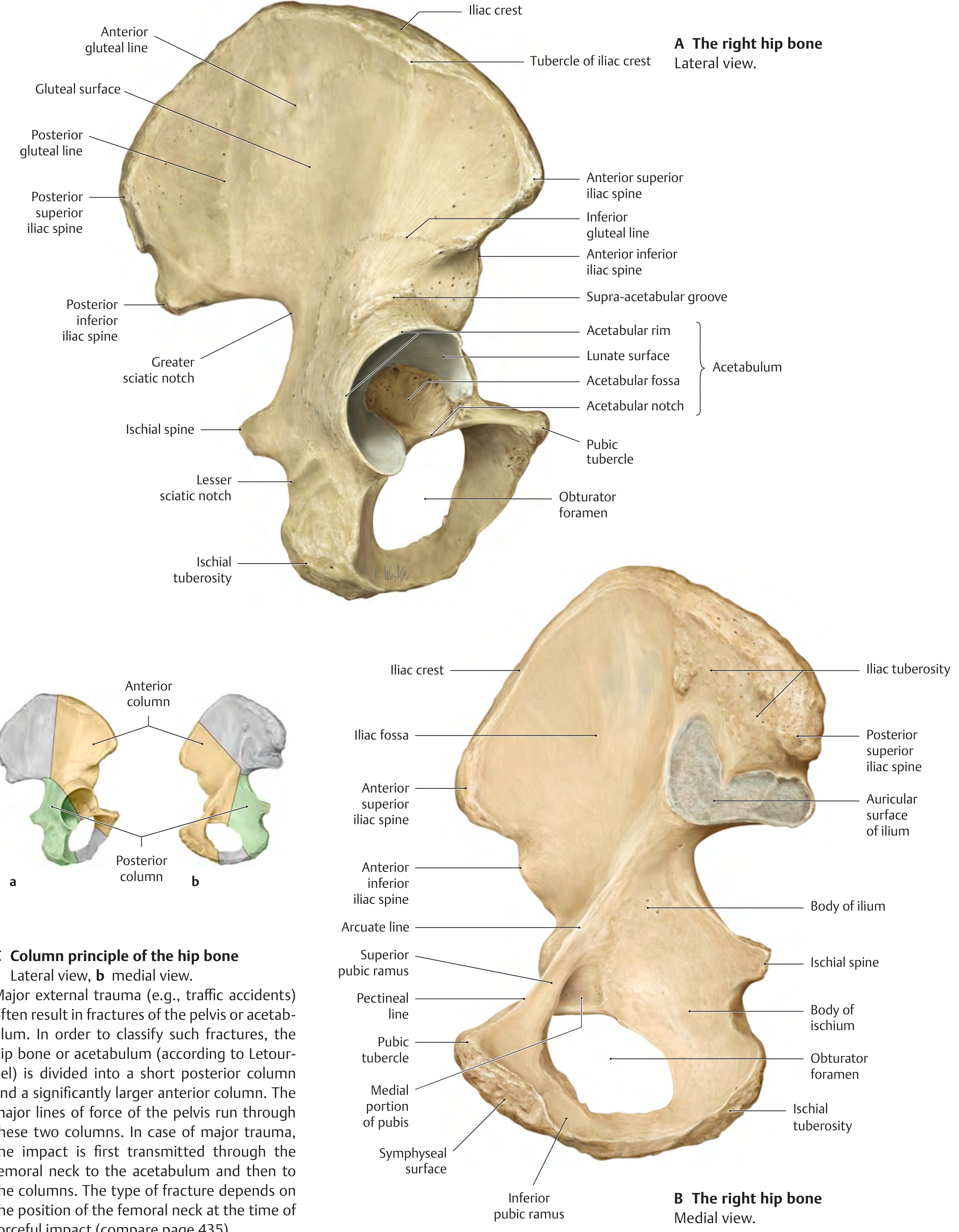
Right hip bone: lateral view (top left), medial view (top right), and column principle (bottom) — THIEME Atlas of Anatomy
The Three Component Bones
1. Ilium
The largest of the three parts, forming the upper, fan-shaped portion of the hip bone. Key features:
- Iliac crest - the curved upper border, palpable along its entire length; has a prominent tubercle of the iliac crest anterolaterally
- Anterior superior iliac spine (ASIS) - attachment for the inguinal ligament and sartorius
- Anterior inferior iliac spine (AIIS) - attachment for the rectus femoris (straight head)
- Posterior superior iliac spine (PSIS) and posterior inferior iliac spine (PIIS)
- Iliac fossa - the smooth concave medial surface where iliacus muscle attaches
- Iliac tuberosity - posterior roughened area for interosseous sacroiliac ligaments
- Auricular surface - ear-shaped articular surface for the sacroiliac joint
- Gluteal surface (lateral) - divided by three gluteal lines (anterior, posterior, inferior) where the three gluteal muscles attach
- Greater sciatic notch - below the PIIS, converted to the greater sciatic foramen by the sacrospinous ligament
2. Ischium
The posteroinferior part, forming the "sit bone." Key features:
- Body of ischium - contributes to the posterior wall of the acetabulum
- Ischial spine - projects medially between greater and lesser sciatic notches; attachment for the sacrospinous ligament
- Lesser sciatic notch - below the ischial spine, converted to the lesser sciatic foramen by ligaments
- Ischial tuberosity - the large rough prominence you sit on; attachments for hamstring muscles and sacrotuberous ligament
- Ramus of ischium - joins with the inferior pubic ramus to form the ischiopubic ramus
3. Pubis
The anteromedial part. Key features:
- Body of pubis - bears the symphyseal surface, which articulates with the opposite pubis at the pubic symphysis
- Superior pubic ramus - projects laterally from the body; has the pectineal line (pecten pubis) and the pubic tubercle
- Inferior pubic ramus - projects inferolaterally to join the ischial ramus
The Hip Bone - Anterior View
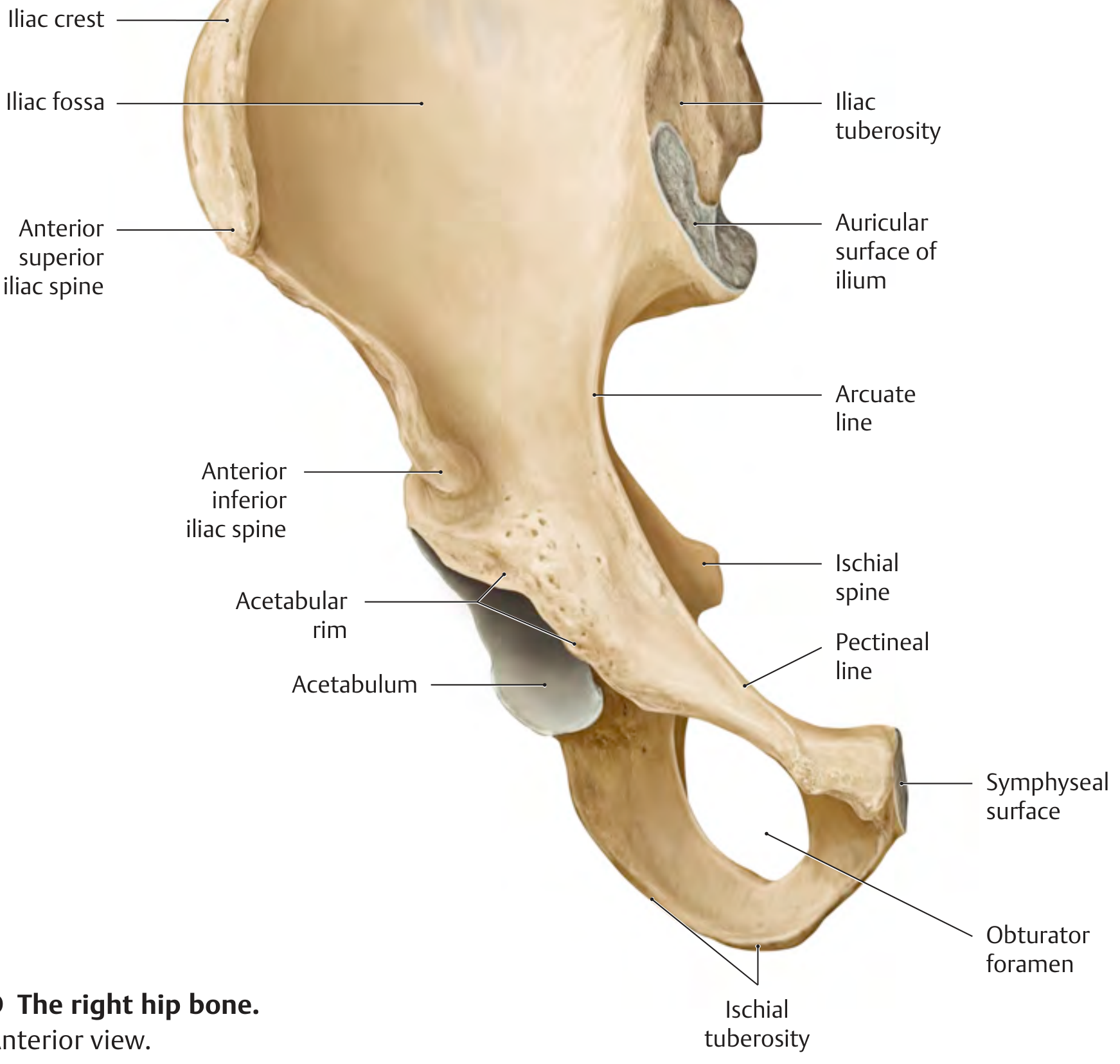
Right hip bone, anterior view — THIEME Atlas of Anatomy
The Acetabulum
The acetabulum is the deep hemispherical socket on the lateral surface of the hip bone. It is formed by contributions from all three component bones:
- Ilium - 2/5 (superiorly)
- Ischium - 2/5 (posteroinferiorly)
- Pubis - 1/5 (anteriorly)
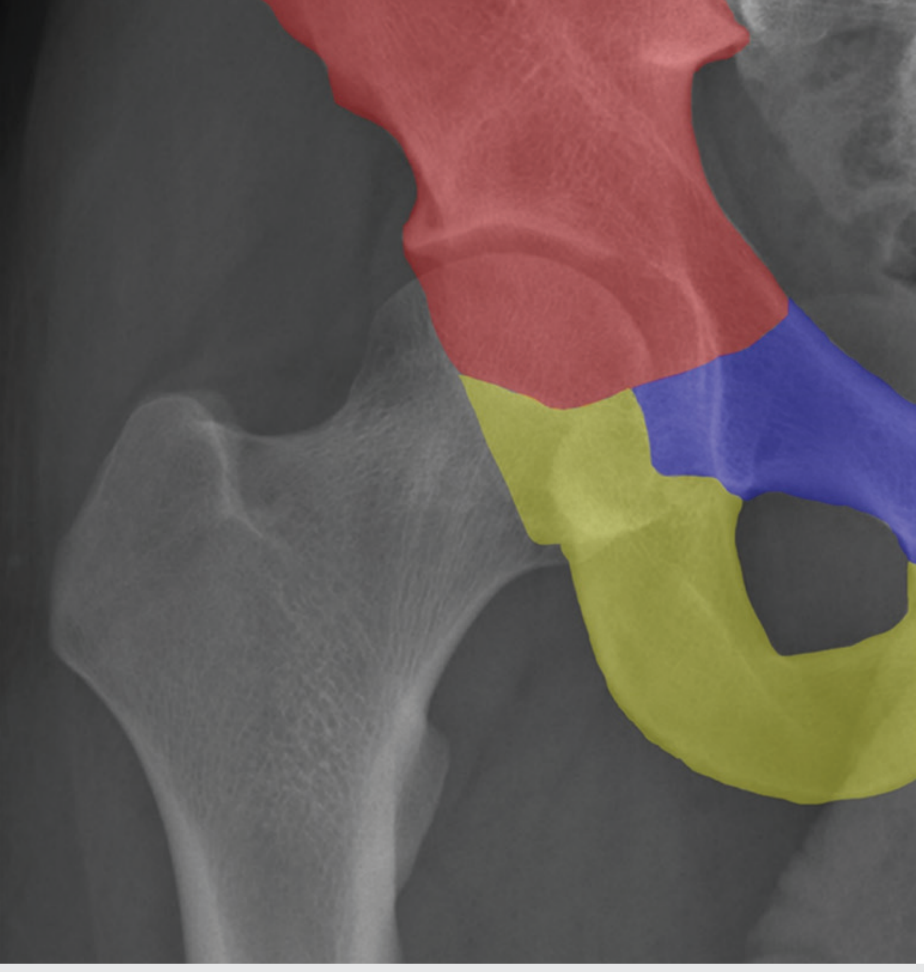
AP radiograph of the right hip: ilium (red), ischium (yellow), pubis (blue) — Imaging Anatomy, Vol. 3
Parts of the acetabulum:
- Acetabular rim - the bony margin
- Lunate surface - the C-shaped articular cartilage-bearing surface (covers ~2/3 of a sphere)
- Acetabular fossa - the central non-articular depression
- Acetabular notch - the inferior gap in the rim, bridged by the transverse acetabular ligament
Triradiate Cartilage
During childhood, the three bones are separated at the acetabulum by a Y-shaped growth plate called the triradiate cartilage. This fuses definitively between ages 14-16 years.
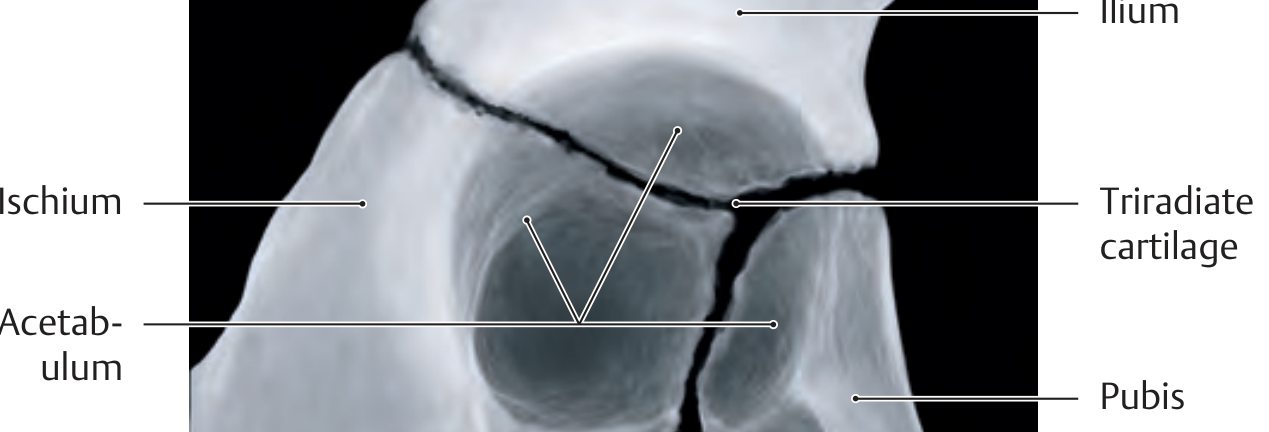
Triradiate cartilage (child): ilium, ischium, and pubis junction at the acetabulum — THIEME Atlas of Anatomy
Obturator Foramen
The large oval opening bounded by the pubis and ischium. It is the largest foramen in the skeleton but is almost entirely closed by the obturator membrane, leaving only the obturator canal superiorly for passage of the obturator nerve and vessels.
The Pelvic Girdle and Pelvic Ring
The two hip bones together form the pelvic girdle, joined:
- Anteriorly - at the pubic symphysis (cartilaginous joint)
- Posteriorly - to the sacrum at the sacroiliac joints
This creates the bony pelvic ring, which is highly stable and allows minimal motion.
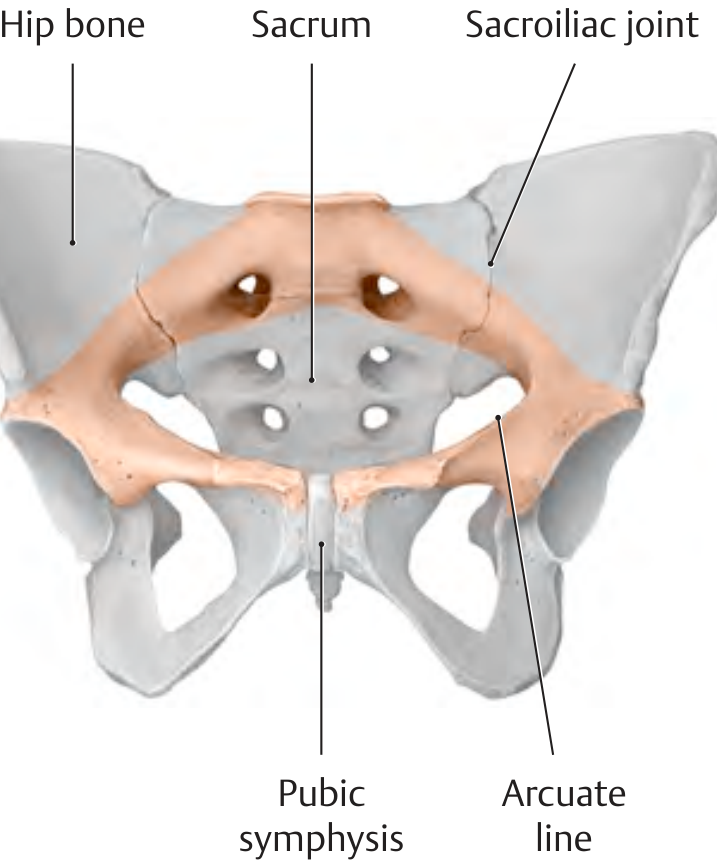
Pelvic ring: hip bones (gray), sacrum (tan), sacroiliac joints, pubic symphysis, and arcuate line — THIEME Atlas of Anatomy
Column Principle (Letournel Classification)
For the purpose of fracture classification, the hip bone is divided into:
- Anterior column - runs from the iliac crest through the ASIS and superior pubic ramus to the pubic symphysis
- Posterior column - runs from the greater sciatic notch through the acetabulum to the ischial tuberosity
Major trauma transmits force through the femoral neck to the acetabulum and then into these columns. The pattern of fracture depends on femoral neck position at impact.
Key Landmarks Summary
| Structure | Part | Clinical Relevance |
|---|---|---|
| ASIS | Ilium | Inguinal ligament attachment; surface landmark |
| Iliac crest | Ilium | Bone marrow biopsy site |
| PSIS | Ilium | Dimple of Venus; sacroiliac joint reference |
| Ischial tuberosity | Ischium | Hamstring origin; ischial bursitis |
| Ischial spine | Ischium | Pudendal nerve block landmark; obstetric diameter |
| Pubic tubercle | Pubis | Inguinal canal landmark; hernia surgery |
| Acetabulum | All three | Hip joint socket; fracture classification |
| Obturator foramen | Pubis + ischium | Obturator hernia site |
Sources: General Anatomy and Musculoskeletal System, THIEME Atlas of Anatomy; Imaging Anatomy Text and Atlas, Vol. 3 - Bones, Joints, Vessels and Nerves
This is a shared conversation. Sign in to Orris to start your own chat.