

IMG_20260621_103621_330.jpg
Explain diabetes Mellitus
Reading File
Now let me search the medical library for comprehensive Diabetes Mellitus content, in parallel with a PubMed search for recent evidence.
Finding Sources
Searching PubMed
"diabetes mellitus"[MeSH Terms] AND "pathogenesis"[MeSH Terms]
The image shows this is from Robbins Pathology / The Endocrine System chapter. Let me search specifically for the pathology textbook content and the key DM sections.
Finding Sources
Finding Sources
The Robbins Pathology book matches exactly what's shown in the image. Let me read the main DM sections.
Reading File
Reading File
Excellent content loading. Let me now read the Type 2 pathogenesis, classification, complications, and clinical features sections.
Reading File
Reading File
Let me read the clinical features and complications sections now.
Reading File
Reading File
I now have comprehensive content from Robbins Pathology. Let me fetch the key diagrams referenced in the textbook.
Loading Image
Loading Image
I now have everything needed for a thorough, well-illustrated answer. Here is a comprehensive explanation of Diabetes Mellitus based on Robbins, Cotran & Kumar - Pathologic Basis of Disease (the exact textbook shown in your image).
Diabetes Mellitus
Source: Robbins, Cotran & Kumar - Pathologic Basis of Disease, Chapter 24: The Endocrine System
Definition
Diabetes mellitus is a group of metabolic disorders sharing the common feature of hyperglycemia caused by defects in insulin secretion, insulin action, or - most commonly - both. Chronic hyperglycemia leads to secondary damage in multiple organ systems, especially the kidneys, eyes, nerves, and blood vessels.
Epidemiology
- Affects >30 million people (>11% of the US population)
- ~1.9 million have Type 1; the vast majority (~90-95%) have Type 2
- ~96 million US adults have prediabetes
- WHO estimates 422 million people with diabetes worldwide
- 7th leading cause of death in the USA
- Total yearly cost in the US: ~$327 billion
Diagnosis (ADA/WHO Criteria)
Normal blood glucose: 70-120 mg/dL
Diabetes is diagnosed by any one of the following (confirmed on a separate day, except random glucose with symptoms):
| Test | Diabetes | Prediabetes |
|---|---|---|
| Fasting plasma glucose | ≥126 mg/dL | 100-125 mg/dL |
| Random plasma glucose | ≥200 mg/dL (with symptoms) | - |
| 2-hr glucose (OGTT, 75g) | ≥200 mg/dL | 140-199 mg/dL |
| HbA1c | ≥6.5% | 5.7-6.4% |
Classification
Type 1 Diabetes (T1D) - ~5-10%
Autoimmune destruction of pancreatic β-cells causing absolute insulin deficiency.
- Most common in patients <20 years, but can occur at any age
- Requires insulin for survival
- Risk of diabetic ketoacidosis (DKA)
- LADA (Latent Autoimmune Diabetes in Adults) is a slowly progressive adult form
Type 2 Diabetes (T2D) - ~90-95%
Combination of peripheral insulin resistance + relative insulin deficiency (inadequate β-cell compensatory response).
- Most individuals are overweight/obese
- Prevalence rising sharply in children and adolescents
Other Forms
- Monogenic diabetes: MODY (Maturity-Onset Diabetes of the Young) - genetic defects in β-cell function or insulin action
- Gestational diabetes: glucose intolerance first recognized during pregnancy
- Secondary causes: pancreatitis, Cushing syndrome, acromegaly, drug-induced
Glucose Homeostasis (Normal)
Glucose is tightly regulated by three processes:
- Hepatic glucose production (gluconeogenesis + glycogenolysis)
- Peripheral glucose uptake (mainly skeletal muscle)
- Insulin/glucagon balance
- Fasting: low insulin, high glucagon → hepatic glucose release prevents hypoglycemia
- Post-meal: insulin rises, glucagon falls → glucose uptake in muscle and fat
Insulin secretion from β-cells: triggered by rising blood glucose → glucose enters β-cell via GLUT2 → metabolized → ↑ATP/ADP ratio → closes K⁺-ATP channels → membrane depolarization → Ca²⁺ influx → insulin granule exocytosis (first-phase rapid, second-phase sustained)
Pathogenesis of Type 1 Diabetes
T1D is an autoimmune disease - immune effector cells attack endogenous β-cell antigens.
Genetic Susceptibility
- HLA gene cluster contributes ~50% of genetic risk
- 90-95% of European patients carry HLA-DR3 or HLA-DR4 (vs ~40% of normal subjects)
- 40-50% of T1D patients are DR3/DR4 compound heterozygotes (vs 5% of normal subjects)
- DR3 or DR4 + DQ8 haplotype = highest inherited risk
- Other susceptibility genes: CTLA4, PTPN22, STAT3, AIRE mutations
Environmental Factors
- Viral infections may trigger islet autoimmunity through molecular mimicry (viral epitopes cross-react with islet antigens)
- Diet, gut microbiome, and hygiene hypothesis also implicated
Mechanisms of β-Cell Destruction
- CD8⁺ cytotoxic T cells directly kill β-cells
- CD4⁺ Th1 cells activate macrophages that produce cytokines damaging β-cells
- Autoantibodies (anti-insulin, anti-GAD65, anti-IA-2) are markers of T1D but not primary effectors
- Progressive loss of β-cell mass over years before clinical presentation
Pathogenesis of Type 2 Diabetes
Two central defects:
1. Insulin Resistance
Tissues (especially skeletal muscle, liver, adipose) fail to respond normally to insulin.
Key contributor - Obesity:
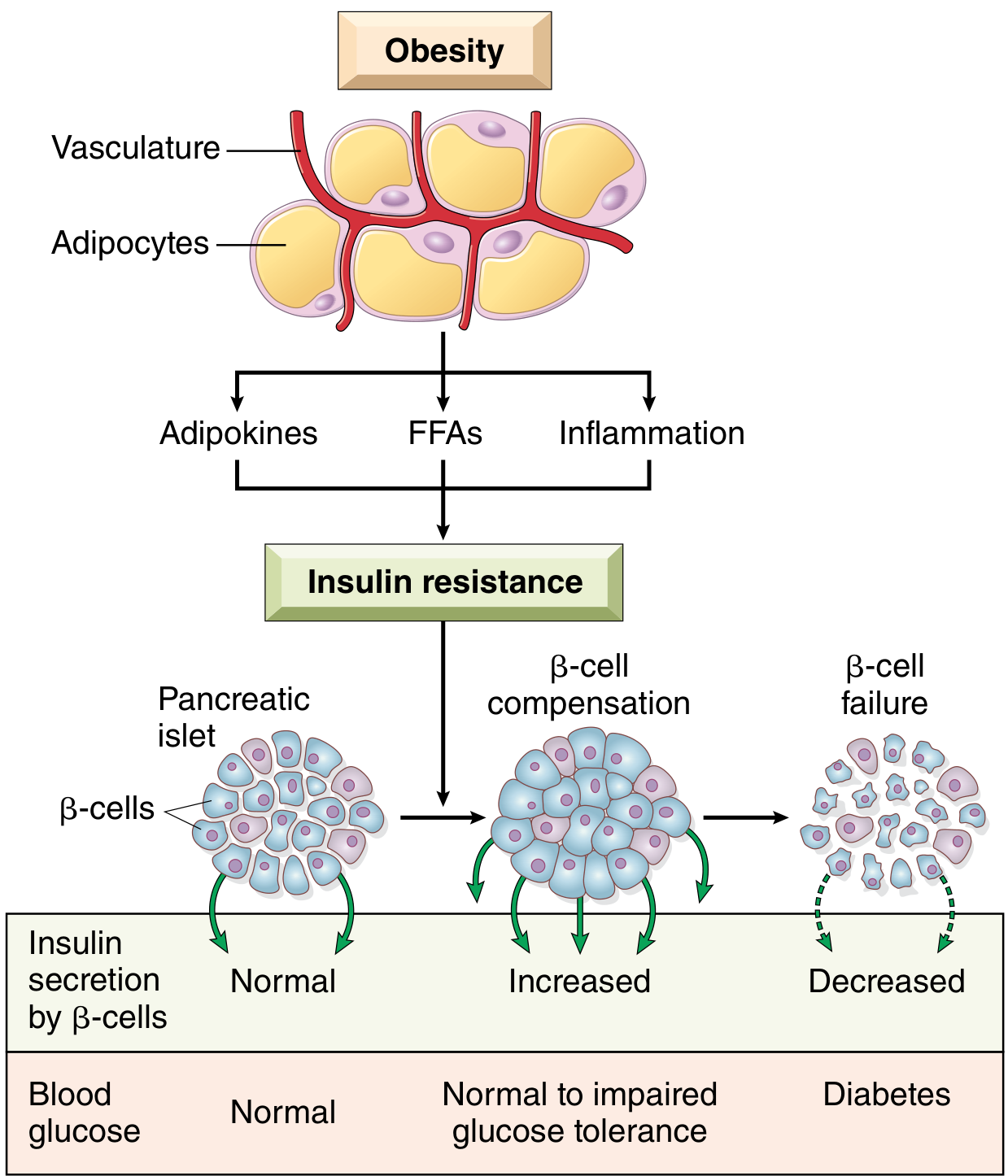
- Free fatty acids (FFAs): Central adipose tissue is highly lipolytic; excess FFAs accumulate toxic lipid intermediates (DAG, ceramides) that impair insulin receptor signaling and activate inflammatory pathways. In the liver, attenuated insulin signaling unleashes phosphoenolpyruvate carboxykinase, driving excess gluconeogenesis.
- Adipokines: Adipose tissue secretes hormones. Adiponectin (which improves insulin sensitivity) is reduced in obesity, worsening resistance.
- Inflammation: Excess FFAs and glucose activate the inflammasome in macrophages and β-cells → IL-1β secretion → proinflammatory cytokine cascade → insulin resistance at peripheral tissues.
2. β-Cell Failure
Initially, β-cells compensate by secreting more insulin (hyperinsulinemia). Over time, sustained demands lead to:
- β-cell exhaustion and reduced mass (partly from amyloid deposition - islet amyloid polypeptide/IAPP)
- Glucotoxicity and lipotoxicity accelerate β-cell dysfunction
- Eventually, insulin secretion is inadequate → frank hyperglycemia
Mechanisms of Vascular Complications (Common to T1D & T2D)
Three major biochemical pathways drive end-organ damage:
1. Advanced Glycation End-products (AGEs)
- Glucose non-enzymatically glycates proteins and lipids → AGEs
- AGEs bind RAGE receptors on endothelial cells, smooth muscle, macrophages → release of cytokines (TGF-β, VEGF), ROS, and procoagulant factors → basement membrane thickening, vascular injury
2. Protein Kinase C (PKC) Activation
- Hyperglycemia → excess diacylglycerol (DAG) synthesis → PKC activation → overproduction of VEGF (retinopathy), TGF-β (glomerulosclerosis), and PAI-1 (thrombosis)
3. Polyol Pathway & Oxidative Stress
- In insulin-independent tissues (nerves, lens, kidney, vessels): excess glucose → aldose reductase converts glucose to sorbitol (polyol pathway)
- This depletes NADPH → impairs glutathione regeneration → ↑ oxidative stress
- Sorbitol accumulation in the lens contributes to cataracts
Long-Term Complications
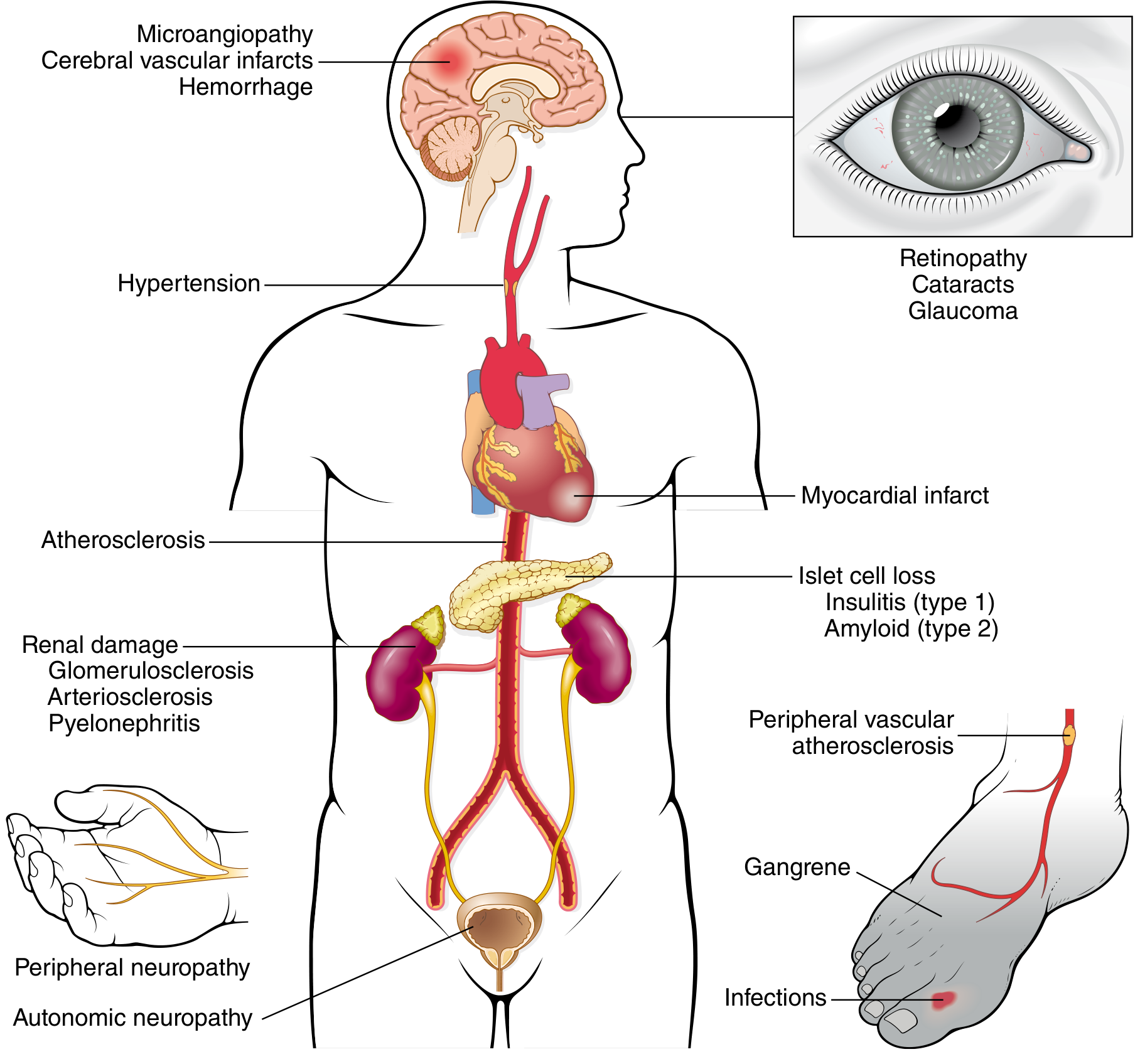
Macrovascular Disease
- Most common cause of death in long-standing diabetes
- 2-4× higher risk of coronary artery disease
- 4× higher risk of dying from cardiovascular complications
- Risk elevated even at the prediabetes stage
- ~75% of T2D patients have hypertension, which amplifies vascular damage
- Diabetic dyslipidemia: ↑ triglycerides, ↑ LDL, ↓ HDL
Diabetic Nephropathy
- Leading cause of end-stage renal disease in the USA
- 30-40% of all diabetic patients develop clinical nephropathy
- Earliest sign: microalbuminuria (30-300 mg/day urinary albumin)
- Progresses to macroalbuminuria → hypertension → ESRD
- Morphology: glomerular basement membrane thickening, diffuse and nodular glomerulosclerosis (Kimmelstiel-Wilson nodules)
Diabetic Ocular Disease
- 60-80% of patients develop diabetic retinopathy - leading cause of adult blindness in the USA
- Key lesion: neovascularization driven by VEGF
- Also: cataracts (sorbitol), glaucoma
Diabetic Neuropathy
- Most common complication: peripheral neuropathy (symmetric, distal sensorimotor)
- Also: autonomic neuropathy (gastroparesis, orthostatic hypotension, impotence)
- Affects up to 50% overall; up to 80% of those with disease >15 years
Infections
- Impaired neutrophil function and poor tissue perfusion increase susceptibility
- Foot infections → gangrene → leading cause of nontraumatic limb amputation
Acute Metabolic Complications
| Feature | Diabetic Ketoacidosis (DKA) | Hyperosmolar Hyperglycemic State (HHS) |
|---|---|---|
| Type | Mainly T1D | Mainly T2D |
| Mechanism | Absolute insulin deficiency → lipolysis → ketones | Severe dehydration + hyperglycemia without significant ketosis |
| Blood glucose | Usually 250-600 mg/dL | Often >600 mg/dL |
| Ketones | Strongly positive | Minimal |
| pH | <7.3 | Usually normal |
| Risk | Coma, death | Coma, death |
Morphology Summary
| Type | Pancreatic Changes |
|---|---|
| T1D | Insulitis (lymphocytic infiltrate), marked reduction in islet cell mass |
| T2D | Amyloid deposition in islets (IAPP/islet amyloid polypeptide), mild reduction in β-cell mass |
Classic Triad of Symptoms
| Symptom | Mechanism |
|---|---|
| Polyuria (excess urination) | Glucosuria → osmotic diuresis |
| Polydipsia (excess thirst) | Dehydration from osmotic diuresis |
| Polyphagia (excess hunger) | Impaired glucose utilization at cellular level |
| Weight loss (especially T1D) | Catabolism - muscle/fat breakdown for energy |
| Blurred vision | Osmotic changes in lens |
Key Summary
- T1D: Autoimmune → absolute insulin deficiency → requires exogenous insulin
- T2D: Insulin resistance + relative insulin deficiency → begins with lifestyle/pharmacotherapy, may eventually need insulin
- Complications arise from chronic hyperglycemia damaging blood vessels and nerves via AGEs, PKC activation, and oxidative stress
- Severity of complications correlates directly with both the degree and duration of hyperglycemia - tight glycemic control demonstrably reduces end-organ damage
- Robbins, Cotran & Kumar Pathologic Basis of Disease, Chapter 24, pp. 997-1010
This is a shared conversation. Sign in to Orris to start your own chat.