
Mechanism of enzymes action
Reading File
Enzymes are biological catalysts that speed up chemical reactions by lowering the activation energy required. They work through specific binding with substrates at their active site, forming an enzyme-substrate complex. Key mechanisms include the "lock and key" model (rigid complementary fit) and the "induced fit" model (enzyme shape changes upon substrate binding). Catalysis occurs via acid-base catalysis, covalent catalysis, metal ion catalysis, or proximity/orientation effects.
Searching sources...
Finding Sources
Searching the Web
mechanism of enzyme action biochemistry
Finding Sources
Finding Sources
Reading File
Reading File
Reading File
Reading File
Finding Sources
Reading File
Reading File
Reading File
Loading Image
Loading Image
I now have comprehensive information from the textbooks. Here is the full, well-organized answer.
Mechanism of Enzyme Action
Enzymes are protein catalysts (a few are ribozymes - catalytic RNAs) that dramatically accelerate biochemical reactions without being consumed. They achieve this by lowering the free energy of activation (ΔG‡) - not by changing the equilibrium constant of the reaction.
1. The Active Site
The active site is a surface-accessible cleft or pocket on the enzyme, typically made up of only 3-12 amino acid residues, even though the enzyme itself is far larger. Within the active site:
- Substrates are brought into close proximity and optimal alignment
- Cofactors and prosthetic groups assist catalysis
- The microenvironment (polarity, hydrophobicity, pH) can differ markedly from the surrounding cytoplasm
This is where both binding and chemical transformation occur.
(Harper's Illustrated Biochemistry, 32nd Ed.)
2. Models of Substrate Binding
Lock-and-Key Model (Emil Fischer)
The shape of the active site is preformed and complementary to the substrate's shape and charge distribution. The substrate fits perfectly, like a key into a lock, with no shape changes required on either side.
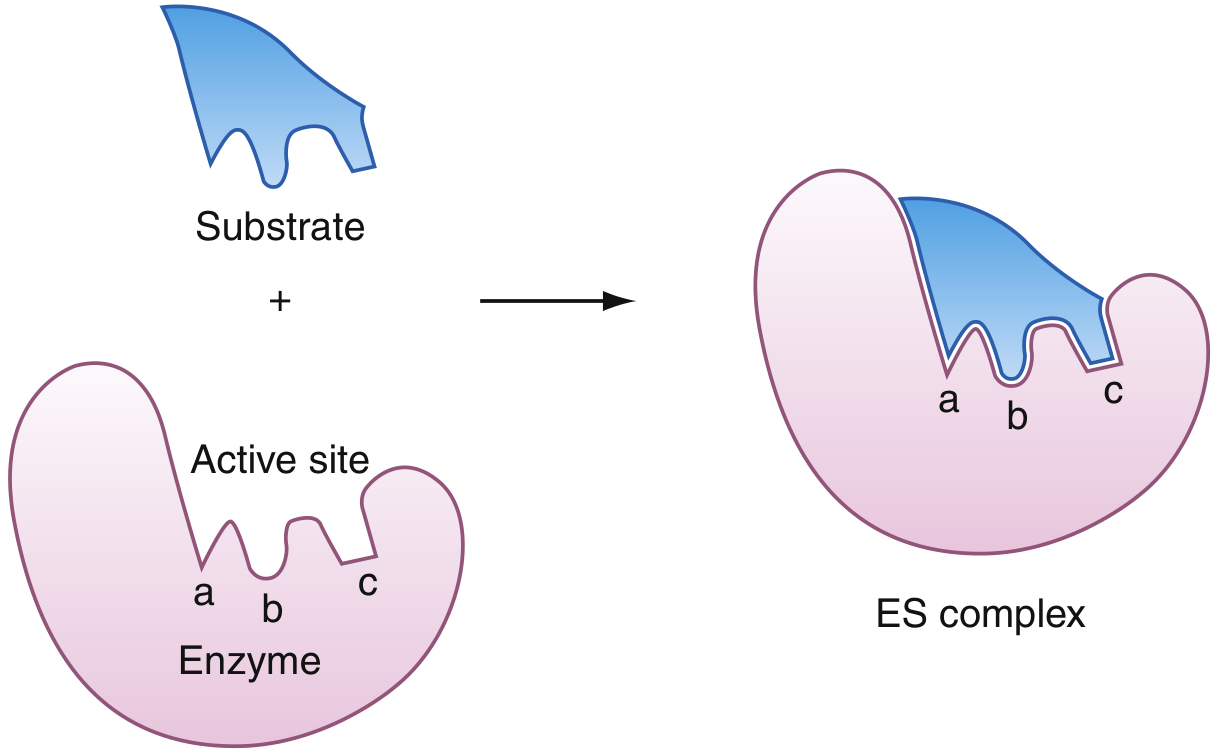
Figure: Lock-and-key model. The enzyme exhibits preformed steric and electronic complementarity to the substrate. (Henry's Clinical Diagnosis and Management by Laboratory Methods)
Induced-Fit Model (Daniel Koshland)
This model addresses the drawback of the rigid lock-and-key model. When the substrate binds, it induces a conformational change in the enzyme - analogous to placing a hand (substrate) into a glove (enzyme). The enzyme reciprocally induces changes in the substrate, harnessing binding energy to facilitate the reaction. Biophysical studies have confirmed this model.
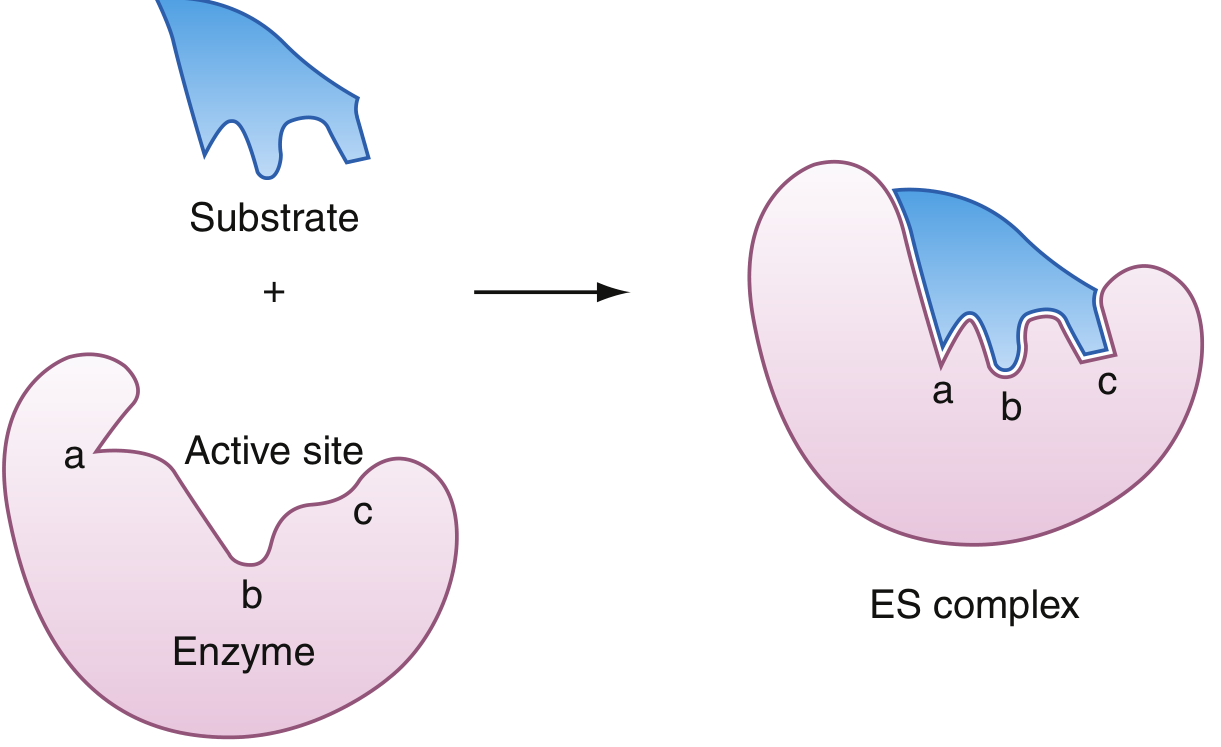
Figure: Induced-fit model. The active site is not rigid but a dynamic surface that reshapes upon substrate binding. (Henry's Clinical Diagnosis)
3. Enzyme Specificity
Enzymes display several levels of specificity:
| Type | Description |
|---|---|
| Binding specificity | Only one or a few substrate molecules are recognized |
| Reaction specificity | Only one type of covalent bond is broken or formed (no by-products) |
| Stereoselectivity | Only one enantiomeric form is accepted (e.g., L-amino acids only for proteases) |
| Geometric specificity | Distinguish cis vs. trans isomers (e.g., fumarase acts on fumarate but not maleate) |
4. The Four Catalytic Strategies
Enzymes use combinations of the following four general mechanisms to dramatically enhance reaction rates:
A. Catalysis by Proximity
When substrates bind to the active site, the enzyme creates a region of high local substrate concentration with substrates oriented in the ideal position to react. This proximity alone accounts for rate enhancements of at least 1000-fold compared to uncatalyzed reactions.
B. Acid-Base Catalysis
Ionizable side chains of amino acids (and prosthetic groups) act as proton donors or acceptors:
- Specific acid/base catalysis: only protons (H⁺) or hydroxide ions (OH⁻) participate
- General acid/base catalysis: any acid or base in the active site participates
Example - HIV Protease: Two conserved aspartyl residues work together. Asp X acts as a general base to activate a water molecule (making it nucleophilic), which attacks the peptide bond forming a tetrahedral intermediate. Asp Y then donates a proton to facilitate bond cleavage. (Harper's Biochemistry)
C. Catalysis by Strain (Transition State Stabilization)
The enzyme binds its substrate in a strained conformation that weakens the target bond through physical distortion and electronic polarization. This conformation mimics the transition state - the highest-energy midpoint between substrate and product. Linus Pauling was the first to propose this principle. Notably, enzymes bind transition state analogs more tightly than substrate analogs, which is exploited in drug design.
D. Covalent Catalysis
A transient covalent bond forms between the enzyme and one or more substrates, creating a modified enzyme that acts as a reactant. This provides a new reaction pathway with a lower activation energy. The enzyme is returned to its original state at the end of the reaction.
- Amino acids that participate: Cys, Ser (most common), occasionally His
- Often follows a "ping-pong" mechanism: first substrate binds and its product is released before the second substrate binds
Example - Chymotrypsin (serine protease): A "catalytic triad" of Asp 102 - His 57 - Ser 195 forms a charge-relay proton shuttle. A covalent acyl-enzyme intermediate forms transiently, then water attacks to complete hydrolysis. (Harper's Biochemistry)
5. Additional Catalytic Mechanisms
| Mechanism | Description |
|---|---|
| Metal ion catalysis | Metal ions (Zn²⁺, Mg²⁺, Fe²⁺) stabilize negative charges, act as Lewis acids, or participate in redox reactions |
| Electrostatic catalysis | Side chains of Lys/Arg stabilize negative charges; Asp/Glu stabilize positive charges during catalysis |
| Nucleophilic catalysis | Cys, Ser, Lys, His, Asp side chains act as nucleophiles in covalent intermediates |
6. Energy Diagram
Enzymes lower the activation energy barrier (ΔG‡) for a reaction. Key points:
- The equilibrium constant (K_eq) is not changed by an enzyme
- Both forward and reverse reactions are accelerated equally
- The enzyme-substrate (ES) complex is more stable than the free enzyme + substrate, but cannot be too stable or the activation energy of the subsequent step would rise
7. Enzyme Cofactors and Coenzymes
Many enzymes require non-protein helpers:
- Coenzymes (e.g., NAD⁺, FAD, CoA): derived from B vitamins; act as "recyclable shuttles" transporting chemical groups between reactions
- Prosthetic groups: tightly bound non-protein components
- Metal ions: act as cofactors in metalloenzymes
Summary Table
| Strategy | Mechanism | Rate Enhancement |
|---|---|---|
| Proximity & orientation | Concentrates and aligns substrates | ~1000x |
| Acid-base catalysis | Proton transfer via amino acid side chains | Variable |
| Transition state stabilization | Strain / distortion of substrate | Large |
| Covalent catalysis | Transient enzyme-substrate bond | Large |
(Sources: Harper's Illustrated Biochemistry 32nd Ed.; Henry's Clinical Diagnosis and Management by Laboratory Methods; Basic Medical Biochemistry 6th Ed.)
This is a shared conversation. Sign in to Orris to start your own chat.