
Write a five mark short note on Solitary thyroid nodule Make it compatible, compact but high yielding. So that... I can easily remember and, uh, write it in a... Systematic way being a 2nd year resident. make it in a way its interesting and easy to learn visually and Create a high density, high yielding image based(generate image) Flashcard I can use Before exam to revise and remember all the important points regarding this short-note. but it should be in a way so its easy to understand and remember also use flowcharts or mindmaps in the response wherever possible dont use code
A high-yield medical exam flashcard titled "SOLITARY THYROID NODULE" for a surgery resident. Dark navy blue background. Clean, organized layout divided into color-coded sections with white text and bright accent colors (yellow, orange, green, red, teal). Include these sections: 1) DEFINITION (yellow header): Single palpable discrete swelling in otherwise normal thyroid; 4% prevalence; Benign:Malignant = 10:1. 2) RED FLAGS for MALIGNANCY (red header) as bullet list: Male gender, Age <20 or >60, Hard/fixed nodule, Rapid growth, Hoarseness (RLN), Dysphagia/Dyspnea, H/O radiation, Family Hx thyroid Ca, Cold nodule on scan, Cervical lymphadenopathy. 3) INVESTIGATIONS (teal header) in order: TSH (first test) → USG neck (primary imaging) → FNAB (gold standard investigation). 4) BETHESDA CATEGORIES (orange header) as a mini table with 6 rows: I Nondiagnostic → Repeat FNAB u/s guided; II Benign (60-70%) → Observe; III AUS/FLUS → Repeat FNAB; IV Follicular Neoplasm → Lobectomy; V Suspicious malignancy → Lobectomy/NTT; VI Malignant → Total/NTT. 5) HOT vs COLD NODULE (green header): Hot = hyperfunctioning, rarely malignant (~1%); Cold = hypofunctioning, higher malignancy risk. 6) MANAGEMENT PEARL (bright yellow box at bottom): Cyst aspirated 3x and reaccumulates → Lobectomy. Include small anatomical thyroid outline icon. Make it visually striking, easy to read, exam-ready, compact but comprehensive. Modern medical flashcard aesthetic.
🫀 SOLITARY THYROID NODULE - 5 Mark Short Note
📌 DEFINITION
- Prevalence ~4% in the general population
- Up to 50% individuals may have occult nodules on autopsy
- Benign : Malignant ratio = 10:1 (>90% of thyroid cancers are curable)
🔴 RED FLAGS FOR MALIGNANCY (High Yield!)
| Feature | Significance |
|---|---|
| Male sex, age <20 or >60 | Higher malignancy risk |
| Hard, firm, fixed nodule | Suggests invasion |
| Rapid increase in size | Anaplastic / aggressive |
| Hoarseness | RLN involvement |
| Dysphagia / Dyspnea | Tracheo-oesophageal compression |
| H/O head-neck radiation | 40% risk of malignancy |
| Family Hx of thyroid Ca / MEN | Medullary thyroid Ca |
| Cervical lymphadenopathy | Metastatic spread |
| Cold nodule on radioscan | Hypofunctioning = higher risk |
Hot nodule (hyperfunctioning, takes up radioiodine) = rarely malignant (~1%) Cold nodule = higher malignancy risk
🔬 INVESTIGATIONS - IN ORDER
STEP 1 → TSH (First & always)
         ↓
         Low TSH → Radionuclide scan (123I / 99mTc)
         → Hot nodule → Treat thyrotoxicosis

         Normal/High TSH →
         ↓
STEP 2 → USG NECK (Primary imaging)
         Suspicious features: hypoechoic, irregular border,
         microcalcifications, increased vascularity, cervical LN
         ↓
STEP 3 → FNAB (Gold Standard Investigation)
         23G needle, Papanicolaou/Wright's stain
         Bethesda criteria → 6 categories
📊 BETHESDA SYSTEM - THE DECISION ENGINE
| Bethesda | Category | Risk of Ca | Action |
|---|---|---|---|
| I | Nondiagnostic | 1-4% | Repeat FNAB (USG-guided) |
| II | Benign | ~2% | Observe + serial USG |
| III | AUS / FLUS | 5-15% | Repeat FNAB / Surgery |
| IV | Follicular Neoplasm | 15-35% | Lobectomy |
| V | Suspicious for Malignancy | 60-75% | Lobectomy / Near-total |
| VI | Malignant | >97% | Total / Near-total thyroidectomy |
AUS = Atypia of Unknown Significance | FLUS = Follicular Lesion of Unknown Significance
🗺️ MANAGEMENT FLOWCHART (from Schwartz's Surgery)
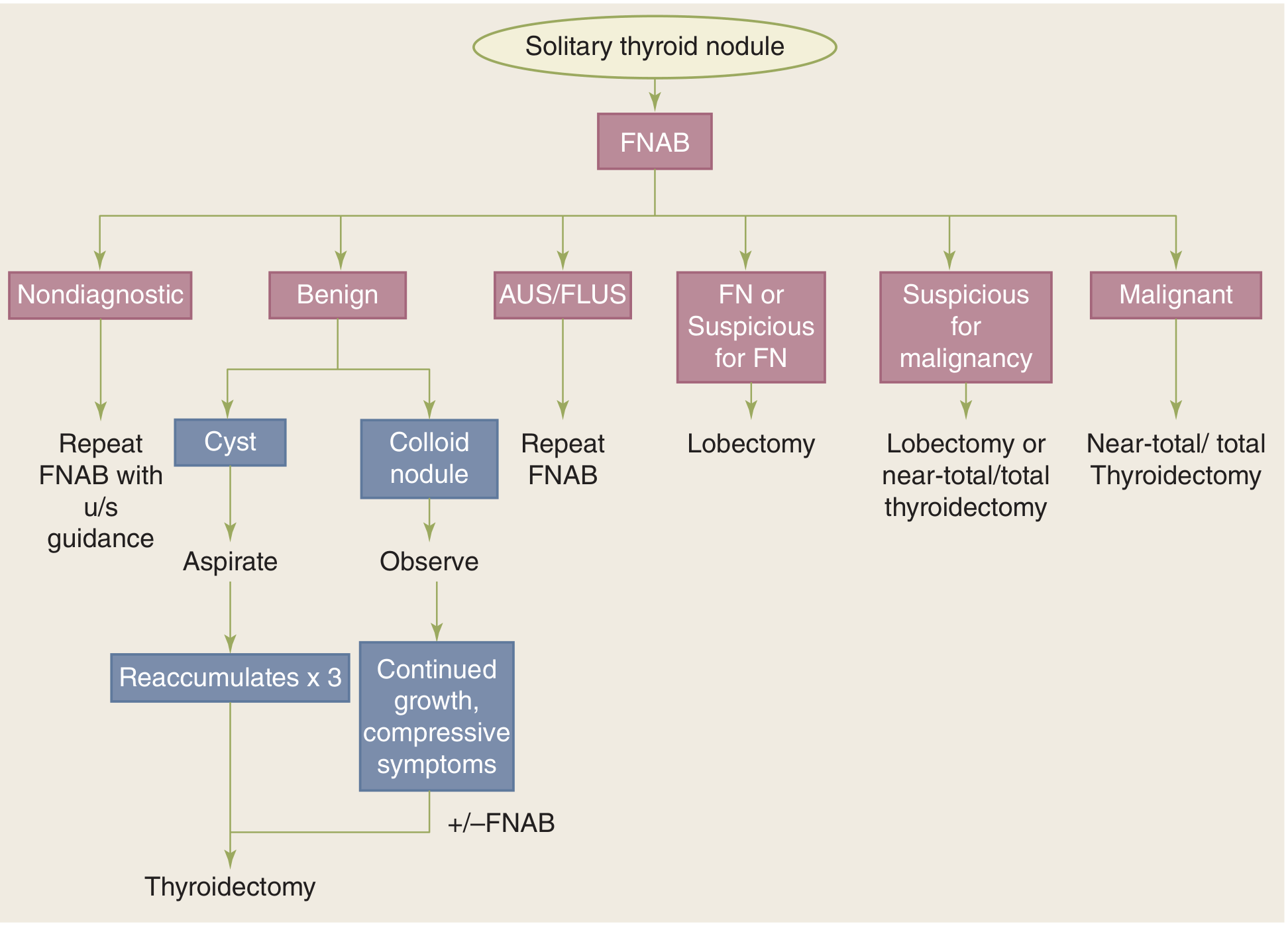
💉 MANAGEMENT PEARLS
- Simple cyst: Aspirate → resolves in ~75%
- Cyst reaccumulates x3 times → Lobectomy
- Complex cyst / cyst >4cm → Lobectomy (malignancy risk 15%)
- Colloid nodule (benign FNAB): Observe with serial USG + Tg
- History of radiation or family Hx thyroid Ca: Total/near-total thyroidectomy (FNAB less reliable in these)
- TSH suppression (levothyroxine to keep TSH 0.1-1.0 µU/mL): Controversial; works better in iodine-deficient areas
⚡ QUICK RECALL MNEMONIC
- Solitary (vs multinodular)
- Age extremes (<20, >60)
- Fixed / Firm nodule
- Enlarged neck nodes
- Cold on radioscan
- Onset rapid
- Lymph node involvement
- Dysphagia / hoarseness / radiation Hx
📚 EXAM-READY FLASHCARD
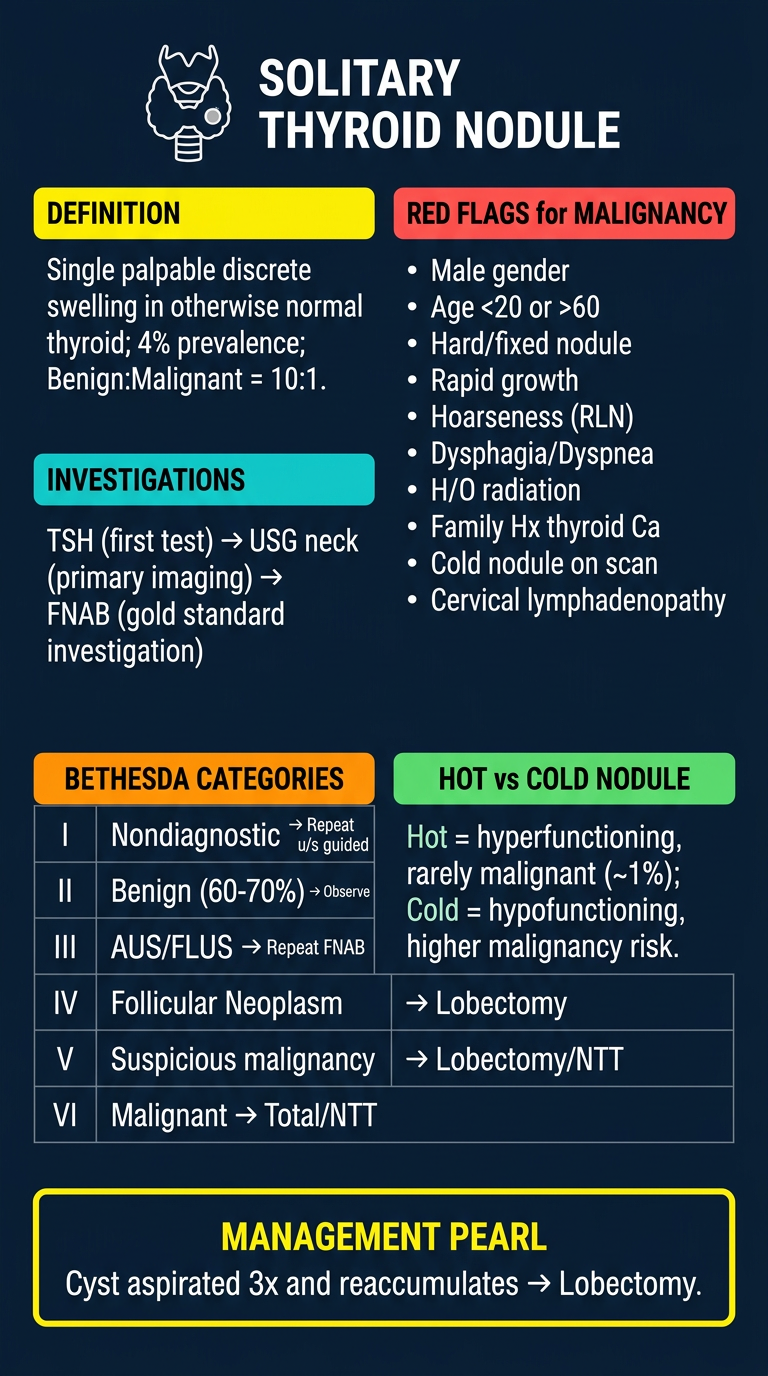
✍️ HOW TO WRITE THIS IN 5 MARKS (Template)
- Definition + Epidemiology (1/2 mark)
- Clinical features - red flags for malignancy (1 mark)
- Investigations in order: TSH → USG → FNAB + Bethesda (1.5 marks)
- Management flowchart based on Bethesda (1.5 marks)
- Closing pearl - cyst rule / radiation exception (1/2 mark)