
Spurr cells
Spur cells (acanthocytes with irregular projections) are red blood cell abnormalities seen in severe liver disease.
Searching sources...
Reading File
Searching the Web
spur cells acanthocytes liver disease hemolytic anemia
Finding Sources
Searching PubMed
spur cell anemia acanthocytosis liver disease
Reading File
Reading File
Reading File
Now let me fetch the spur cell image from Harrison's and the Frameworks for Internal Medicine section:
Reading File
Reading File
Loading Image
Spur Cells (Acanthocytes)
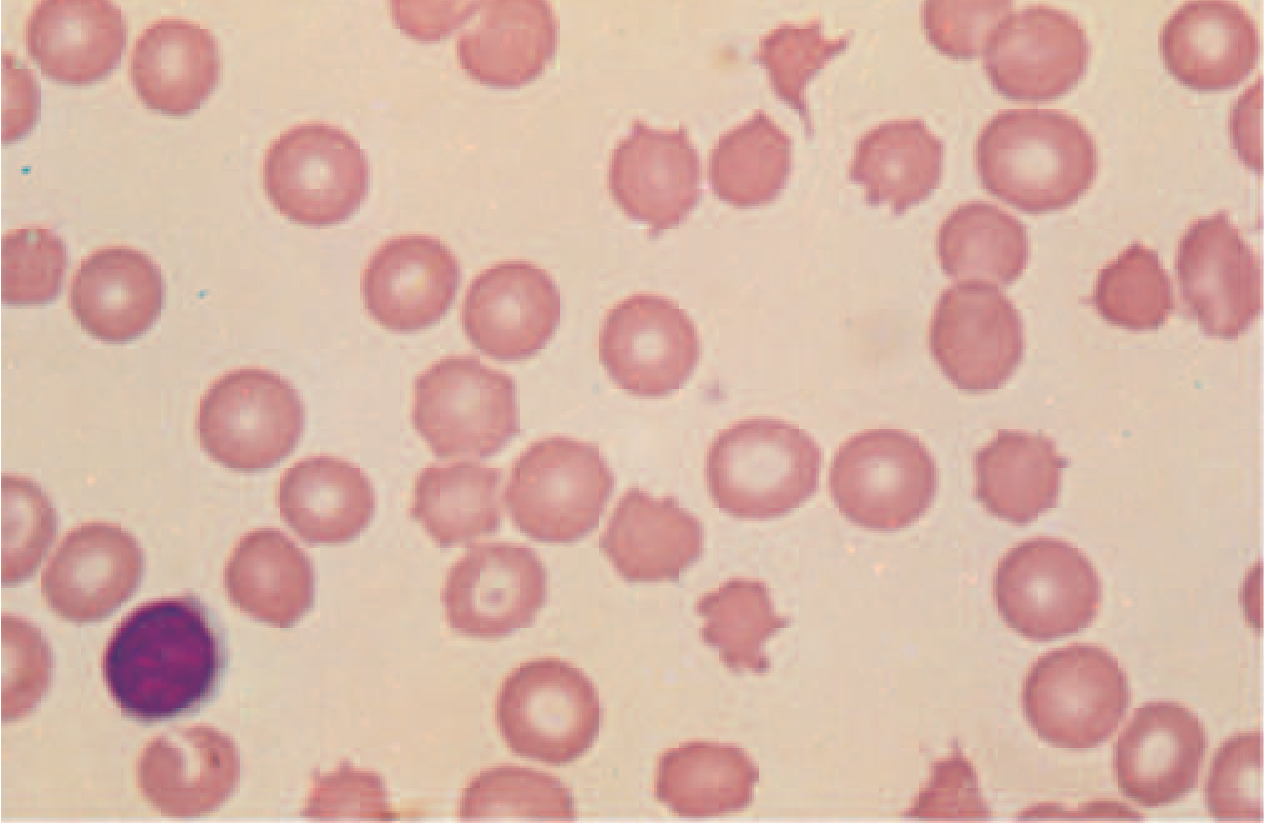
Peripheral blood smear showing spur cells - distorted red cells with several irregularly distributed thorn-like projections. - Harrison's Principles of Internal Medicine 22E, Fig. 66-11
Definition and Morphology
Spur cells (also called acanthocytes) are RBCs with irregular, sharp, unevenly distributed thorn-like projections from the cell membrane. Key morphologic features:
- Fewer projections than echinocytes/burr cells, but the projections are longer and irregularly spaced
- Generally lack central pallor (unlike echinocytes/burr cells, which preserve it)
- Dense, contracted appearance
- Must be distinguished from echinocytes (burr cells), which have numerous, evenly distributed, shorter spicules - most often an artifact or seen in uremia
Pathophysiology
In advanced liver disease, the failing liver cannot maintain normal lipoprotein metabolism. This leads to:
- Excess free cholesterol accumulates in the RBC membrane, raising the cholesterol-to-phospholipid ratio
- The membrane becomes rigid and abnormally shaped - initially forming acanthocytes
- As acanthocytes circulate through the spleen, their projections get caught in narrow splenic passages
- Cholesterol crystals form within the membrane, and the spleen remodels the cell into the classic spur shape
- Eventually the spur cells are destroyed in the spleen - extravascular hemolysis
This produces a Coombs-negative, non-immune hemolytic anemia.
- Harrison's Principles of Internal Medicine 22E, p. 490
- Frameworks for Internal Medicine, p. 8284-8288
- Goldman-Cecil Medicine, p. 2804
Associated Conditions
| Condition | Mechanism |
|---|---|
| Advanced (alcoholic) liver cirrhosis | Primary cause; abnormal lipid metabolism |
| Other chronic liver disease | Same mechanism |
| Abetalipoproteinemia | Absent apolipoprotein B; abnormal lipid transport |
| Post-splenectomy state | Spleen no longer removes abnormal RBCs |
| McLeod blood group | Absent Kx antigen on RBC membrane |
| Lu (Lutheran) blood group | Membrane protein abnormality |
| Malabsorptive states | Nutritional lipid/vitamin deficiency |
| Neuroacanthocytosis syndromes | Inherited (chorea-acanthocytosis, McLeod syndrome) |
Spur Cell Anemia - Clinical Picture
Spur cell anemia is a distinct syndrome in end-stage liver disease:
- Diagnosis: >20% acanthocytes on peripheral smear + hemolytic anemia
- Labs: elevated LDH, elevated AST, low haptoglobin, reticulocytosis (often striking), Coombs-negative
- Hematocrit: significant anemia; Hgb often 6-10 g/dL
- Prognosis is poor - >5% spur cells in the RBC population is associated with decreased survival in liver disease
- Often transfusion-dependent
- Part of Zieve's syndrome when accompanied by jaundice + transient hyperlipidemia (cholesterol can exceed 1000 mg/dL, normalizing within 1-2 weeks)
Key Clinical Distinctions
| Feature | Spur cells (Acanthocytes) | Burr cells (Echinocytes) |
|---|---|---|
| Projections | Few, long, irregular | Many, short, evenly spaced |
| Central pallor | Absent | Present |
| Main cause | Liver disease, abetalipoproteinemia | Uremia, artifact, dehydration |
| Spleen role | Destroys them (hemolysis) | Less relevant |
- Tietz Textbook of Laboratory Medicine 7th Ed., p. 4065
- Goldman-Cecil Medicine, p. 2804
This is a shared conversation. Sign in to Orris to start your own chat.