
Anti phospholiapse a2 receptor
"anti-PLA2R" AND "membranous nephropathy"
membranous nephropathy PLA2R immunofluorescence subepithelial deposits
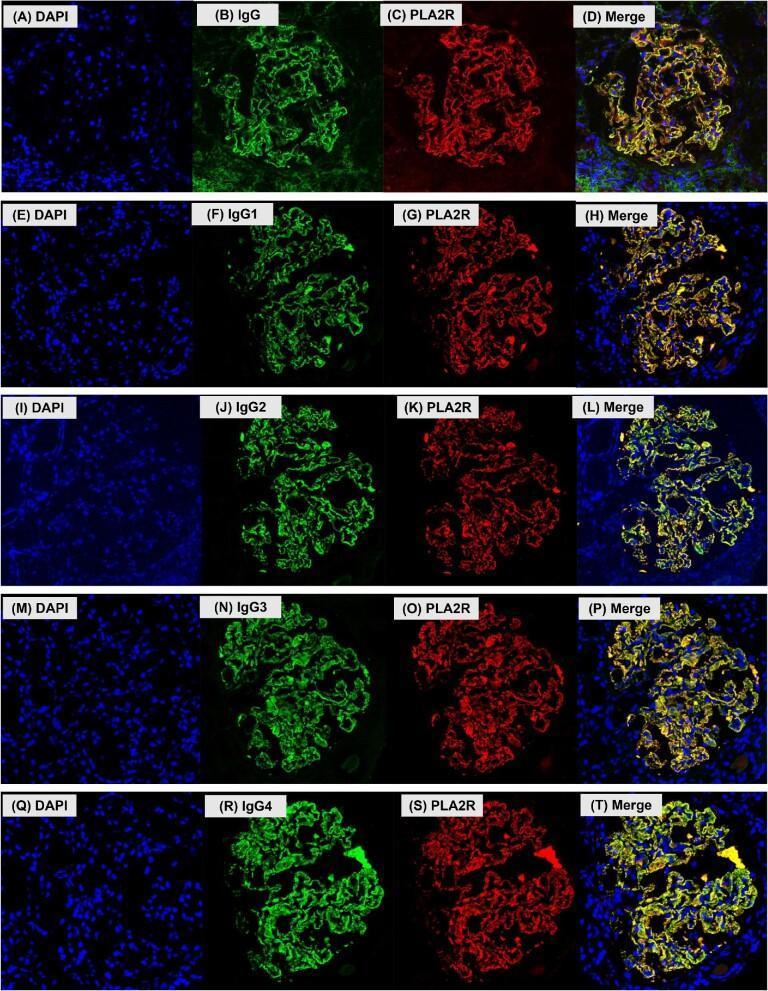
This composite of confocal light microscopy images illustrates immunofluorescence staining patterns in human glomerular tissue, specifically focusing on membranous nephropathy (MN). The 20-panel figure is organized into five rows (A-T), each representing a different IgG target: total IgG, IgG1, IgG2, IgG3, and IgG4. Within each row, four panels show: (1) DAPI nuclear staining in blue, (2) IgG or specific IgG subclasses in green, (3) PLA2R antigen in red, and (4) a merged overlay. The staining reveals a granular, loop-like distribution along the glomerular basement membrane (GBM), characteristic of subepithelial immune complex deposits. In the merged columns (D, H, L, P, T), the overlap of green (IgG) and red (PLA2R) signals produces a yellow color, demonstrating the co-localization of the PLA2R antigen with total IgG and all four IgG subclasses. DAPI staining confirms that these deposits are extracellular and distinct from cellular nuclei. This visual evidence supports the role of PLA2R as a major autoantigen in primary MN and characterizes the subclass composition of the associated immune deposits.
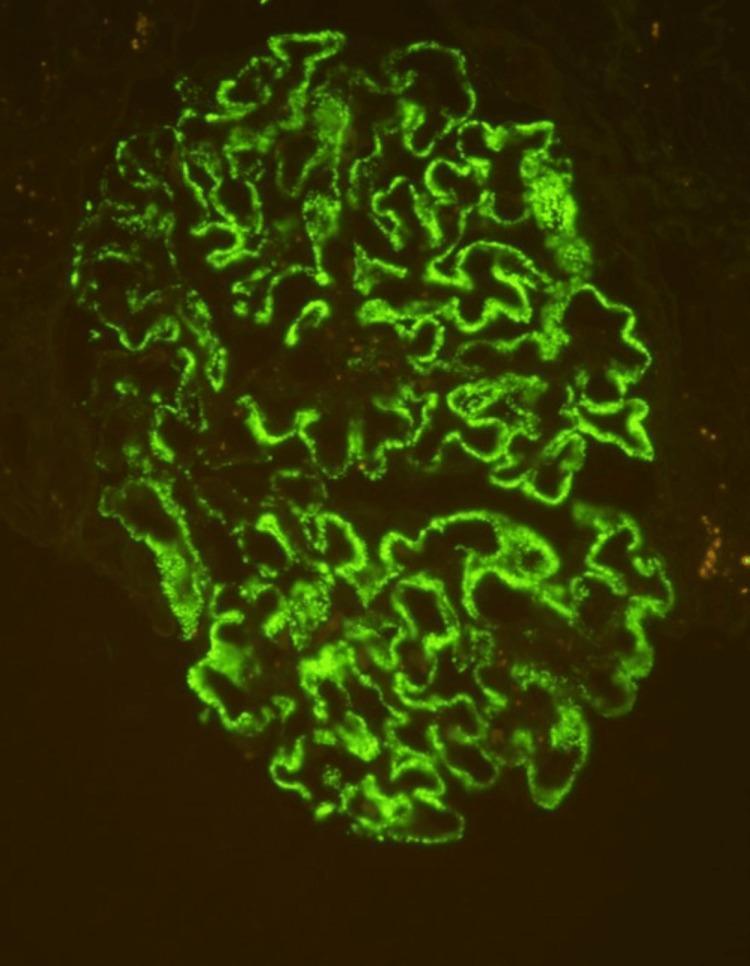
This diagnostic image is a high-power (400x) immunofluorescence micrograph of a human glomerulus from a renal biopsy specimen. The image demonstrates a diffuse, granular staining pattern of 3+ intensity, specifically localized along the glomerular capillary loops. The green fluorescent signal highlights the convoluted, interconnected morphology of the basement membrane area in a 'beaded' fashion, which is characteristic of immune complex deposition. Pathologically, this visual finding represents positive staining for phospholipase A2 receptor (PLA2R) antibodies, a definitive diagnostic marker for primary membranous nephropathy. The absence of mesangial or endocapillary staining emphasizes the subepithelial nature of the deposits. This specimen is critical for differentiating primary autoimmune-mediated glomerular disease from secondary causes in patients presenting with nephrotic syndrome.
Anti-Phospholipase A2 Receptor (anti-PLA2R) Antibody
What it is

Genetics
Clinical use
- Serum anti-PLA2R is positive in about 75-80% of primary MN.
- Complement levels, ANA, ANCA and RF are normal.
- A positive serum test in a nephrotic patient with no secondary cause can support a diagnosis of primary MN without a biopsy. This depends on context, for example preserved kidney function and no features of secondary disease.
- A negative test does not exclude MN. Other antigens include THSD7A, NELL1 and EXT1/2 (the last two are usually associated with secondary MN). - Robbins, Cotran & Kumar Pathologic Basis of Disease (antigen list in the glomerular injury figure)
- A higher titer at diagnosis (highest tertile) is associated with loss of kidney function.
- Epitope spreading, meaning antibodies beyond the N-terminal epitope, has been linked to a worse outcome in some studies but not others.
- Antibodies to intracellular antigens may carry an independent adverse risk.
- A low or falling titer predicts spontaneous or treatment-induced complete remission. - Comprehensive Clinical Nephrology, 7th Edition, p. 303-304 (Table 21.4)
- Antibody levels change before proteinuria and albumin do. A falling titer typically comes first, and clinical remission follows after a lag. This lag reflects the time needed to stop forming deposits and let the podocyte recover.
- A high or rising titer suggests the disease will persist or worsen.
- The textbook states the titer should not be used alone to start or delay immunosuppression. Albumin, proteinuria and eGFR must also be considered.
- Immunologic remission (undetectable titer) helps guide when to reduce or stop treatment.
- The same textbook gives relapse rates after complete remission of about 25-40%, and up to 50% after partial remission.
Pathology correlate
Testing notes
Recent evidence (last 2 years)
- PLA2R autoantibodies as a multifaceted biomarker (systematic review and meta-analysis, 2025, PMID 39820570) covers diagnosis and prognosis in nephrotic syndrome and MN.
- Recurrent MN after transplantation (meta-analysis, 2025, PMID 40576095) looks at incidence and risk factors, including anti-PLA2R.
- Obinutuzumab for MN (systematic review, 2026, PMID 41852044) covers anti-CD20 therapy and its effect on PLA2R antibodies and remission.