
A 50y old male complains of dragging sensation in abdomen. Physical examination revealed pallor and massive spleenomegaly. There is no lymphadenopathy. Total leucocyte count is 1,60,000 cell/mm³ and platelet count is 2 Lakhs/mm³. M a) What is the probable diagnosis? b) Describe cytogenetic change in this case? c) Enumerate peripheral blood smear findings? Give very brief answers pathology it for 5 marks question
Quick Answer:
This is classic Chronic Myeloid Leukemia (CML) - massive splenomegaly + no lymphadenopathy + markedly elevated WBC (~1.6 lakh/mm³) with normal/elevated platelets in a middle-aged male is the textbook presentation.
Searching sources...
Reading File
Finding Sources
Finding Sources
Reading File
Reading File
Finding Sources
Reading File
I have all the information needed. Let me also fetch the peripheral blood smear image from the textbook.
Loading Image
Loading Image
Here is a complete, exam-ready answer for a 5-mark question:
a) Probable Diagnosis: Chronic Myeloid Leukemia (CML)
Clues pointing to CML:
- Middle-aged male (peak incidence: 5th-6th decade)
- Dragging sensation in abdomen due to massive splenomegaly (a hallmark feature)
- Pallor (anemia from marrow infiltration)
- Markedly elevated TLC: 1,60,000/mm³ (leukocytosis is the defining feature)
- No lymphadenopathy (distinguishes from lymphoma/CLL)
- Platelets normal/elevated (2 lakhs) - typical in chronic phase CML
- CML is a myeloproliferative neoplasm (MPN), not a lymphoproliferative one
b) Cytogenetic Change: Philadelphia (Ph) Chromosome
Translocation: t(9;22)(q34;q11)
- A reciprocal translocation between chromosome 9 and chromosome 22
- The ABL proto-oncogene (on chromosome 9q34) translocates to the BCR (breakpoint cluster region) gene on chromosome 22q11
- This creates the Philadelphia (Ph) chromosome - a shortened chromosome 22
- Results in BCR::ABL fusion gene encoding a 210 kDa BCR-ABL chimeric protein
- BCR-ABL has constitutively active tyrosine kinase activity, driving growth factor-independent proliferation (via RAS, STAT, AKT pathways) with normal differentiation - hence the mature cells in peripheral blood
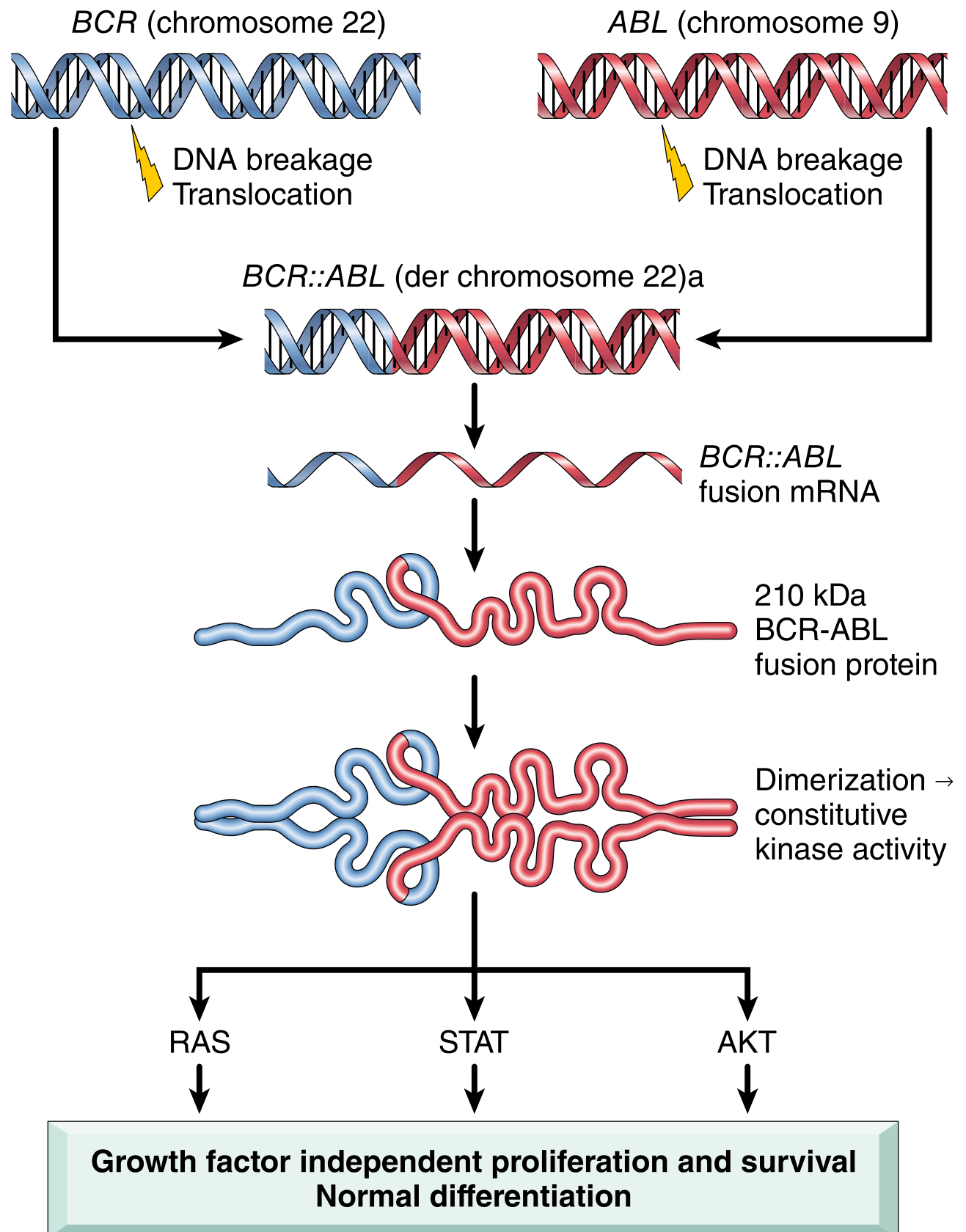
Present in >90% of CML cases; remaining cases have cryptic rearrangements detectable by FISH or PCR.
c) Peripheral Blood Smear Findings in CML
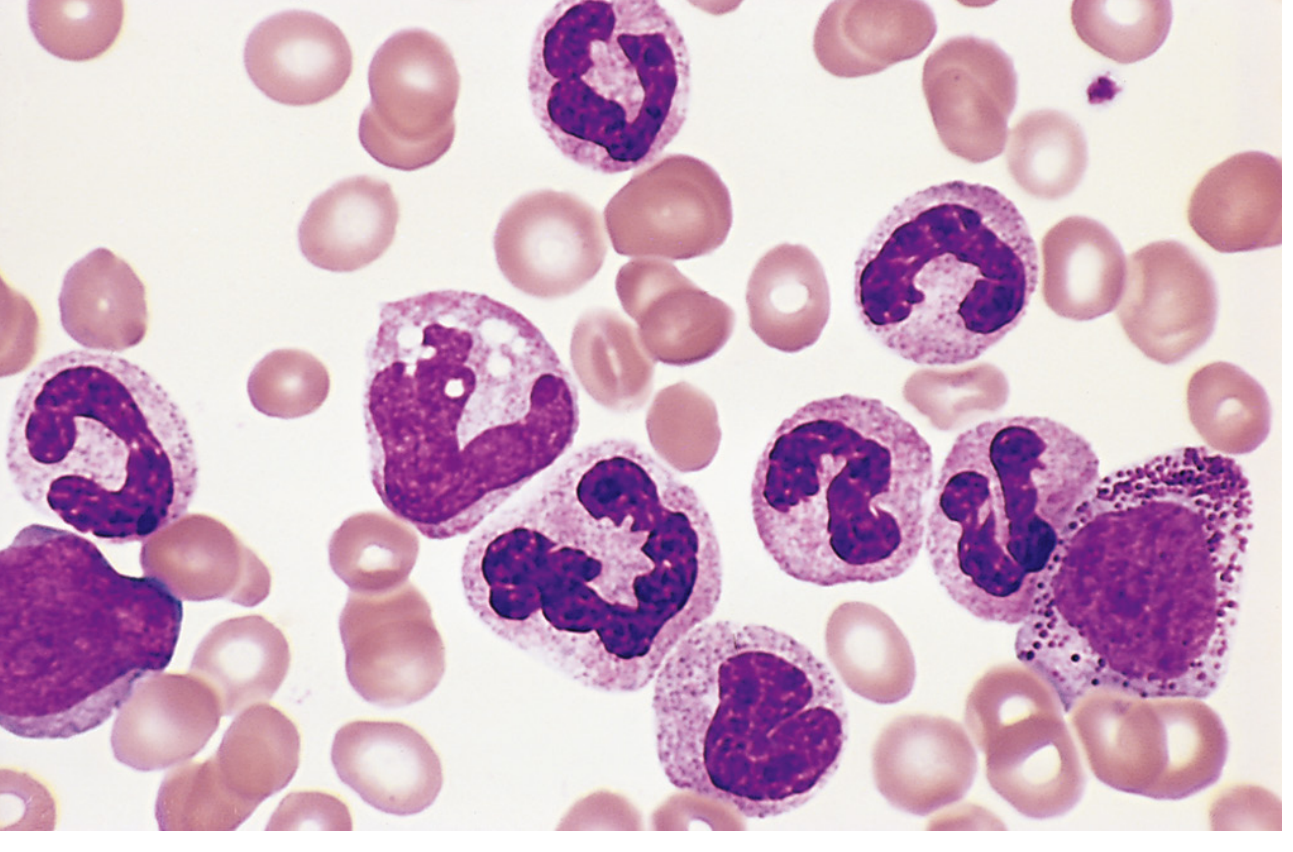
(Robbins & Kumar Pathologic Basis of Disease - Fig. 13.35: many mature neutrophils, metamyelocytes, and myelocytes)
| Finding | Details |
|---|---|
| Leukocytosis | WBC markedly elevated (often >1 lakh/mm³) |
| Full granulocytic spectrum | From myeloblasts to mature neutrophils - the "myelocyte bulge" (myelocytes + metamyelocytes predominate) |
| Myelocytes & metamyelocytes | Characteristic; more than any other stage |
| Basophilia | Increased basophils (virtually diagnostic of CML among MPNs) |
| Eosinophilia | Mild increase in eosinophils |
| Thrombocytosis | Increased/normal platelets with abnormal platelet morphology |
| Normocytic normochromic anemia | Pallor on RBC background |
| Blasts | <10% in chronic phase (if >20% = blast crisis) |
| Reduced/absent LAP score | Leukocyte Alkaline Phosphatase (LAP) score is low/zero (distinguishes from leukemoid reaction where LAP is high) |
Key diagnostic memory: The smear shows a "left shift" with the full myeloid maturation spectrum - myeloblast → promyelocyte → myelocyte (predominant) → metamyelocyte → band → neutrophil - along with basophilia and eosinophilia.
Sources: Robbins & Kumar Pathologic Basis of Disease (9780443264528); Goldman-Cecil Medicine (9780323930345)
13. Explain the laboratory approach to diagnose a male child with repeated joint bleeding. Pathology for 3 marks give briefly
Quick Answer:
A male child with repeated joint bleeding (hemarthrosis) almost certainly has Hemophilia A or B (X-linked recessive). The lab approach centers on coagulation screening tests followed by specific factor assays to confirm and type the hemophilia.
Searching sources...
Finding Sources
Finding Sources
Finding Sources
Reading File
Finding Sources
Finding Sources
Reading File
Loading Image
Here is a concise, exam-focused answer for 3 marks:
Laboratory Approach to Diagnose a Male Child with Repeated Joint Bleeding (Hemarthrosis)
Clinical clue: A male child with recurrent hemarthrosis points strongly to Hemophilia A (Factor VIII deficiency) or Hemophilia B (Factor IX deficiency) - both X-linked recessive disorders. The lab approach proceeds in two steps: screening, then confirmation.
Step 1 - Screening Tests
| Test | Expected Result in Hemophilia |
|---|---|
| Platelet count | Normal |
| Bleeding time (BT) | Normal |
| Prothrombin Time (PT/INR) | Normal (extrinsic pathway intact) |
| aPTT (activated Partial Thromboplastin Time) | Prolonged (intrinsic pathway defect) |
| Thrombin time | Normal |
- The hallmark pattern: Isolated prolonged aPTT with normal PT and normal platelet count/BT - this means the defect lies in the intrinsic pathway (Factors VIII, IX, XI, XII)
- Hemarthrosis specifically indicates a coagulation factor deficiency (deep tissue bleeding), not a platelet disorder
Step 2 - Specific Factor Assays (Confirmation)
Once aPTT is found prolonged in isolation, specific factor activity assays are done:
| Assay | Finding |
|---|---|
| Factor VIII activity assay | Reduced → Hemophilia A |
| Factor IX activity assay | Reduced → Hemophilia B |
Severity grading by factor level:
- Severe: <1% activity (spontaneous joint bleeds)
- Moderate: 1-5%
- Mild: 5-40%
Step 3 - Additional Tests
- Mixing study (1:1 with normal plasma): aPTT corrects → confirms factor deficiency (not inhibitor)
- vWF antigen & ristocetin cofactor assay: to distinguish from von Willebrand Disease (in vWD, Factor VIII may also be low but BT/PFA is abnormal and vWF is reduced)
- Genetic/molecular testing: to identify the causative mutation (useful for carrier detection and prenatal diagnosis)
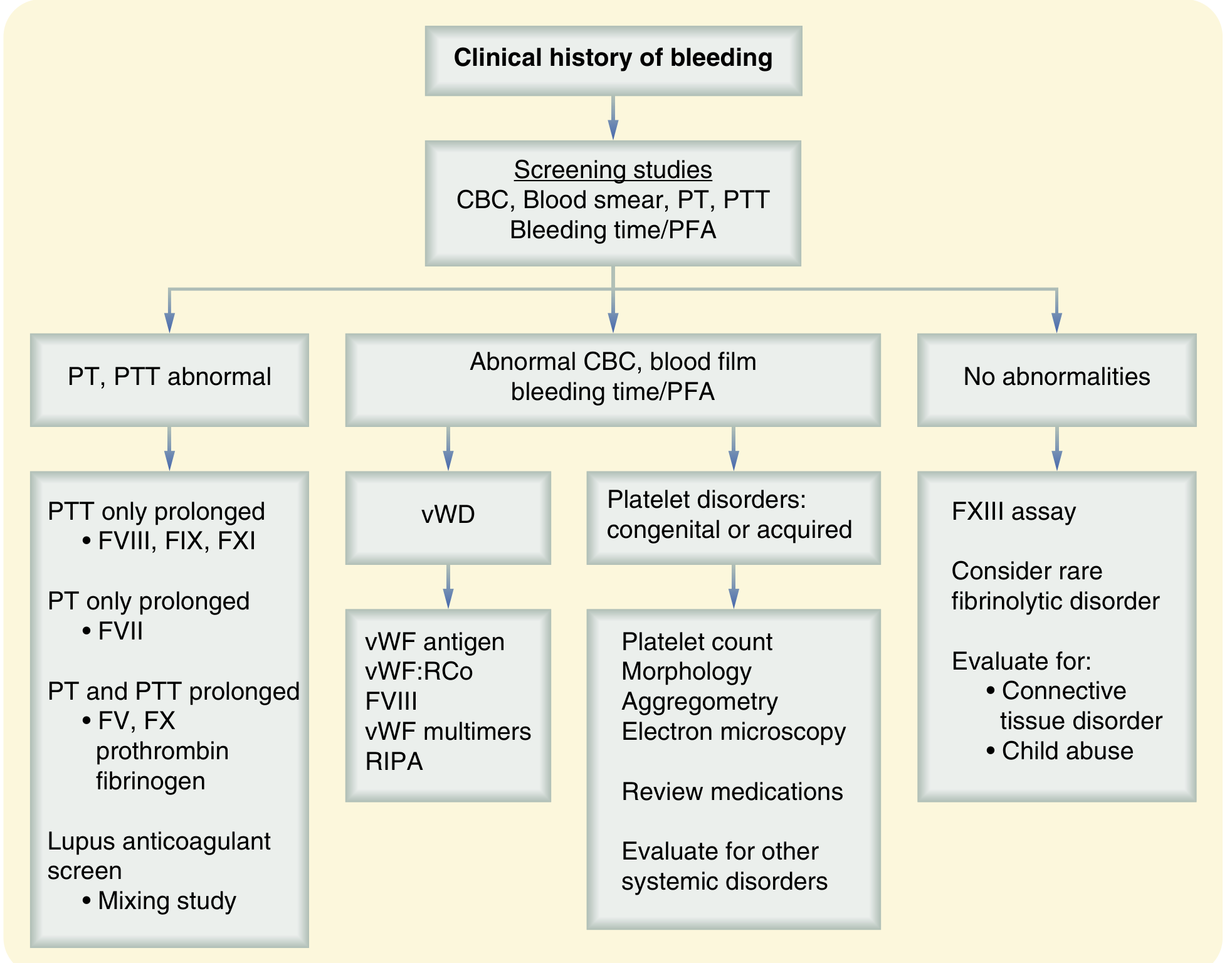
(Sabiston Textbook of Surgery - Lab evaluation flowchart: isolated prolonged PTT → check FVIII, FIX, FXI)
Summary for 3 marks:
- Screening: Platelet count + BT (normal), PT (normal), aPTT (prolonged) → intrinsic pathway defect
- Confirmation: Specific factor assays - Factor VIII ↓ = Hemophilia A; Factor IX ↓ = Hemophilia B
- Mixing study corrects aPTT (rules out inhibitor); vWF assay to exclude vWD
Sources: Goldman-Cecil Medicine (9780323930345); Sabiston Textbook of Surgery (9780443124341)
This is a shared conversation. Sign in to Orris to start your own chat.