
Primary amenorrhea
I'll read the medical library skill first before answering.
Reading File
Now I'll run parallel searches across the medical library and PubMed simultaneously.
Finding Sources
Searching PubMed
"primary amenorrhea"[MeSH Terms] AND diagnosis
Good. Now let me read the three key sources in parallel.
Reading File
Reading File
Finding Sources
Excellent content. Now let me read more of Berek & Novak's (the most detailed gynecology source) and the Family Medicine text for evaluation/management details, in parallel.
Reading File
Reading File
I have rich content. Let me read the evaluation/management and specific condition sections from Berek & Novak's more deeply, plus look for the MRKH and androgen insensitivity sections.
Reading File
Finding Sources
I have strong content. Let me get the evaluation/management section and the AIS clinical image in parallel.
Reading File
Reading File
Excellent. I now have comprehensive content. Let me also read the treatment/management section and the MRKH/outflow tract section from Berek & Novak's.
Reading File
Finding Sources
I have all the key content I need. Let me also fetch the AIS clinical photograph that was referenced.
Loading Image
I now have comprehensive textbook content from multiple authoritative sources. Here is the complete, well-organized answer.
Primary Amenorrhea
Definition
Primary amenorrhea is defined as:
- Absence of menses by age 13 when there is no visible development of secondary sexual characteristics, OR
- Absence of menses by age 15 in the presence of normal secondary sexual characteristics
Failure to begin breast development by age 13 always warrants investigation. The threshold ages were lowered by 1 year from older definitions to reflect two standard deviations above the current mean age of puberty onset.
- Berek & Novak's Gynecology, p. 1856
Pathophysiology Framework
Normal menstruation requires a functioning:
Hypothalamus (pulsatile GnRH) → Anterior pituitary (FSH, LH) → Ovary (estrogen/progesterone) → Uterus/outflow tract (endometrium + patent tract)
Failure at any link causes amenorrhea. Breast development signals prior estrogen exposure, so absence of breast development = never exposed to estrogen, pointing to gonadal or central causes.
Classification by Gonadotropin Status
The WHO classifies amenorrhea into three groups:
| WHO Group | Gonadotropins | Estrogen | Typical Cause |
|---|---|---|---|
| I - Hypogonadotropic hypogonadism | Low/normal FSH | Absent | Hypothalamic/pituitary failure |
| II - Normogonadotropic anovulation | Normal FSH | Present | PCOS, functional |
| III - Hypergonadotropic hypogonadism | Elevated FSH | Absent | Gonadal failure |
| (IV) - Hyperprolactinemic anovulation | Variable | Present | Prolactinoma |
Causes of Primary Amenorrhea
Step 1: Is breast development (secondary sexual characteristics) present?
A. No Breast Development (No Estrogen Exposure)
1. Hypergonadotropic Hypogonadism (High FSH/LH) - Gonadal Failure
| Condition | Key Features |
|---|---|
| Turner syndrome (45,X) | Most common cause of hypergonadotropic hypogonadism. Short stature, webbed neck, shield chest, cubitus valgus, low hairline, streak ovaries. ~30% of primary amenorrhea cases have a karyotypic abnormality |
| Partial X deletion / mosaicism | Variable phenotype; occasional estrogen synthesis possible |
| Pure gonadal dysgenesis (46,XX or 46,XY) | Streak gonads without Turner stigmata; 46,XY form = Swyer syndrome |
| 17α-Hydroxylase deficiency | Hypertension, hypokalemia; elevated progesterone + 11-deoxycorticosterone, low cortisol/estradiol - can be life-threatening if untreated |
| LH/FSH receptor mutations | Rare; FSH receptor mutation common in Finland |
| Galactosemia | Detected on newborn screening; galactose-1-phosphate uridyltransferase deficiency causes ovarian failure |
| Gonadotoxic damage | Prior radiotherapy or alkylating chemotherapy (cyclophosphamide) before puberty |
Key point: If FSH is elevated → get karyotype. If Y chromosome present → gonadectomy to prevent gonadoblastoma.
- Berek & Novak's Gynecology, pp. 1858-1866
2. Hypogonadotropic Hypogonadism (Low/Normal FSH/LH) - Central Failure
| Condition | Key Features |
|---|---|
| Constitutional (physiologic) delay | Most common cause of hypogonadotropic hypogonadism. Family history of delayed puberty; normal physical exam; consistent growth rate; self-resolving |
| Kallmann syndrome | Second most common hypothalamic cause. GnRH pulse generator failure + anosmia (absent olfactory bulbs). Variable inheritance (X-linked, autosomal) |
| CNS lesions | Craniopharyngioma, other tumors; headaches, visual field defects, DI symptoms |
| Hypopituitarism | Inadequate LH/FSH production |
| Nutritional disorders / anorexia nervosa | Weight loss → reduced GnRH pulsatility |
B. Breast Development Present, Absent or Abnormal Pelvic Anatomy
(Estrogen was present; problem is the outflow tract or uterus)
| Condition | Key Features |
|---|---|
| Müllerian agenesis / MRKH syndrome (Mayer-Rokitansky-Küster-Hauser) | Vaginal agenesis ± rudimentary uterus; karyotype 46,XX; normal ovaries; accounts for ~10-15% of primary amenorrhea. Associated renal anomalies in ~1/3 (agenesis, horseshoe kidney). Normal female secondary sexual characteristics |
| Complete Androgen Insensitivity Syndrome (CAIS) | 46,XY; blind vaginal pouch; testes in labia/inguinal canal; well-developed breasts but absent/scant pubic and axillary hair (see image below); testosterone in male range; gonadectomy after puberty recommended |
| Transverse vaginal septum | Outflow obstruction; cyclic pelvic pain (cryptomenorrhea) |
| Imperforate hymen | Bluish bulging at introitus with Valsalva; cyclic pain; hematocolpos |
| Cervical/uterine agenesis | Rare isolated defect |
| Ovotesticular DSD | Ambiguous genitalia; variable karyotype (mostly 46,XX); both gonadal tissues present |
Complete Androgen Insensitivity - Clinical Photograph:
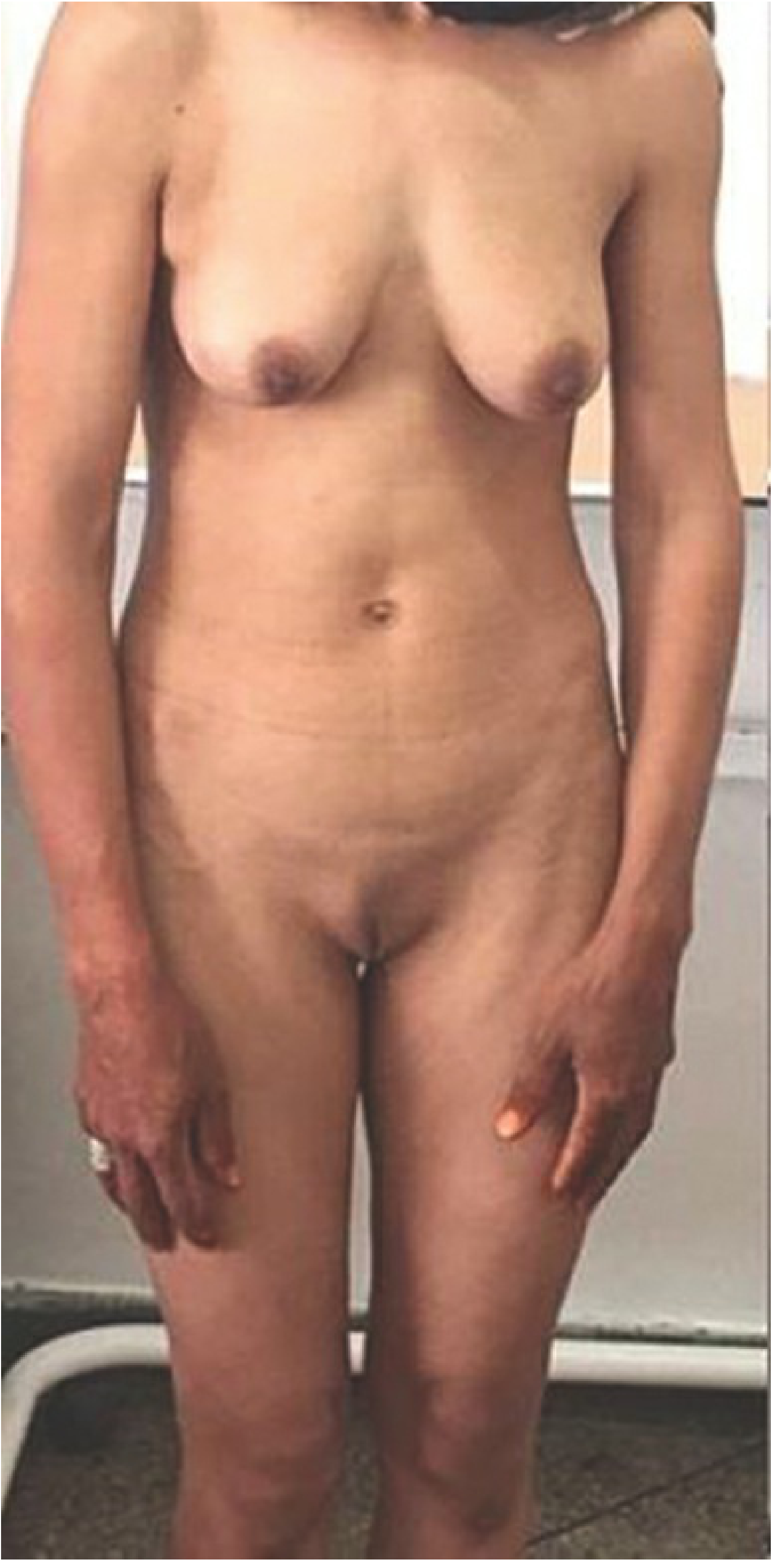
Fig. 34-3: Well-developed patient with complete androgen insensitivity. Note the characteristic paucity of pubic hair and well-developed breasts. - Berek & Novak's Gynecology, p. 1869
C. Breast Development Present, Normal Pelvic Anatomy
(Same spectrum as secondary amenorrhea - look for functional/hormonal causes)
- PCOS
- Hyperprolactinemia (prolactinoma)
- Primary ovarian insufficiency (POI)
- Hypothyroidism
- Hypothalamic functional amenorrhea (exercise, stress, weight loss)
- Pituitary/hypothalamic lesions
Causes Summary (Tietz / Family Medicine)
Lower tract / outflow: Vaginal aplasia, imperforate hymen, congenital vaginal atresia
Uterine: Congenital absence (MRKH), endometritis
Ovarian: Turner/gonadal dysgenesis, 17-hydroxylase deficiency, autoimmune oophoritis, resistant ovary syndrome, PCOS
Adrenal: Congenital adrenal hyperplasia
Thyroid: Hypothyroidism
Pituitary-hypothalamic: Hypopituitarism, constitutional delay, Kallmann syndrome, nutritional disorders
- Tietz Textbook of Laboratory Medicine, 7th Ed., p. corresponding section
Evaluation
Initial Workup
Step 1 - Rule out pregnancy: Serum or urine hCG first, regardless of stated sexual history.
Step 2 - Physical exam: Assess for:
- Secondary sexual characteristics (breast Tanner stage)
- Body habitus, height, weight
- Pubic/axillary hair presence
- Dysmorphic features (Turner stigmata: webbed neck, low hairline, cubitus valgus)
- Anosmia (Kallmann)
- Pelvic anatomy: vagina, cervix, uterus
Step 3 - Initial labs:
| Test | Purpose |
|---|---|
| FSH, LH | Differentiate hypo vs. hypergonadotropic |
| Estradiol | Assess estrogenic status |
| Prolactin | Rule out hyperprolactinemia |
| TSH | Rule out thyroid disease |
| Karyotype | If FSH elevated or anatomy abnormal |
Step 4 - If FSH elevated:
- Karyotype to identify Turner, gonadal dysgenesis, etc.
- If Y chromosome found → gonadectomy (gonadoblastoma risk)
- If normal karyotype with elevated FSH → consider 17α-hydroxylase deficiency (check BP, electrolytes, serum progesterone, ACTH stimulation test)
Step 5 - Imaging:
- Pelvic ultrasound or MRI: to identify presence/absence of uterus, ovaries, vagina; mullerian anomalies
- If no uterus found on ultrasound → karyotype to differentiate MRKH (46,XX) from CAIS (46,XY)
- Renal ultrasound / IVP: if mullerian anomaly found (rule out associated renal malformations)
- MRI brain: if CNS lesion suspected (visual symptoms, headaches, DI)
For Turner syndrome specifically:
-
Echocardiogram every 3-5 years (coarctation of aorta in up to 30%)
-
Thyroid function yearly
-
Assess for hearing loss, renal malformations, diabetes, hypertension
-
Cardiac MRI important component of cardiac evaluation
-
Berek & Novak's Gynecology, pp. 1869-1876
Key Diagnostic Algorithm
Primary Amenorrhea
        │
        ├─ Breast development absent?
        │       │
        │       ├─ FSH/LH high → Hypergonadotropic hypogonadism
        │       │       → Karyotype
        │       │       → Turner, gonadal dysgenesis, enzyme deficiency
        │       │
        │       └─ FSH/LH low → Hypogonadotropic hypogonadism
        │               → Constitutional delay, Kallmann, CNS lesion
        │
        └─ Breast development present?
                │
                ├─ Abnormal pelvic anatomy (no uterus/vagina)
                │       → Karyotype
                │       → 46,XX = MRKH
                │       → 46,XY = CAIS (no pubic hair)
                │
                └─ Normal pelvic anatomy
                        → FSH, prolactin, TSH
                        → Treat like secondary amenorrhea
                        → PCOS, hyperprolactinemia, functional
Treatment Principles
| Etiology | Management |
|---|---|
| Turner syndrome / gonadal failure | Hormone replacement therapy (estrogen + progestogen) to induce puberty, maintain bone density, and reduce cardiovascular risk |
| Y-containing gonadal dysgenesis | Gonadectomy (gonadoblastoma/germ cell tumor risk) + HRT |
| CAIS | Vaginoplasty for functional vagina; gonadectomy after puberty (or watchful waiting with surveillance); psychological support |
| MRKH | Progressive vaginal dilation (Frank method) as first-line; surgical vaginoplasty (McIndoe) if dilation fails; uterine transplant for fertility in select cases |
| Imperforate hymen / vaginal septum | Surgical incision/resection |
| Constitutional delay | Reassurance; low-dose estrogen may be given to induce puberty if causing psychosocial distress |
| Kallmann / hypogonadotropic hypogonadism | Pulsatile GnRH or exogenous gonadotropins for fertility; HRT for feminization |
| Hyperprolactinemia (prolactinoma) | Dopamine agonist (cabergoline, bromocriptine) |
| Hypothyroidism | Levothyroxine |
| Hypothalamic functional (weight/exercise/stress) | Treat underlying cause; nutritional rehabilitation |
Health Implications of Untreated Amenorrhea
- Bone loss/osteoporosis - from chronic estrogen deficiency
- Cardiovascular risk - especially in Turner syndrome
- Infertility
- Psychological impact - particularly in MRKH and AIS patients (identity, sexuality)
- Malignancy risk - gonadoblastoma in Y-containing streak gonads
"Absent or irregular menses may be an indication that a woman has a medical condition that can affect her overall health. The health implications can vary depending on the etiology of the amenorrhea. Therefore, a cause for amenorrhea should be established whenever possible." - Berek & Novak's Gynecology, p. 1857
Sources: Berek & Novak's Gynecology (9th Ed.); Tietz Textbook of Laboratory Medicine (7th Ed.); Textbook of Family Medicine (9th Ed.); Harrison's Principles of Internal Medicine (22nd Ed., 2025)
This is a shared conversation. Sign in to Orris to start your own chat.