
Heart failure
Reading File
The query is broad. Let me clarify what the user needs before diving in.
Asking for Preferences
What aspect of heart failure are you interested in? · What's your background?
Finding Sources
Searching PubMed
"heart failure" AND "management"
Now let me read the key heart failure sections from Braunwald's (gold standard cardiology textbook) and the Family Medicine textbook in parallel:
Reading File
Reading File
Those sections were reference lists. Let me get the actual content sections from the Family Medicine textbook and search for the main HF content in Braunwald's:
Reading File
Finding Sources
Excellent content found. Now let me pull more from the Family Medicine textbook (clinical features, diagnosis, management) and from Katzung's pharmacology section, and also search for HF images:
Reading File
Reading File
Searching Images
heart failure pathophysiology diagram
Good content. Let me now get the management/treatment section and the drug treatment details:
Reading File
Reading File
Excellent. I now have rich content. Let me get the drug treatment details and the vicious cycle diagram:
Reading File
Loading Image
Loading Image
I now have comprehensive content. Let me also quickly read the drug dosage table continuation and the device/advanced therapy sections:
Reading File
I now have comprehensive material. Let me update todos and write the answer:# Heart Failure — Comprehensive Medical Student Guide
Definition
Heart failure (HF) is a clinical syndrome in which the heart cannot meet the metabolic requirements of the body at normal filling pressures. It is not synonymous with "congestive heart failure" — pulmonary congestion may be absent, and the term HF is preferred. — Textbook of Family Medicine 9e
Types / Classification
By Ejection Fraction
| Type | EF | Mechanism |
|---|---|---|
| HFrEF (reduced EF) | <45–50% | Reduced LV contraction (systolic dysfunction) |
| HFpEF (preserved EF) | >45–50% | Impaired LV filling/relaxation (diastolic dysfunction) |
| High-output HF | Variable | Body demands exceed even elevated CO (thyrotoxicosis, beriberi, severe anemia, AV shunts) |
ACC/AHA Staging (complements NYHA)
| Stage | Description | Equivalent NYHA |
|---|---|---|
| A | At risk, no LV dysfunction, no symptoms (HTN, DM, CAD, family Hx) — ~60 million | N/A |
| B | LV dysfunction, asymptomatic | Class I |
| C | LV dysfunction, symptomatic with exertion | Class II–III |
| D | Symptoms at rest | Class IV |
— Textbook of Family Medicine 9e
NYHA Functional Classes
- I — No limitation of ordinary activity
- II — Slight limitation; comfortable at rest
- III — Marked limitation; comfortable only at rest
- IV — Symptoms at rest; any activity causes discomfort
Epidemiology
-
650,000 new cases/year in the USA
- ~50% mortality within 5 years of diagnosis
- 1-month rehospitalization rate ~25%
- Estimated cost >$39 billion annually
Pathophysiology
The Core Problem: LV Remodeling
The old hemodynamic model has been replaced by the concept of LV remodeling — progressive dilation, stretching, and functional decline triggered by an initial injury (MI, HTN, valvular disease, diabetes, alcohol, anemia, congenital defects). Remodeling is reversible with appropriate therapy.
Neurohormonal Activation (the vicious cycle)
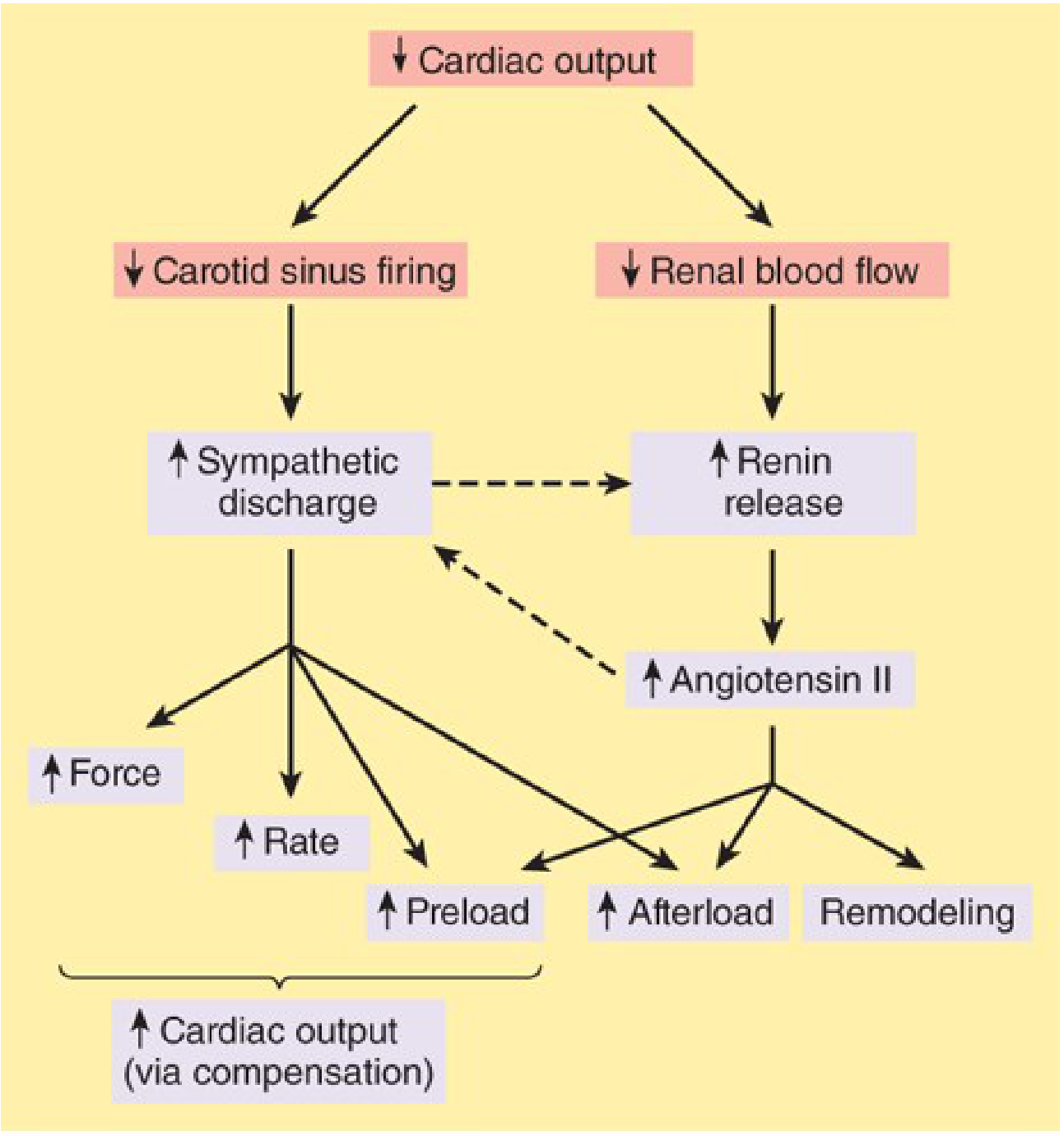
Reduced CO triggers two major compensatory cascades:
-
Sympathetic Nervous System (SNS)
- Baroreceptor resetting → ↑ sympathetic outflow, ↓ parasympathetic
- → Tachycardia, ↑ contractility, vasoconstriction (↑ afterload)
- Chronic: β₁-receptor downregulation, Ca²⁺ overload via RyR channels, apoptosis via caspases
-
RAAS
- ↓ Renal perfusion → ↑ renin → ↑ Angiotensin II → ↑ aldosterone
- Angiotensin II causes myocyte apoptosis, hypertrophy, ventricular fibrosis, and ↑ afterload
- Aldosterone "escapes" ACE inhibitor suppression → selective aldosterone blockade needed
-
Other mediators: Endothelin-1 (potent vasoconstrictor), inflammatory cytokines (TNF-α, IL-6), natriuretic peptides (BNP/NT-proBNP — counter-regulatory, used as biomarker)
Cellular Changes
- ↑ MMPs → cardiac fibrosis and collagen deposition
- Impaired SERCA Ca²⁺ reuptake into SR → diastolic dysfunction
- Altered β-adrenergic signaling: β₁ ↓, β₂ and α₁ ↑ (important for drug choice)
- Metabolic switch: fatty acid oxidation → glycolysis
- Myocardial hypertrophy → initially compensatory, then ischemia, diastolic impairment, geometric distortion
Four Determinants of Cardiac Performance
- Preload — Frank-Starling curve; filling pressure >20–25 mmHg → pulmonary congestion; target of diuretics/venodilators
- Afterload — vascular resistance; increased in HF by Ang II, endothelin; target of vasodilators, ACE inhibitors, ARBs
- Contractility — reduced in HFrEF; target of inotropes (digoxin, dobutamine)
- Heart rate — tachycardia increases O₂ demand; target of β-blockers
— Katzung's Basic & Clinical Pharmacology 16e
Clinical Features
Symptoms
- Left-sided failure: dyspnea on exertion → orthopnea → PND, fatigue, exercise intolerance, non-productive cough
- Right-sided failure: peripheral edema, ascites, RUQ pain (hepatic congestion), anorexia, nausea
- Both: reduced urine output (↓ renal perfusion), confusion (↓ cerebral perfusion in severe HF)
Signs
| System | Findings |
|---|---|
| Cardiovascular | S₃ gallop (hallmark of HFrEF), displaced apical impulse, tachycardia, JVD |
| Respiratory | Bibasal crackles, dullness (pleural effusion), wheeze ("cardiac asthma") |
| Abdomen | Hepatomegaly, ascites, hepatojugular reflux |
| Peripheral | Pitting edema (bilateral), cool peripheries, cyanosis in severe cases |
Diagnosis
Initial workup (all patients with suspected HF)
- 12-lead ECG — LVH, Q waves (previous MI), LBBB, arrhythmias
- Chest X-ray — cardiomegaly (CTR >0.5), upper lobe diversion, Kerley B lines, bat-wing pulmonary edema, pleural effusions
- Echocardiography (key) — quantifies EF, assesses wall motion, valve function, filling pressures. Essential for distinguishing HFrEF vs HFpEF
- Natriuretic peptides — BNP or NT-proBNP: elevated in HF; helps distinguish cardiac vs non-cardiac dyspnea
- Labs: CBC, electrolytes, BUN/Cr, LFTs, glucose, TFTs, iron studies (ferritin + TSAT), ESR/ANA, urinalysis
- Coronary angiography — if ischemic etiology suspected and EF significantly reduced
When to biopsy
Myocardial biopsy is recommended in:
- New-onset HF (<2 weeks) with dilated LV + hemodynamic compromise
- New-onset HF (2 weeks–3 months) with dilated LV + new ventricular arrhythmias/heart block/failure to respond to therapy
— Textbook of Family Medicine 9e
Management
Non-Pharmacological
- Sodium restriction: ≤2 g/day
- Free water restriction: 1 L/day (in fluid-overloaded patients)
- Daily weight monitoring; report ≥3 lb/week gain
- Regular aerobic exercise (improves functional capacity in stable HF)
- Smoking cessation, alcohol avoidance
- Supplemental O₂ if SpO₂ <92%
- Screen and treat sleep apnea (associated with HF and arrhythmias)
- Aggressive BP, lipid, and diabetes control
- Referral to specialist HF clinic (reduces hospitalizations)
Pharmacological Therapy — HFrEF (Mortality-Modifying)
1. ACE Inhibitors (first-line)
- ↓ Absolute mortality ~4%; ↓ combined morbidity/mortality 30–35%
- Block Ang II → ↓ vasoconstriction, ↓ aldosterone, ↓ remodeling
- Examples: Enalapril 2.5–20 mg BID; Lisinopril 5–40 mg QD; Ramipril 5 mg BID; Captopril 6.25–50 mg TID
- If ACE inhibitor intolerant (cough/angioedema) → use ARB (Candesartan, Valsartan, Losartan)
2. Beta-Blockers (first-line)
- Reverse β-receptor downregulation; reduce catecholamine-mediated toxicity and arrhythmias
- Titrate slowly (every 2 weeks) to maximum tolerated dose; start only in stable (not decompensated) HF
- Approved agents (USA): Carvedilol (non-selective β₁/β₂/α₁), Metoprolol succinate XL (β₁-selective), Bisoprolol (β₁-selective)
- COMET trial: carvedilol (non-selective) → 17% further reduction in mortality vs metoprolol tartrate
- Carvedilol preferred in diabetics (no adverse glycemic effect; improves insulin sensitivity)
3. Aldosterone Antagonists (Mineralocorticoid Receptor Antagonists)
- Spironolactone / Eplerenone — add when aldosterone "escapes" ACE inhibitor suppression
- Reduce mortality in symptomatic HFrEF (RALES, EPHESUS trials)
4. ARNi (Sacubitril/Valsartan — Entresto)
- Replaces ACE inhibitor; neprilysin inhibitor + ARB combination
- Reduces mortality and hospitalization in HFrEF vs ACE inhibitor alone (PARADIGM-HF)
- Now a Class I recommendation in ACC/AHA guidelines for HFrEF
5. SGLT2 Inhibitors (Dapagliflozin, Empagliflozin)
- Mortality and hospitalization reduction in both HFrEF and HFpEF
- The DAPA-HF and EMPEROR-Reduced trials established Class I indication for HFrEF
- Recent 2025 meta-analysis (PMID: 40884036) — dapagliflozin in hospitalized HF reduces subsequent events
6. SGLT2 + ARNi = "Fantastic Four" of HFrEF
Current guideline-directed medical therapy (GDMT) for HFrEF now emphasizes four pillars:
- ACE-I/ARB/ARNi + Beta-blocker + MRA + SGLT2 inhibitor
Drug Dosage Summary (Selected)
| Drug Class | Agent | Starting Dose | Target Dose |
|---|---|---|---|
| ACE-I | Enalapril | 2.5 mg QD | 10–20 mg BID |
| ACE-I | Lisinopril | 2.5–5 mg QD | 20–40 mg QD |
| ARB | Candesartan | 16 mg QD | 32 mg QD |
| β-blocker | Carvedilol | 3.125 mg BID | 25 mg BID |
| β-blocker | Metoprolol XL | 12.5 mg QD | 200 mg QD |
| MRA | Spironolactone | 25 mg QD | 25–50 mg QD |
Pharmacological Therapy — HFpEF
- Less evidence-based than HFrEF
- SGLT2 inhibitors (empagliflozin/dapagliflozin) — now recommended (EMPEROR-Preserved, DELIVER trials)
- Aggressive BP control (target <130/80)
- Diuretics for congestion
- Non-dihydropyridine CCBs (diltiazem, verapamil) for rate control
- ACE-I/ARBs may reduce LVH over time
Diuretics (symptom relief only — no mortality benefit)
- Loop diuretics (furosemide) for fluid overload
- No proven survival benefit; monitor electrolytes closely
- Avoid simultaneous initiation with ACE inhibitor (risk of hypotension, ↑Cr)
Digoxin
- Improves symptoms in symptomatic systolic HF with severely reduced EF; also useful for rate control in AF
- No mortality benefit; narrow therapeutic window (target 0.5–0.8 ng/mL)
Device Therapy
- ICD: for HFrEF (EF <35%) despite GDMT — sudden cardiac death prevention
- CRT (Cardiac Resynchronization Therapy): for HFrEF with LBBB (QRS ≥150 ms) — improves EF, symptoms, mortality
- CRT-D: combined ICD + CRT
- LVAD (Left Ventricular Assist Device): bridge to transplant or destination therapy in Stage D HF (INTERMACS 1–3)
- Heart transplantation: definitive therapy in end-stage HF
Key Points to Remember for Exams
| Concept | Key Fact |
|---|---|
| S₃ gallop | Pathognomonic for HFrEF; volume overload |
| BNP/NT-proBNP | ↑ in HF; normal essentially excludes acute HF |
| Mortality drugs in HFrEF | ACE-I/ARNi, β-blocker, MRA, SGLT2-I |
| No mortality benefit | Diuretics, digoxin |
| HFpEF treatment | Mostly symptomatic; SGLT2-I now have evidence |
| Aldosterone escape | Requires addition of spironolactone/eplerenone to ACE-I |
| Carvedilol vs metoprolol | Non-selective preferred; safe in diabetes |
| Do NOT start β-blocker in | Acutely decompensated HF |
Sources: Textbook of Family Medicine 9e; Katzung's Basic & Clinical Pharmacology 16e; Goodman & Gilman's Pharmacological Basis of Therapeutics; Recent meta-analyses: PMID 40884036 (SGLT2i in hospitalized HF, 2025), PMID 39732888 (cardiac rehabilitation in HF, 2024)This is a comprehensive medical student overview of heart failure. Here's a quick summary of what's covered:
Structure of the guide:
- Definition & Types — HFrEF vs HFpEF vs high-output; ACC/AHA Stages A–D; NYHA Classes I–IV
- Pathophysiology — LV remodeling as the core process; the SNS + RAAS vicious cycle (with diagram); cellular changes in calcium handling, β-receptor remodeling, apoptosis; the four determinants of cardiac performance (preload, afterload, contractility, HR)
- Clinical Features — left-sided vs right-sided symptoms and signs; S₃ gallop as hallmark
- Diagnosis — ECG, CXR, echo (key test), BNP/NT-proBNP, targeted labs, indications for biopsy
- Management:
- Non-pharmacological (salt/fluid restriction, exercise, monitoring)
- "Fantastic Four" GDMT for HFrEF: ACE-I/ARNi + β-blocker + MRA + SGLT2 inhibitor — all with mortality benefit
- HFpEF management (SGLT2i now evidence-based as of 2022–2025)
- Devices: ICD, CRT, LVAD, transplant
- What doesn't improve mortality: diuretics, digoxin (symptom relief only)
A recent 2025 meta-analysis (PMID 40884036, Circulation) confirmed SGLT2 inhibitors reduce events even in patients hospitalized for HF, reinforcing their guideline-level status.
Let me know if you'd like to go deeper on any specific area — e.g., acute decompensated HF management, specific drug mechanisms, or ECG/imaging interpretation in HF.
This is a shared conversation. Sign in to Orris to start your own chat.