
Constipation management
I'll look up constipation management from the medical library for you.
Searching sources...
Reading File
Now let me search the library and PubMed in parallel:
Finding Sources
Searching PubMed
"constipation" AND "management"
Good. Now let me read from the most relevant sources in parallel - Goodman & Gilman's for pharmacology and Harriet Lane for pediatric/general management:
Reading File
Reading File
Now let me get more content from Harriet Lane (maintenance therapy + more drugs) and search for a broader laxatives/constipation section in another textbook:
Reading File
Finding Sources
Excellent - let me now read the Goodman & Gilman's comprehensive laxatives section:
Reading File
Loading Image
Now let me read the actual laxatives section content from Goodman & Gilman's:
Finding Sources
Finding Sources
Now let me read the main Goodman & Gilman's section on constipation pathophysiology and treatment, plus Harrison's interventions section:
Reading File
Reading File
I need to read more of the Goodman & Gilman's laxatives content - it got truncated at line 1735:
Reading File
I now have sufficient, comprehensive content to write a thorough answer. Let me compile everything.
Constipation Management
Bristol Stool Form Scale
Types 1-2 indicate constipation. The goal of treatment is stools resembling Types 3-4.
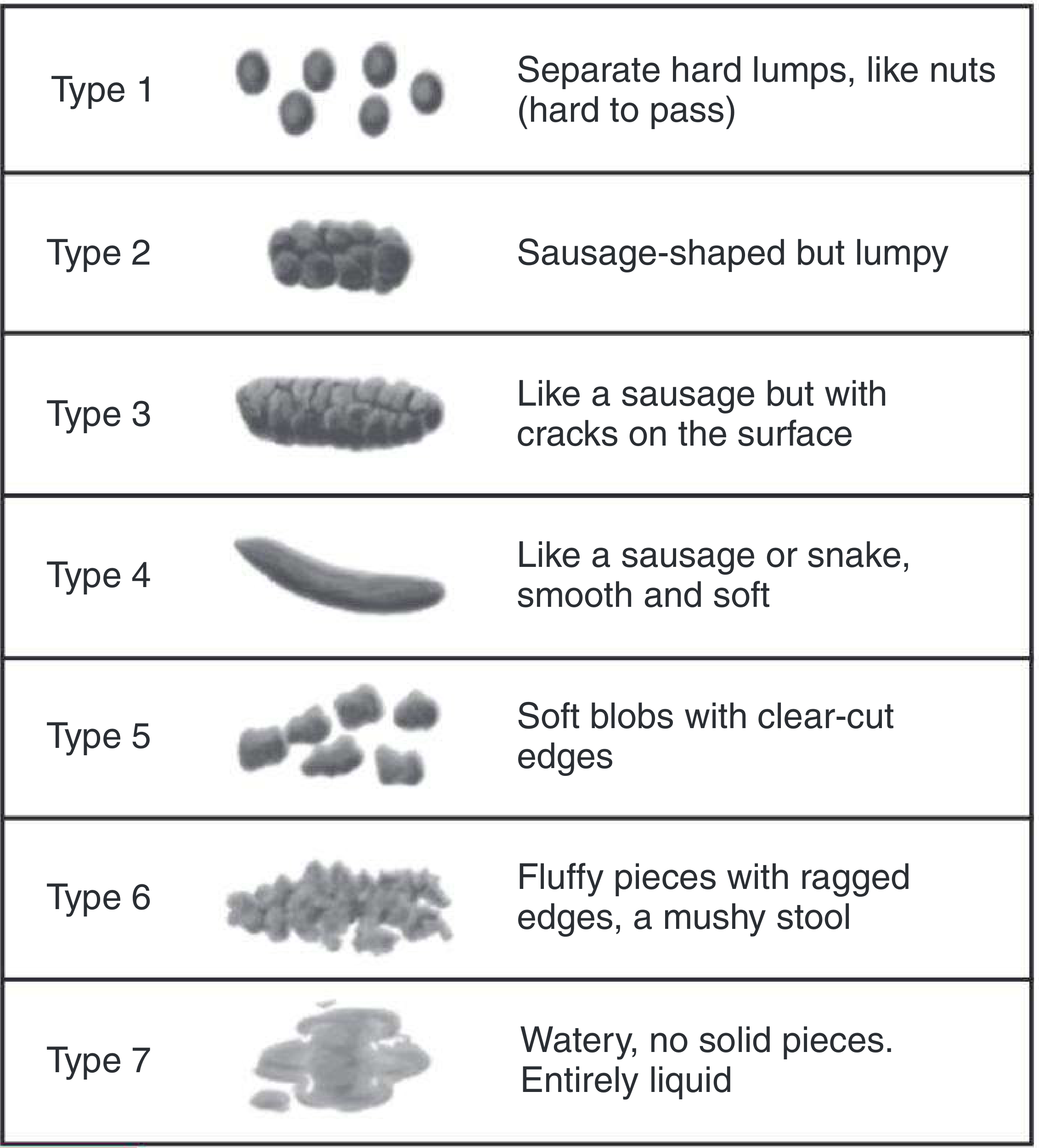
Definition & Pathophysiology
Patients define constipation not just as decreased frequency, but also as difficulty initiating defecation, passage of firm or small-volume feces, or a sensation of incomplete evacuation. Up to 60% of patients presenting with constipation actually have normal colonic transit - they either have IBS or define constipation in non-frequency terms. In the remainder, the problem is either:
-
Delayed colonic transit - defect in colonic motility
-
Outlet disorder - dysfunction of the rectoanal neuromuscular apparatus
-
Goodman & Gilman's Pharmacological Basis of Therapeutics, p. 1728
Secondary / Reversible Causes to Exclude
- Low dietary fiber intake
- Medications: opioids, anticholinergics, CCBs, iron supplements, antacids (calcium/aluminum)
- Hormonal: hypothyroidism, hyperparathyroidism, diabetes
- Neurogenic: Parkinson's, spinal cord lesions, Hirschsprung's disease
- Systemic illness: scleroderma, amyloidosis
Step 1: Non-Pharmacologic Measures (First-Line)
Most guidelines recommend these as primary measures:
-
Dietary fiber: 20-35 g/day - fruits, vegetables, whole grains
-
Adequate fluid intake
-
Physical activity
-
Bowel habit training: regular toilet time, positive reinforcement (especially in children)
-
Review and reduce constipating medications where possible
-
Goodman & Gilman's, p. 1732-1734
Step 2: Pharmacologic Management
A. Osmotic Laxatives (First-Line)
Current evidence supports osmotic or stimulant laxatives as first treatment strategies in functional and chronic constipation.
| Agent | Mechanism | Dose / Notes |
|---|---|---|
| Polyethylene glycol (PEG/Macrogol) | Non-absorbable polymer; retains water osmotically | 17 g in 8 oz water/juice daily; first-line for both disimpaction and maintenance |
| Lactulose | Synthetic disaccharide; hydrolyzed by colonic bacteria to short-chain fatty acids, draws water osmotically | 15-30 mL at night; effects in 24-48 h; best alternative if PEG unavailable |
| Sorbitol | Similar to lactulose; equally efficacious | 15-30 mL of 70% solution |
| Magnesium citrate / Mg hydroxide | Osmotic + stimulates CCK release | 4 mL/kg/day; use with caution in renal insufficiency or cardiac disease |
| Sodium phosphate | Osmotic enema | Avoid in children <2 yrs; risk of acute nephropathy |
- Harriet Lane Handbook, 23rd ed., p. 423 | Goodman & Gilman's, p. 1843-1844
B. Stimulant (Irritant) Laxatives
Recommended when patients do not respond to osmotic laxatives. They act directly on enterocytes, enteric neurons, and smooth muscle to promote water/electrolyte accumulation and stimulate motility.
| Agent | Notes |
|---|---|
| Bisacodyl (diphenylmethane) | Oral, suppository, or enema. Marketed as enteric-coated tablets (avoid with antacids/milk - premature dissolution). 1-2 suppositories/day |
| Senna (anthraquinone) | Oral. Frequently used; 2 tbsp at bedtime for opioid-induced constipation prevention |
| Ricinoleic acid (castor oil) | Anthraquinone derivative; rarely used in modern practice |
Use at lowest effective dose for the shortest period necessary. Chronic overuse can cause electrolyte loss, secondary aldosteronism, steatorrhea, protein-losing enteropathy, and osteomalacia.
- Goodman & Gilman's, p. 1855-1858
C. Stool Softeners / Emollients
| Agent | Mechanism | Notes |
|---|---|---|
| Docusate sodium (100 mg twice daily) | Anionic surfactant; lowers stool surface tension, allows aqueous/fatty mixing | Well tolerated but marginal efficacy in chronic constipation; not first-line |
| Mineral oil | Softens/lubricates stool; interferes with water reabsorption | Risk: impairs fat-soluble vitamin absorption, lipid pneumonitis if aspirated, foreign-body reactions. Avoid in infants and at bedtime |
- Goodman & Gilman's, p. 1850-1852
D. Bulk-Forming Agents
| Agent | Notes |
|---|---|
| Psyllium, methylcellulose, polycarbophil | Increase stool bulk and water content. Require adequate fluid intake to avoid obstruction. Useful adjuncts but generally not first-line for established constipation |
Note: Bulk-forming laxatives should be avoided in chronic intestinal pseudo-obstruction (CIPO) as they increase the load on an already dysmotile colon. - Yamada's Gastroenterology, 7th ed.
E. Secretagogues (for Refractory/Chronic Constipation)
| Agent | Mechanism | Use |
|---|---|---|
| Lubiprostone | Activates ClC-2 chloride channels in intestinal epithelium; increases fluid secretion | Chronic idiopathic constipation; opioid-induced constipation unresponsive to standard laxatives |
| Linaclotide / Plecanatide | Guanylate cyclase-C agonists; stimulate intestinal secretion and transit | Chronic idiopathic constipation and IBS-C |
F. Prokinetics
| Agent | Use |
|---|---|
| Prucalopride (5-HT4 agonist) | Chronic constipation refractory to laxatives; particularly useful in chronic intestinal pseudo-obstruction |
Opioid-Induced Constipation (OIC)
Nearly all patients on opioids develop constipation. Prevention is the preferred strategy - do not wait for constipation to develop.
First-line prevention:
- Bulk-forming agents: psyllium 1 tbsp daily
- Osmotic laxatives: PEG 1 tbsp daily
- Stimulant laxatives: senna 2 tbsp at bedtime
Refractory OIC:
-
Methylnaltrexone (peripherally restricted mu-opioid antagonist) - reverses OIC without affecting central analgesia; causes laxation within 24 h in placebo-controlled trials
-
Naloxegol - similar peripherally limited opioid antagonist
-
Lubiprostone
-
Harrison's Principles of Internal Medicine, 22nd ed., p. 465 | Goodman & Gilman's, p. 497
Special Populations
Pediatric (Harriet Lane Handbook, 23rd ed.)
Disimpaction:
- Oral/NG: PEG - 1 to 1.5 g/kg/day for 3 days (>3 years); or magnesium citrate
- Rectal: Saline or mineral oil enemas
- Infants (<1 year): Glycerin suppositories; 2-4 oz of 100% prune or pear juice. PEG used off-label. Avoid mineral oil, stimulant laxatives, phosphate enemas
Maintenance therapy (3-12 months):
- Daily PEG (first-line)
- Lactulose as second-line
- Stimulant laxatives and stool softeners as adjuncts
- Evidence does not support probiotics
- Dietary: increased fruits, vegetables, whole grains, fluids (limit cow's milk)
- Behavioral: regular toilet schedule with positive reinforcement; mental health referral if encopresis is a concern
- Discontinue therapy gradually only after return of regular bowel movements with good evacuation
Geriatric
- Osmotic laxatives (PEG, lactulose, sorbitol) are safe and effective
- Avoid sodium phosphate enemas (electrolyte/renal risk)
- Review polypharmacy as the primary driver
Renal Impairment
- Avoid magnesium-containing preparations (Mg toxicity)
- Avoid sodium phosphate (acute nephropathy)
- PEG is safe
Home Cleanout Protocol (Harriet Lane, Box 12.1)
- Take a stimulant laxative (bisacodyl or senna) with 8 oz liquid per dosing instructions
- Drink PEG mixed with water or clear non-carbonated liquid - full amount over 2 hours
- 1-2 hours after finishing PEG, expect passage of formed/thick brown stool progressing to thinner, clearer stool
Red Flags Warranting Investigation
Constipation with any of these warrants further workup (colonoscopy, imaging, anorectal manometry):
- Rectal bleeding / haematochezia
- Weight loss, anorexia
- Iron-deficiency anemia
- New onset in patients >50 years
- Family history of colorectal cancer
- Failure to respond to 4-6 weeks of laxatives
- Suspected outlet disorder (prolonged straining, incomplete evacuation, need for manual maneuvers)
Sources: Goodman & Gilman's Pharmacological Basis of Therapeutics, 14th ed. | Harriet Lane Handbook, 23rd ed. (Johns Hopkins) | Harrison's Principles of Internal Medicine, 22nd ed. (2025)
This is a shared conversation. Sign in to Orris to start your own chat.