
Gall stone causes
Reading File
Now I'll search the medical library and PubMed simultaneously for gallstone causes.
Finding Sources
Searching PubMed
cholelithiasis pathogenesis risk factors
Good. Now let me read from the top sources in parallel.
Reading File
Reading File
Reading File
Let me get more detail on the pathogenesis from Robbins and the Sleisenger reference.
Reading File
Reading File
I now have rich textbook content to provide a thorough answer. Let me also fetch the gallstone image for the response.
Loading Image
Here is a complete, textbook-grounded answer on gallstone causes:
Gallstone Causes (Cholelithiasis)
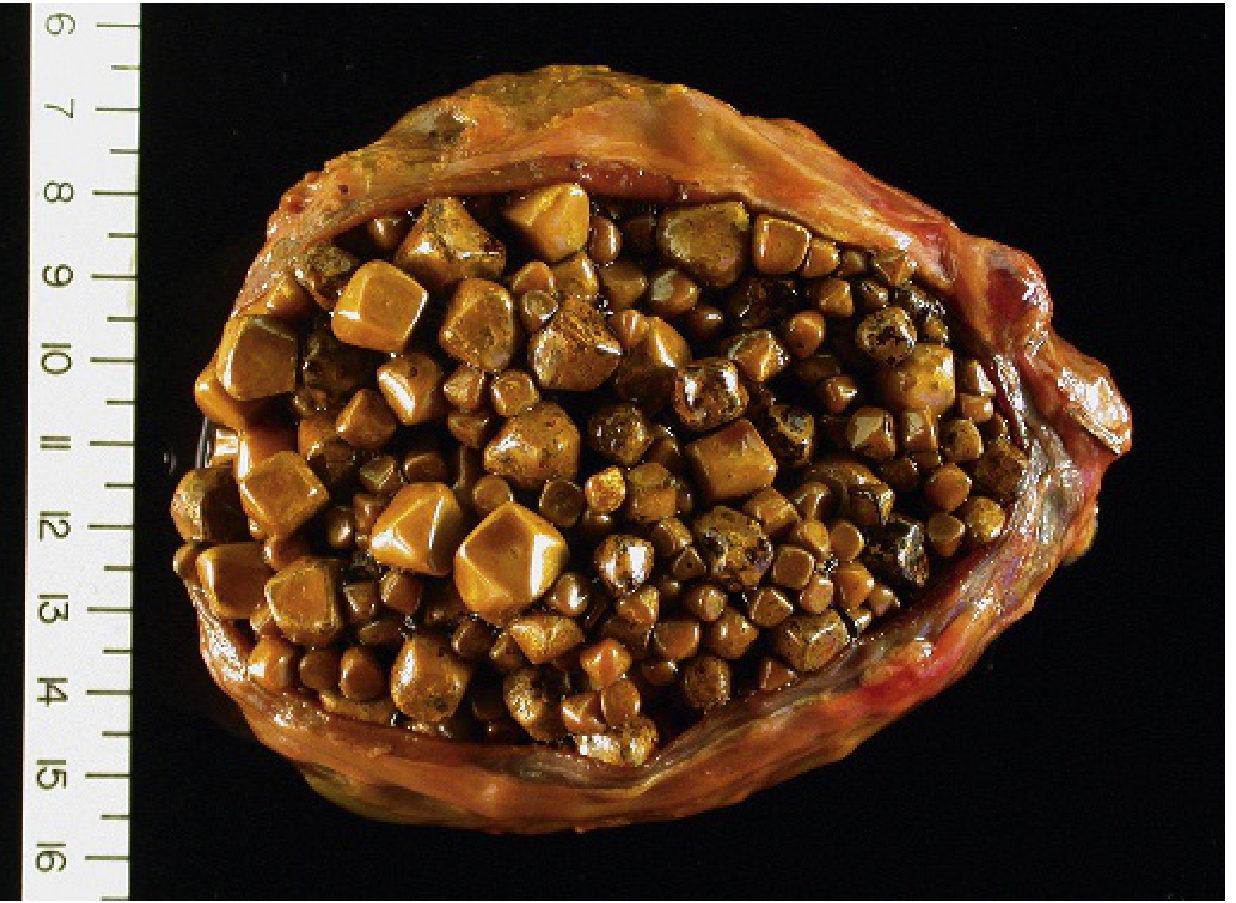
Gallstones affect 10-20% of adults in Western countries and about 1 million new cases are diagnosed annually in the United States. There are two fundamentally different types of stones, each with distinct causes.
1. Cholesterol Stones (80% in the West)
Cholesterol is solubilized in bile by bile salts and lecithins. When cholesterol concentration exceeds the solubilizing capacity of bile - a state called supersaturation - cholesterol crystallizes out of solution. Three interacting mechanisms drive this:
A. Bile Supersaturation with Cholesterol
- Obesity and metabolic syndrome - increase hepatic cholesterol secretion into bile
- Rapid weight loss - mobilizes peripheral cholesterol that floods into bile
- Insulin resistance - alters bile acid metabolism
- Estrogens - increase hepatic cholesterol uptake and synthesis, causing excess biliary cholesterol secretion
B. Crystal Nucleation and Growth
- Once supersaturated, cholesterol crystals nucleate faster than they can be flushed out
- Mucus hypersecretion traps crystals, enhancing aggregation into stones
C. Gallbladder Hypomotility / Stasis
Any condition that reduces gallbladder emptying promotes stone formation:
- Pregnancy - progesterone slows smooth muscle motility; estrogens also increase bile lithogenicity
- Prolonged fasting / total parenteral nutrition (TPN) - gallbladder isn't stimulated by CCK
- Vagotomy - disrupts neural control of gallbladder contraction
- Spinal cord injury
2. Pigment Stones (Predominantly in Asia and developing countries)
These are made of insoluble calcium bilirubinate salts. They form when bile contains excess unconjugated bilirubin.
Black Pigment Stones (found in sterile gallbladder bile)
Caused by conditions producing chronic hemolysis, which floods the bile with unconjugated bilirubin:
- Sickle cell anemia - by age 10, at least 14% of children have gallstones; 36% by age 10-20
- Hereditary spherocytosis
- Thalassemia
- Cirrhosis - reduced bile salt synthesis impairs bilirubin solubilization
Brown Pigment Stones (found in infected biliary ducts)
Caused by biliary infection - bacteria (e.g., E. coli, liver flukes like Clonorchis sinensis) produce phospholipases that release fatty acids from lecithins, forming calcium soaps. Common in Asia.
Summary Table of Risk Factors
| Category | Cholesterol Stones | Pigment Stones |
|---|---|---|
| Demographics | Northern Europeans, Native Americans, North/South Americans | Asian, non-Western populations |
| Age | Advancing age (>80 yrs: 25-30%) | Any age |
| Sex/Hormones | Female sex, oral contraceptives, pregnancy | - |
| Metabolic | Obesity, insulin resistance, rapid weight loss | - |
| Hemolysis | - | Sickle cell, spherocytosis, thalassemia |
| GI disorders | Ileal disease (Crohn), ileal resection (disrupts bile acid enterohepatic cycling) | Crohn disease, ileal resection, cystic fibrosis |
| Hepatic | Inborn errors of bile acid metabolism, dyslipidemia syndromes | Cirrhosis |
| Infection | - | Biliary infection, liver flukes |
| Genetic | ~25% heritable; ABCB4, ABCG5/G8 mutations | UGT1A1 polymorphism (Gilbert syndrome) |
| Iatrogenic | TPN, prolonged fasting, fibrates (increase cholesterol secretion) | - |
Key Pathogenesis Summary
- Cholesterol stones = bile supersaturation + nucleation + stasis
- Pigment stones = excess unconjugated bilirubin (hemolysis) or biliary infection (bacteria hydrolyze conjugated bilirubin)
Sources: Robbins & Kumar Basic Pathology, p. 630; Robbins, Cotran & Kumar Pathologic Basis of Disease, Table 18.11; Sleisenger and Fordtran's Gastrointestinal and Liver Disease, Table 62.2
Recent evidence note: A 2026 Mendelian randomization meta-analysis (PMID 40064441) found causal links between gastrointestinal inflammation and gallstone formation, supporting the known association with inflammatory bowel disease. A 2025 systematic review (PMID 40499738) confirmed GLP-1 receptor agonists (e.g., semaglutide) are associated with gallstone and cholecystitis risk - likely through rapid weight loss and altered gallbladder motility - an increasingly relevant cause given widespread use of these drugs.
This is a shared conversation. Sign in to Orris to start your own chat.