
Renal pharmacology, Diuretics but focus more on loop and thiazide and use katzung and all othrr books
Reading File
Finding Sources
Finding Sources
Finding Sources
Finding Sources
Now I have the key sources. Let me read the main pharmacology chapters in parallel — Katzung, Goodman & Gilman, and Lippincott for diuretics.
Finding Sources
Finding Sources
Finding Sources
Finding Sources
Now I have all the file paths. Let me read the key sections from Katzung, Goodman & Gilman, and Lippincott in parallel.
Reading File
Reading File
Reading File
I need to read the core diuretics chapter from Katzung (block3) starting around the right section. Let me read the Katzung diuretics chapter content directly.
Reading File
Reading File
Excellent content loading. Let me now read the Katzung loop diuretics and thiazide sections, plus search for images.
Reading File
Searching Images
loop diuretics mechanism of action thick ascending limb NKCC2
Excellent! I have rich content. Let me now read the remaining key sections — Katzung's loop diuretics continued, Goodman & Gilman loop/thiazide sections, and search for a thiazide mechanism image.
Reading File
Reading File
Searching Images
thiazide diuretic mechanism distal convoluted tubule NCC cotransporter
I have excellent content from multiple textbooks and great images. Let me read the G&G thiazide/loop sections and Goodman & Gilman's dedicated renal chapter for completeness.
Reading File
Reading File
I have comprehensive content from Katzung and Goodman & Gilman. Let me read the adverse effects/toxicity sections and fetch the key images.
Reading File
Loading Image
Loading Image
I now have comprehensive data from Katzung, Goodman & Gilman, Lippincott Pharmacology, and excellent mechanism diagrams from Harrison's. Let me also quickly read the loop diuretics toxicity section from Katzung and check the Lippincott loop diuretics section.
Reading File
Reading File
I now have comprehensive, detailed content from all three major pharmacology textbooks. Let me update my todos and write the comprehensive answer.Here is the comprehensive synthesis from Katzung (16th ed.), Goodman & Gilman, Lippincott Illustrated Reviews: Pharmacology, and Harrison's Principles:
Renal Pharmacology: Diuretics
With Focus on Loop and Thiazide Agents
1. Overview & Nephron Targets
Diuretics increase urine output by reducing renal tubular reabsorption of Na⁺ and water. Each class acts at a distinct nephron segment:
| Class | Site of Action | Transporter Blocked | Efficacy |
|---|---|---|---|
| Carbonic anhydrase inhibitors | Proximal convoluted tubule | Carbonic anhydrase | Low |
| Loop diuretics | Thick ascending limb (TAL) | Na⁺/K⁺/2Cl⁻ (NKCC2) | Highest |
| Thiazides | Distal convoluted tubule (DCT) | Na⁺/Cl⁻ (NCC) | Moderate |
| K⁺-sparing | Collecting duct | ENaC / Aldosterone receptor | Low |
| Osmotic | Proximal tubule + descending loop | Osmotic gradient | Moderate |
Urinary electrolyte changes: Loop agents produce ++++NaCl, +K⁺, metabolic alkalosis ↑; Thiazides produce ++NaCl, +K⁺, metabolic alkalosis ↑ — Katzung, Table 15-2
2. LOOP DIURETICS
Chemistry
Four agents are in clinical use:
- Furosemide — sulfonamide derivative; most widely used
- Bumetanide — sulfonamide; ~40× more potent than furosemide by weight
- Torsemide — sulfonamide; longest duration
- Ethacrynic acid — phenoxyacetic acid derivative (NOT a sulfonamide); the methylene group forms a cysteine adduct which is the active form
Ethacrynic acid is structurally unique — the only non-sulfonamide loop diuretic, used in patients with true sulfonamide allergy. — Katzung, p. 406
Mechanism of Action
Loop diuretics inhibit the Na⁺/K⁺/2Cl⁻ cotransporter (NKCC2) on the luminal membrane of the TAL of the loop of Henle, acting from inside the tubular lumen.
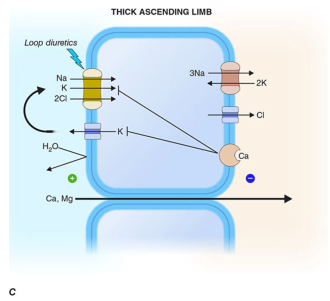
Key consequences of NKCC2 inhibition:
- Massive natriuresis — the TAL normally reabsorbs 25–30% of filtered NaCl; this is the largest single-segment reabsorptive capacity in the nephron, so its blockade yields the greatest diuresis of any drug class. — Lippincott Pharmacology, p. 337
- Abolition of the medullary concentrating gradient — TAL is impermeable to water but reabsorbs solute, creating the hyperosmotic medullary interstitium essential for water reabsorption from the collecting duct. Loop diuretics destroy this gradient → dilute urine even in states of ADH excess.
- Inhibition of tubuloglomerular feedback — Increased NaCl delivery to the macula densa would normally reduce GFR via TGF. Because TGF is mediated by NKCC2 itself (NKCC1 at macula densa), loop diuretics prevent this shutdown, maintaining stable GFR. This contrasts with carbonic anhydrase inhibitors and thiazides, which are limited by TGF-mediated GFR reduction. — Goodman & Gilman, p. 675
- Hypercalciuria — Normally, the positive lumen potential in the TAL (generated by K⁺ recycling via ROMK into the lumen) drives paracellular reabsorption of Ca²⁺ and Mg²⁺. Loop diuretics abolish this lumen-positive potential → increased urinary Ca²⁺ and Mg²⁺.
- Secondary K⁺ wasting — Increased Na⁺ delivery to the distal tubule and collecting duct stimulates ENaC-mediated Na⁺ reabsorption in exchange for K⁺ secretion, causing hypokalemia. — Goodman & Gilman, p. 675
Dose-response: Loop diuretics display a sigmoidal ("S"-shaped) dose-response curve with a threshold, steep slope, and ceiling effect. Below the threshold, no diuresis occurs; above the ceiling, no additional response. Dosing must be individualized — in resistance, frequency rather than dose should be increased. — Lippincott Pharmacology, p. 338
Pharmacokinetics
| Drug | Bioavailability (oral) | Elimination | Duration |
|---|---|---|---|
| Furosemide | 40–70% (variable) | Renal (glomerular filtration + tubular secretion) | 2–3 h |
| Bumetanide | >80% | 50% renal, 50% hepatic | 4–6 h |
| Torsemide | >80% (most reliable) | Mainly hepatic | 4–6 h |
| Ethacrynic acid | Oral/IV | Renal/hepatic | 2–3 h |
- All loop diuretics are secreted into the tubular lumen by OAT1/OAT3 in the proximal tubule. They act from the luminal side. Therefore, drugs competing for proximal secretion (e.g., probenecid, NSAIDs) reduce their efficacy. — Katzung, p. 407
- In hypoalbuminemia (nephrotic syndrome), furosemide is highly protein-bound in plasma; albumin-bound drug cannot be filtered or secreted, reducing luminal concentration and efficacy.
- In renal failure: furosemide t½ increases from ~1 h (normal) to >24 h.
Typical doses:
| Drug | Oral Daily Dose |
|---|---|
| Furosemide | 20–80 mg |
| Bumetanide | 0.5–2 mg |
| Torsemide | 5–20 mg |
| Ethacrynic acid | 50–200 mg |
Katzung, Table 15-4
Clinical Indications
- Acute pulmonary edema / heart failure — Drug of choice for acute decompensated HF; reduces venous pressure, preload, and edema rapidly
- Chronic heart failure (when GFR < 30–40 mL/min, or thiazide-refractory)
- Renal insufficiency — Effective even in CKD (unlike thiazides, which lose efficacy at GFR <30)
- Nephrotic syndrome — First-line for edema management (twice-daily preferred)
- Hypercalcemia — IV furosemide + IV saline; loop diuretics promote Ca²⁺ excretion (combine saline to prevent compensatory proximal Ca²⁺ reabsorption)
- Acute hyperkalemia — Promotes K⁺ excretion
- Hypertensive urgency/emergency — IV furosemide for rapid volume reduction
- Thiamine deficiency caution — Long-term loop diuretics may worsen thiamine deficiency in HF patients — Katzung, p. 408
Adverse Effects — Loop Diuretics
| Adverse Effect | Mechanism | Notes |
|---|---|---|
| Hypokalemia | ↑ Na⁺ to collecting duct → ↑ aldosterone → ENaC ↑ K⁺ excretion | Most common; EKG changes, muscle weakness |
| Hypomagnesemia | Loss of paracellular Mg²⁺ reabsorption in TAL | Predictable with chronic use; causes refractory hypokalemia |
| Hypocalcemia | ↑ urinary Ca²⁺ (paracellular loss) | Mild; secondary hyperparathyroidism long-term |
| Metabolic alkalosis | ↑ HCO₃⁻ reabsorption (via ↑ aldosterone, volume contraction) | "Contraction alkalosis" |
| Ototoxicity | Inhibition of NKCC1 in inner ear endolymph | Usually dose-related, reversible; worst with IV, rapid infusion, or combined aminoglycosides |
| Hyperuricemia / gout | Volume depletion → ↑ proximal uric acid reabsorption | Prevent with lower doses |
| Dehydration / hypovolemia | Massive fluid losses | Especially in elderly/cirrhosis |
| Hyponatremia | Less common than with thiazides; occurs with compensatory water intake | |
| Allergic reactions | Sulfonamide cross-reactivity (furosemide, bumetanide, torsemide — NOT ethacrynic acid) | Rash, eosinophilia, interstitial nephritis; DRESS syndrome (rare) |
Katzung, pp. 408–409; Goodman & Gilman; Lippincott Pharmacology
3. THIAZIDE DIURETICS
Chemistry & Key Agents
Discovered in 1957 as more potent carbonic anhydrase inhibitor derivatives. It was later found they inhibit NaCl (not NaHCO₃) transport in the DCT. — Katzung, p. 411
True thiazides (benzothiadiazine ring): chlorothiazide (first oral agent), hydrochlorothiazide (HCTZ) — prototypical
Thiazide-like diuretics (no benzothiadiazine ring but same mechanism): chlorthalidone, indapamide, metolazone
- Chlorthalidone: ~2× more potent than HCTZ, much longer t½ (~45–60 h vs 6–12 h for HCTZ) → better 24-h BP control. Studies support superior antihypertensive effect but also more adverse effects. — Katzung, p. 417
- Indapamide: significant vasodilatory properties; preferred in some guidelines
- Metolazone: retains efficacy at low GFR; synergistic with loop diuretics
Mechanism of Action
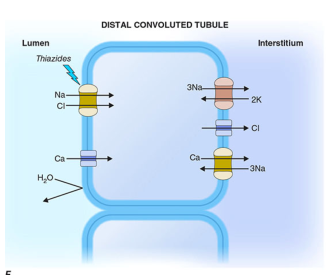
Thiazides inhibit the Na⁺/Cl⁻ cotransporter (NCC) on the luminal side of DCT cells. To reach the lumen, they must first be secreted by the proximal tubule (OAT pathway) — hence reduced efficacy with declining renal function. — Lippincott Pharmacology, p. 333
Unique feature — Calcium retention:
- Loop diuretics → hypercalciuria (loss of lumen-positive potential in TAL)
- Thiazides → hypocalciuria (Ca²⁺ reabsorption enhanced)
- Mechanism: (1) Volume depletion → enhanced proximal Na⁺ and passive Ca²⁺ reabsorption; (2) In DCT, blockade of Na⁺ entry lowers intracellular Na⁺ → enhances basolateral Na⁺/Ca²⁺ exchanger (NCX) activity → more Ca²⁺ exits basolaterally. — Katzung, p. 412
- This is the basis for using thiazides in hypercalciuric nephrolithiasis and osteoporosis protection
Urinary composition with thiazides:
| Ion | Change |
|---|---|
| Na⁺, Cl⁻ | ↑↑ |
| K⁺ | ↑ |
| Mg²⁺ | ↑ |
| Ca²⁺ | ↓ (unique!) |
| HCO₃⁻ | ↑ (mild) |
| Uric acid | ↓ (retained) |
Lippincott Pharmacology, Figure 9.7
Limitation in renal failure: Thiazides lose efficacy when GFR falls below ~30 mL/min/1.73m² because tubular secretion is reduced. An exception: chlorthalidone retains some BP-lowering effect even in stage 4 CKD. Antihypertensive effects of thiazides may persist at lower GFR even when diuretic effect is lost. Switch to loop diuretics for volume management in CKD. — Lippincott Pharmacology, p. 333; Katzung
Pharmacokinetics
| Drug | Dose (daily oral) | Frequency | Notes |
|---|---|---|---|
| Hydrochlorothiazide | 25–100 mg | Once daily | Most widely used |
| Chlorthalidone | 25–50 mg | Once daily | Longer t½; preferred for HTN |
| Indapamide | 2.5–10 mg | Once daily | Vasodilatory properties |
| Metolazone | 2.5–10 mg | Once daily | Works in CKD; synergistic with loops |
| Chlorothiazide | 0.5–2 g | Twice daily | Original agent; poor bioavailability |
| Bendroflumethiazide | 2.5–10 mg | Once daily |
Katzung, Table 15-5; Lippincott Pharmacology
Clinical Indications
- Hypertension — First-line agent; large ALLHAT trial confirmed outcomes equivalent to or better than ACE inhibitors and calcium channel blockers in essential HTN. Thiazides enhance efficacy of virtually all other antihypertensives, especially ACE inhibitors. — Katzung, p. 416–417
- Mild-moderate heart failure (NYHA I–II, preserved renal function)
- Nephrolithiasis from hypercalciuria — Reduces urinary Ca²⁺; must combine with low-salt diet (excess NaCl overwhelms hypocalciuric effect)
- Nephrogenic diabetes insipidus (NDI) — Paradoxically reduces urine volume by causing mild volume depletion → ↑ proximal reabsorption → ↓ volume reaching collecting duct
- Osteoporosis — Modestly increases bone mineral density (from Ca²⁺ retention)
- Spironolactone add-on — Growing evidence that spironolactone is the most effective agent in drug-resistant hypertension when added to diuretics
Adverse Effects — Thiazides
| Adverse Effect | Notes |
|---|---|
| Hypokalemia | Most common; risk highest in women, underweight patients, >5 years use |
| Hyponatremia | More common than with loop diuretics; ADH elevation + reduced diluting capacity + thirst; elderly women most vulnerable; 25% of hospital hyponatremia cases |
| Hyperglycemia | Dose-dependent (significant at HCTZ >50 mg/d); inhibits pancreatic K⁺ channels → ↓ insulin release; worsened by hypokalemia |
| Hyperlipidemia | 5–15% ↑ total cholesterol and LDL; may normalize with long-term use |
| Hyperuricemia / gout | Most associated with gout (vs loop diuretics); mainly young men <60 years |
| Hypomagnesemia | More likely than loop diuretics; usually after >1 year |
| Metabolic alkalosis | Contraction alkalosis |
| Hypercalcemia | Rare directly, but unmasks latent hypercalcemia (hyperparathyroidism, malignancy) |
| Allergic reactions | Sulfonamide derivatives: rash, photosensitivity, rarely hemolytic anemia, thrombocytopenia, necrotizing pancreatitis |
| Skin cancers | Meta-analysis (>10 million): OR ~1.35 for squamous cell, ~1.10 for melanoma |
| Impotence | Likely volume depletion-related |
| Acute angle-closure glaucoma | Secondary to hyponatremia |
| Weakness/paresthesias | Electrolyte disturbances |
Katzung, pp. 413–415
4. Comparison: Loop vs Thiazide
| Feature | Loop Diuretics | Thiazide Diuretics |
|---|---|---|
| Site | TAL of loop of Henle | Distal convoluted tubule |
| Transporter | NKCC2 | NCC |
| Diuretic potency | Highest ("ceiling diuretics") | Moderate |
| Ca²⁺ effect | ↑ Ca²⁺ excretion (hypercalciuria) | ↓ Ca²⁺ excretion (hypocalciuria) |
| Ca²⁺ use | Hypercalcemia (IV furosemide + saline) | Hypercalciuria / nephrolithiasis |
| Efficacy in CKD | Yes (effective even at low GFR) | No (loses efficacy at GFR <30) |
| Hyponatremia risk | Lower | Higher |
| Ototoxicity | Yes (NKCC1 in inner ear) | No |
| Urine osmolality | Dilute (cannot concentrate) | Can produce hyperosmolar urine |
| Gout | Yes (both) | More strongly associated |
| Metabolic alkalosis | Yes | Yes |
| Hyperglycemia | Less | More (dose-dependent) |
| K⁺ wasting | Yes | Yes |
| Mg²⁺ wasting | Yes | More so (>1 year) |
| Synergy | Combine with thiazides for resistant edema | Combine with loops (sequential nephron blockade) |
5. Diuretic Resistance
Causes include:
- Non-compliance / excess dietary Na⁺
- Reduced renal perfusion (GFR ↓ → less secretion of drug into tubular lumen)
- Protein binding in tubular lumen (especially in nephrotic syndrome with hypoalbuminemia)
- NSAIDs — inhibit prostaglandin synthesis → reduce renal blood flow → reduce drug secretion and response (both loop and thiazide)
- "Braking phenomenon" — Compensatory ↑ Na⁺ reabsorption at segments distal to drug's site of action (especially DCT hypertrophy with loop diuretic use)
- Distal tubular remodeling with chronic loop diuretic use
Management of diuretic resistance:
- IV loop diuretics (bolus or continuous infusion)
- Sequential nephron blockade — Add a thiazide/metolazone to a loop diuretic: blocks Na⁺ reabsorption at BOTH TAL AND DCT, preventing compensatory distal reabsorption
- IV albumin + furosemide in nephrotic syndrome
- Switch furosemide → torsemide or bumetanide (more reliable bioavailability)
- Add acetazolamide for metabolic alkalosis-associated resistance
- Ultrafiltration as last resort
6. Drug Interactions (Both Classes)
| Interaction | Effect |
|---|---|
| NSAIDs | ↓ efficacy of both loops and thiazides (prostaglandin inhibition) |
| Probenecid | ↓ loop/thiazide secretion into tubular lumen |
| Aminoglycosides | ↑ nephrotoxicity and ototoxicity with loop diuretics |
| Digitalis | Hypokalemia from diuretics → ↑ digoxin toxicity |
| Lithium | Thiazides ↑ proximal Na⁺ reabsorption → ↑ Li⁺ reabsorption → lithium toxicity |
| ACE inhibitors | Enhanced antihypertensive effect; hypovolemia risk |
| Corticosteroids | Additive K⁺ wasting |
| Cisplatin | ↑ ototoxicity with loop diuretics |
7. Special Clinical Scenarios
Nephrogenic DI: Thiazides → volume depletion → ↑ proximal reabsorption → less water to collecting duct → paradoxical antidiuresis
Cirrhosis / ascites: Use spironolactone as foundation; add loop diuretics cautiously (risk of hepatorenal syndrome); avoid aggressive diuresis
Hypertension with diabetes: Chlorthalidone preferred over HCTZ (longer duration); avoid high-dose HCTZ due to hyperglycemia
Acute pulmonary edema: IV furosemide — venodilatory effect occurs within minutes (before diuresis), reducing preload rapidly. Diuresis peaks at 1–2 h.
Osteoporosis: Thiazides → ↑ bone mineral density; loop diuretics → chronic hypercalciuria may worsen bone loss
Sources
- Katzung's Basic and Clinical Pharmacology, 16th Edition — Chapter 15 (Diuretics)
- Goodman & Gilman's The Pharmacological Basis of Therapeutics — Chapter 33
- Lippincott Illustrated Reviews: Pharmacology — Chapter 9 (Renal Pharmacology)
- Harrison's Principles of Internal Medicine, 21st Edition — Mechanism diagrams
- Brenner and Rector's The Kidney — Diuretic physiology
- Comprehensive Clinical Nephrology, 7th Edition — Clinical diuretic useThis covers renal pharmacology / diuretics comprehensively, synthesized across all available textbooks. Here's a quick orientation to the content above:
What's covered:
- Overview table — All diuretic classes, nephron site, transporter, and potency hierarchy
- Loop Diuretics — full pharmacology:
- Chemistry of all 4 agents (furosemide, bumetanide, torsemide, ethacrynic acid)
- NKCC2 mechanism with Harrison's diagram showing TAL transport
- Why they're the most potent diuretics (25–30% of filtered NaCl handled by TAL)
- Sigmoidal dose-response curve with threshold and ceiling (Lippincott)
- Pharmacokinetics table including furosemide's variable bioavailability vs. torsemide/bumetanide >80%
- Adverse effects: hypokalemia, ototoxicity (NKCC1 in inner ear), hypercalciuria, hypomagnesemia, hyperuricemia, metabolic alkalosis
- Thiazide Diuretics — full pharmacology:
- NCC mechanism with Harrison's DCT diagram
- The critical Ca²⁺ reabsorption paradox (opposite of loops) explained mechanistically
- Chlorthalidone vs HCTZ comparison
- Loss of efficacy at GFR <30 (vs loops)
- Adverse effects: hyponatremia (> loops), hyperglycemia (dose-dependent), hyperlipidemia, skin cancer risk, gout
- Side-by-side comparison table
- Diuretic resistance — mechanisms + "sequential nephron blockade" strategy
- Drug interactions — NSAIDs, digoxin, lithium, aminoglycosides
- Special scenarios — nephrogenic DI, acute pulmonary edema, cirrhosis, osteoporosis
This is a shared conversation. Sign in to Orris to start your own chat.