
Synapse and there type
A synapse is the junction between two neurons (or a neuron and an effector cell) where signals are transmitted. Here's a quick overview before I pull detailed content from the medical library:
- Chemical synapses use neurotransmitters released across a synaptic cleft
- Electrical synapses (gap junctions) allow direct ion flow between cells
- They can be classified by location (axodendritic, axosomatic, etc.) or by effect (excitatory vs. inhibitory)
Searching sources...
Reading File
Finding Sources
Finding Sources
Reading File
Reading File
Reading File
Reading File
Finding Sources
Loading Image
Loading Image
Reading File
Loading Image
Here is a thorough breakdown of synapses and their types, drawn from multiple authoritative textbooks (Guyton & Hall, Neuroscience: Exploring the Brain, Histology: A Text and Atlas, and Medical Physiology).
The Synapse
A synapse is a specialized junction where one part of a neuron contacts and communicates with another neuron or effector cell (muscle or gland). The signal flows from the presynaptic side (initiates transmission) to the postsynaptic side (receives transmission).
Classification 1 - By Transmission Mechanism
The two major types of synapses are chemical and electrical:
1. Electrical Synapses
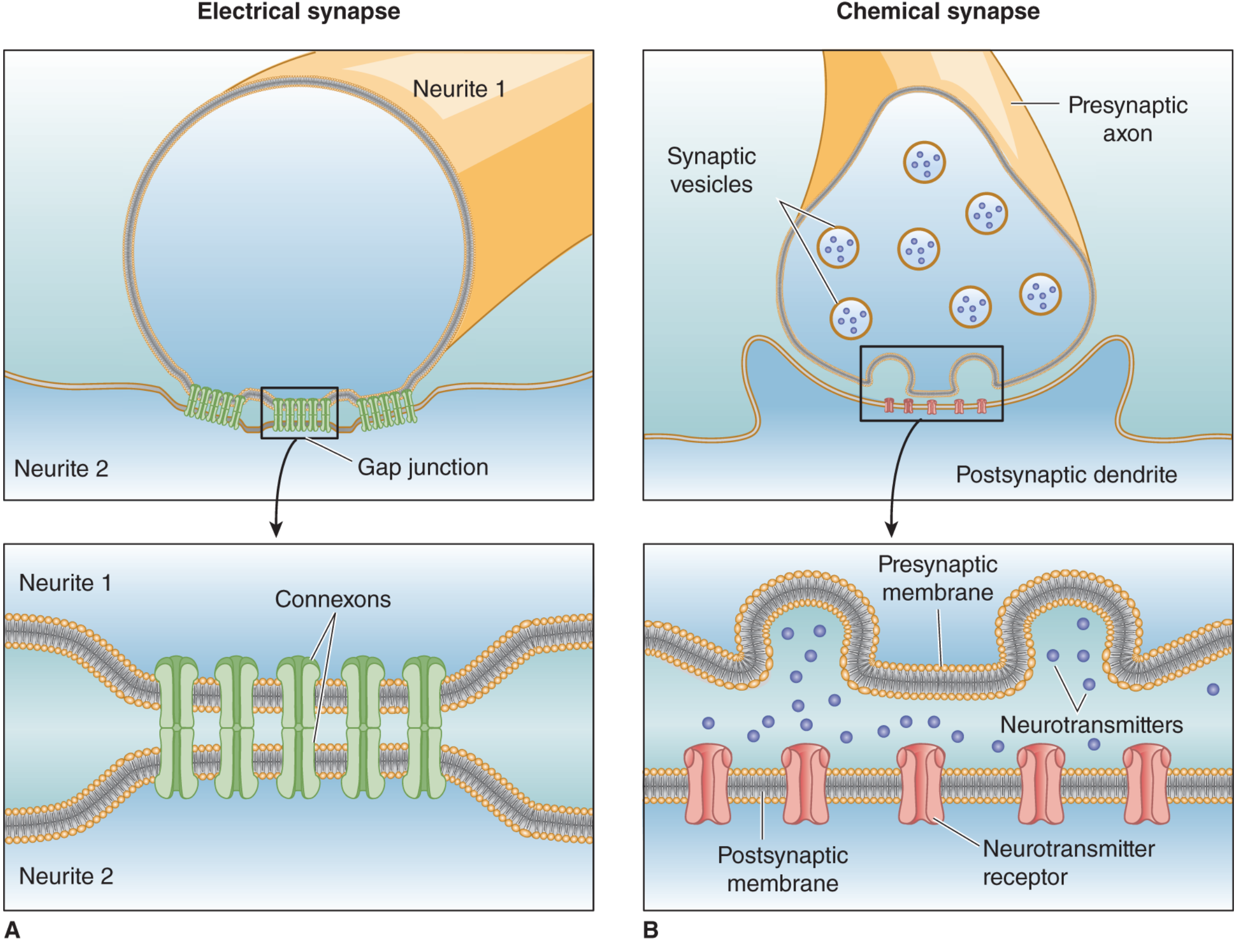
- Occur at specialized sites called gap junctions
- The membranes of two cells are separated by only ~3 nm
- Six connexin subunits form a channel called a connexon; two connexons (one from each cell) combine to make a gap junction channel
- Ions pass directly from the cytosol of one cell to the cytosol of the other - no chemical intermediary is needed
- Transmission is bidirectional (unlike chemical synapses)
- Signal propagation is immediate (no delay)
- Found between dendrites, cell bodies, axons, cardiac muscle cells, smooth muscle, glia, and epithelial cells
- Particularly common in early development; help coordinate synchronous neuronal firing (e.g., hypothalamic hormone-secreting neurons)
"Electrical synapses are relatively simple in structure and function, and they allow the direct transfer of ionic current from one cell to the next." - Neuroscience: Exploring the Brain, 5th ed.
2. Chemical Synapses
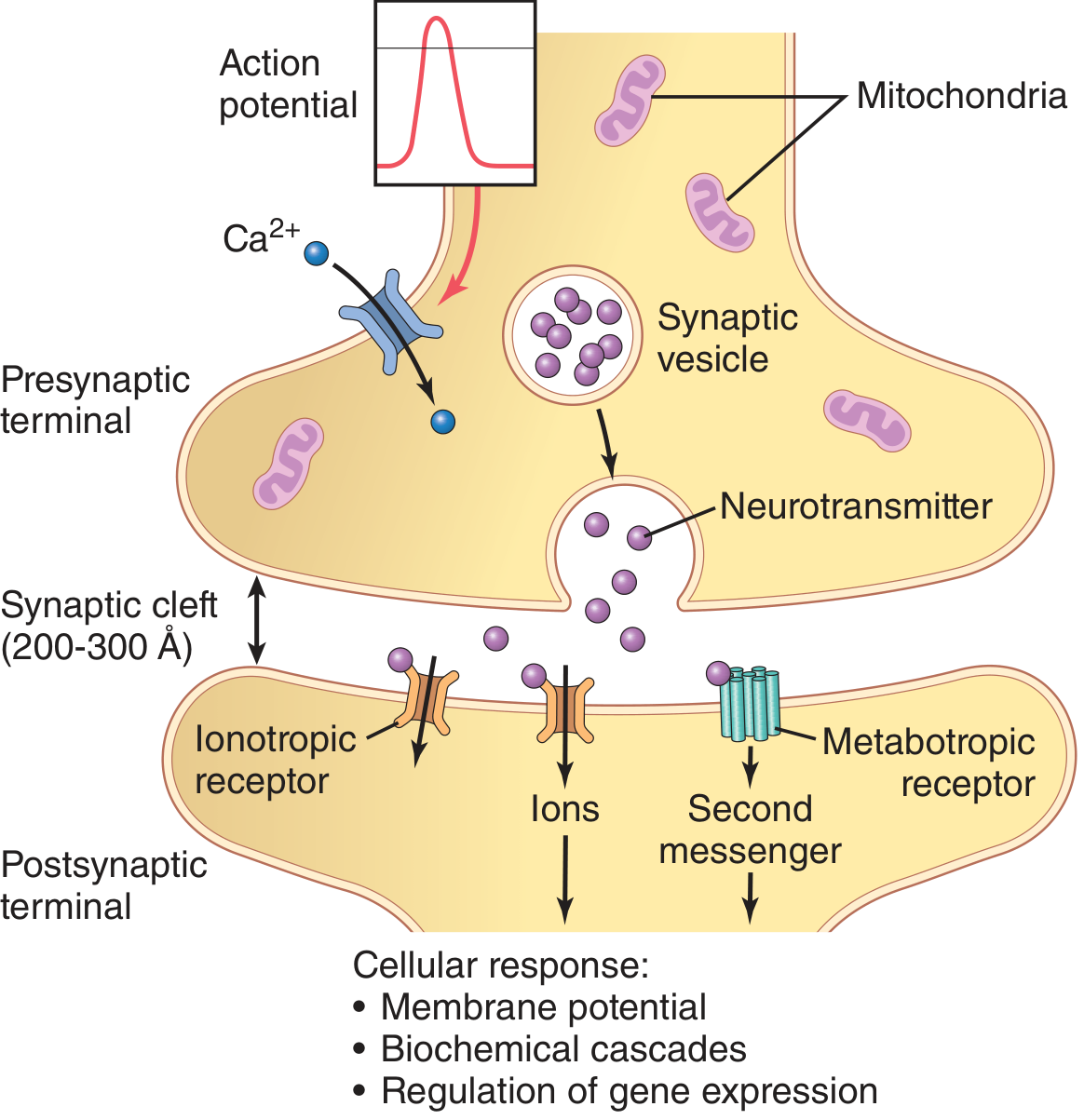
- Most synapses in the mature human CNS are chemical
- Pre- and postsynaptic membranes separated by a synaptic cleft of 200-300 Å (20-50 nm) - about 10 times wider than a gap junction
- The cleft is filled with a fibrous extracellular protein matrix that binds the membranes together
- The presynaptic terminal contains:
- Synaptic vesicles (~50 nm) - store neurotransmitter
- Large dense-core vesicles / secretory granules (~100 nm) - contain soluble proteins
- Mitochondria - provide ATP for neurotransmitter synthesis
- Active zones - the actual sites of neurotransmitter release
- The postsynaptic membrane contains the postsynaptic density (dense accumulation of receptor proteins)
- Transmission is unidirectional (presynaptic → postsynaptic)
- There is a brief synaptic delay compared to electrical synapses
- Signal can be excitatory or inhibitory depending on the neurotransmitter released and the receptor present
How it works:
- An action potential arrives at the presynaptic terminal
- Depolarization opens voltage-gated Ca²⁺ channels
- Ca²⁺ influx triggers vesicle fusion and exocytosis of neurotransmitter
- Neurotransmitter diffuses across the cleft and binds to postsynaptic receptors
- Depending on the receptor type, the postsynaptic cell is either excited or inhibited
Known neurotransmitters (>50 identified): Acetylcholine, glutamate, GABA, glycine, dopamine, serotonin, norepinephrine, epinephrine, histamine, and more.
Postsynaptic receptor types:
| Receptor Type | Mechanism | Speed |
|---|---|---|
| Ionotropic | Ligand-gated ion channels; direct ion flow | Fast |
| Metabotropic | G-protein coupled; activate second messengers | Slow, prolonged |
Classification 2 - By Location (Morphological Types)
Based on which parts of neurons are connected:
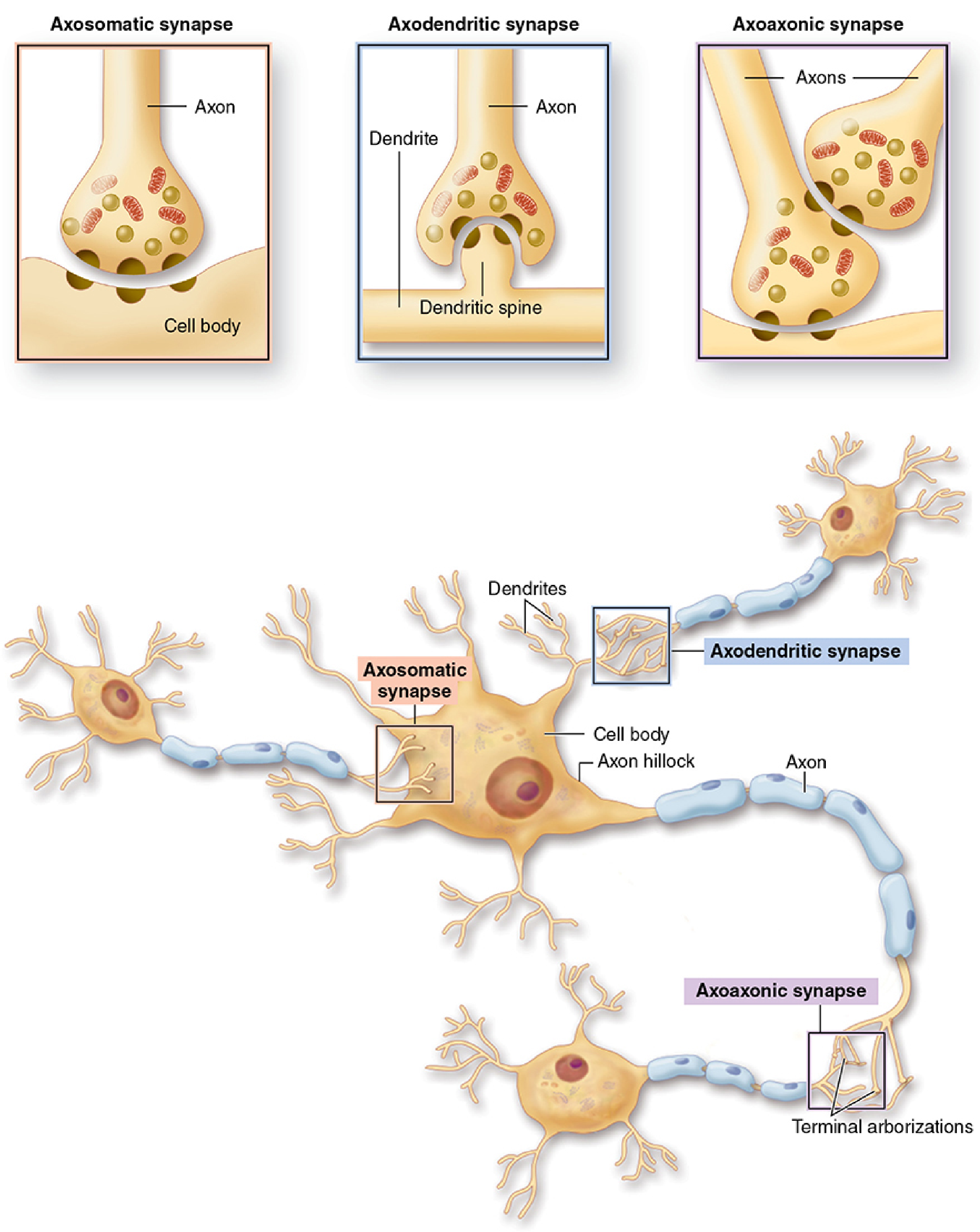
| Type | Connection | Notes |
|---|---|---|
| Axodendritic | Axon terminal → Dendrite | Most common type; some contact dendritic spines (linked to learning and memory) |
| Axosomatic | Axon terminal → Cell body (soma) | Direct influence on the neuron's firing threshold |
| Axoaxonic | Axon terminal → Axon of another neuron | Can enhance or inhibit axodendritic/axosomatic transmission (presynaptic modulation) |
| Dendrodendritic | Dendrite → Dendrite | Less common; allows local signaling between dendrites |
"The contact site and direction of communication determine the way in which a synapse is named: axodendritic, axosomatic, and axoaxonic synapses." - Medical Physiology
A presynaptic axon can make multiple contacts as it travels along a postsynaptic neuron - contacts along the way are called boutons en passant ("buttons in passing"), while the terminal enlarged tip is called a bouton terminal (end bulb).
Classification 3 - By Functional Effect
| Type | Effect | Example Neurotransmitters |
|---|---|---|
| Excitatory synapse | Depolarizes the postsynaptic membrane (EPSP) | Glutamate, acetylcholine |
| Inhibitory synapse | Hyperpolarizes the postsynaptic membrane (IPSP) | GABA, glycine |
A single motor neuron in the spinal cord may receive 10,000 to 200,000 presynaptic terminals on its dendrites and soma - about 80-95% on dendrites and 5-20% on the soma. The net effect (excitation or inhibition) depends on summation of all inputs.
Quick Comparison Summary
| Feature | Electrical Synapse | Chemical Synapse |
|---|---|---|
| Structure | Gap junctions (connexons) | Synaptic cleft + vesicles + receptors |
| Transmission | Ionic current (direct) | Neurotransmitter (indirect) |
| Direction | Bidirectional (usually) | Unidirectional |
| Speed | Immediate | Brief delay |
| Modulation | Limited | Highly modifiable (plasticity) |
| Location | Heart, smooth muscle, brain (less common) | Dominant in CNS and PNS |
Sources: Guyton and Hall Textbook of Medical Physiology; Neuroscience: Exploring the Brain, 5th ed.; Histology - A Text and Atlas (Eroschenko); Junqueira's Basic Histology; Medical Physiology (Boron & Boulpaep)
Synapse and there classification anatomical,physiological,functional,chemical,morphological
Synapses can be classified across multiple frameworks - anatomical (location), physiological (effect), functional (mechanism), chemical (neurotransmitter), and morphological (structural appearance). Let me pull comprehensive textbook content across all five classification systems.
Searching sources...
Finding Sources
Finding Sources
Finding Sources
Finding Sources
Reading File
Reading File
Reading File
Finding Sources
Finding Sources
Finding Sources
Reading File
Finding Sources
Reading File
Loading Image
Reading File
Reading File
Loading Image
Loading Image
Here is a complete, well-organized breakdown of synaptic classification across all five frameworks you asked about, drawn from multiple authoritative textbooks.
Synapse - Complete Classification
A synapse is the specialized junction where a neuron contacts and communicates with another neuron or effector cell (muscle/gland). The presynaptic side initiates transmission; the postsynaptic side receives it.
Classification 1 - ANATOMICAL (by location/site of contact)
Based on which parts of the neurons form the junction:
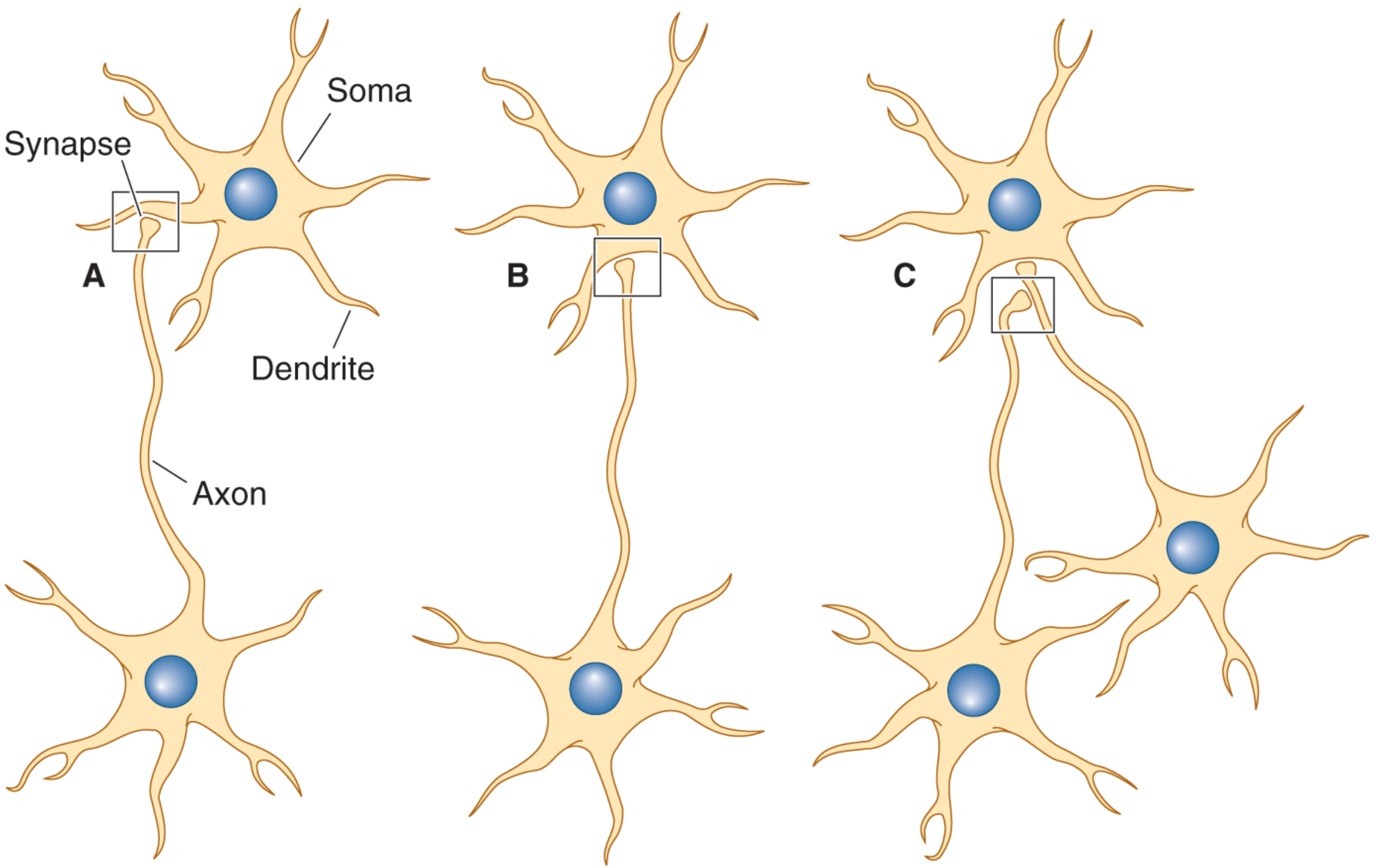
| Type | Connection | Key Features |
|---|---|---|
| Axodendritic | Axon terminal → Dendrite | Most common type in the CNS; many contact dendritic spines (axospinous subtype) - spines are linked to learning and memory |
| Axosomatic | Axon terminal → Cell body (soma) | Directly influences the neuron's firing threshold; about 5-20% of synaptic input to a motor neuron |
| Axoaxonic | Axon terminal → Axon of another neuron | Mediates presynaptic inhibition or facilitation; modulates the amount of transmitter released by the postsynaptic axon |
| Dendrodendritic | Dendrite → Dendrite | Found in specialized neurons (e.g., olfactory bulb); allows local lateral signal processing |
| Somatosomatic | Cell body → Cell body | Rare; found in some CNS regions |
| Somatodendritic | Cell body → Dendrite | Rare; found in the mammalian brain |
"Synapses can form on many parts of a neuron, not just from the axon of one neuron to the dendrite of another neuron as axodendritic synapses." - Stahl's Essential Psychopharmacology
In addition, synapses between a neuron and an effector organ are:
- Neuromuscular junction (NMJ) - motor axon → skeletal muscle (one of the largest synapses in the body)
- Neuroeffector junction - autonomic axon → smooth muscle, cardiac muscle, or glands
Classification 2 - PHYSIOLOGICAL (by effect on postsynaptic membrane)
Based on whether the synapse raises or lowers the probability of firing an action potential:
A. Excitatory Synapse
- Opens Na⁺ channels on the postsynaptic membrane
- Na⁺ influx causes depolarization of the postsynaptic membrane
- Produces an Excitatory Postsynaptic Potential (EPSP)
- EPSP reversal potential ~0 mV (Na⁺ and K⁺ conduct equally through the channel)
- Makes the postsynaptic neuron more likely to fire
- Example neurotransmitters: glutamate, aspartate, acetylcholine
B. Inhibitory Synapse
- Opens Cl⁻ channels (or K⁺ channels) on the postsynaptic membrane
- Cl⁻ influx (or K⁺ efflux) causes hyperpolarization
- Produces an Inhibitory Postsynaptic Potential (IPSP)
- IPSP moves membrane potential toward ~-70 mV (Cl⁻ Nernst potential)
- Makes the postsynaptic neuron less likely to fire
- Example neurotransmitters: GABA, glycine
C. Modulatory Synapse
- Does not directly cause EPSP/IPSP but alters the neuron's response to other inputs
- Works via G-protein coupled receptors (GPCRs) and second messenger cascades
- Example: norepinephrine via β-adrenergic receptors activates cAMP → phosphorylates K⁺ channels → reduces adaptation and increases sustained firing
- Responses last from milliseconds to days
- Example neurotransmitters: norepinephrine, dopamine, serotonin, neuropeptides
"Modulatory transmitters allow the nervous system tremendous potential and flexibility." - Medical Physiology (Boron & Boulpaep)
Classification 3 - FUNCTIONAL (by mechanism of transmission)
Based on how the signal is transmitted across the junction:
| Feature | Electrical Synapse | Chemical Synapse |
|---|---|---|
| Structure | Gap junctions (connexons/connexins) | Synaptic cleft (20-50 nm) + vesicles + receptors |
| Signal carrier | Ionic current (direct) | Neurotransmitter molecules |
| Direction | Bidirectional (usually) | Unidirectional |
| Speed | Instantaneous | Brief synaptic delay |
| Plasticity | Limited | High (basis of learning/memory) |
| Location | Heart, smooth muscle, glia, some CNS neurons | Dominant throughout CNS and PNS |
| Key role | Synchronizes groups of neurons (e.g., hypothalamic hormone pulses) | Targeted, modifiable signal transmission |
Further subdivision of chemical synapses by mechanism of action:
| Sub-type | Receptor | Speed | Mechanism |
|---|---|---|---|
| Ionotropic | Ligand-gated ion channels | Fast (ms) | Transmitter binding directly opens ion channel |
| Metabotropic | G-protein coupled receptors (GPCRs) | Slow (sec-min) | Transmitter activates second messenger cascade |
Classification 4 - CHEMICAL (by neurotransmitter used)
Based on the neurotransmitter released at the synapse:
| Type | Neurotransmitter | Location | Effect |
|---|---|---|---|
| Cholinergic | Acetylcholine (ACh) | All preganglionic ANS fibers, parasympathetic postganglionic, NMJ, some CNS | Excitatory (NMJ, sympathetic ganglia); Inhibitory (heart) |
| Adrenergic | Norepinephrine (NE) | Sympathetic postganglionic fibers, locus coeruleus | Excitatory or inhibitory (receptor-dependent) |
| Dopaminergic | Dopamine (DA) | Substantia nigra → striatum, mesolimbic, mesocortical pathways | Modulation; involved in reward, motor control |
| Serotonergic | Serotonin (5-HT) | Raphe nuclei → widespread CNS | Mood regulation, sleep, appetite |
| GABAergic | GABA | Most widespread inhibitory synapse in CNS | Inhibitory (Cl⁻ influx → hyperpolarization) |
| Glycinergic | Glycine | Spinal cord, brainstem | Inhibitory |
| Glutamatergic | Glutamate | Most widespread excitatory synapse in CNS | Excitatory; NMDA/AMPA/kainate receptors |
| Purinergic | ATP, Adenosine | Widespread | Modulation; pain signaling |
| Peptidergic | Substance P, enkephalins, VIP, etc. | Varies | Modulation; often co-released with classical transmitters |
"All skeletal neuromuscular junctions use acetylcholine. In contrast, neuronal synapses use many transmitters. The most ubiquitous are amino acids: glutamate and aspartate excite, whereas GABA and glycine inhibit." - Medical Physiology
Classification 5 - MORPHOLOGICAL (by ultrastructural appearance under electron microscopy)
Described by E.G. Gray (1959) based on electron microscopic appearance:
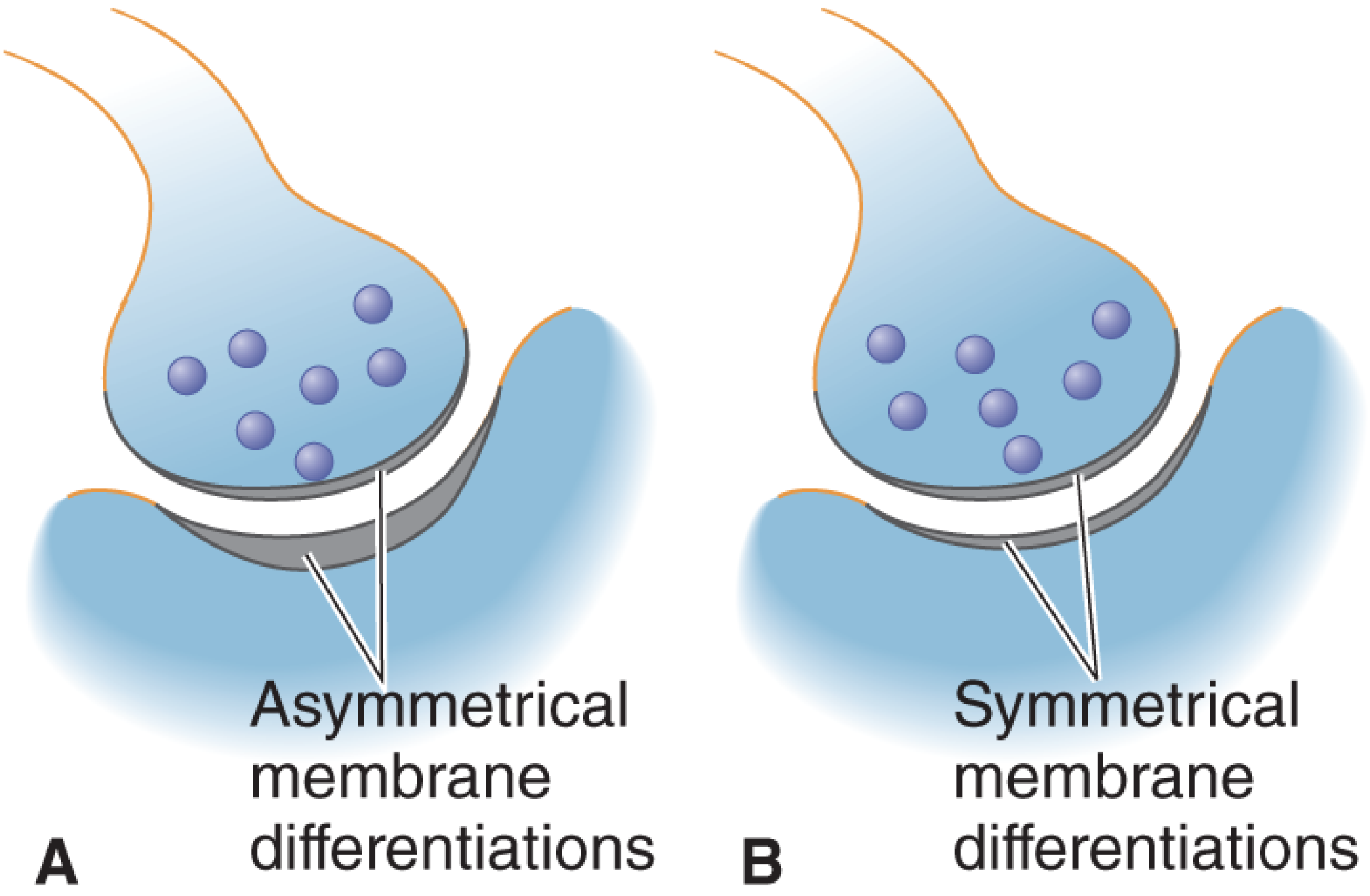
| Feature | Gray's Type I (Asymmetric) | Gray's Type II (Symmetric) |
|---|---|---|
| Postsynaptic density | Thicker than presynaptic | Equal thickness on both sides |
| Membrane differentiations | Asymmetrical | Symmetrical |
| Synaptic cleft width | Wider (~30 nm) | Narrower (~20 nm) |
| Vesicle shape | Round (spherical) | Flat or pleomorphic (oval/flattened) |
| Functional correlation | Usually excitatory | Usually inhibitory |
| Location | Often axodendritic / axospinous | Often axosomatic |
| Typical transmitter | Glutamate | GABA, glycine |
Additional morphological notes:
- Bouton terminal (end bulb) - the enlarged presynaptic terminal at the axon's endpoint
- Bouton en passant - synaptic contacts made along the course of an axon (not just at the end)
- Synapses are not visible in routine H&E staining; silver staining (Golgi method) is needed to visualize them under light microscopy
Summary Table - All 5 Classifications
| Classification | Basis | Main Subtypes |
|---|---|---|
| Anatomical | Location/site of contact | Axodendritic, Axosomatic, Axoaxonic, Dendrodendritic, NMJ |
| Physiological | Effect on postsynaptic potential | Excitatory (EPSP), Inhibitory (IPSP), Modulatory |
| Functional | Mechanism of transmission | Electrical (gap junctions), Chemical (ionotropic/metabotropic) |
| Chemical | Neurotransmitter used | Cholinergic, Adrenergic, GABAergic, Glutamatergic, Dopaminergic, Serotonergic, Glycinergic, Peptidergic |
| Morphological | Ultrastructural EM appearance | Gray's Type I (asymmetric/excitatory), Gray's Type II (symmetric/inhibitory) |
Sources: Guyton and Hall Textbook of Medical Physiology; Neuroscience: Exploring the Brain, 5th ed.; Medical Physiology (Boron & Boulpaep); Junqueira's Basic Histology, 17e; Histology - A Text and Atlas (Eroschenko); Stahl's Essential Psychopharmacology
This is a shared conversation. Sign in to Orris to start your own chat.