
Hashimoto thyroiditis
Reading File
Now I'll search the medical library and PubMed simultaneously for comprehensive coverage.
Finding Sources
Searching PubMed
"Hashimoto thyroiditis"[MeSH Terms] AND management
Good results. Now I'll read the most comprehensive sources in parallel - Robbins Pathology (pathology basis), Current Surgical Therapy (clinical management), and also search for images/histology.
Reading File
Reading File
Finding Sources
Excellent content. Let me now read Harrison's (current clinical management) and get the rest of the surgical therapy section, plus fetch key images in parallel.
Reading File
Reading File
Loading Image
I now have comprehensive content from multiple textbooks. Let me fetch the histology image and the goiter image, and get the Harrison's clinical features/diagnosis/treatment section.
Loading Image
Finding Sources
Searching PubMed
"Hashimoto thyroiditis"[MeSH Terms] AND "thyroid peroxidase antibodies"
I have excellent content from multiple authoritative sources. Let me now compile the comprehensive answer.
Hashimoto Thyroiditis
Hashimoto thyroiditis (chronic autoimmune/lymphocytic thyroiditis) is the most common cause of hypothyroidism in iodine-sufficient regions and the most prevalent autoimmune disease in the United States. It was first described by Hakaru Hashimoto in 1912.
Epidemiology
-
Prevalence of hypothyroidism in iodine-replete populations: 1-2%; Hashimoto accounts for ~85% of those cases
-
Mean annual incidence: up to 4 per 1000 women, 1 per 1000 men
-
Female:male ratio = 10:1 to 20:1
-
Peak presentation: 30-65 years of age (mean diagnosis age ~60 years)
-
Subclinical hypothyroidism found in 6-8% of women (10% over age 60) and 3% of men
-
Annual risk of progressing to overt hypothyroidism is ~4% when subclinical hypothyroidism is combined with positive TPO antibodies
-
Robbins & Kumar Basic Pathology, p. 731; Harrison's Principles of Internal Medicine 22E, p. 3072
Types
- Goitrous (classic) form - diffuse thyroid enlargement
- Atrophic form - minimal residual thyroid tissue, represents the end stage with extensive fibrosis
- Fibrosing variant - marked fibrosis with IgG4-positive plasma cell infiltration; can mimic Riedel thyroiditis
- Hashitoxicosis - transient thyrotoxicosis from follicular disruption at disease onset
- Current Surgical Therapy 14e, p. 885
Pathogenesis
The disease results from a breakdown of immune self-tolerance to thyroid autoantigens, leading to progressive autoimmune destruction of thyrocytes:
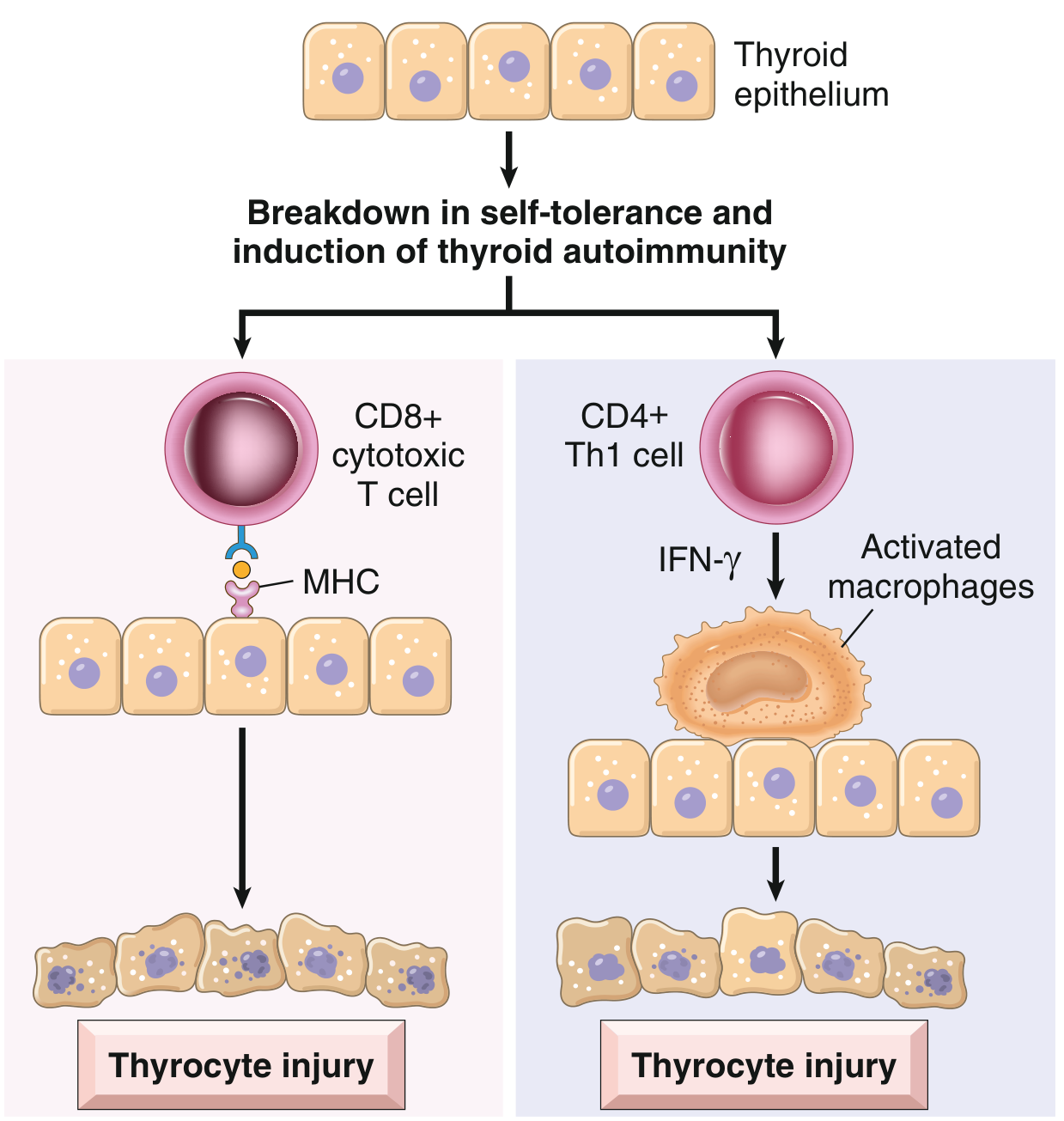
Three major immune mechanisms operate:
- CD8+ cytotoxic T cells - directly kill thyroid epithelial cells via MHC class I recognition
- CD4+ Th1 cytokines - secretion of IFN-γ recruits and activates macrophages, which destroy follicles; TNF-α and IL-1 are also implicated
- Autoantibodies - anti-TPO (antimicrosomal) and antithyroglobulin antibodies are present in nearly all patients and may cause damage via antibody-dependent cell-mediated cytotoxicity (ADCC) or complement activation; though whether these are cause or consequence of injury remains debated
Genetic factors:
- ~40% concordance in monozygotic twins
- ~50% of asymptomatic siblings have antithyroid antibodies
- HLA-DR3, DR4, DR5 (Caucasians) are the strongest genetic risk factors
- Polymorphisms in CTLA-4 (T-cell inhibitor) and PTPN22 increase susceptibility
- Associated with Down syndrome (chromosome 21 gene) and Turner syndrome
- Shared genetic risk with type 1 DM, Addison's disease, pernicious anemia, vitiligo
Environmental factors: High iodine intake, low selenium, reduced childhood microbial exposure, and smoking cessation transiently increase risk. Alcohol use appears protective.
- Robbins & Kumar Basic Pathology, p. 731-732; Harrison's 22E, p. 3072-3073
Morphology / Histology
Gross: Thyroid is usually diffusely and symmetrically enlarged, firm. In atrophic thyroiditis, the gland is small and scarred.
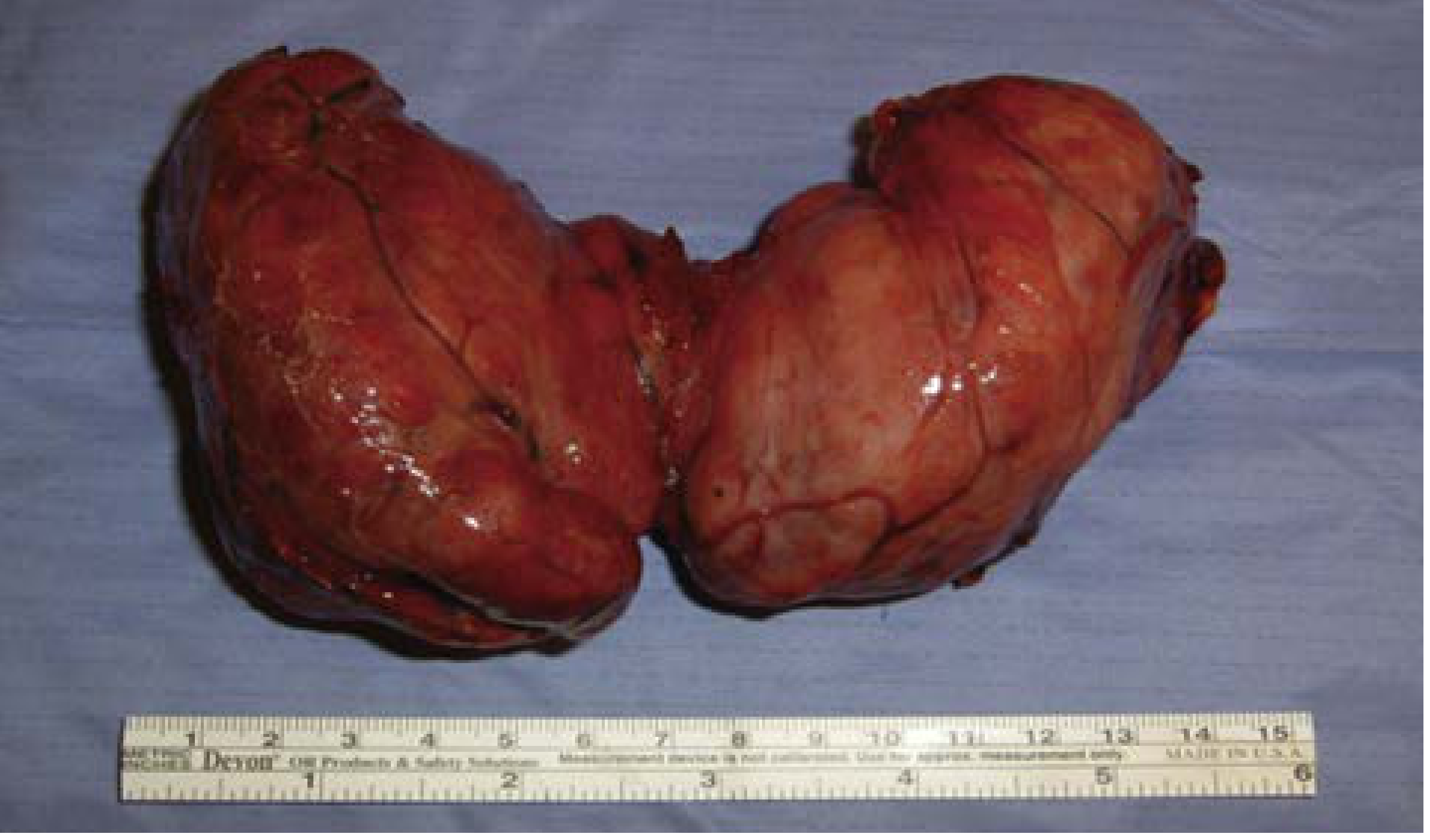
Microscopic (key features):
-
Widespread lymphocytic infiltrate with lymphocytes, plasma cells, macrophages
-
Well-developed germinal centers (lymphoid follicle formation)
-
Atrophic thyroid follicles with scant colloid
-
Hürthle (oxyphil) cell metaplasia - follicular epithelium replaced by cells with abundant eosinophilic granular cytoplasm packed with mitochondria (a metaplastic response to injury)
-
Increased interstitial fibrosis
-
Robbins & Kumar Basic Pathology, p. 732; Harrison's 22E, p. 3072
Clinical Features
Presentation:
- Painless, diffuse, firm thyroid enlargement (goiter) - most common presentation
- Symptoms of hypothyroidism (weight gain, fatigue, cold intolerance, constipation, dry skin, bradycardia, delayed reflexes)
- Less commonly, transient thyrotoxicosis (Hashitoxicosis) at disease onset due to follicular disruption releasing preformed hormone
- Globus sensation, profound fatigue, muscle/joint pain, poor sleep, dry mouth/eyes - these may persist even with adequate thyroid hormone replacement (thought to be autoimmune-related)
- Compressive symptoms in large goiters: dyspnea, dysphagia, cough, hoarseness
Thyroid status progression:
- Euthyroid phase (compensation: TSH rises, T4 normal = subclinical hypothyroidism)
- Overt hypothyroidism (TSH typically >10 mIU/L, free T4 falls)
- Atrophic end stage
Associated conditions: Graves' disease (can coexist or evolve), other autoimmune diseases (DM type 1, Addison's, pernicious anemia, vitiligo), Down syndrome, Turner syndrome
Malignancy risk:
-
Higher incidence of thyroid lymphoma (primary thyroid lymphoma almost always arises in a background of Hashimoto thyroiditis)
-
Increased incidence of papillary thyroid carcinoma (disputed; may cause false-positive FNAB results)
-
Current Surgical Therapy 14e, p. 885-886; Harrison's 22E, p. 3072
Diagnosis
| Test | Finding |
|---|---|
| TSH | Elevated (subclinical or overt hypothyroidism) |
| Free T4 | Low (in overt hypothyroidism); normal (subclinical) |
| Anti-TPO antibodies | Elevated in nearly all patients (most sensitive) |
| Antithyroglobulin antibodies | Elevated in many patients |
| Ultrasound | Diffusely heterogeneous, hypoechoic gland; may show nodules |
| FNAB | Indicated for nodules; shows follicular cells, colloid, lymphocytes, Hürthle cells (Bethesda II = benign) |
-
Positive TPO antibodies + elevated TSH usually clinch the diagnosis without biopsy
-
FNAB findings: Bethesda III (AUS), IV (Hürthle cell neoplasm), or V (suspicious for PTC) may occur due to Hürthle cell changes causing false-positive results
-
Schwartz's Principles of Surgery 11e; Current Surgical Therapy 14e
Treatment
Medical
- Euthyroid, asymptomatic patients: no treatment required; monitor TSH
- Hypothyroidism: levothyroxine (LT4) replacement
- Starting dose: 1.6 mcg/kg/day (weight-based)
- Titrate to normalize TSH
- Subclinical hypothyroidism: treat if TSH >10 mIU/L, or if symptomatic, pregnant, or TPO antibody-positive with progressive rise in TSH
- Hashitoxicosis: beta-blockers for symptom control; antithyroid drugs generally not needed (transient)
- Persistent symptoms despite adequate LT4 replacement (fatigue, pain, cognitive symptoms) do not routinely improve with additional thyroid hormone; thought to be autoimmune-mediated
Surgical
Surgery is rarely necessary but indicated for:
- Thyroid nodule with indeterminate or malignant FNAB (Bethesda III-VI)
- Unilateral or bilateral thyromegaly with mass effect/compressive symptoms (tracheal compression, dysphagia, hoarseness)
- Persistent symptoms despite adequate thyroid hormone replacement (emerging evidence)
Procedure choice:
- Disease limited to one lobe: lobectomy + isthmusectomy
- Most patients: total thyroidectomy
Evidence for surgery in persistent symptoms: The Norwegian Trial on Surgery for Hashimoto Disease (prospective RCT) showed total thyroidectomy vs. hormone therapy alone improved health-related quality of life, fatigue scores, and normalized anti-TPO titers in histologically verified Hashimoto patients.
Surgical note: The firm, inflamed gland can be difficult to retract; traction on the recurrent laryngeal nerve (RLN) is a risk. Intraoperative nerve monitoring is recommended. Enlarged reactive central neck lymph nodes can mimic thyroid cancer - frozen section can differentiate.
- Current Surgical Therapy 14e, p. 886; Harrison's 22E
Hashimoto Variants & Related Conditions
| Condition | Relationship |
|---|---|
| Atrophic thyroiditis | End stage of Hashimoto; extensive fibrosis, near-total follicle loss |
| Painless (silent) thyroiditis | Variant of Hashimoto; autoimmune follicular destruction causing transient hyperthyroidism |
| Postpartum thyroiditis | Specific type of painless thyroiditis; occurs within 1 year of delivery/abortion; up to 10% of pregnancies |
| Fibrosing variant | Rare; marked IgG4+ plasma cell infiltrate; mimics Riedel thyroiditis |
| Hashitoxicosis | Transient thyrotoxicosis from Hashimoto follicular rupture |
Key Associations & Complications
- Primary thyroid lymphoma (MALT type) - nearly always in Hashimoto background; suspect with rapid gland enlargement
- Papillary thyroid carcinoma - possible increased risk (TSH-driven); Hashimoto can cause false-positive FNAB
- Hashimoto encephalopathy - rare steroid-responsive encephalopathy with high antithyroid antibodies, often euthyroid
- Polyglandular autoimmune syndromes (Type 2 includes Hashimoto + Addison's + T1DM)
- Increased prevalence in iodine-replete populations; iodine excess can accelerate thyroid autoimmunity
Sources: Robbins & Kumar Basic Pathology (p. 731-732), Harrison's Principles of Internal Medicine 22E (p. 3072-3074), Current Surgical Therapy 14e (p. 885-886), Schwartz's Principles of Surgery 11e
This is a shared conversation. Sign in to Orris to start your own chat.