
Peep for md anaesthesia exam . With possible meet Ss critical care questions .
Reading File
PEEP (Positive End-Expiratory Pressure) is a core topic for MD Anaesthesia and Critical Care exams. Let me pull detailed content from the medical library now.
Searching sources...
Finding Sources
Finding Sources
Searching the Web
PEEP MD anaesthesia critical care exam questions important topics 2024
Good - I have file paths. Now let me read the PEEP sections from Miller's Anesthesia and Morgan & Mikhail in parallel, and also search for related critical care topics (ARDS, lung protective ventilation, auto-PEEP, optimal PEEP).
Reading File
Reading File
Finding Sources
Finding Sources
Excellent content found. Let me now read more from Morgan & Mikhail (the PEEP effects section), Harrison's optimal PEEP/ARDS section, and Barash on auto-PEEP - all in parallel.
Reading File
Reading File
Reading File
Finding Sources
Excellent - rich content. Let me now read the continuation from Morgan & Mikhail (hemodynamic/cardiovascular effects of PEEP) and from Harrison's (ARDS ventilation strategy), plus search for PEEP indications and complications.
Reading File
Reading File
Finding Sources
Finding Sources
Finding Sources
Reading File
Finding Sources
I have enough rich content from authoritative textbooks. Let me now compile the comprehensive exam-oriented answer.
PEEP - Complete MD Anaesthesia & Critical Care Exam Guide
1. DEFINITION
Positive End-Expiratory Pressure (PEEP) = application of positive pressure during the expiratory phase of a mechanically delivered breath.
- The ventilator's PEEP valve creates a pressure threshold that allows expiratory flow only when airway pressure exceeds the set PEEP level.
- CPAP = positive pressure applied during both inspiration and expiration in a spontaneously breathing patient. PEEP and CPAP are often used interchangeably in clinical practice.
- Morgan & Mikhail's Clinical Anesthesiology, 7e
2. TYPES OF PEEP
| Type | Description |
|---|---|
| Extrinsic / Applied PEEP | Set on the ventilator deliberately |
| Intrinsic PEEP (auto-PEEP / iPEEP) | Dynamic hyperinflation from incomplete exhalation - gas trapped before next breath begins |
| Best PEEP / Optimal PEEP | The PEEP level that maximises oxygenation / compliance with minimal haemodynamic compromise |
| Physiological PEEP | ~3-5 cmH2O - the glottis provides natural PEEP during spontaneous breathing |
3. MECHANISM OF ACTION / PHYSIOLOGICAL BASIS
Primary effect: increases FRC (Functional Residual Capacity)
In patients with decreased lung volume, PEEP:
- Increases FRC above closing capacity
- Keeps tidal ventilation above airway closing capacity
- Recruits (re-expands) collapsed alveoli - occurs above the Lower Inflection Point (LIP) of the pressure-volume curve
- Improves lung compliance
- Corrects V/Q mismatch - reduces intrapulmonary shunting → improves PaO2
Redistribution of lung water: PEEP does NOT reduce total extravascular lung water, but redistributes it from the alveolar-endothelial space to peribronchial/perihilar areas - this can also improve oxygenation.
- Morgan & Mikhail's Clinical Anesthesiology, 7e
4. PULMONARY EFFECTS
| Effect | Mechanism |
|---|---|
| ↑ FRC | Keeps alveoli open at end-expiration |
| ↑ Lung compliance | On the optimal part of P-V curve |
| ↓ Intrapulmonary shunt | Alveolar recruitment |
| ↑ PaO2 / SpO2 | Improved V/Q matching |
| Redistributes lung water | Peribronchial redistribution |
| ↓ Atelectotrauma | Prevents repeated open-close cycles |
5. CARDIOVASCULAR EFFECTS ⚠️ (High-yield exam topic)
PEEP increases intrathoracic pressure (ITP), which has multiple cardiovascular consequences:
| Effect | Mechanism |
|---|---|
| ↓ Venous return | ↑ ITP compresses great veins → ↓ RV preload |
| ↓ Cardiac output | ↓ preload, ↑ RV afterload (compresses pulmonary vasculature) |
| ↓ Blood pressure | Especially in hypovolaemic patients |
| ↑ CVP / PCWP readings | Artificially elevated - correct by subtracting ~half the PEEP |
| RV strain | High PEEP → ↑ PVR → RV dilation and shift of IVS → ↓ LV filling |
Clinical pearl: The haemodynamic effects of PEEP are AMPLIFIED in:
- Hypovolaemia
- Obstructive shock
- Poor cardiac reserve
- High-compliance lungs (emphysema)
- Barash's Clinical Anesthesia, 9e; Miller's Anesthesia, 10e
6. AUTO-PEEP (Intrinsic PEEP) - Critical Care High-Yield
Definition: Positive alveolar pressure remaining at end-expiration due to dynamic hyperinflation (incomplete exhalation before the next breath begins).
Who gets it?
- COPD / emphysema (↓ elastic recoil)
- Severe asthma (expiratory flow obstruction)
- OLV (One-lung ventilation) patients - average 4-6 cmH2O in lung cancer patients with COPD
- Elderly patients (↓ recoil)
- High I:E ratio (insufficient expiratory time)
How to detect:
- Expiratory pause manoeuvre - hold expiration with both valves closed; airway pressure rises to equal alveolar pressure = auto-PEEP value
- Flow-time waveform - expiratory flow fails to return to zero before the next breath
Consequences:
- Haemodynamic compromise (↓ CO, hypotension)
- Alveolar overdistension → barotrauma
- ↑ Work of breathing (patient must overcome intrinsic PEEP to trigger the ventilator)
- Ventilator dyssynchrony
Management of auto-PEEP:
- ↓ Respiratory rate - more time for exhalation
- ↓ Tidal volume
- ↓ I:E ratio (increase inspiratory flow rate to shorten Ti)
- Bronchodilators (asthma/COPD)
- Apply extrinsic PEEP = 75-85% of auto-PEEP (reduces trigger work without worsening hyperinflation)
- Permissive hypercapnia if needed
- Barash's Clinical Anesthesia, 9e; Miller's Anesthesia, 10e
7. OPTIMAL / BEST PEEP - How to Titrate
The goal: find the PEEP that maximises alveolar recruitment without causing overdistension or haemodynamic compromise.
Methods of titration:
| Method | Description |
|---|---|
| Compliance method (Best PEEP) | Incrementally increase PEEP; plot static compliance vs. PEEP; PEEP at maximum compliance = "best PEEP" |
| Driving pressure method | PEEP that minimises (Pplateau - PEEP) = driving pressure |
| P-V curve / Inflection point | Set PEEP 2 cmH2O above the Lower Inflection Point (LIP) on the pressure-volume curve |
| ARDSNet table | Low PEEP/High FiO2 OR High PEEP/Low FiO2 table (see below) |
| Oesophageal pressure | Transpulmonary pressure monitoring to guide PEEP |
| Electrical Impedance Tomography | Real-time regional ventilation distribution |
| PEEP trials | Decremental PEEP trial from high to low after recruitment manoeuvre |
P-V curve concept (Harrison's, 22e):
- Optimal tidal breathing occurs on the most compliant portion of the P-V curve
- PEEP prevents end-expiratory alveolar collapse (point A on curve)
- Plateau pressure must stay <30 cmH2O to avoid overdistension (point D)
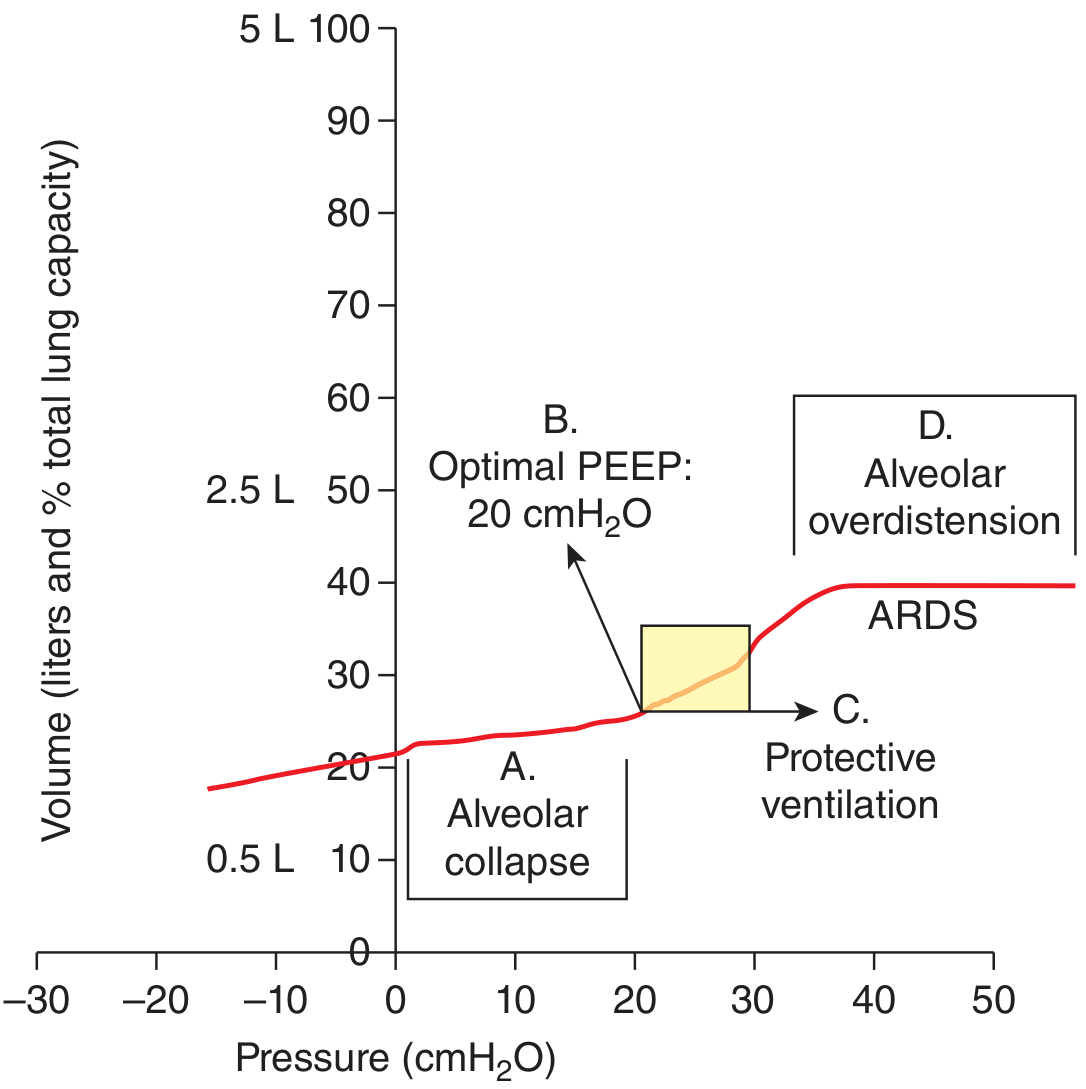
P-V curve showing optimal PEEP zone in ARDS - Harrison's Principles, 22e
8. INDICATIONS FOR PEEP
| Indication | Notes |
|---|---|
| ARDS / ALI | Mainstay - opens recruitable lung |
| Cardiogenic pulmonary oedema | ↓ preload and afterload + recruits alveoli |
| Post-operative atelectasis | Prevents/treats |
| OSA / Obesity hypoventilation | Stents upper airway, prevents collapse |
| Prevention of atelectasis | Intraoperatively in obese/Trendelenburg |
| Neonatal RDS | Surfactant deficiency - PEEP maintains alveolar patency |
Minimum PEEP in all ventilated patients: 5 cmH2O (ARDSNet protocol recommends ≥5 cmH2O minimum)
9. ARDS AND PEEP - The ARDSNet Protocol (Exam Classic)
Lung-protective ventilation strategy (ARMA trial / ARDSNet):
| Parameter | Target |
|---|---|
| Tidal Volume | 6 mL/kg ideal body weight |
| Plateau pressure | < 30 cmH2O |
| PEEP | Minimum 5 cmH2O, titrated by table |
| FiO2 target | SpO2 88-95% |
| pH | 7.30-7.45 (permissive hypercapnia allowed) |
ARDSNet PEEP/FiO2 Tables:
- Low PEEP / High FiO2 table: PEEP 5→18 with FiO2 titrated upward
- High PEEP / Low FiO2 table: PEEP 5→24 (higher values for more severe ARDS)
Berlin Definition of ARDS (2012):
| Severity | P/F Ratio | PEEP minimum |
|---|---|---|
| Mild | 200-300 | ≥5 cmH2O |
| Moderate | 100-200 | ≥5 cmH2O |
| Severe | <100 | ≥5 cmH2O |
- Harrison's Principles of Internal Medicine, 22e; Murray & Nadel's Respiratory Medicine
10. CONTRAINDICATIONS / CAUTION WITH PEEP
| Situation | Reason |
|---|---|
| Undrained pneumothorax | Absolute - can cause tension pneumothorax |
| Severe hypovolaemia | ↓↓ CO and BP |
| Raised ICP | ↑ ITP → ↑ CVP → impairs cerebral venous drainage |
| Obstructive shock (PE, cardiac tamponade) | Worsens RV afterload |
| Unilateral lung disease | PEEP preferentially over-distends normal lung |
| Post-pneumonectomy | Risk of bronchopleural fistula |
| Air trapping / severe asthma | Can worsen auto-PEEP |
11. COMPLICATIONS OF HIGH PEEP
- Haemodynamic compromise - ↓ CO, hypotension
- Barotrauma - pneumothorax, pneumomediastinum, subcutaneous emphysema
- Volutrauma - overdistension injury even without pressure rise
- Atelectotrauma - cyclic opening/closing (if PEEP too low)
- Biotrauma - inflammatory mediator release → MSOF
- ↑ Dead space - overdistended alveoli have no perfusion → V/Q >1
- Hepatic/renal impairment - ↓ CO, ↑ venous pressure
- Falsely elevated PCWP/CVP readings
- Water retention - ↓ ANP, ↑ ADH (from ↓ CO)
12. PEEP IN SPECIFIC SCENARIOS (Critical Care Vivas)
PEEP in One-Lung Ventilation (OLV)
- Dependent lung FRC falls during OLV (lateral position, paralysis, mediastinal weight)
- Apply PEEP to dependent (ventilated) lung to restore FRC
- Caution: if auto-PEEP already present (COPD), adding external PEEP may worsen air trapping
- Low auto-PEEP (<2 cmH2O): external PEEP of 5 cmH2O will significantly ↑ total PEEP
- High auto-PEEP (>10 cmH2O): external PEEP has smaller net effect
- Titrate PEEP to minimise driving pressure (Pplateau - PEEP)
- Miller's Anesthesia, 10e
PEEP in Asthma/COPD (ICU)
- High risk of auto-PEEP
- Strategy: ↓ RR, ↓ TV, ↑ expiratory time, permissive hypercapnia
- Apply external PEEP = 75-85% of measured auto-PEEP to ↓ trigger work
- Do NOT apply high PEEP blindly
PEEP in Cardiogenic Pulmonary Oedema (CPE)
- CPAP/PEEP reduces preload (↓ venous return) and LV afterload (↑ intrathoracic pressure reduces transmural pressure)
- CPAP 5-10 cmH2O is first-line NIV in CPE
- Reduces intubation rate and mortality
PEEP and ICP
- PEEP >10 cmH2O can impair cerebral venous drainage → ↑ ICP
- In TBI: use minimum necessary PEEP
- If PEEP needed for oxygenation: maintain CPP by ensuring adequate MAP
13. PEEP vs. CPAP - Key Distinction
| Feature | PEEP | CPAP |
|---|---|---|
| Breathing | Mandatory / assisted breaths | Spontaneous breathing |
| Inspiration | Positive pressure applied | Positive pressure maintained |
| Application | Ventilated patients | Spontaneously breathing patients |
| Airway | Usually ETT/tracheostomy | Mask, nasal cannula, or ETT |
| Example use | ARDS on MV | OSA, CPE, post-extubation |
14. VENTILATION MODES WITH PEEP (for context)
| Mode | PEEP role |
|---|---|
| AC-VC (Assist Control Volume Control) | Clinician sets PEEP + VT + RR |
| AC-PC (Pressure Control) | Clinician sets PEEP + driving pressure |
| PRVC | Set VT + PEEP; ventilator adjusts pressure |
| PSV | Clinician sets PEEP + max inspiratory pressure; patient controls rest |
| SIMV | PEEP set; mix of mandatory + spontaneous breaths |
- Harrison's Principles, 22e
15. EXAMINATION BUZZWORDS - QUICK RECALL
| Term | Definition |
|---|---|
| LIP (Lower Inflection Point) | Pressure at which alveoli start recruiting on P-V curve |
| UIP (Upper Inflection Point) | Pressure at which alveolar overdistension begins |
| Driving Pressure | Pplateau - PEEP (target <15 cmH2O in ARDS) |
| Plateau Pressure | Airway pressure during inspiratory hold (reflects alveolar pressure) |
| Peak Airway Pressure | = resistance + compliance + PEEP |
| VILI | Ventilator-Induced Lung Injury (barotrauma + volutrauma + atelectotrauma + biotrauma) |
| Open Lung Strategy | Recruitment + optimal PEEP to keep alveoli open throughout cycle |
| Permissive Hypercapnia | Accepting ↑ PaCO2 to avoid overdistension; pH ≥7.2 acceptable |
16. POSSIBLE EXAM QUESTIONS - MD Anaesthesia / Critical Care
Short Answer / Essay:
- What is PEEP? Describe its physiological effects on the respiratory and cardiovascular systems.
- Define auto-PEEP. How is it detected and managed in a ventilated asthmatic?
- What is "best PEEP"? How do you determine it clinically?
- Describe lung-protective ventilation in ARDS. What role does PEEP play?
- What are the cardiovascular effects of PEEP? How do you manage PEEP-related hypotension?
- Compare and contrast PEEP vs. CPAP.
- Discuss the use of PEEP in one-lung ventilation.
- What are the complications of inappropriately high PEEP?
Viva triggers:
- "Patient on 15 cmH2O PEEP for ARDS becomes hypotensive - what do you do?"
- "How do you detect auto-PEEP at the bedside?"
- "Patient has severe asthma on ventilator - how do you set PEEP?"
- "Define driving pressure and its significance in ARDS"
Sources: Morgan & Mikhail's Clinical Anesthesiology 7e | Miller's Anesthesia 10e | Barash's Clinical Anesthesia 9e | Harrison's Principles of Internal Medicine 22e | Murray & Nadel's Respiratory Medicine
Peep for md anaesthesia exam . With possible meet Ss critical care questions
I already covered this comprehensively in my previous response above. Here is the complete structured answer repeated for your reference - optimised for MD Anaesthesia and Critical Care viva/written exams.
PEEP - Complete MD Anaesthesia & Critical Care Exam Guide
1. DEFINITION
Positive End-Expiratory Pressure (PEEP) = maintenance of airway pressure above atmospheric at the end of expiration during mechanical ventilation.
- The ventilator's PEEP valve allows expiratory flow only when airway pressure exceeds the set PEEP level.
- CPAP = same positive pressure applied during both phases in a spontaneously breathing patient.
2. TYPES OF PEEP
| Type | Description |
|---|---|
| Extrinsic / Applied PEEP | Set deliberately on the ventilator |
| Intrinsic PEEP (auto-PEEP, iPEEP) | Dynamic hyperinflation - gas trapped due to incomplete exhalation |
| Best / Optimal PEEP | PEEP that maximises compliance and oxygenation with minimal haemodynamic compromise |
| Physiological PEEP | ~3-5 cmH2O - provided naturally by the glottis during spontaneous breathing |
3. MECHANISM / PHYSIOLOGICAL BASIS
Primary effect: raises FRC (Functional Residual Capacity)
- Keeps tidal ventilation above closing capacity
- Recruits collapsed alveoli - occurs above the Lower Inflection Point (LIP) on the P-V curve
- Improves lung compliance
- Corrects V/Q mismatch → reduces intrapulmonary shunt → ↑ PaO2
- Redistributes extravascular lung water from alveolar-endothelial interface to peribronchial/perihilar areas
Does NOT reduce total lung water - only redistributes it.
4. PULMONARY EFFECTS
| Effect | Mechanism |
|---|---|
| ↑ FRC | Alveoli held open at end-expiration |
| ↑ Compliance | Lung operating on steep part of P-V curve |
| ↓ Intrapulmonary shunt | Alveolar recruitment |
| ↑ PaO2 / SpO2 | Better V/Q matching |
| ↓ Atelectotrauma | Prevents cyclic collapse-reopening |
| Redistributes lung water | Peribronchial redistribution |
5. CARDIOVASCULAR EFFECTS (High-yield)
PEEP raises intrathoracic pressure (ITP) which affects the heart and vessels:
| Effect | Mechanism |
|---|---|
| ↓ Venous return | ↑ ITP compresses great veins → ↓ RV preload |
| ↓ Cardiac output | ↓ preload + ↑ RV afterload (compressed pulmonary vasculature) |
| ↓ Blood pressure | Especially in hypovolaemia |
| ↑ CVP / PCWP (factitious) | Readings falsely elevated - subtract ~half the PEEP |
| RV strain / dilation | ↑ PVR → RV overload → IVS shift → ↓ LV filling |
Amplified in: hypovolaemia, obstructive shock, poor cardiac reserve, high-compliance lungs (emphysema).
6. AUTO-PEEP (Intrinsic PEEP) - Critical Care Favourite
Definition: Residual positive alveolar pressure at end-expiration due to incomplete exhalation and dynamic hyperinflation.
Causes:
- COPD / emphysema (↓ elastic recoil)
- Severe asthma (expiratory flow obstruction)
- High RR / high I:E ratio (insufficient expiratory time)
- One-lung ventilation in COPD patients (average 4-6 cmH2O)
- Elderly patients
Detection:
- Expiratory hold / pause manoeuvre - close both valves at end expiration; pressure equilibrates to alveolar pressure = auto-PEEP
- Flow-time curve - expiratory flow fails to return to zero before next breath
Consequences:
- Haemodynamic compromise (↓ CO, hypotension)
- Alveolar overdistension → barotrauma
- ↑ Work of breathing (patient must overcome iPEEP to trigger ventilator)
- Ventilator dyssynchrony
- Inaccurate PEEP titration if unrecognised
Management:
- ↓ Respiratory rate
- ↓ Tidal volume
- ↑ Inspiratory flow rate (shortens Ti, lengthens Te)
- Bronchodilators (COPD/asthma)
- Apply external PEEP = 75-85% of measured auto-PEEP (reduces trigger work without worsening hyperinflation)
- Permissive hypercapnia if needed
7. OPTIMAL / BEST PEEP - Titration Methods
Goal: maximise alveolar recruitment without overdistension or haemodynamic compromise.
| Method | Principle |
|---|---|
| Static compliance method | Incrementally ↑ PEEP; plot Cst vs PEEP; maximum compliance = best PEEP |
| Driving pressure method | PEEP that minimises (Pplateau - PEEP); target driving pressure <15 cmH2O |
| P-V curve / LIP method | Set PEEP 2 cmH2O above Lower Inflection Point |
| ARDSNet table | Low PEEP/High FiO2 OR High PEEP/Low FiO2 table |
| Oesophageal pressure | Transpulmonary pressure monitoring (Ptp = Palv - Ppleural) |
| Decremental PEEP trial | After recruitment manoeuvre, decrease PEEP stepwise; stop at compliance drop |
| EIT (Electrical Impedance Tomography) | Real-time regional ventilation distribution |
P-V curve key points:
- A = Zone of alveolar collapse (below LIP) - avoid by using PEEP above LIP
- B-C = Optimal zone - most compliant, linear part of curve
- D = Overdistension (above UIP) - avoid by keeping Pplat <30 cmH2O
8. ARDS AND PEEP - ARDSNet Lung-Protective Strategy
Berlin Definition (2012):
| Severity | PaO2/FiO2 | PEEP |
|---|---|---|
| Mild | 200-300 mmHg | ≥5 cmH2O |
| Moderate | 100-200 mmHg | ≥5 cmH2O |
| Severe | <100 mmHg | ≥5 cmH2O |
ARDSNet lung-protective ventilation:
| Parameter | Target |
|---|---|
| Tidal Volume | 6 mL/kg ideal body weight |
| Plateau pressure | < 30 cmH2O |
| Driving pressure | < 15 cmH2O |
| PEEP | Minimum 5 cmH2O - titrated by PEEP/FiO2 table |
| SpO2 target | 88-95% |
| pH | 7.30-7.45 (permissive hypercapnia allowed) |
Rescue strategies in refractory ARDS:
- Prone positioning (16 h/day - PROSEVA trial showed ↓ 28-day mortality)
- High PEEP + recruitment manoeuvres
- NMBA (neuromuscular blockade) - cisatracurium
- Inhaled nitric oxide / prostacyclin (vasodilators)
- HFOV (controversial)
- ECMO
9. INDICATIONS FOR PEEP
| Indication | Notes |
|---|---|
| ARDS / ALI | Cornerstone therapy |
| Cardiogenic pulmonary oedema | ↓ preload + afterload + recruits alveoli |
| Post-operative atelectasis | Prevents / reverses |
| OSA / obesity hypoventilation | Stents upper airway |
| Neonatal RDS | Surfactant deficiency - maintains patency |
| Post-extubation hypoxia | Bridge with CPAP/NIV |
| Intraoperative (obese, prone) | Prevent atelectasis |
10. CONTRAINDICATIONS / CAUTION
| Situation | Reason |
|---|---|
| Undrained pneumothorax | Absolute - may cause tension pneumothorax |
| Severe hypovolaemia | ↓↓ CO and BP |
| Raised ICP (TBI) | ↑ ITP → ↑ CVP → impairs cerebral venous drainage |
| Obstructive shock (PE, tamponade) | Worsens RV afterload |
| Unilateral lung disease | Over-distends normal lung |
| Post-pneumonectomy | Risk of bronchopleural fistula |
| Severe air trapping | Can worsen auto-PEEP |
11. COMPLICATIONS OF HIGH PEEP
- Haemodynamic compromise (↓ CO, hypotension)
- Barotrauma - pneumothorax, pneumomediastinum, subcutaneous emphysema
- Volutrauma - overdistension even without visible pressure rise
- ↑ Dead space - overdistended alveoli not perfused
- Biotrauma - cytokine release → MSOF
- Factitious ↑ CVP / PCWP
- Water retention (↓ ANP, ↑ ADH from ↓ CO)
- Hepatic / renal impairment (↓ CO + ↑ venous congestion)
- Worsening of auto-PEEP if over-applied in obstructive lung disease
12. PEEP IN SPECIFIC CLINICAL SCENARIOS
One-Lung Ventilation (OLV)
- Lateral position + paralysis + mediastinal weight → ↓ FRC of dependent lung
- Apply PEEP to dependent (ventilated) lung to restore FRC toward normal
- Key interaction with auto-PEEP in COPD:
- Low auto-PEEP (<2 cmH2O): external PEEP 5 cmH2O causes significant ↑ in total PEEP
- High auto-PEEP (>10 cmH2O): external PEEP has smaller additive effect
- Titrate PEEP to minimise driving pressure during OLV
Asthma / COPD on ICU Ventilator
- High risk of auto-PEEP
- Ventilation strategy: ↓ RR (10-14/min), ↓ TV, ↑ inspiratory flow, I:E = 1:3 or 1:4
- Permissive hypercapnia - pH ≥7.20 acceptable
- External PEEP = 75-85% of auto-PEEP to reduce trigger work
- Mortality from acute severe asthma on MV has fallen from 23% to <5% with this approach
Cardiogenic Pulmonary Oedema (CPE)
- CPAP 5-10 cmH2O = first-line NIV
- Reduces preload (↓ venous return) + reduces LV afterload (↑ ITP reduces transmural Pao)
- Reduces intubation rate and improves outcome
TBI + ARDS (the dilemma)
- PEEP needed for ARDS but risks raising ICP
- Use minimum PEEP compatible with oxygenation
- Maintain CPP = MAP - ICP (target CPP >60 mmHg)
- Head elevation 30°, optimise PaCO2 (35-40 mmHg)
13. PEEP vs. CPAP - Distinction
| Feature | PEEP | CPAP |
|---|---|---|
| Breathing | Mandatory / assisted | Spontaneous |
| Applied via | ETT / tracheostomy usually | Mask, nasal, or ETT |
| Inspiration | Positive pressure delivered | Pressure maintained (high-flow) |
| Expiration | Positive pressure maintained | Positive pressure maintained |
| Clinical use | ARDS, ICU MV | OSA, CPE, post-extubation |
| Requires ventilator | Yes | Not necessarily |
14. KEY TERMINOLOGY - Quick Recall Table
| Term | Definition / Target |
|---|---|
| LIP | Lower inflection point - alveolar recruitment begins |
| UIP | Upper inflection point - overdistension begins |
| Driving pressure | Pplateau - PEEP (target <15 cmH2O in ARDS) |
| Plateau pressure | Measured during inspiratory hold (= alveolar pressure when no flow) - target <30 cmH2O |
| Peak airway pressure | = Resistance component + Compliance component + PEEP |
| Transpulmonary pressure | Palveolar - Ppleural (true distending pressure) |
| VILI | Barotrauma + Volutrauma + Atelectotrauma + Biotrauma |
| Open lung strategy | Recruitment + optimal PEEP - keep alveoli open throughout cycle |
| Permissive hypercapnia | Accept ↑ PaCO2 to prevent overdistension - pH >7.20 |
| P/F ratio | PaO2 / FiO2 - defines ARDS severity |
15. POSSIBLE EXAM QUESTIONS
Written / Short Answer:
- Define PEEP. Describe its physiological effects on the respiratory and cardiovascular systems.
- Define auto-PEEP. How is it detected and managed in a ventilated COPD patient?
- What is "best PEEP"? Describe methods of determining optimal PEEP.
- Describe ARDSNet lung-protective ventilation. What role does PEEP play?
- What are the cardiovascular effects of PEEP? How do you manage PEEP-induced hypotension?
- Compare PEEP and CPAP. Give clinical examples of each.
- Discuss PEEP in one-lung ventilation.
- List the complications of inappropriately high PEEP.
- How does PEEP affect intracranial pressure? How do you manage a TBI patient who also has ARDS?
- Explain driving pressure. What is its significance in ARDS management?
Viva scenarios:
- "Patient on PEEP 15 cmH2O for ARDS becomes hypotensive - what do you do?"
- "How do you detect auto-PEEP at the bedside without specialised equipment?"
- "Ventilating a severe asthmatic in ICU - how do you set PEEP and why?"
- "Explain the P-V curve and where you would set PEEP and tidal volume in ARDS."
- "Patient with head injury now has worsening SpO2 - do you increase PEEP?"
- "What is driving pressure and why is it better than plateau pressure for guiding ventilation in ARDS?"
Sources: Morgan & Mikhail's Clinical Anesthesiology 7e | Miller's Anesthesia 10e | Barash's Clinical Anesthesia 9e | Harrison's Principles of Internal Medicine 22e | Murray & Nadel's Textbook of Respiratory Medicine
This is a shared conversation. Sign in to Orris to start your own chat.