
Preterm Low birth weight baby growth chart
Reading File
Now let me search the medical library and web in parallel for preterm/low birth weight growth charts.
Finding Sources
Searching the Web
preterm low birth weight baby growth chart Fenton WHO INTERGROWTH-21
Finding Sources
Loading Image
Loading Image
Finding Sources
Reading Web Page
https://ucalgary.ca/resource/preterm-growth-chart/preterm-gr…
Finding Sources
Searching the Web
preterm LBW growth chart parameters weight length head circumference SGA VLBW ELBW classification
Loading Image
Loading Image
Finding Sources
Reading File
Finding Sources
Now I have enough to give a thorough, well-illustrated answer. Let me compile everything.
Preterm / Low Birth Weight Baby Growth Charts
1. Birth Weight Classification
| Category | Birth Weight |
|---|---|
| Normal term | 2500 - 4200 g |
| Low birth weight (LBW) | < 2500 g |
| Very low birth weight (VLBW) | < 1500 g |
| Extremely low birth weight (ELBW) | < 1000 g |
Source: Miller's Anesthesia, 10e
2. Gestational Age (Prematurity) Classification
| Category | Gestational Age |
|---|---|
| Mild preterm | 32-37 weeks |
| Very preterm | 28-31 weeks |
| Extremely preterm | < 28 weeks |
| Limit of viability | 22-26 weeks |
3. Size-for-Gestational-Age (SGA/AGA/LGA) - The Basis of Growth Charts
Plotting weight against gestational age allows classification into three categories:
- SGA (Small for Gestational Age) - below the 10th percentile
- AGA (Appropriate for Gestational Age) - 10th to 90th percentile
- LGA (Large for Gestational Age) - above the 90th percentile
Both SGA and LGA infants frequently have developmental problems or complications associated with maternal disease. - Miller's Anesthesia, 10e
Here is a classic birth weight vs. gestational age classification chart:
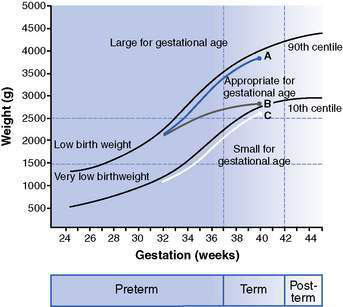
The shaded blue zone (24-36 weeks) represents the preterm period, showing how LBW and VLBW thresholds intersect with gestational age. Infants born at the same gestational age can fall in very different weight categories depending on intrauterine growth.
4. The Fenton Preterm Growth Chart (Recommended Standard)
The Fenton Chart (2013, updated 2025 - "third generation") is the most widely used preterm-specific growth chart. It is endorsed by:
- American Academy of Pediatrics (AAP)
- French, Portuguese, Colombian, Turkish, and Spanish Pediatric Societies
- Merck Manual
- Chinese Neonatal Network
What it plots:
| Parameter | Axis |
|---|---|
| Weight (kg) | Left Y-axis |
| Length (cm) | Right Y-axis |
| Head Circumference (cm) | Right Y-axis |
X-axis: Gestational age in weeks (22 to 50 weeks post-menstrual age)
Percentile lines shown: 3rd, 10th, 50th, 90th, 97th
The chart bridges preterm monitoring and seamlessly joins the WHO Growth Standard at 50 weeks (term-equivalent), providing continuity of care. The 2025 update is based on a 15-country meta-analysis and uses actual age (weeks + days) rather than completed weeks only.
Here is the Fenton 2025 chart for girls:

The chart shows:
- Green dots - Length measurements
- Blue dots - Head circumference measurements
- Red dots - Weight measurements
- Curves converge with WHO standards at 40 weeks corrected age
5. INTERGROWTH-21st Chart
An alternative widely-used chart, developed by the University of Oxford. Key differences from Fenton:
| Feature | Fenton 2013/2025 | INTERGROWTH-21st |
|---|---|---|
| Population | Meta-analysis, multi-country | Prospective cohort, 8 countries |
| GA range | 22-50 weeks | 26-42 weeks |
| Endorsed by | AAP, multiple societies | WHO (postnatal extension) |
| Purpose | Growth monitoring + size-at-birth | Growth monitoring |
| Agreement | Good for AGA | Classifies more infants as SGA vs. Fenton |
Studies (2024, INTERGROWTH-21 vs Fenton) show that the two charts generally agree for AGA classification, but INTERGROWTH-21st tends to identify more infants as SGA, particularly at lower gestational ages. The choice of chart can affect clinical decisions.
6. How to Use These Charts - Step by Step
- Determine gestational age at birth (by LMP, early ultrasound, or Ballard score)
- Plot birth weight, length, and head circumference at birth gestational age to assign size-at-birth (SGA/AGA/LGA)
- Serial measurements at each follow-up: use the baby's corrected (post-menstrual) age - count from the LMP or estimated due date, not the birth date
- Before 40 weeks corrected age: use the Fenton or INTERGROWTH-21st preterm chart
- After 40 weeks corrected age: transition to the WHO Child Growth Standards (0-24 months), still adjusting for prematurity up to 24-36 months
Age correction formula:
Corrected age = Chronological age - (40 weeks - gestational age at birth)
Example: A baby born at 28 weeks, now 6 months old: corrected age = 6 months - 3 months = 3 months
7. Expected Postnatal Growth Rates (Preterm NICU Goals)
| Parameter | Target rate (VLBW/ELBW, NICU) |
|---|---|
| Weight gain | ~15-20 g/kg/day |
| Length | ~1 cm/week |
| Head circumference | ~0.5-1 cm/week |
Most VLBW infants experience an initial weight loss of 5-15% in the first week, then recover to birth weight by 10-14 days, followed by catch-up growth.
8. Red Flags on the Growth Chart
- Consistent fall across 2 or more major percentile lines = growth faltering - warrants nutritional review, metabolic/endocrine workup
- Persistent SGA despite adequate nutrition = may indicate constitutional smallness, genetic syndrome, or TORCH infection sequelae
- Asymmetric growth (weight lagging more than length) = caloric insufficiency or chronic illness
- Head circumference not growing parallel to weight/length = possible neurological concern (microcephaly or hydrocephalus)
Key reference: The latest Fenton 2025 chart (with online plotter) is available at ucalgary.ca/fenton. The chart can be downloaded separately for boys and girls.
This is a shared conversation. Sign in to Orris to start your own chat.