
Treatment of miliaria
Reading File
Now let me search the medical library for miliaria treatment in parallel with a PubMed search.
Finding Sources
Searching PubMed
miliaria treatment management
Good results from the library. Let me read the key sections in parallel.
Reading File
Reading File
Reading File
Let me get the detailed treatment sections from Andrews' and search for treatment-specific paragraphs.
Reading File
Finding Sources
Let me get the Fitzpatrick's clinical course and treatment section.
Reading File
Reading File
I now have comprehensive information from multiple authoritative sources. Let me also fetch a clinical image to include.
Loading Image
I now have all the information needed for a thorough response. Here is the complete treatment guide for miliaria:
Treatment of Miliaria
Miliaria (heat rash) results from obstruction of eccrine sweat ducts, typically in hot, humid conditions or with febrile illness. Staphylococcus epidermidis extracellular polysaccharide is implicated in causing the ductal occlusion. Treatment varies by type and severity.
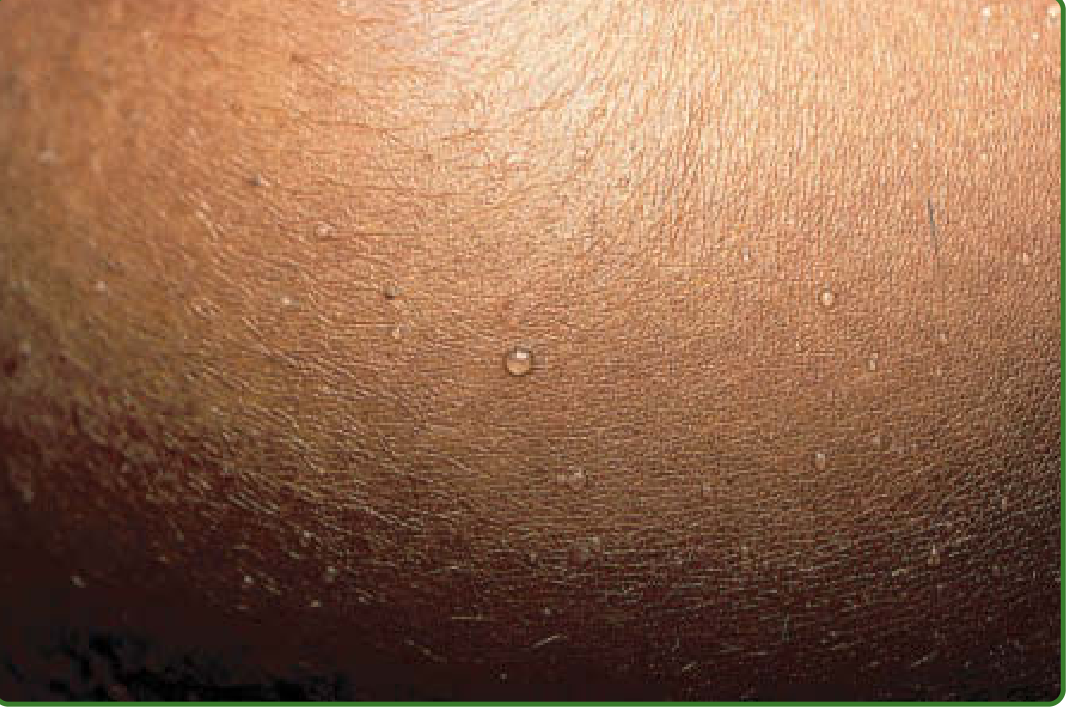
Figure: Miliaria crystallina - delicate, droplike clear vesicles with no underlying erythema (Fitzpatrick's Dermatology)
Types and Their Treatment
1. Miliaria Crystallina
- Superficial, 1-mm clear fragile vesicles at the stratum corneum level; no inflammatory reaction
- No treatment required - lesions are self-limited and rupture easily on their own
- Seen in febrile or bedridden patients and bundled infants; drugs such as isotretinoin and doxorubicin may also trigger it
- Andrews' Diseases of the Skin, p. 34
2. Miliaria Rubra (Prickly Heat)
This is the most symptomatic type - pruritic, erythematous papulovesicles with a prickling/burning sensation:
- Cool the patient - place in a cool, air-conditioned environment (even one night provides significant relief)
- Circulating fans to cool the skin surface
- Chlorhexidine in a light cream or lotion provides some relief from itching
- 1% salicylic acid applied TID to localized areas in adults (use with caution - avoid salicylate toxicity)
- Antihistamines for symptomatic pruritus
- Lightweight, breathable, loose-fitting clothing - avoid occlusive garments
- Avoid activities or environments that induce sweating
- Harrison's Principles of Internal Medicine 22E, p. 3817; Andrews' Diseases of the Skin, p. 34
3. Miliaria Pustulosa
- Preceded by another dermatitis that damaged the sweat duct
- Treatment follows the same principles as miliaria rubra
- Address any underlying dermatitis (contact dermatitis, intertrigo, lichen simplex chronicus)
- Check for pseudohypoaldosteronism if recurrent episodes occur
4. Miliaria Profunda
- Deepest type (dermal-epidermal junction obstruction); asymptomatic white papules on trunk/extremities
- Topical anhydrous lanolin - has resulted in dramatic improvement; dissolves keratinous plug and restores normal sweat flow
- Fitzpatrick's Dermatology, p. 1496
General (Non-Type-Specific) Measures
| Measure | Mechanism / Notes |
|---|---|
| Cool environment / air conditioning | Most effective intervention; reduces sweating stimulus |
| Remove occlusive clothing | Reduces ductal occlusion |
| Circulating fans | Promotes evaporative cooling |
| Anhydrous lanolin | Resolves poral occlusion; restores normal sweat secretion |
| Hydrophilic ointment | Dissolves keratinous plugs; facilitates sweat flow |
| Colloidal oatmeal or cornstarch baths | Soothing and cooling; beneficial if used in moderation |
| Dusting powders (cornstarch, baby talcum) | Useful in mild cases |
| Treat underlying febrile illness | Removes the precipitating sweating stimulus |
Andrews' Diseases of the Skin, p. 34
Postmiliarial Hypohidrosis
An important complication to recognise: miliaria invariably produces hypohidrosis afterward, and sweating may be depressed to half the normal amount for up to 3 weeks after resolution. Severity of hypohidrosis is proportional to the severity of the preceding miliaria. Patients with extensive involvement should avoid heat stress and strenuous activity during this recovery period, as impaired sweating can cause heat retention and heat illness.
Key Prevention Points
- Control heat and humidity exposure (the single most important factor)
- Treat febrile illnesses promptly
- Use light, loose clothing that allows air circulation
- In infants, avoid over-swaddling and excessive incubator temperatures
- Parents should be counselled that miliaria in infants resolves rapidly once the baby is placed in a cooler environment
Fitzpatrick's Dermatology, p. 1496; Textbook of Family Medicine 9e
This is a shared conversation. Sign in to Orris to start your own chat.