
Mapelson circuit type short note 6 page from dorsch and dorsch
Mapleson breathing systems
Mapleson breathing systems Dorsch and Dorsch fresh gas flow A B C D E F
https://pmc.ncbi.nlm.nih.gov/articles/PMC3821268/
Dorsch and Dorsch Understanding Anesthesia Equipment Mapleson circuits chapter fresh gas flow
schematic diagram Mapleson breathing circuits A B C D E F fresh gas inlet APL valve reservoir bag
Mapleson Circuits
Introduction
- Adequate fresh gas flow (FGF)
- Correct arrangement of circuit components
- Effective venting of exhaled gas through the APL valve or open expiratory limb
- Mode of ventilation, spontaneous or controlled
Note: I do not have the full Dorsch and Dorsch text in the available library. This six-page exam-style note follows the standard descriptions consistent with Dorsch and Dorsch, cross-checked with major anaesthesia texts.
1. Components of a Mapleson Circuit
- Fresh gas inlet (FGI): Delivers oxygen and anaesthetic gases from the anaesthesia machine.
- Patient connection: Connects the circuit to a face mask, supraglottic airway, or endotracheal tube.
- Reservoir tube: Acts as a gas reservoir and provides a low-resistance pathway.
- Reservoir bag: Stores gas, permits manual ventilation, and gives a visual and tactile indication of ventilation.
- APL valve: Adjustable pressure-limiting valve, also called a pop-off valve. It allows release of excess gas and limits circuit pressure.
2. Principle of Carbon Dioxide Elimination
- Alveolar gas remains in the circuit.
- The patient rebreathes carbon dioxide.
- Inspired carbon dioxide and end-tidal carbon dioxide rise.
- Hypercapnia may occur.
General rule
- Spontaneous ventilation: the circuit should preferentially eliminate expired alveolar gas during expiration.
- Controlled ventilation: the circuit should direct fresh gas toward the patient and push alveolar gas away from the patient.
3. Classification of Mapleson Circuits
| Circuit | Common name | Main feature |
|---|---|---|
| A | Magill circuit | FGI far from patient; APL valve near patient |
| B | Mapleson B | FGI and APL valve near patient; bag at far end |
| C | Waters to-and-fro | Short version of B, without corrugated tubing |
| D | Mapleson D | FGI near patient; APL valve and bag at far end |
| E | Ayre’s T-piece | Mapleson D without reservoir bag or APL valve |
| F | Jackson-Rees circuit | Mapleson E with open-ended reservoir bag |
-
Group A: Mapleson A
-
Group B/C: Mapleson B and C
-
T-piece group: Mapleson D, E, and F
-
Barash, Cullen, and Stoelting’s Clinical Anesthesia, 9e, p. 2010
4. Mapleson A Circuit
Arrangement
- Fresh gas inlet is at the end farthest from the patient.
- APL valve is close to the patient.
- Also known as the Magill circuit.
Function during spontaneous ventilation
Mechanism
- At the start of expiration, dead-space gas enters the circuit.
- Alveolar gas then reaches the APL valve near the patient.
- With the APL valve open, carbon dioxide-rich alveolar gas is vented.
- During the expiratory pause, continuing FGF fills the circuit with fresh gas and flushes remaining alveolar gas through the APL valve.
- On the next inspiration, the patient receives mainly fresh gas plus dead-space gas.
Function during controlled ventilation
Advantages
- Most economical Mapleson system for spontaneous breathing.
- Low resistance.
- Simple and lightweight.
- Suitable for spontaneous ventilation in adults.
Disadvantages
- Very inefficient for controlled ventilation.
- High FGF requirement causes anaesthetic gas wastage.
- Operating room pollution may occur.
- APL valve close to the patient may interfere with surgery near the head and neck.
Use
- Spontaneously breathing adult patient.
- Historically used during inhalational anaesthesia.
- Less commonly used in modern practice because circle systems are more economical.
5. Mapleson B and C Circuits
Mapleson B arrangement
Mapleson C arrangement
Functional characteristics
Advantages
- Compact, especially Mapleson C.
- Low resistance.
- Mapleson C can be useful for short periods of manual ventilation.
- Convenient during resuscitation or transport in selected settings.
Disadvantages
- High FGF is required in both spontaneous and controlled ventilation.
- Inefficient compared with Mapleson A for spontaneous breathing.
- Inferior to D, E, and F circuits for controlled ventilation.
- Limited modern use.
Use
- Mapleson C may be used for emergency ventilation, resuscitation, and transport.
- Mapleson B is rarely used today.
6. Mapleson D Circuit
Arrangement
Function during controlled ventilation
Mechanism
- During inspiration, fresh gas enters near the patient.
- It is delivered directly toward the patient.
- During expiration, exhaled alveolar gas travels away from the patient toward the reservoir bag and APL valve.
- The continuing FGF helps push carbon dioxide-rich gas toward the APL valve for elimination.
Fresh gas flow
Advantages
- Efficient during controlled ventilation.
- Low resistance.
- Can be used for both spontaneous and controlled ventilation.
- Useful when the anaesthetist is some distance from the patient.
- Reservoir bag and APL valve are away from the surgical field.
Disadvantages
- Higher FGF requirement than a circle system.
- Increased operating room pollution if scavenging is inadequate.
- Heat and humidity are poorly conserved.
- Rebreathing occurs if FGF is inadequate.
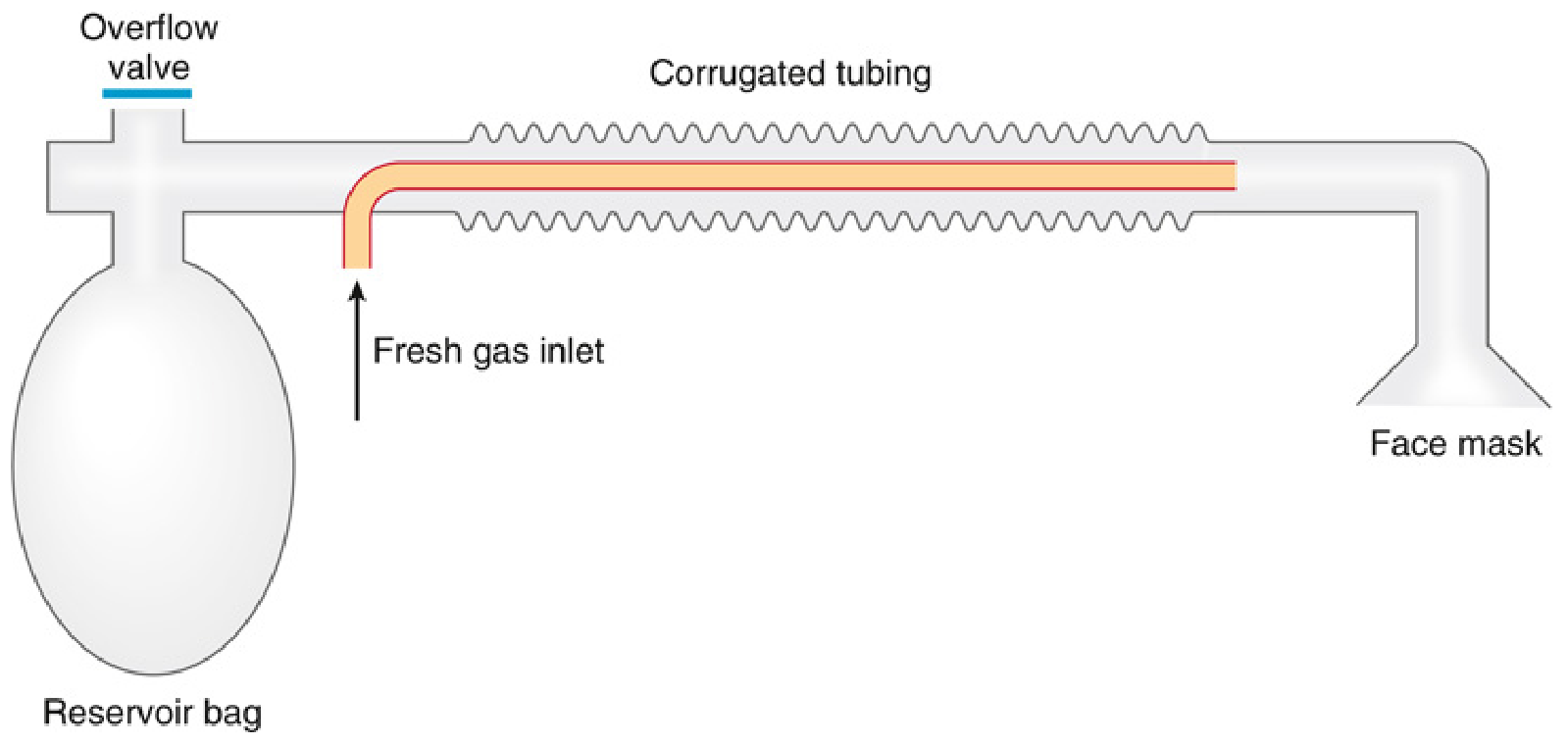
Bain Circuit: Coaxial Mapleson D
Design
- A narrow inner tube carries fresh gas to the patient end.
- Exhaled gas travels back through the outer corrugated tube.
- The reservoir bag and APL valve are at the machine end.
Advantages
- Lightweight and less bulky.
- Low resistance.
- Convenient for head and neck procedures and remote locations.
- Exhaled warm gas in the outer tube partially warms inspired fresh gas by countercurrent heat exchange.
- The transparent outer tube allows inspection of the inner tube.
Hazards
- Rebreathing
- Hypercapnia
- Hypoxaemia
- Failure to deliver the intended anaesthetic gas mixture
7. Mapleson E Circuit: Ayre’s T-Piece
Arrangement
- Fresh gas inlet near the patient.
- Open-ended expiratory limb.
- No APL valve.
- No reservoir bag.
Advantages
- Very low resistance to breathing.
- Lightweight.
- Minimal drag on the endotracheal tube.
- Suitable for neonates and small children.
- Easy to assemble.
- Useful when a low-resistance circuit is required.
Disadvantages
- High FGF required.
- No reservoir bag, so the anaesthetist cannot observe bag movement or feel lung compliance.
- Manual controlled ventilation is difficult and carries a risk of excessive airway pressure.
- No effective scavenging of waste gas.
- Poor heat and humidity conservation.
8. Mapleson F Circuit: Jackson-Rees Modification
Arrangement
Advantages
- Very low resistance, making it useful in neonates and children.
- Reservoir bag allows observation of respiration.
- Allows manual ventilation.
- Gives tactile feedback about lung compliance.
- More useful than Mapleson E for assisted or controlled ventilation.
- Lightweight and compact.
Disadvantages
- Requires high FGF.
- Waste anaesthetic gas pollution can be significant.
- The open tail makes scavenging difficult.
- Excessive occlusion of the tail can cause high airway pressure and barotrauma.
- Inadequate FGF may cause rebreathing.
Fresh gas flow
-
Spontaneous ventilation: 2.5 to 3 times minute ventilation
-
Controlled ventilation: 1.5 to 2 times minute ventilation
-
Miller’s Anesthesia, 10e, p. 2353
Use
- Commonly used in paediatric anaesthesia.
- Suitable for transport and manual ventilation in infants and small children.
- Useful when low circuit resistance is particularly important.
9. Relative Efficiency of Mapleson Circuits
During spontaneous ventilation
- Mapleson A requires the lowest FGF, approximately equal to minute ventilation.
- D, E, and F require higher flows.
- B and C are relatively inefficient.
During controlled ventilation
- D, E, and F are preferred for controlled ventilation.
- B and C are intermediate.
- Mapleson A is very inefficient.
| Circuit | Spontaneous ventilation | Controlled ventilation |
|---|---|---|
| A | Best, FGF about 1 × minute ventilation | Worst, needs very high FGF |
| B | Inefficient | Inefficient |
| C | Inefficient | Inefficient |
| D | Moderately efficient | Efficient |
| E | Moderately efficient | Efficient but limited by absent bag |
| F | Moderately efficient | Efficient, especially in paediatrics |
10. General Advantages and Disadvantages
Advantages of Mapleson circuits
- Simple construction.
- Lightweight and portable.
- Low resistance to breathing.
- Inexpensive.
- Rapid alteration of inspired gas composition when FGF is changed.
- No carbon dioxide absorbent is required.
- No risk of absorbent-related degradation of volatile agents.
- Particularly useful in paediatric practice, transport, and selected emergency situations.
Disadvantages
- Require high FGF to avoid carbon dioxide rebreathing.
- High consumption of oxygen, carrier gas, and volatile anaesthetic.
- Increased environmental contamination by waste anaesthetic gases.
- Poor conservation of heat and humidity.
- Scavenging is often difficult.
- Rebreathing can occur rapidly when FGF is inadequate or the circuit is incorrectly assembled.
- Less economical than a circle system.
11. Conclusion
- Mapleson A is best for spontaneous ventilation.
- Mapleson D and Bain circuit are preferred for controlled ventilation.
- Mapleson E and F are low-resistance T-piece systems useful especially in paediatric practice.
- Mapleson B and C are now rarely used because of poor efficiency.
Only dorsch and dorsch
Dorsch and Dorsch Understanding Anesthesia Equipment Mapleson circuits edition
Rewrite the 6-page note using only Dorsch and Dorsch
Rewrite the 6-page note using only Dorsch and Dorsch
Mapelson circuit short note from dorsch and dorsch only
"Understanding Anesthesia Equipment" "Mapleson Breathing Systems" Dorsch
Concise exam note
~/attachments/ad61b815-8d36-4ea3-ba43-f7407f35daf4
python -c "from pypdf import PdfReader; p='/tmp/workspace/attachments/ad61b815-8d36-4ea3-ba43-f7407f35daf4/mapelson circuit .pdf'; r=PdfReader(p); print('PAGES',len(r.pages)); [print('\\n---PAGE',i+1,'---\\n', (pg.extract_text() or '')[:6000]) for i,pg in enumerate(r.pages)]"
Mapleson Breathing Systems
Definition and principle
- Carbon dioxide absorber
- Unidirectional valves
- Separate inspiratory and expiratory limbs
- Patient connection
- Fresh gas inlet
- Reservoir bag
- Corrugated tubing
- Adjustable pressure-limiting (APL) valve
Mapleson A System
Configuration
Fresh gas inlet and reservoir bag - corrugated tubing - APL valve - patient
Lack modification
- APL valve is easier to reach.
- Waste-gas scavenging is easier.
Use and functional analysis
- Keep the APL valve fully open.
- During expiration, dead-space gas and then alveolar gas enter the tubing.
- Once the bag fills, alveolar gas escapes through the APL valve.
- Continuing FGF flushes expired gas from the circuit before the following inspiration.
- It is the most efficient Mapleson system during spontaneous breathing.
- Partially close the APL valve and compress the reservoir bag.
- During expiration, expired gases remain in the tubing, with carbon dioxide-rich alveolar gas nearest the patient.
- At the start of the next inspiration, alveolar gas is inhaled first.
- Therefore, there is substantial rebreathing and wastage of fresh gas.
- A ventilator that vents excess gas should not be used because the entire circuit can become dead space.
- Standard anaesthesia machine ventilators are unsuitable for classic Mapleson A use.
- Incorrectly assembled Lack systems, with FGF near the APL valve rather than the reservoir bag, produce excessive dead space.
Mapleson B System
Configuration
Use
- For spontaneous ventilation, keep APL fully open.
- For assisted or controlled ventilation, partly close the APL valve to inflate the lungs.
Functional analysis
- Near the end of expiration, tubing close to the patient contains fresh gas mixed with some alveolar gas.
- To prevent rebreathing, FGF should equal peak inspiratory flow, usually 20-25 L/min.
- A flow greater than twice minute volume has been recommended, although lower flows of 0.8-1.2 times minute volume may sometimes suffice.
- Slightly more efficient than Mapleson A because fresh gas accumulates near the patient during the expiratory pause.
- Performance is variable because inspired gas composition depends greatly on the respiratory pattern.
- Recommended FGF: 2-2.5 times minute volume.
Mapleson C System
Configuration
Use and function
- During spontaneous breathing, it is almost as efficient as Mapleson A if the expiratory pause is minimal.
- Its efficiency decreases as expiratory pause lengthens.
- Recommended FGF:
- Spontaneous ventilation: 2 times minute volume
- Controlled ventilation: 2-2.5 times minute volume
Mapleson D System
Configuration
Patient - T-piece with FGF inlet - corrugated tubing - reservoir bag and APL valve
Bain modification
- Fresh gas travels through a narrow inner tube.
- Exhaled gas travels in the outer corrugated tube.
- The clear outer tube permits inspection of the inner tube.
- A long Bain circuit can be used for remote anaesthesia, for example in MRI.
Use
- Leave the APL valve open.
- Excess gas vents through the APL valve during expiration.
- Partly close APL valve and squeeze reservoir bag.
- Excess gas vents during inspiration.
- Replace reservoir bag with ventilator hose and close the APL valve.
- Excess gas vents through the ventilator spill valve.
Functional analysis
- Recommended FGF: usually 1.5-3 times minute volume.
- Reported weight-based values: 100-300 mL/kg/min.
- A low FGF permits inspired carbon dioxide rebreathing.
- Prolonged inspiratory time, high respiratory rate, and an inspiratory plateau increase rebreathing.
- A long expiratory pause decreases rebreathing.
- With high FGF, the system behaves more like a non-rebreathing circuit, but at the cost of higher gas consumption and loss of heat and humidity.
Bain hazards
Preuse checks for Bain circuit
- Perform the usual leak test.
- Occlude the inner tube at the patient end with a low oxygen flow running. The flowmeter indicator should fall if the inner tube is intact and connected.
- With oxygen flush, a Venturi effect should cause the reservoir bag to deflate if the inner tube is patent.
Mapleson E System
Configuration
Use
- Commonly used to supply oxygen or humidified gas to spontaneously breathing patients.
- Use for anaesthesia has decreased because waste-gas scavenging is difficult.
- For spontaneous ventilation, leave the expiratory limb open.
- Controlled ventilation can be performed by intermittently occluding the expiratory limb, but assisted ventilation is difficult.
Functional features
- Without an expiratory limb, spontaneous breathing causes no rebreathing.
- If an expiratory limb is added, the FGF required is similar to Mapleson D.
- During controlled ventilation, only fresh gas inflates the lungs, so rebreathing does not occur.
Air dilution
- FGF exceeding peak inspiratory flow, usually 3-5 times minute volume, or
- FGF of 2 times minute volume with reservoir tubing volume at least one-third of tidal volume.
Hazard
Mapleson F System
Configuration
Use
- For spontaneous breathing, leave the relief opening fully open.
- For controlled or assisted ventilation, partially occlude the tail to distend the bag and squeeze the bag.
- A ventilator hose may replace the bag for mechanical ventilation.
Functional analysis
- FGF requirements for preventing rebreathing during spontaneous and controlled ventilation are the same as for Mapleson D.
- It offers lower work of breathing than a paediatric circle system, though the difference may only matter in very sick spontaneously breathing patients.
Hazards
- Excessive pressure and barotrauma may occur during manual ventilation.
- A reservoir bag makes excessive pressure less likely than with Mapleson E.
- Addition of an HME may increase resistance and delay inhalational induction.
Respiratory Gas Monitoring
- At the tracheal tube connector, or
- About 2 cm distal in the elbow connector.
Advantages
- Simple, inexpensive, rugged equipment.
- Few moving parts and easily disinfected or sterilized.
- Useful for emergency positive-pressure ventilation.
- Usually low resistance to breathing.
- Lightweight with little drag on face mask or tracheal tube.
- Easy to position and useful in remote locations.
- Lower compression and compliance volume losses than circle systems.
- Rapid change in inspired gas concentration after changing FGF.
- Coaxial circuits, Lack and Bain, conserve some heat through warming of inspiratory gas by expired gas.
- No carbon dioxide absorbent, hence no absorbent-related carbon monoxide or compound A formation.
Disadvantages
- High FGF requirement causes increased cost and atmospheric pollution.
- High FGF reduces inspired heat and humidity unless humidification is added.
- Optimal FGF can be difficult to establish and must be changed when ventilation mode changes.
- Reduced FGF can rapidly produce rebreathing.
- In A, B, and C systems, the APL valve lies close to the patient and may be inaccessible; scavenging is awkward.
- E and F systems are difficult to scavenge.
- Mapleson E may cause air dilution.
- Not suitable for malignant hyperthermia because FGF may not be increased enough to eliminate the markedly increased carbon dioxide load.
High-yield summary
| System | Best setting | Key point |
|---|---|---|
| A - Magill | Spontaneous ventilation | Most efficient during spontaneous breathing |
| B | Rarely used | Requires high FGF in both modes |
| C | Short-term/manual use | Mapleson B without corrugated tubing |
| D | Controlled ventilation | Most efficient Mapleson circuit for controlled ventilation |
| Bain | Controlled ventilation | Coaxial Mapleson D; check inner tube |
| E - Ayre’s T-piece | Small patients, spontaneous breathing | No bag or APL valve; risk of barotrauma during manual ventilation |
| F - Jackson-Rees | Paediatric manual ventilation | T-piece with open-tailed bag; functions like Mapleson D |
Create a one-page Mapleson circuits comparison table
Mapleson Circuits: One-Page Comparison Table
| Circuit | Alternative name / configuration | FGF: spontaneous ventilation | FGF: controlled ventilation | Main use / relative efficiency | Major advantages | Important limitations / hazards |
|---|---|---|---|---|---|---|
| A | Magill. FGF and reservoir bag at machine end; APL valve near patient. | About 51-85 mL/kg/min | Inefficient, substantial rebreathing | Most efficient for spontaneous ventilation | Low FGF requirement during spontaneous breathing | Unsuitable with conventional anaesthesia-machine ventilators. APL valve is near patient and scavenging is awkward. |
| A modification | Lack circuit. Mapleson A with an expiratory limb leading to APL valve at machine end. | Similar principle to A | Not preferred | Spontaneous breathing | Easier APL adjustment and scavenging | Slightly increases work of breathing. Incorrect assembly can create large dead space. |
| B | FGF inlet and APL valve near patient; reservoir bag at far end of corrugated tubing. | Usually high: up to peak inspiratory flow, about 20-25 L/min; reported range 0.8-1.2 × MV may suffice | 2-2.5 × MV | Rarely used; variable efficiency | Simple circuit | High FGF requirement; variable performance, especially during controlled ventilation. |
| C | Waters to-and-fro. Mapleson B without corrugated tubing. | 2 × MV | 2-2.5 × MV | Short, compact form; can be nearly as efficient as A if expiratory pause is minimal | Compact and simple | Efficiency declines as expiratory pause increases; high FGF required. |
| D | T-piece near patient with FGF inlet; corrugated tube leading to reservoir bag and APL valve at machine end. | Usually 1.5-3 × MV or 100-300 mL/kg/min | Most efficient Mapleson circuit for controlled ventilation; adequate FGF and a long expiratory pause reduce rebreathing | Best Mapleson circuit for controlled ventilation | APL valve away from patient; excess-gas scavenging is relatively easy; useful for manual or mechanical ventilation | High FGF, gas wastage, loss of heat/humidity. Rebreathing increases with short expiratory pause, long inspiratory time, high rate, or inspiratory plateau. |
| D modification | Bain circuit. Coaxial D: inner tube carries FGF to patient; outer tube carries expired gas. | Same principle as D | Same principle as D | Controlled ventilation; remote sites such as MRI | Lightweight, less bulky; inner tube visible through clear outer tube; some warming of inspired gas | Inner-tube disconnection, leak, kink, twist, blockage, or faulty assembly can turn the circuit into dead space and cause severe rebreathing. Perform a preuse inner-tube integrity test. |
| E | Ayre’s T-piece. T-piece with FGF near patient and open expiratory limb; no bag and no APL valve. | No rebreathing if there is no expiratory limb. With limb, same FGF requirement as D. | No rebreathing because fresh gas inflates lungs | Spontaneous oxygen/humidified-gas delivery, particularly small patients | Very simple and low resistance | Difficult scavenging. During spontaneous breathing, air dilution may occur if reservoir tubing is too short. Manual occlusion for controlled ventilation risks overinflation/barotrauma because there is no bag or APL valve. |
| F | Jackson-Rees / Rees modification of Ayre’s T-piece. E system plus reservoir bag with open tail or relief opening. | Same as D | Same as D | Paediatric spontaneous, assisted, or manual ventilation | Reservoir bag gives visual and tactile feedback; lower work of breathing than a paediatric circle system | Same general risks as E, though excessive pressure is less likely because a bag is present. Scavenging can be difficult. |
Key exam points
- All Mapleson systems lack CO₂ absorber, unidirectional valves, and separate inspiratory/expiratory limbs. CO₂ elimination is by fresh-gas washout.
- End-tidal CO₂ monitoring is the best guide to adequate FGF.
- Best for spontaneous ventilation: Mapleson A.
- Best for controlled ventilation: Mapleson D, including the Bain modification.
- E and F: T-piece systems. F adds a reservoir bag.
- A low FGF in any system can cause rebreathing, reflected by raised inspired and/or end-tidal CO₂.