
Cranial nerve
Reading File
Finding Sources
Searching Images
cranial nerves overview diagram
Reading File
Reading File
Searching Images
12 cranial nerves base of skull overview
Loading Image
Loading Image
Reading File
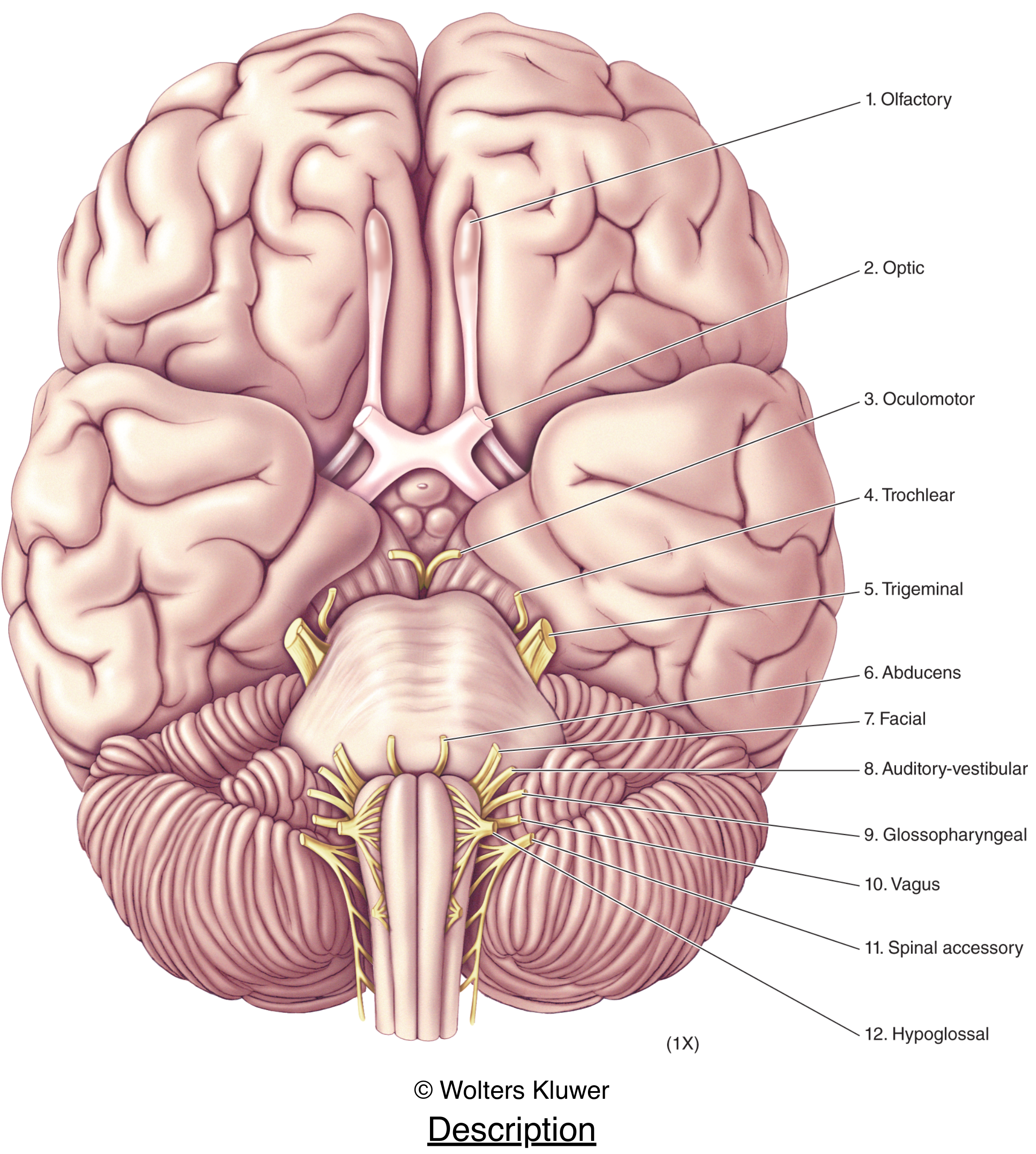
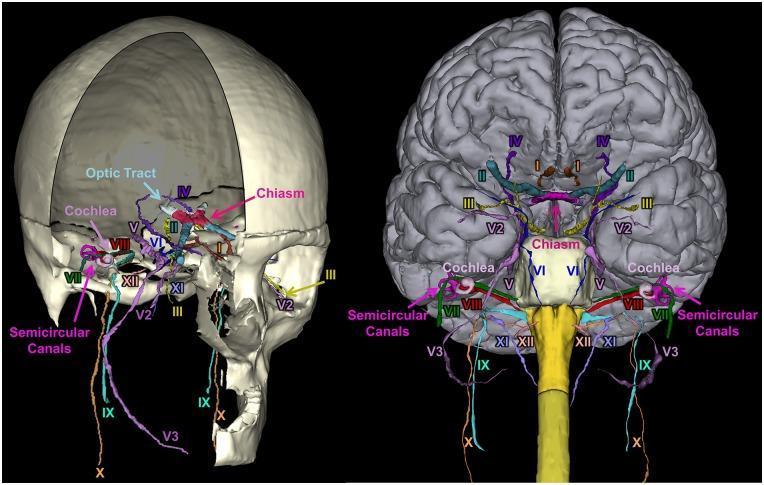
Here is a comprehensive overview of the 12 Cranial Nerves, drawn from Neuroscience: Exploring the Brain and Gray's Anatomy for Students.
The 12 Cranial Nerves
Twelve pairs of cranial nerves emerge from the base of the brain and pass through foramina or fissures in the cranial cavity. The first two (CN I and CN II) are technically extensions of the CNS; the remaining ten are true peripheral nerves. All except CN XI originate directly from the brain.
Functional Components
Each cranial nerve carries one or more functional fiber types:
| Abbreviation | Type | General Function |
|---|---|---|
| GSA | General somatic afferent | Touch, pain, temperature |
| GVA | General visceral afferent | Sensory from viscera |
| SA | Special afferent | Smell, taste, vision, hearing, balance |
| GSE | General somatic efferent | Motor to voluntary (skeletal) muscle |
| GVE | General visceral efferent | Motor to smooth muscle, heart, glands (parasympathetic) |
| BE | Branchial efferent | Motor to pharyngeal arch–derived muscles |
Individual Nerves at a Glance
| # | Name | Fiber Type | Exit from Skull | Key Function |
|---|---|---|---|---|
| I | Olfactory | SA | Cribriform plate (ethmoid) | Smell |
| II | Optic | SA | Optic canal | Vision |
| III | Oculomotor | GSE, GVE | Superior orbital fissure | Moves eye (SR, IR, MR, IO, levator palpebrae); pupil constriction & lens accommodation (parasympathetic) |
| IV | Trochlear | GSE | Superior orbital fissure | Moves eye via superior oblique |
| V | Trigeminal | GSA, BE | V1: Superior orbital fissure; V2: Foramen rotundum; V3: Foramen ovale | Facial sensation (V1/V2/V3); mastication muscles (V3) |
| VI | Abducens | GSE | Superior orbital fissure | Lateral rectus (abducts eye) |
| VII | Facial | GSA, SA, GVE, BE | Stylomastoid foramen | Facial expression muscles; taste (ant. 2/3 tongue); lacrimal/salivary gland secretion |
| VIII | Vestibulocochlear | SA | Internal acoustic meatus | Hearing (cochlear); balance (vestibular) |
| IX | Glossopharyngeal | GSA, GVA, SA, GVE, BE | Jugular foramen | Taste (post. 1/3 tongue); parotid gland; stylopharyngeus; carotid body/sinus |
| X | Vagus | GSA, GVA, SA, GVE, BE | Jugular foramen | Parasympathetics to heart, lungs, abdominal organs; pharyngeal/laryngeal muscles |
| XI | Accessory (Spinal) | BE | Jugular foramen | Sternocleidomastoid & trapezius muscles |
| XII | Hypoglossal | GSE | Hypoglossal canal | All intrinsic/extrinsic tongue muscles (except palatoglossus) |
Key Clinical Points
- CN IV (Trochlear) is the only cranial nerve to exit the dorsal surface of the brainstem and decussates before exiting — the thinnest and longest intracranial course.
- CN III palsy: presents with ptosis, "down and out" gaze, and a blown (dilated, fixed) pupil — classic sign of posterior communicating artery aneurysm.
- CN VI has the longest intracranial course and is most vulnerable to raised intracranial pressure → a "false localizing sign."
- CN VII courses through the facial canal of the temporal bone, giving off branches before exiting at the stylomastoid foramen; Bell's palsy affects the entire ipsilateral face (upper + lower), distinguishing peripheral from central lesions.
- CN V (Trigeminal) is the largest cranial nerve, with three divisions (ophthalmic V1, maxillary V2, mandibular V3). V3 is the only division with both sensory and motor (branchial efferent) fibers.
- CN X (Vagus) has the widest distribution — from the pharynx to the transverse colon.
- CN I and II nuclei/cell bodies lie within the CNS (olfactory bulb; lateral geniculate nucleus/retina), making them susceptible to CNS-type demyelinating disease (e.g., optic neuritis in multiple sclerosis).
Memory Aid
"On Old Olympus' Towering Top, A Finn And German Viewed Some Hops"
→ O-O-O-T-T-A-F-A-G-V-S-H = CN I through XII
Sources: Neuroscience: Exploring the Brain, 5th ed. | Gray's Anatomy for Students, 4th ed.
This is a shared conversation. Sign in to Orris to start your own chat.