
Crao
Reading File
Finding Sources
Searching PubMed
"central retinal artery occlusion" treatment management
Searching the Web
CRAO central retinal artery occlusion diagnosis management 2024 2025
Reading File
Reading File
Reading File
Reading File
Reading File
Reading File
Loading Image
Central Retinal Artery Occlusion (CRAO)
CRAO is an ophthalmic emergency - effectively a "stroke of the eye" - caused by sudden blockage of the central retinal artery, the primary blood supply to the inner retina.
Pathophysiology
The ophthalmic artery (first branch of the internal carotid) supplies the central retinal artery, which perfuses the inner retina. Occlusion leads to ischemia and infarction of the inner retinal layers. Irreversible damage is estimated to begin after ~4 hours (primate studies suggest partial recovery is possible if ischemia is reversed within 4 hours; in humans, the threshold may be up to 6 hours).
The fovea/macula is the thinnest part of the retina, so the intact choroidal circulation remains visible through it, creating the pathognomonic "cherry-red spot" while the surrounding ischemic retina turns pale and opaque.
Etiology
| Category | Examples |
|---|---|
| Embolism (most common) | Cholesterol (Hollenhorst plaque - refractile, yellow, at bifurcations); calcium (white, from cardiac valves); platelet-fibrin (dull white, from atheromas) |
| Thrombosis | In situ arterial thrombosis |
| Vasculitis | Giant cell arteritis (GCA), SLE, polyarteritis nodosa, Behçet |
| Hypercoagulable states | Antiphospholipid syndrome, protein C/S deficiency, factor V Leiden, polycythemia |
| Cardiac | Emboli from valvular disease, AF |
| Rare | Migraine/vasospasm, sickle cell, syphilis, trauma, elevated IOP |
Symptoms
- Sudden, painless, monocular vision loss occurring over seconds (counting fingers to light perception in ~94% of eyes)
- Often preceded by episodes of amaurosis fugax
- Exception: GCA-related CRAO may be painful
- If vision is light perception or worse, strongly suspect ophthalmic artery occlusion (worse prognosis)
Signs
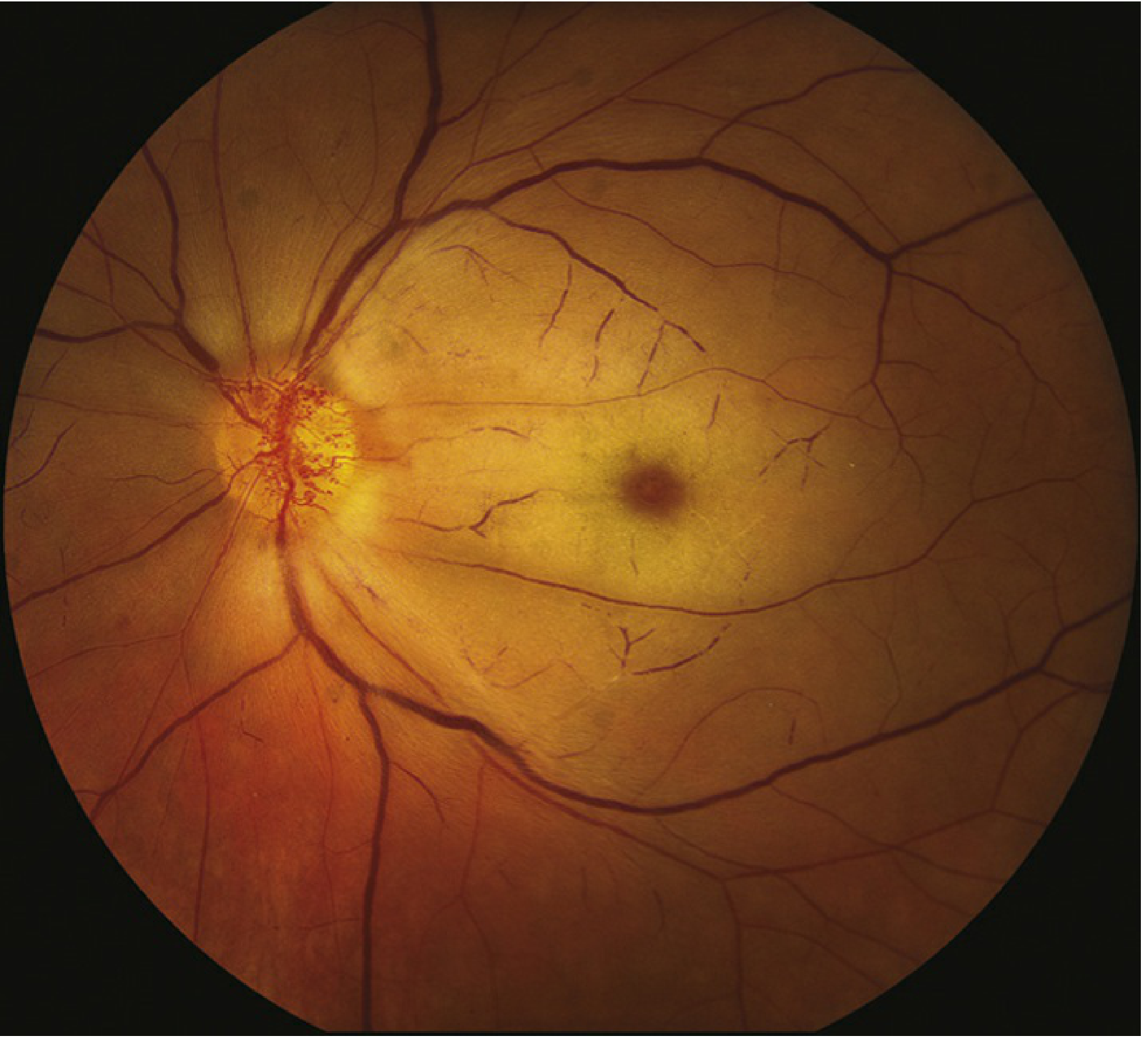
Fundus in CRAO: diffuse retinal whitening/pallor with the classic cherry-red spot at the fovea
- Cherry-red spot at the macula (contrast between pale surrounding retina and intact choroidal perfusion at the fovea)
- Profound RAPD (relative afferent pupillary defect), sometimes total (amaurotic pupil)
- Narrowed/attenuated retinal arterioles; boxcarring or segmentation of blood column
- Peripapillary retinal swelling and opacity
- Emboli visible in ~20% of cases
- If a cilioretinal artery is present (~1/3 of eyes), the macular area supplied by it retains normal color - central vision may be preserved
- Over days-weeks, the retinal cloudiness resolves, but arteries remain attenuated; later signs include optic atrophy and inner retinal atrophy
Late complications: Rubeosis iridis (neovascularization of the iris) in up to ~20%, typically at 4-5 weeks; retinal/disc neovascularization in ~2%.
Differential Diagnosis
| Condition | Key Differentiator |
|---|---|
| Ophthalmic artery occlusion | No cherry-red spot; entire retina whitened; concern for GCA |
| Commotio retinae | History of blunt trauma; resolves spontaneously |
| Cherry-red spot (metabolic) | Tay-Sachs, Niemann-Pick type A; bilateral; early in life |
| Optic neuritis | Normal peripheral retina; pain with eye movement |
Workup
CRAO should be treated as an acute stroke (AAO 2018 guidelines mandate immediate ED referral, preferably to a stroke center).
- ESR, CRP, platelets - if patient ≥55 years and no embolus visible, rule out GCA immediately. If GCA is suspected, start high-dose steroids urgently to protect the fellow eye.
- Blood pressure measurement
- Labs: Fasting glucose, HbA1c, CBC with differential, PT/PTT. In patients <50 or with appropriate risk factors: lipid profile, ANA, RF, syphilis serology, serum protein electrophoresis, hemoglobin electrophoresis, hypercoagulable panel.
- Carotid duplex Doppler ultrasound
- Cardiac workup: ECG, echocardiography, Holter monitoring (to detect AF), consider bubble study
- OCT - highly useful for diagnosis; may show hyperreflective inner retinal thickening; can also show an embolic plaque in the superficial optic nerve head
- FA (fluorescein angiography): Delayed/absent arterial filling; masking of choroidal fluorescence by retinal edema
- ERG: Diminished b-wave (helps distinguish from optic nerve disease if diagnosis is uncertain)
Treatment
CRAO is treated as an acute stroke. Immediate ED referral with an affiliated stroke center is the standard of care. IV tPA within 4.5 hours of onset has support from more recent studies (analogous to ischemic stroke), though ophthalmologists have not reached full consensus.
Ocular interventions (anecdotal; no strong RCT evidence; may be attempted within 90-120 minutes of onset):
- Ocular massage - digital or three-mirror contact lens; apply pressure 10-15 seconds then release, repeat for 3-5 minutes; aims to dislodge embolus/thrombus mechanically
- Anterior chamber paracentesis - withdraw 0.1-0.2 mL aqueous with a 27-gauge needle to acutely lower IOP
- IOP-lowering medications: Acetazolamide 500 mg IV (or 2×250 mg PO), topical beta-blocker (timolol/levobunolol 0.5%)
- Rebreathing (paper bag) / Carbogen (95% O₂ + 5% CO₂) - promotes vasodilation via hypercapnia; limited evidence
- Nd:YAG laser embolysis - if an occluding embolus is visible; limited experience
- Intra-arterial tPA - no clear benefit shown in RCTs
If GCA is suspected: High-dose IV methylprednisolone immediately; do not delay for biopsy results.
Prognosis
- Poor overall: in two-thirds of cases, final VA is worse than 6/120 (20/400)
- Only ~1 in 5 patients is left with VA of 6/12 (20/40) or better
- Eyes with a patent cilioretinal artery may have preserved central vision
- Absence of light perception at presentation suggests GCA or ophthalmic artery occlusion (worse prognosis)
Follow-Up
- Repeat eye exam at 1-4 weeks to screen for neovascularization (iris, disc, angle, retina) - occurs in up to 20% at ~4 weeks
- If neovascularization develops: panretinal photocoagulation (PRP) and/or anti-VEGF injection
- Systemic follow-up with internist/neurologist for stroke risk factor management
Sources: Kanski's Clinical Ophthalmology 10e, The Wills Eye Manual, Tintinalli's Emergency Medicine 9e
This is a shared conversation. Sign in to Orris to start your own chat.