
Signs of antemortem hanging
ligature mark neck hanging antemortem
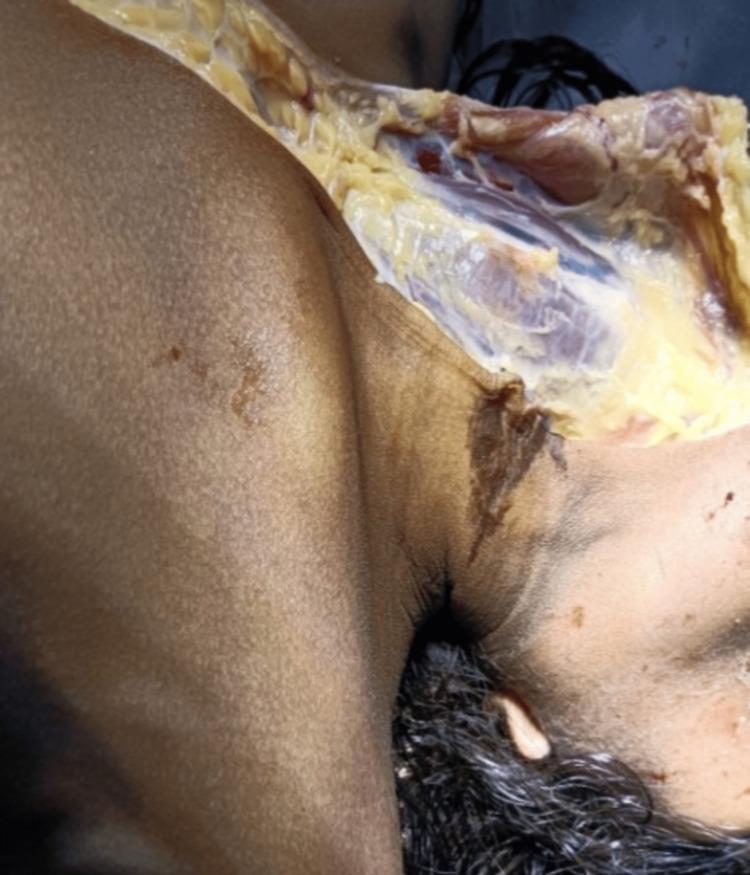
This forensic clinical photograph depicts an autopsy examination of a human neck, illustrating findings consistent with suspension hanging. A prominent, dark brown, parchment-like ligature mark is visible on the right lateral aspect of the neck. The mark exhibits an oblique, upward orientation toward the mastoid region, characteristic of antemortem compression. A surgical dissection flap has been reflected to expose the underlying subcutaneous tissue and superficial fascia. This underlying tissue appears white, glistening, and yellowish, without evidence of significant subcutaneous or intramuscular hemorrhage, which is a key diagnostic feature in certain forensic assessments of ligature-related injuries. The image serves as an educational resource for forensic pathology, specifically demonstrating the external morphology of a ligature furrow and the corresponding internal examination of neck structures during a medicolegal postmortem.
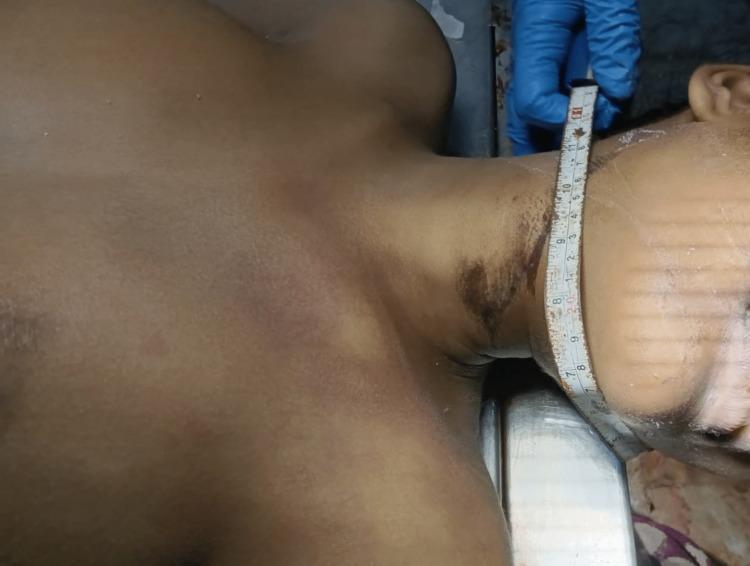
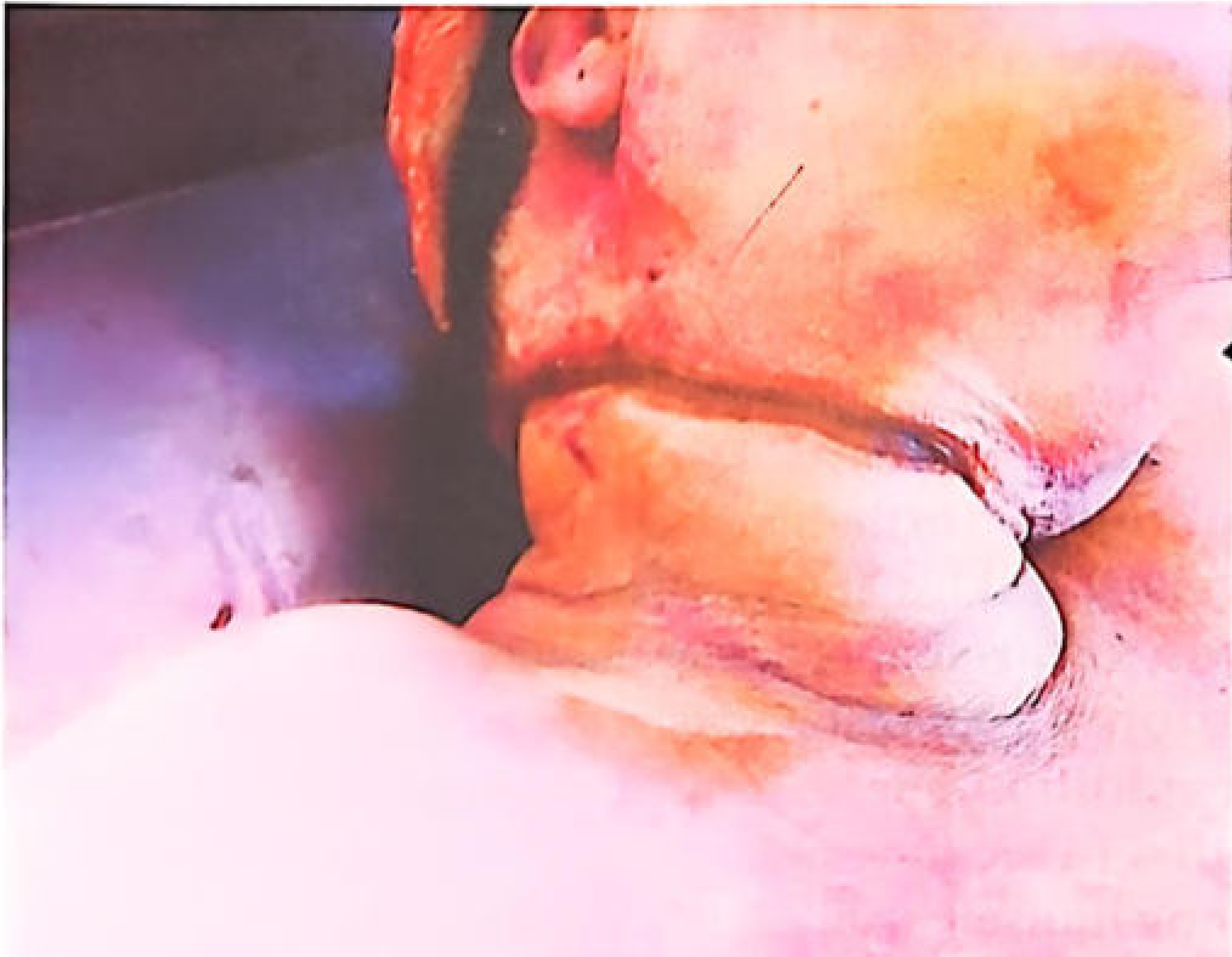
A clinical photograph and forensic pathology record showing a ligature mark on the neck of a deceased individual during a medicolegal postmortem examination. The image displays a dark brown, non-continuous ligature furrow located on the upper portion of the neck, situated above the thyroid cartilage. The mark follows an oblique path, ascending toward the lower jaw and mastoid region. Visually, the base of the furrow appears hard, leathery, and parchment-like, characterized by localized skin excoriation and irregular hyperpigmentation. A measuring tape is held against the neck by a gloved hand to document the dimensions and placement of the mark. The surrounding skin shows varying degrees of postmortem discoloration. This image is significant in forensic medicine for documenting features of hanging or suspension and distinguishing antemortem ligature marks from other forms of neck trauma.
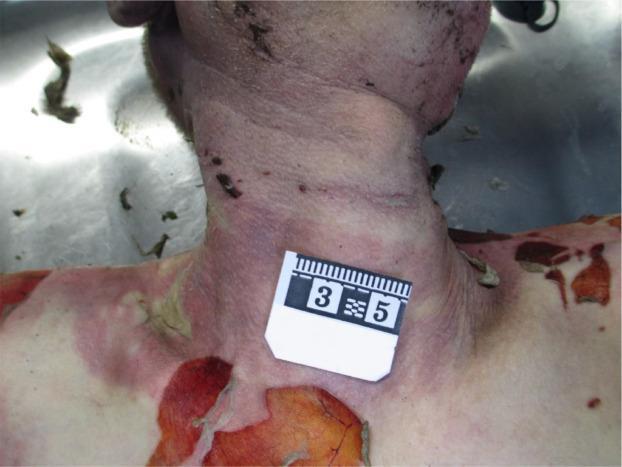
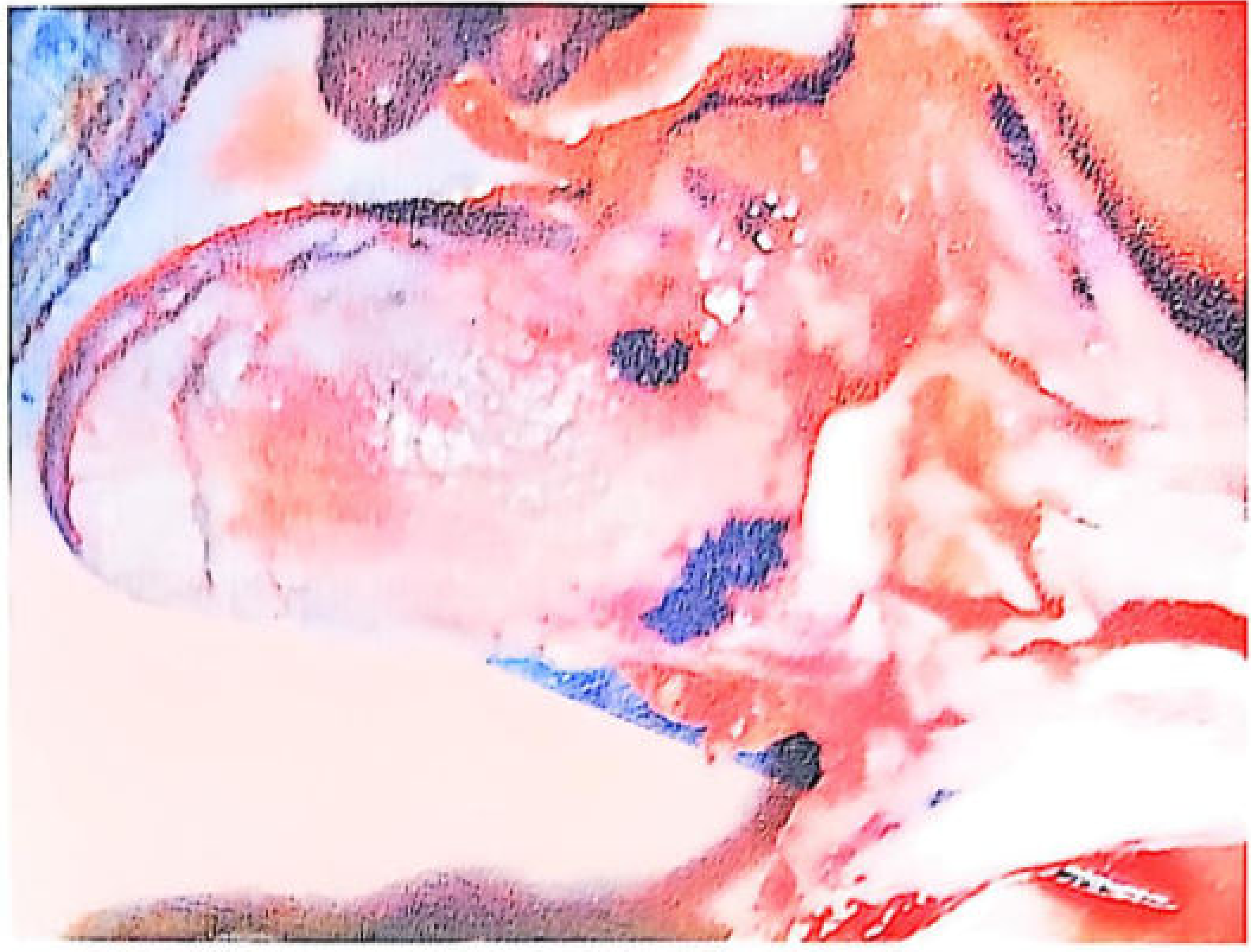
This forensic clinical photograph depicts the anterior neck and upper torso of a deceased individual, illustrating key post-mortem findings. A distinct, horizontally oriented ligature mark is visible across the mid-to-lower neck, characterized by a purplish, indented furrow indicating antemortem or perimortem constriction. The mark is described as 'open,' suggesting it does not fully encircle the neck without interruption. Surrounding the neck and extending onto the chest and shoulders are significant thermal injuries. These are characterized by patchy areas of erythema and extensive epidermal slippage (skin peeling) with yellowish to reddish-brown underlying dermis, consistent with post-mortem burn changes. Scattered dark punctate lesions and debris are also noted on the neck surface. A forensic scale is placed on the lower neck for measurement. The image serves as an educational resource for forensic pathology, demonstrating the visual differentiation between ligature strangulation marks and thermal artifacts on a cadaver.
Signs of Antemortem Hanging
A. External Signs
1. Ligature Mark (Furrow / Groove)
- Position: Oblique, directed upwards toward the point of suspension, typically above the thyroid cartilage, between the larynx and chin
- Direction: Ascends obliquely along the line of the mandible toward the mastoid processes; often absent or less marked at the nape (where the knot is)
- Character: Initially pale; becomes yellowish-brown, dry, hard, and parchment-like over time
- Abrasions and ecchymoses may be present at the site of the knot and in the base of the groove
- Skin tags (visible under hand lens) may indicate the direction of ligature movement (upward)
- Congested rim: Marginal hyperemia bordering the furrow
- Microscopy: Presence of vital tissue reaction (inflammatory response) in the skin and deeper tissues beneath the groove - this confirms antemortem hanging. However, absence of tissue reaction does NOT exclude antemortem hanging (Gordon et al.)
Note: A ligature mark can be reproduced if the body is suspended within 2 hours of death, so the mark alone is not pathognomonic.
2. Le Facie Sympathique (Vasque's Sign)
- When the ligature knot presses on the cervical sympathetic chain, the eye on the same side remains open with a dilated pupil (unilateral)
- This is a specific indicator of antemortem hanging
3. Face and Eyes
- Face may be pale (carotid compression dominant) or congested and cyanosed (venous obstruction dominant)
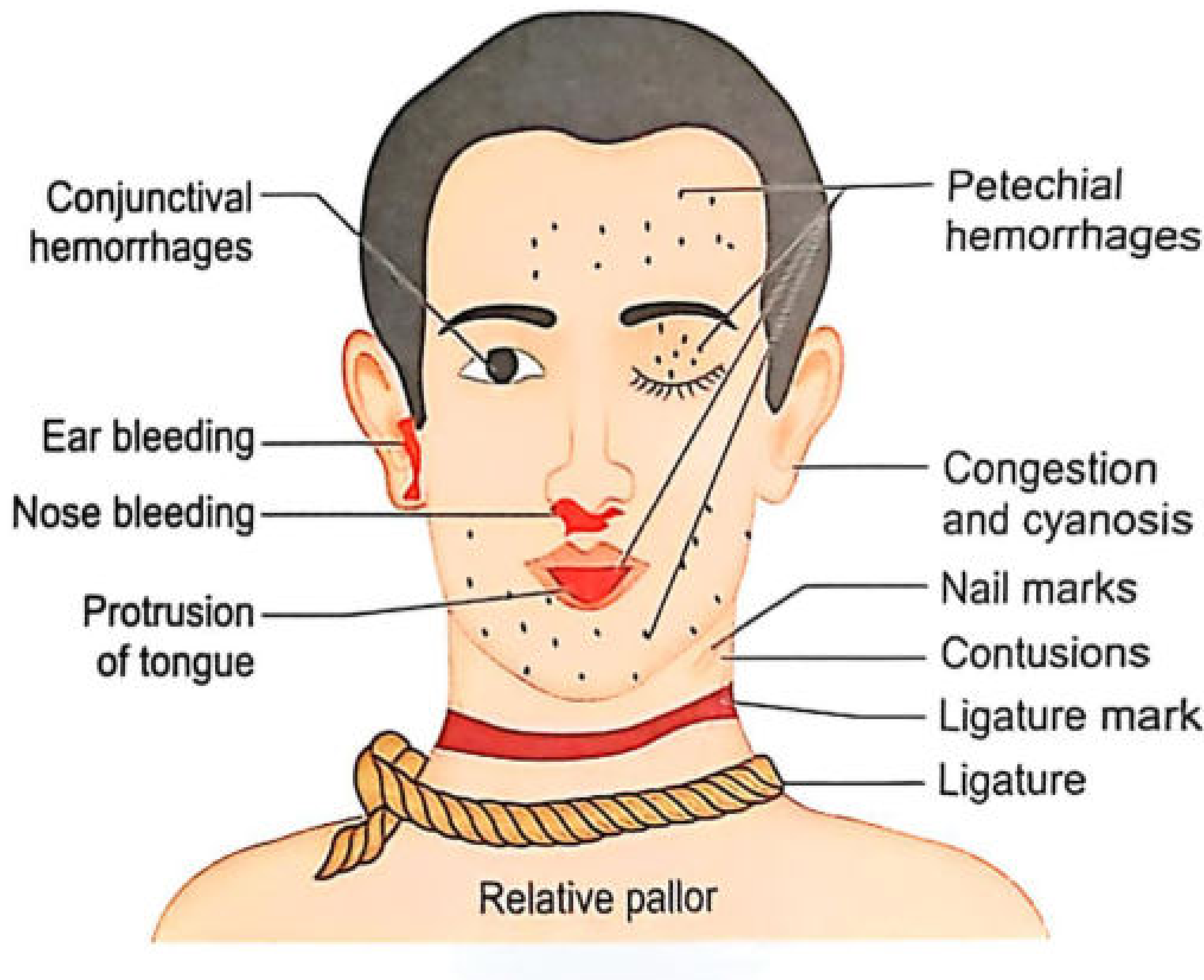
- Petechial hemorrhages (Tardieu spots) on conjunctivae, face, and scalp - seen when venous obstruction precedes arterial
- Eyeballs prominent due to congestion
- Conjunctival congestion and hemorrhage (may be unilateral if knot is on one side)
4. Tongue and Mouth
- Tongue may be swollen, blue, and forced against teeth
- Tip may protrude between lips/teeth (due to ligature lifting the glossopharyngeal skeleton), turning dark brown or black from drying
- Dribbling of saliva from the angle of the mouth (side opposite the knot) - due to stimulation of salivary glands / pterygopalatine ganglion by the ligature - indicates antemortem hanging
5. Hands and Other External Features
- Hands may be clenched (especially in violent hanging)
- Penile turgidity / semierection in males (from hypostasis after prolonged suspension)
- Postmortem lividity in dependent parts: legs, feet, forearms, hands, and occasionally external genitalia
- Escape of urine and feces from relaxation of sphincters
B. Internal Signs (Neck Dissection)
| Finding | Significance |
|---|---|
| Hemorrhages in neck strap muscles (~25%) | Suggestive of antemortem violence |
| Rupture of platysma or sternomastoid (5-10%) | Indicates considerable antemortem force |
| Transverse intimal tears/splits of carotid arteries at the groove (ipsilateral to knot) | Strong indicator of antemortem hanging - due to traction/stretching while alive |
| Extravasation of blood in carotid artery walls | Confirms vital reaction |
| Bruising of deep muscles at base of tongue | Crushing against hard palate by upward push of ligature |
| Hemorrhage in lymph nodes above and below ligature mark | Indicates antemortem congestion |
| Submucosal petechiae in epiglottis, larynx, trachea | Antemortem asphyxial change |
| Congested, edematous lungs with bloody serum on section | Asphyxial death feature |
| Subarachnoid effusion | Non-specific |
| Simon's hemorrhages - bleeding into outer layers of intervertebral discs (lumbar) | Seen in bodies suspended for long time (antemortem) |
| Hyoid bone fracture with blood at fracture site | Confirms antemortem injury; fracture alone is insufficient |
| Thyroid cartilage fracture with hemorrhage at site | Confirms antemortem |
Key rule: Fractures of the hyoid or thyroid cartilage can only be considered antemortem if blood is found at the fracture site. - DiMaio's Forensic Pathology
C. Histological / Microscopic Signs
| Finding | Significance |
|---|---|
| Vital tissue reaction (inflammatory infiltrate, vascular changes) in skin under ligature mark | Confirms antemortem hanging |
| Acid mucopolysaccharides: remain present in antemortem hanging marks (unlike vital bruises/abrasions where they disappear) | Suggestive of antemortem nature |
| Fibrin in vessels at groove site | Vital reaction |
| Absence of tissue reaction | Does NOT exclude antemortem hanging |
D. Summary Diagnostic Criteria for Antemortem Hanging
- Presence of an oblique ligature mark around the neck
- Abrasions, ecchymoses, and redness about the ligature mark
- Dribbling of saliva from the mouth
- Rupture of the intima of the carotid arteries
- Congestion and hemorrhage in lymph nodes above and below the ligature mark
- Absence of any other cause of death
- Postmortem signs of asphyxia
- Le facie sympathique (unilateral eye open with dilated pupil)
Antemortem vs Postmortem Hanging - Key Distinctions
| Feature | Antemortem Hanging | Postmortem Suspension |
|---|---|---|
| Ligature mark tissue reaction | Present | Absent (but absence doesn't exclude AM) |
| Carotid intimal tears with hemorrhage | Present | Absent |
| Hyoid/thyroid fracture + bleeding at site | Present | Absent |
| Dribbling of saliva | Present | Absent |
| Le facie sympathique | Present | Absent |
| Petechiae on conjunctiva/face | Present | Only on skin of legs/arms (gravitational) |
| Semen at tip of penis | May be present | Can occur (hypostasis) |
PM finding in case of ligature strangulation Give me answer for 5 marks question
Postmortem Findings in Ligature Strangulation
Definition
I. External Findings
- Face is markedly congested, cyanosed, and swollen (more pronounced than in hanging, because vertebral arteries continue to supply blood to the head while veins are compressed)
- Petechial hemorrhages (Tardieu spots) are seen in:
- Conjunctivae (bilateral, confluent scleral hemorrhage)
- Skin of eyelids, face, forehead, behind the ears, and scalp
- Present in 86% of ligature strangulation cases (DiMaio)
- Eyeballs prominent and congested
- Pupils dilated
- Tongue - swollen, bruised, bitten, may protrude between lips; tip may be dark brown from drying
- Seen as a groove / depression around the neck
- Position: at the level of thyroid cartilage or below (lower than in hanging); runs nearly horizontal, encircling the neck completely or nearly so
- Appearance: initially pale; later becomes yellowish-brown, dry, hard, and parchment-like
- Abrasions and ecchymoses along the edges confirm it was made during life
- Pattern of the ligature may be imprinted on skin (mirror image phenomenon / pressure abrasion)
- If ligature went around neck more than once: multiple parallel marks one above the other
- May be absent at nape if hair or clothing intervened
- Ligature mark may be faint or absent if a soft ligature (e.g., towel) was used and removed quickly
Distinction from hanging: In hanging the mark is oblique, ascending upward; in strangulation it is horizontal, at or below the thyroid cartilage.
II. Internal Findings
| Structure | Finding |
|---|---|
| Subcutaneous tissue under mark | Ecchymosed (hemorrhage more common than in hanging) |
| Strap/neck muscles | Hemorrhages (more pronounced than in hanging due to greater applied force) |
| Carotid arteries | May show intimal tears and subintimal hemorrhage |
| Superior horns of thyroid cartilage | Commonly fractured (level of ligature is at/near thyroid cartilage) |
| Hyoid bone | Rarely fractured (ligature usually below it); may fracture with considerable violence in persons >40 years |
| Trachea | Congested; may show mucosal hemorrhages |
| Larynx | Petechial hemorrhages on epiglottis, laryngeal mucosa |
| Lymph nodes | Congested above and below ligature mark |
- Lungs: congested, edematous; subpleural petechiae (Tardieu spots on pleura and epicardium)
- Heart: right side distended with dark blood; petechiae on pericardium
- Brain: congested; subarachnoid effusion
- Abdominal organs: generally congested
III. General (Asphyxial) Signs
- Blood - dark and fluid (due to hypoxia preventing coagulation)
- Postmortem lividity - well-marked on dependent parts
- Body temperature may be raised by 2-3°C due to ante-mortem convulsions
- Escape of urine and feces (sphincter relaxation)
- Signs of struggle may be present (injuries on face, chest, fingernail marks)
IV. Key Differences from Hanging (Exam Comparison)
| Feature | Ligature Strangulation | Hanging |
|---|---|---|
| Ligature mark level | At/below thyroid cartilage | Above thyroid cartilage (between larynx and chin) |
| Direction of mark | Horizontal, complete | Oblique, often incomplete at nape |
| Face | Deeply congested | Often pale (complete carotid occlusion) |
| Petechiae (face/conjunctivae) | Very prominent (86%) | Less marked |
| Hyoid fracture | Rare (ligature below it) | More common |
| Thyroid cartilage fracture | Superior horns commonly fractured | Less common |
| Manner of death | Usually homicidal | Usually suicidal |
Give me according essential of narayan reddy
Postmortem Findings in Ligature Strangulation
(As per Narayan Reddy - Essentials of Forensic Medicine & Toxicology)
EXTERNAL FINDINGS
1. Ligature Mark
- A well-defined, slightly depressed groove at any level on the neck, but usually about the middle or below the thyroid cartilage
- The mark completely encircles the neck transversely (nearly horizontal) - more prominent at front and sides than at back
- Initially pale; later becomes hard, yellow or brown and parchment-like with dried exudate forming a stiff film
- Cord/rope/wire: produces a deep groove with abraded, parchment-like base
- Soft material (towel/cloth): mark may be red, poorly defined, faint, or even absent; detectable under UV light
- Nylon/silk/terylene fabrics: may leave only a 2-3 mm wide mark (ridges of fabric dig in)
- Petechial hemorrhages immediately adjacent to the ligature mark - confirms the mark was made during life
- Narrow zone of reddening/congestion immediately above and below the groove (lateral blood displacement)
- Skin is pale below the ligature mark; puffy, edematous, congested, cyanotic and hemorrhagic above
- Scratches (vertical/crescentic) near the ligature from victim's attempts to pull it away; fingernails may carry skin debris
- Pattern of ligature may be imprinted on neck as a pressure abrasion (mirror image phenomenon)
- Multiple turns = multiple parallel marks; skin caught between loops may show bruising
2. Face and Head
- Face is puffy, edematous, congested and cyanotic (vertebral arteries continue to supply blood; veins compressed)
- Eyes: wide open, bulging, suffused, with confluent scleral hemorrhage; pupils dilated
- Petechial hemorrhages (Tardieu spots) common in:
- Skin of eyelids, conjunctivae
- Face, forehead, behind the ears, scalp
- Tongue: swollen, often bruised, dark-colored, protruded
- Bloody froth from mouth and nostrils; may be bleeding from nose and ears
- Hands usually clenched
Note: All asphyxial signs may be absent if death occurs rapidly from vagal inhibition (pressure on carotid sheath).
INTERNAL FINDINGS
- Superficial hemorrhage under ligature mark (often minimal)
- Severe engorgement and hemorrhage into tissues in and above the compressed area
- Adjacent neck muscles usually lacerated; deep muscles show little or no bruising if soft ligature used
- Sometimes: no external mark but extensive bruising of deeper tissues
- Subcapsular and interstitial thyroid hemorrhages are common
- Mucous membrane of pharynx, pyriform sinuses, epiglottis and larynx: hemorrhagic infiltration
- Lymphoid follicles at base of tongue and palatine tonsils: congested
- Posterior lingual mucosa, submaxillary and parotid glands: studded with petechiae
- Bruising of root of tongue and floor of mouth
- Hemorrhage under mucosa of larynx, especially beneath vocal cords (larger than petechial hemorrhages of asphyxia)
- Larynx, trachea and bronchi: congested; contain frothy, blood-stained mucus
- Intima usually NOT damaged by a soft ligature
- Carotid artery damage may occur if a narrow ligature is applied with force
- Fracture of superior horns of thyroid cartilage is more common (ligature is at thyroid level)
- Hyoid fracture is rare (ligature is usually below it; occurs with considerable violence or in persons >40 years)
- Fracture is considered antemortem only if blood is present at the fracture site
- Lungs: congested, edematous; subpleural (Tardieu) petechiae
- Heart: right side engorged with dark fluid blood; petechiae on epicardium/pericardium
- All thoracic and abdominal viscera: intensely congested
- Blood: dark and fluid throughout
Summary Table (Narayan Reddy)
| Feature | Ligature Strangulation |
|---|---|
| Ligature mark level | At/below thyroid cartilage |
| Direction of mark | Horizontal, nearly complete |
| Face | Markedly congested, cyanosed |
| Petechiae | Prominent - face, conjunctivae, scalp |
| Tongue | Swollen, bruised, protruded |
| Thyroid cartilage | Superior horns commonly fractured |
| Hyoid bone | Rarely fractured |
| Carotid intima | Usually intact (damaged only with narrow forceful ligature) |
| Thyroid hemorrhage | Subcapsular/interstitial - common |
| Manner of death | Usually homicidal |
Create a pdf of the given information about ligature strangulation Give
ls -la /tmp/workspace/ 2>/dev/null || mkdir -p /tmp/workspace && echo "workspace ready"
mkdir -p /tmp/workspace/forensic-pdf && python3 << 'EOF' from reportlab.lib.pagesizes import A4 from reportlab.lib.styles import getSampleStyleSheet, ParagraphStyle from reportlab.lib.units import cm from reportlab.lib import colors from reportlab.platypus import (SimpleDocTemplate, Paragraph, Spacer, Table, TableStyle, HRFlowable, KeepTogether) from reportlab.lib.enums import TA_CENTER, TA_LEFT, TA_JUSTIFY OUTPUT = "/tmp/workspace/forensic-pdf/Ligature_Strangulation_PM_Findings.pdf" doc = SimpleDocTemplate( OUTPUT, pagesize=A4, rightMargin=2*cm, leftMargin=2*cm, topMargin=2.5*cm, bottomMargin=2.5*cm, title="Postmortem Findings in Ligature Strangulation", author="Narayan Reddy – Essentials of Forensic Medicine & Toxicology" ) styles = getSampleStyleSheet() # Custom styles TITLE = ParagraphStyle('title', parent=styles['Title'], fontSize=18, textColor=colors.HexColor('#1a237e'), spaceAfter=6, leading=22, alignment=TA_CENTER) SUBTITLE = ParagraphStyle('subtitle', parent=styles['Normal'], fontSize=11, textColor=colors.HexColor('#37474f'), spaceAfter=14, alignment=TA_CENTER, italic=True) H1 = ParagraphStyle('h1', parent=styles['Heading1'], fontSize=13, textColor=colors.white, backColor=colors.HexColor('#1a237e'), spaceBefore=14, spaceAfter=6, leading=18, leftIndent=-8, rightIndent=-8, borderPad=5) H2 = ParagraphStyle('h2', parent=styles['Heading2'], fontSize=11, textColor=colors.HexColor('#1a237e'), spaceBefore=10, spaceAfter=4, leading=15, borderWidth=0, borderPad=0) BODY = ParagraphStyle('body', parent=styles['Normal'], fontSize=10, leading=15, spaceAfter=4, alignment=TA_JUSTIFY) BULLET = ParagraphStyle('bullet', parent=styles['Normal'], fontSize=10, leading=15, spaceAfter=3, leftIndent=14, bulletIndent=4) NOTE = ParagraphStyle('note', parent=styles['Normal'], fontSize=9.5, leading=13, spaceAfter=4, textColor=colors.HexColor('#b71c1c'), leftIndent=10, borderWidth=1, borderColor=colors.HexColor('#b71c1c'), borderPad=4, backColor=colors.HexColor('#fff3f3')) SOURCE = ParagraphStyle('source', parent=styles['Normal'], fontSize=8.5, textColor=colors.HexColor('#546e7a'), alignment=TA_CENTER, spaceAfter=4) story = [] # ── TITLE ────────────────────────────────────────────────────────────────── story.append(Paragraph("Postmortem Findings in Ligature Strangulation", TITLE)) story.append(Paragraph( "As per <i>The Essentials of Forensic Medicine & Toxicology</i> — K.S. Narayan Reddy, 36th Edition (2026)", SUBTITLE)) story.append(HRFlowable(width="100%", thickness=2, color=colors.HexColor('#1a237e'))) story.append(Spacer(1, 10)) # ── DEFINITION ───────────────────────────────────────────────────────────── story.append(Paragraph("DEFINITION", H1)) story.append(Paragraph( "Strangulation is a form of asphyxia caused by constriction of the neck by a " "ligature or by hands or any other means, <b>without suspending the body</b>. " "In ligature strangulation, the constricting force is applied by <b>external force " "other than body weight</b> (distinguishing it from hanging).", BODY)) # ── CAUSE OF DEATH ───────────────────────────────────────────────────────── story.append(Paragraph("CAUSE OF DEATH", H1)) bullets_cod = [ "Asphyxia – elevation of larynx and tongue closes airway at pharyngeal level", "Cerebral anoxia or venous congestion", "Combined asphyxia and venous congestion", "Vagal inhibition – pressure on carotid sheath", "Fracture-dislocation of cervical vertebrae (rare)", ] for b in bullets_cod: story.append(Paragraph(f"• {b}", BULLET)) # ── EXTERNAL PM FINDINGS ─────────────────────────────────────────────────── story.append(Spacer(1, 6)) story.append(Paragraph("EXTERNAL POSTMORTEM FINDINGS", H1)) story.append(Paragraph("1. Ligature Mark", H2)) lm_data = [ ["Feature", "Description"], ["Position", "At/below thyroid cartilage; usually about middle of neck"], ["Direction", "Nearly HORIZONTAL; completely encircles neck\n(more prominent front and sides)"], ["Early appearance", "Pale, soft groove"], ["Later appearance", "Yellowish-brown, dry, hard, PARCHMENT-LIKE"], ["Rope/cord/wire", "Deep, well-defined groove with abraded parchment base"], ["Soft cloth/towel", "Faint or absent mark; detectable under UV light"], ["Nylon/silk fabric", "Narrow 2–3 mm mark (ridges of fabric imprint on skin)"], ["Borders", "Narrow zone of reddening/congestion above & below groove"], ["Below ligature", "Pale skin"], ["Above ligature", "Puffy, edematous, congested, cyanotic, hemorrhagic"], ["Petechiae at mark", "Immediately adjacent – confirms mark made DURING LIFE"], ["Multiple turns", "Multiple parallel marks; bruising if skin caught between loops"], ["Scratches", "Vertical/crescentic nail marks near ligature (victim's attempt to remove)"], ["Pattern transfer", "Mirror image / pressure abrasion of ligature pattern on skin"], ] lm_table = Table(lm_data, colWidths=[5*cm, 11*cm]) lm_table.setStyle(TableStyle([ ('BACKGROUND', (0,0), (-1,0), colors.HexColor('#1a237e')), ('TEXTCOLOR', (0,0), (-1,0), colors.white), ('FONTNAME', (0,0), (-1,0), 'Helvetica-Bold'), ('FONTSIZE', (0,0), (-1,-1), 9), ('ROWBACKGROUNDS', (0,1), (-1,-1), [colors.HexColor('#e8eaf6'), colors.white]), ('GRID', (0,0), (-1,-1), 0.4, colors.HexColor('#9fa8da')), ('VALIGN', (0,0), (-1,-1), 'TOP'), ('LEFTPADDING', (0,0), (-1,-1), 6), ('RIGHTPADDING', (0,0), (-1,-1), 6), ('TOPPADDING', (0,0), (-1,-1), 4), ('BOTTOMPADDING', (0,0), (-1,-1), 4), ('FONTNAME', (0,1), (0,-1), 'Helvetica-Bold'), ])) story.append(lm_table) story.append(Spacer(1, 8)) story.append(Paragraph("2. Face and Head", H2)) face_bullets = [ "<b>Face</b>: puffy, edematous, markedly congested and cyanotic (vertebral arteries continue to supply blood; veins compressed)", "<b>Eyes</b>: wide open, bulging, suffused; confluent scleral hemorrhage; pupils dilated", "<b>Petechial hemorrhages (Tardieu spots)</b>: skin of eyelids, conjunctivae, face, forehead, behind ears, scalp", "<b>Tongue</b>: swollen, often bruised, dark-colored, protruded between lips", "<b>Bloody froth</b> from mouth and nostrils; bleeding from nose and ears", "<b>Hands</b>: usually clenched", "<b>Genital organs</b>: may be congested; discharge of urine, feces, seminal fluid", ] for b in face_bullets: story.append(Paragraph(f"• {b}", BULLET)) story.append(Spacer(1, 4)) story.append(Paragraph( "⚠ NOTE: All asphyxial signs may be ABSENT if death occurs rapidly from vagal inhibition " "(sudden pressure on carotid sheath).", NOTE)) # ── INTERNAL PM FINDINGS ─────────────────────────────────────────────────── story.append(Paragraph("INTERNAL POSTMORTEM FINDINGS", H1)) story.append(Paragraph( "<i>Neck examined AFTER removal of brain and chest organs (to allow blood to drain from neck vessels)</i>", ParagraphStyle('italic_body', parent=BODY, textColor=colors.HexColor('#37474f')))) story.append(Spacer(1, 4)) story.append(Paragraph("A. Neck Structures", H2)) neck_bullets = [ "<b>Superficial hemorrhage</b> under ligature mark (often minimal)", "<b>Severe engorgement and hemorrhage</b> into tissues in and above the compressed area", "<b>Adjacent neck muscles</b>: usually lacerated", "<b>Deep muscles</b>: little or no bruising if soft ligature used (but may show extensive deep bruising with no external mark)", "<b>Subcapsular and interstitial thyroid hemorrhages</b> — common and characteristic", "<b>Mucous membrane</b> of pharynx, pyriform sinuses, epiglottis, larynx: hemorrhagic infiltration", "<b>Lymphoid follicles</b> at base of tongue and palatine tonsils: congested", "<b>Submaxillary and parotid glands</b>, posterior lingual mucosa: studded with petechiae", "<b>Bruising of root of tongue</b> and floor of mouth", "<b>Hemorrhage under laryngeal mucosa</b>, especially below vocal cords (larger than asphyxial petechiae)", "<b>Larynx, trachea, bronchi</b>: congested; frothy blood-stained mucus", "<b>Carotid arteries</b>: intima usually intact; damaged only if narrow ligature applied with great force", ] for b in neck_bullets: story.append(Paragraph(f"• {b}", BULLET)) story.append(Paragraph("B. Hyoid Bone and Thyroid Cartilage", H2)) bone_data = [ ["Structure", "Finding", "Notes"], ["Superior horns of\nthyroid cartilage", "COMMONLY FRACTURED", "Ligature at thyroid level → direct compression"], ["Hyoid bone", "RARELY FRACTURED", "Ligature usually below it; fracture only with great violence or age >40 yrs"], ["Rule", "Fracture = antemortem ONLY if blood at fracture site", "Fracture alone is insufficient"], ] bone_table = Table(bone_data, colWidths=[4.5*cm, 5.5*cm, 6*cm]) bone_table.setStyle(TableStyle([ ('BACKGROUND', (0,0), (-1,0), colors.HexColor('#283593')), ('TEXTCOLOR', (0,0), (-1,0), colors.white), ('FONTNAME', (0,0), (-1,0), 'Helvetica-Bold'), ('FONTSIZE', (0,0), (-1,-1), 9), ('ROWBACKGROUNDS', (0,1), (-1,-1), [colors.HexColor('#e8eaf6'), colors.white]), ('GRID', (0,0), (-1,-1), 0.4, colors.HexColor('#9fa8da')), ('VALIGN', (0,0), (-1,-1), 'TOP'), ('LEFTPADDING', (0,0), (-1,-1), 6), ('TOPPADDING', (0,0), (-1,-1), 4), ('BOTTOMPADDING', (0,0), (-1,-1), 4), ('FONTNAME', (0,1), (0,-1), 'Helvetica-Bold'), ])) story.append(bone_table) story.append(Spacer(1, 8)) story.append(Paragraph("C. Thoracic and Abdominal Viscera", H2)) viscera_bullets = [ "<b>Lungs</b>: congested, edematous; subpleural Tardieu petechiae", "<b>Heart</b>: right side engorged with dark fluid blood; petechiae on pericardium/epicardium", "<b>Blood</b>: dark and fluid throughout (hypoxia prevents clotting)", "<b>All viscera</b>: intensely congested (Fig. 13.24, Narayan Reddy)", "<b>Brain</b>: congested; subarachnoid effusion possible", ] for b in viscera_bullets: story.append(Paragraph(f"• {b}", BULLET)) # ── COMPARISON TABLE ─────────────────────────────────────────────────────── story.append(Paragraph("HANGING vs. LIGATURE STRANGULATION — KEY DIFFERENCES", H1)) comp_data = [ ["Feature", "Ligature Strangulation", "Hanging"], ["Ligature mark level", "At/below thyroid cartilage", "Above thyroid cartilage\n(between larynx and chin)"], ["Direction of mark", "Horizontal; complete", "Oblique (upward); often\nincomplete at nape"], ["Face", "Markedly congested,\ncyanosed, puffy", "Often pale\n(complete carotid occlusion)"], ["Petechiae on face/conjunctivae", "Very prominent\n(86% of cases)", "Less marked"], ["Tongue", "Swollen, bruised, dark,\nprotruded", "Swollen; tip may protrude\nand dry"], ["Thyroid cartilage", "Superior horns commonly\nfractured", "Less common"], ["Hyoid bone", "Rarely fractured", "More common\n(15–20% avg)"], ["Carotid intima", "Usually intact", "Transverse intimal tears\n(antemortem indicator)"], ["Thyroid hemorrhage", "Common\n(subcapsular/interstitial)", "Rare"], ["Manner of death", "Usually HOMICIDAL", "Usually SUICIDAL"], ["Le facie sympathique", "Absent", "Present (if knot on\ncervical sympathetic)"], ] comp_table = Table(comp_data, colWidths=[5*cm, 5.5*cm, 5.5*cm]) comp_table.setStyle(TableStyle([ ('BACKGROUND', (0,0), (-1,0), colors.HexColor('#1a237e')), ('TEXTCOLOR', (0,0), (-1,0), colors.white), ('FONTNAME', (0,0), (-1,0), 'Helvetica-Bold'), ('FONTSIZE', (0,0), (-1,-1), 9), ('ROWBACKGROUNDS', (0,1), (-1,-1), [colors.HexColor('#e8eaf6'), colors.white]), ('GRID', (0,0), (-1,-1), 0.4, colors.HexColor('#9fa8da')), ('VALIGN', (0,0), (-1,-1), 'TOP'), ('LEFTPADDING', (0,0), (-1,-1), 6), ('TOPPADDING', (0,0), (-1,-1), 4), ('BOTTOMPADDING', (0,0), (-1,-1), 4), ('FONTNAME', (0,1), (0,-1), 'Helvetica-Bold'), ('BACKGROUND', (1,1), (1,-1), colors.HexColor('#fce4ec')), ('BACKGROUND', (2,1), (2,-1), colors.HexColor('#e8f5e9')), ])) story.append(comp_table) story.append(Spacer(1, 10)) # ── MANNER OF DEATH ──────────────────────────────────────────────────────── story.append(Paragraph("MANNER OF DEATH", H1)) manner_bullets = [ "<b>Homicidal</b>: Most common. Victim unable to apply sufficient ligature force on themselves; signs of struggle may be present", "<b>Suicidal</b>: Rare. Ligature found in situ with multiple turns; signs of venous congestion very well developed above ligature; no signs of struggle", "<b>Accidental</b>: Rare. Entanglement in ropes, machinery, window cords (common in children); clothing caught in moving parts", ] for b in manner_bullets: story.append(Paragraph(f"• {b}", BULLET)) # ── SOURCE ───────────────────────────────────────────────────────────────── story.append(Spacer(1, 12)) story.append(HRFlowable(width="100%", thickness=1, color=colors.HexColor('#9fa8da'))) story.append(Spacer(1, 4)) story.append(Paragraph( "Source: The Essentials of Forensic Medicine and Toxicology, K.S. Narayan Reddy, 36th Edition, 2026 · " "Also referenced: Parikh's Textbook of Medical Jurisprudence; DiMaio's Forensic Pathology, 3rd Ed.; " "P.C. Dikshit Textbook of Forensic Medicine and Toxicology", SOURCE)) doc.build(story) print("PDF created successfully:", OUTPUT) EOF
Ligature Strangulation PM Findings
PDF Document · PDF
- Definition and Cause of Death
- External PM Findings - Ligature mark (detailed table), face/head changes, Tardieu spots
- Internal PM Findings - Neck structures, thyroid hemorrhages, hyoid/thyroid cartilage fractures, visceral findings
- Hanging vs. Ligature Strangulation comparison table (color-coded)
- Manner of Death (Homicidal / Suicidal / Accidental)
- Source citation (Narayan Reddy 36th ed.)
Give me a pdf of Short notes on manual strangulation and its MLI according to narayan reddy book
python3 << 'EOF' from reportlab.lib.pagesizes import A4 from reportlab.lib.styles import getSampleStyleSheet, ParagraphStyle from reportlab.lib.units import cm from reportlab.lib import colors from reportlab.platypus import (SimpleDocTemplate, Paragraph, Spacer, Table, TableStyle, HRFlowable, KeepTogether) from reportlab.lib.enums import TA_CENTER, TA_LEFT, TA_JUSTIFY OUTPUT = "/tmp/workspace/forensic-pdf/Manual_Strangulation_Throttling.pdf" doc = SimpleDocTemplate( OUTPUT, pagesize=A4, rightMargin=2*cm, leftMargin=2*cm, topMargin=2.5*cm, bottomMargin=2.5*cm, title="Manual Strangulation (Throttling) – Short Notes & MLI", author="Narayan Reddy – Essentials of Forensic Medicine & Toxicology, 36th Ed." ) styles = getSampleStyleSheet() DARK = colors.HexColor('#1b5e20') # dark green theme MID = colors.HexColor('#2e7d32') LIGHT= colors.HexColor('#e8f5e9') ACC = colors.HexColor('#b71c1c') GRID = colors.HexColor('#a5d6a7') TITLE_S = ParagraphStyle('title_s', parent=styles['Title'], fontSize=18, textColor=DARK, spaceAfter=4, leading=22, alignment=TA_CENTER) SUBTITLE_S = ParagraphStyle('subtitle_s', parent=styles['Normal'], fontSize=10.5, textColor=colors.HexColor('#4e342e'), spaceAfter=12, alignment=TA_CENTER, italic=True) H1 = ParagraphStyle('h1', parent=styles['Heading1'], fontSize=12, textColor=colors.white, backColor=DARK, spaceBefore=12, spaceAfter=5, leading=17, leftIndent=-8, rightIndent=-8, borderPad=5) H2 = ParagraphStyle('h2', parent=styles['Heading2'], fontSize=11, textColor=DARK, spaceBefore=8, spaceAfter=3, leading=15) BODY = ParagraphStyle('body', parent=styles['Normal'], fontSize=10, leading=15, spaceAfter=4, alignment=TA_JUSTIFY) BULLET = ParagraphStyle('bullet', parent=styles['Normal'], fontSize=10, leading=15, spaceAfter=3, leftIndent=16, bulletIndent=6) SUB_BULLET = ParagraphStyle('sub_bullet', parent=styles['Normal'], fontSize=9.5, leading=14, spaceAfter=2, leftIndent=30, bulletIndent=20) NOTE = ParagraphStyle('note', parent=styles['Normal'], fontSize=9.5, leading=13, spaceAfter=5, textColor=ACC, leftIndent=8, borderWidth=1, borderColor=ACC, borderPad=4, backColor=colors.HexColor('#fff3f3')) KEYBOX = ParagraphStyle('keybox', parent=styles['Normal'], fontSize=9.5, leading=13, spaceAfter=5, textColor=DARK, leftIndent=8, borderWidth=1, borderColor=DARK, borderPad=4, backColor=LIGHT) SOURCE_S = ParagraphStyle('source_s', parent=styles['Normal'], fontSize=8.5, textColor=colors.HexColor('#546e7a'), alignment=TA_CENTER, spaceAfter=4) story = [] # ── TITLE ────────────────────────────────────────────────────────────────── story.append(Paragraph("Manual Strangulation (Throttling)", TITLE_S)) story.append(Paragraph("Short Notes & Medicolegal Importance", TITLE_S)) story.append(Paragraph( "As per <i>The Essentials of Forensic Medicine & Toxicology</i> — " "K.S. Narayan Reddy, 36th Edition (2026)", SUBTITLE_S)) story.append(HRFlowable(width="100%", thickness=2, color=DARK)) story.append(Spacer(1, 8)) # ── DEFINITION ───────────────────────────────────────────────────────────── story.append(Paragraph("DEFINITION", H1)) story.append(Paragraph( "Asphyxia produced by compression of the neck by <b>human hands</b> is called " "<b>Throttling</b> or Manual Strangulation. It is a form of strangulation where the " "constricting force is the pressure of fingers, thumb or palm — " "<b>not body weight and not a ligature</b>.", BODY)) story.append(Paragraph( "⚡ Cause of Death: Primarily <b>occlusion of carotid arteries</b> or <b>vagal inhibition</b> " "(much more common than in ligature strangulation). Airway occlusion plays only a <b>minor role</b>.", KEYBOX)) # ── EXTERNAL PM FINDINGS ─────────────────────────────────────────────────── story.append(Paragraph("POSTMORTEM APPEARANCES — EXTERNAL", H1)) story.append(Paragraph("1. Bruises on the Neck (Most Important)", H2)) story.append(Paragraph( "The situation and extent of bruises depend on: <i>relative positions of assailant and victim, " "manner of grasping, and degree of pressure exerted.</i>", BODY)) grip_data = [ ["Type of Grip", "Pattern of Marks"], ["Right hand from FRONT", "Thumb impression on RIGHT side (under lower jaw over cornu of thyroid);\n" "Finger marks on LEFT side — obliquely downward and outward, one below the other"], ["Grip from BEHIND", "Pressure all around the neck; bruising more prominent at fingertip pressure points"], ["BOTH hands used", "Thumb of one hand + finger marks of other on either side; OR both thumbs on one side,\n" "several finger marks on opposite side"], ["One hand front, one hand back", "Bruises on BOTH front and back of neck"], ["Child / small neck / large hand", "Bruises may be towards the back of the neck"], ["Shifting grip / struggle", "Multiple scattered bruises at various levels and sides of the neck"], ] grip_table = Table(grip_data, colWidths=[4.5*cm, 11.5*cm]) grip_table.setStyle(TableStyle([ ('BACKGROUND', (0,0), (-1,0), DARK), ('TEXTCOLOR', (0,0), (-1,0), colors.white), ('FONTNAME', (0,0), (-1,0), 'Helvetica-Bold'), ('FONTSIZE', (0,0), (-1,-1), 9), ('ROWBACKGROUNDS', (0,1), (-1,-1), [LIGHT, colors.white]), ('GRID', (0,0), (-1,-1), 0.4, GRID), ('VALIGN', (0,0), (-1,-1), 'TOP'), ('LEFTPADDING', (0,0), (-1,-1), 5), ('TOPPADDING', (0,0), (-1,-1), 4), ('BOTTOMPADDING', (0,0), (-1,-1), 4), ('FONTNAME', (0,1), (0,-1), 'Helvetica-Bold'), ])) story.append(grip_table) story.append(Spacer(1, 6)) story.append(Paragraph( "Character of bruises: <b>Oval or round</b>, size of digit (1.5–2 cm); bleeding into contused " "area increases size. If fingers skid across skin, longer irregular marks along jaw/chin occur.", BODY)) story.append(Paragraph("2. Fingernail Abrasions (Scratches)", H2)) nail_bullets = [ "<b>Victim's own nails</b>: crescentic or irregular scratches on the neck from attempts to remove assailant's grip", "<b>Assailant's nails</b>: may produce linear abrasions on victim's neck; their nails may have skin debris from victim", "Nail marks appear similar whether produced just before or just after death; <b>contusions are only produced during life</b>", ] for b in nail_bullets: story.append(Paragraph(f"• {b}", BULLET)) story.append(Paragraph("3. General Asphyxial Signs", H2)) gen_bullets = [ "Face: <b>deeply cyanosed, congested, puffy</b> (vertebral arteries continue to flow; veins compressed)", "<b>Petechial hemorrhages</b> — conjunctivae, eyelids, face, forehead, behind ears, scalp", "Eyes: wide open, bulging; confluent scleral hemorrhage", "Tongue: swollen, bruised, dark-colored, protruded", "Bloody froth from mouth and nostrils", "Hands clenched; sphincter relaxation (urine/feces escape)", "<b>Signs absent</b> if rapid death from vagal inhibition (pale face, no asphyxial signs)", ] for b in gen_bullets: story.append(Paragraph(f"• {b}", BULLET)) # ── INTERNAL PM FINDINGS ─────────────────────────────────────────────────── story.append(Paragraph("POSTMORTEM APPEARANCES — INTERNAL", H1)) story.append(Paragraph( "<i>Neck must be dissected in a bloodless field (brain + thoraco-abdominal organs removed first; " "V-shaped incision from mastoid to manubrium sterni — Fig. 13.29, Narayan Reddy)</i>", ParagraphStyle('italic_note', parent=BODY, textColor=colors.HexColor('#37474f')))) story.append(Spacer(1, 4)) story.append(Paragraph("A. Neck Soft Tissues", H2)) neck_int = [ "Bruises in: <b>dermis, superficial fascia, deep fascia, strap muscles, thyroid gland substance</b>, submandibular glands", "Bruises usually separate; in some cases absent externally but present deeply", "<b>Severe engorgement and hemorrhage</b> into tissues above level of compression", "Adjacent neck muscles: <b>lacerated</b>; soft tissues compressed upward and backward against cervical vertebrae", "<b>Subcapsular and interstitial thyroid gland hemorrhages</b>", "<b>Tears of carotid intima</b> — 0.5–1 cm below bifurcation (examine longitudinally with blunt dissection)", "Mucosa of pharynx, pyriform sinuses, epiglottis, larynx: <b>hemorrhagic infiltration</b>", "Lymphoid follicles at base of tongue, palatine tonsils: congested", "Submaxillary and parotid glands studded with petechiae", "<b>Deep hemorrhages</b> at base of tongue", "Larynx, trachea, bronchi: congested; frothy blood-stained mucus; desquamated epithelium", ] for b in neck_int: story.append(Paragraph(f"• {b}", BULLET)) story.append(Paragraph("B. Hyoid Bone", H2)) story.append(Paragraph( "<b>Hyoid fracture is strongly suggestive of throttling</b> (inward compression type). " "The fingers squeeze the greater horns toward each other — fracture within 1 cm of tip; " "posterior fragment displaced inward; periosteum torn on outer side.", BODY)) hyoid_data = [ ["Type", "Mechanism", "Significance"], ["Inward compression\n(THROTTLING type)", "Fingers squeeze greater horns inward", "STRONGLY suggestive of throttling; periosteum torn externally"], ["Anteroposterior\ncompression", "Neck compressed front to back", "Seen in hanging with drop"], ["Avulsion fracture", "Muscle pull during violent neck movement", "May occur in hanging or extreme force"], ] hyoid_table = Table(hyoid_data, colWidths=[4.5*cm, 6.5*cm, 5*cm]) hyoid_table.setStyle(TableStyle([ ('BACKGROUND', (0,0), (-1,0), MID), ('TEXTCOLOR', (0,0), (-1,0), colors.white), ('FONTNAME', (0,0), (-1,0), 'Helvetica-Bold'), ('FONTSIZE', (0,0), (-1,-1), 9), ('ROWBACKGROUNDS', (0,1), (-1,-1), [LIGHT, colors.white]), ('GRID', (0,0), (-1,-1), 0.4, GRID), ('VALIGN', (0,0), (-1,-1), 'TOP'), ('LEFTPADDING', (0,0), (-1,-1), 5), ('TOPPADDING', (0,0), (-1,-1), 4), ('BOTTOMPADDING', (0,0), (-1,-1), 4), ('FONTNAME', (0,1), (0,-1), 'Helvetica-Bold'), ])) story.append(hyoid_table) story.append(Spacer(1, 6)) story.append(Paragraph("C. Thyroid Cartilage", H2)) tc_bullets = [ "<b>Superior horn fractures</b>: most common; only right may be broken if thumb applied on that side; indicates pressure but not necessarily fatal", "<b>Ala fractures</b>: midline or oblique; indicates considerable force", "<b>Cricoid cartilage fracture</b>: seen <b>almost exclusively in fatal cases of throttling</b> — important diagnostic sign", "Fracture considered antemortem ONLY if <b>blood at fracture site</b>; rough handling of body can fracture cartilage postmortem", ] for b in tc_bullets: story.append(Paragraph(f"• {b}", BULLET)) story.append(Paragraph("D. Other Internal Findings", H2)) other_int = [ "<b>Lungs</b>: congested, edematous; subpleural petechiae; pulmonary oedema; subpleural blebs", "<b>Brain</b>: congested; petechial hemorrhages in white matter; subarachnoid hemorrhages possible", "<b>Blood</b>: dark and fluid (hypoxia prevents clotting)", "<b>All viscera</b>: generally congested", ] for b in other_int: story.append(Paragraph(f"• {b}", BULLET)) story.append(Paragraph( "⚠ ARTEFACT WARNING: Spurious blood collections behind pharynx, larynx and on anterior spine are " "common postmortem artefacts — due to overdistension of pharyngo-laryngeal venous sinuses. " "These can mimic throttling. All neck structures must be examined IN SITU.", NOTE)) # ── MLI ─────────────────────────────────────────────────────────────────── story.append(Paragraph("MEDICOLEGAL IMPORTANCE (MLI)", H1)) story.append(Paragraph("1. Was Death Caused by Throttling?", H2)) mli1_bullets = [ "Cutaneous bruising and abrasions with hemorrhage in soft tissue (unusual in hanging/ligature strangulation)", "Extensive bruising with or without rupture of neck muscles", "Engorgement of tissues at and above level of compression", "Fracture of larynx, thyroid cartilage and hyoid bone", "<b>Cricoid cartilage fracture</b> — almost exclusively in throttling (pathognomonic)", "General signs of asphyxia", "Fingernail abrasions from victim's attempts to free himself", "Pressure must be applied for <b>at least 2 minutes</b> to cause death", "If suspended body shows extensive neck injuries → strong probability victim was <b>throttled first, then suspended</b> (homicide disguised as hanging)", "Hyoid bone fracture = <b>strongly suggestive of throttling</b>", ] for b in mli1_bullets: story.append(Paragraph(f"• {b}", BULLET)) story.append(Paragraph("2. Manner of Death", H2)) manner_data = [ ["Manner", "Features"], ["SUICIDAL\n(NOT POSSIBLE)", "Suicide by throttling is IMPOSSIBLE — compression produces rapid unconsciousness and fingers relax.\n" "A person might try to strangle himself with hands; on failure may resort to a ligature."], ["HOMICIDAL\n(MOST COMMON)", "Most common manner. Method of choice in infants, children, women.\n" "Adults throttled when intoxicated, drugged, stunned, or taken unawares.\n" "Signs of struggle usually present in adults.\n" "Often associated with rape or attempted rape.\n" "Contusions and fingernail abrasions on neck = PRESUMPTION OF HOMICIDE.\n" "Alleged assailant should be examined for scratches on back of hands and face."], ["ACCIDENTAL\n(RARE)", "Sudden grip of neck as demonstration of affection, joke, or physiological experiment → " "cardiac inhibition.\n" "Victim cannot have died instantaneously if bruising present (bruising requires beating heart)."], ] manner_table = Table(manner_data, colWidths=[3.5*cm, 12.5*cm]) manner_table.setStyle(TableStyle([ ('BACKGROUND', (0,0), (-1,0), DARK), ('TEXTCOLOR', (0,0), (-1,0), colors.white), ('FONTNAME', (0,0), (-1,0), 'Helvetica-Bold'), ('FONTSIZE', (0,0), (-1,-1), 9), ('ROWBACKGROUNDS', (0,1), (-1,-1), [LIGHT, colors.HexColor('#fff9c4'), colors.HexColor('#fce4ec')]), ('GRID', (0,0), (-1,-1), 0.4, GRID), ('VALIGN', (0,0), (-1,-1), 'TOP'), ('LEFTPADDING', (0,0), (-1,-1), 5), ('TOPPADDING', (0,0), (-1,-1), 4), ('BOTTOMPADDING', (0,0), (-1,-1), 4), ('FONTNAME', (0,1), (0,-1), 'Helvetica-Bold'), ('TEXTCOLOR', (0,2), (0,2), ACC), ])) story.append(manner_table) story.append(Spacer(1, 8)) story.append(Paragraph("3. Assessment of Force Used", H2)) force_bullets = [ "<b>Severe damage to neck structures</b> → considerable force → indicative of intent to injure or kill", "<b>Hyoid bone or laryngeal fracture</b> → appreciable force used → homicidal in nature (cannot be accidental touch)", "<b>Brief/minor neck contact</b> → consistent with restraint without intent to kill", "<b>Minor/absent damage</b> → does not exclude homicide (e.g., karate blow can kill without much damage)", "If only slight changes: <b>guarded opinion</b> about degree of force", ] for b in force_bullets: story.append(Paragraph(f"• {b}", BULLET)) story.append(Paragraph("4. Examination of the Alleged Assailant", H2)) assail_bullets = [ "Examine for <b>scratches and bruising</b> on face, arms, back of hands (inflicted by victim's fingernails)", "Take <b>fingernail scrapings</b> from assailant to compare with victim's tissue types", "Assailant's injuries may indicate correlation with victim's defensive actions", "Victim may have bitten assailant's hands or fingers", ] for b in assail_bullets: story.append(Paragraph(f"• {b}", BULLET)) story.append(Paragraph("5. Timing — Antemortem vs. Perimortem", H2)) story.append(Paragraph( "When throttling is attempted at about the moment of death, it may be impossible to " "determine with certainty whether the deceased was alive or dead at the time. " "<b>Nail marks appear similar whether produced just before or just after death. " "However, contusions (bruises) are produced ONLY during life.</b>", BODY)) story.append(Paragraph( "KEY RULE: Presence of contusions = antemortem throttling. " "Presence of nail marks alone = inconclusive (may be perimortem or postmortem).", KEYBOX)) # ── QUICK RECAP TABLE ───────────────────────────────────────────────────── story.append(Paragraph("QUICK REVISION — KEY FEATURES OF THROTTLING", H1)) recap_data = [ ["Feature", "Throttling"], ["Definition", "Asphyxia by human hand compression of neck"], ["Main cause of death", "Carotid occlusion / vagal inhibition (NOT airway)"], ["Bruise shape", "Oval/round, 1.5–2 cm (size of fingertip)"], ["Classic neck marks", "Thumb on one side, finger marks opposite (from grip pattern)"], ["Nail marks on neck", "Crescentic / linear — from victim trying to remove grip"], ["Cricoid fracture", "Almost exclusively in throttling — important diagnostic sign"], ["Hyoid fracture", "Strongly suggestive; inward compression type"], ["Thyroid fracture", "Superior horns most common; ala in severe cases"], ["Suicide", "IMPOSSIBLE"], ["Manner", "Predominantly HOMICIDAL"], ["Assailant examination", "Scratches on back of hands/face; nail scrapings"], ["Proof of antemortem", "CONTUSIONS (not nail marks alone)"], ["Fatal period", "Pressure for ≥2 minutes required"], ] recap_table = Table(recap_data, colWidths=[5*cm, 11*cm]) recap_table.setStyle(TableStyle([ ('BACKGROUND', (0,0), (-1,0), DARK), ('TEXTCOLOR', (0,0), (-1,0), colors.white), ('FONTNAME', (0,0), (-1,0), 'Helvetica-Bold'), ('FONTSIZE', (0,0), (-1,-1), 9), ('ROWBACKGROUNDS', (0,1), (-1,-1), [LIGHT, colors.white]), ('GRID', (0,0), (-1,-1), 0.4, GRID), ('VALIGN', (0,0), (-1,-1), 'TOP'), ('LEFTPADDING', (0,0), (-1,-1), 5), ('TOPPADDING', (0,0), (-1,-1), 4), ('BOTTOMPADDING', (0,0), (-1,-1), 4), ('FONTNAME', (0,1), (0,-1), 'Helvetica-Bold'), ])) story.append(recap_table) # ── SOURCE ───────────────────────────────────────────────────────────────── story.append(Spacer(1, 12)) story.append(HRFlowable(width="100%", thickness=1, color=GRID)) story.append(Spacer(1, 4)) story.append(Paragraph( "Source: The Essentials of Forensic Medicine and Toxicology, K.S. Narayan Reddy, 36th Edition (2026), " "Chapter 13 — Strangulation (pp. 343–353)", SOURCE_S)) doc.build(story) print("PDF created:", OUTPUT) EOF
Manual Strangulation Throttling
PDF Document · PDF
| Section | Content |
|---|---|
| Definition | Throttling = asphyxia by human hand; carotid occlusion / vagal inhibition (not airway) |
| External PM | Grip pattern table (6 types), bruise character, fingernail abrasions, asphyxial signs |
| Internal PM | Neck muscles, thyroid gland hemorrhage, carotid intima tears, hyoid fracture (inward compression type), cricoid/thyroid cartilage fractures, lung/brain changes |
| Artefact warning | Postmortem pharyngo-laryngeal blood collections can mimic throttling |
| MLI — 5 headings | Was it throttling? · Manner of death (suicide impossible!) · Force assessment · Assailant examination · Antemortem vs. perimortem timing |
| Quick revision table | All key facts at a glance |