
Myocarditis deseases basic to advance clinical explain kro
Reading File
Now let me search the library for comprehensive myocarditis content in parallel:
Finding Sources
Searching PubMed
myocarditis diagnosis management
Now let me read the most comprehensive sources in parallel - Braunwald's, Robbins Pathology, and Goldman-Cecil:
Reading File
Reading File
Reading File
Excellent content. Now let me read more from Braunwald's (the gold standard for cardiology) and Goldman-Cecil for clinical features and management:
Reading File
Reading File
Finding Sources
Now let me get the detailed clinical content from Fuster & Hurst's and the management section from Braunwald's:
Reading File
Reading File
Reading File
I now have comprehensive content. Let me also quickly fetch one key diagnostic image and get the Grainger & Allison radiology content for imaging findings:
Reading File
Loading Image
Excellent - I now have comprehensive, high-quality content from multiple authoritative textbooks. Let me also fetch the MRI image:
Loading Image
I now have all the content needed for a thorough, well-structured answer. Let me compile the complete clinical overview:
Myocarditis - Basic to Advanced Clinical Overview
1. Definition
Myocarditis is an inflammatory process involving the myocardium (heart muscle), characterized histologically by myocyte injury (degeneration or necrosis) with an inflammatory cellular infiltrate - not due to ischemia. It encompasses a diverse group of clinical entities triggered by infectious agents, immune-mediated processes, or toxins.
It is important to distinguish myocarditis from conditions like ischemic heart disease, where inflammation is secondary to another cause of myocardial injury.
- Goldman-Cecil Medicine, p. 511
- Robbins & Kumar Basic Pathology, p. 375
2. Epidemiology
- Incidence and prevalence are hard to estimate due to variable presentation (often subclinical)
- Population estimates: 1 in 100,000 to 1 in 10,000
- Postmortem studies: myocarditis found in up to 12% of young victims of sudden cardiac death
- More common in young adults and males
- May also be the inflammatory phase of arrhythmogenic cardiomyopathy
3. Etiology - Causes (Complete Classification)
A. Infectious Causes
| Category | Examples |
|---|---|
| Viral (most common in Western world) | Coxsackievirus A & B (most common), Enteroviruses, Adenovirus, Parvovirus B19, HHV-6, CMV, HIV, Influenza, SARS-CoV-2, Hepatitis C, RSV |
| Protozoal (most common worldwide) | Trypanosoma cruzi (Chagas disease), Toxoplasma gondii |
| Bacterial | Corynebacterium diphtheriae, Mycoplasma pneumoniae, Staphylococcus, Neisseria meningitidis, Mycobacterium, Brucella |
| Spirochetal | Borrelia burgdorferi (Lyme disease), Treponema pallidum, Leptospira |
| Fungal | Aspergillus, Candida, Cryptococcus, Histoplasma |
| Rickettsial | Rickettsia rickettsii, Coxiella burnetii |
| Parasitic | Trichinella spiralis, Echinococcus, Taenia solium |
B. Immune-Mediated Causes
- Autoantigens: SLE, polymyositis/dermatomyositis, systemic sclerosis, EGPA
- Alloantigens: Heart transplant rejection
- Allergen (drug hypersensitivity): Penicillin, sulfonamides, methyldopa, tetracycline, thiazides, tricyclic antidepressants
C. Toxic Causes
- Drugs: Anthracyclines, cocaine, amphetamines, cyclophosphamide, 5-FU, trastuzumab, checkpoint inhibitors (increasingly recognized), clozapine
- Physical agents: Electric shock, radiation, hyperpyrexia
- Heavy metals: Copper, iron, lead
- Others: Arsenic, snake bite, scorpion venom, carbon monoxide
D. Special Cases
-
mRNA COVID-19 vaccine myocarditis: Rare, especially in male adolescents/young adults after the 2nd dose, usually within 1 week - most recover uneventfully
-
Giant cell myocarditis (GCM): Rare, fulminant, aggressive - requires early immunosuppression
-
Eosinophilic myocarditis: Drug hypersensitivity or hypereosinophilic syndrome
-
Goldman-Cecil Medicine, Table 47-3, p. 510-511
-
Robbins & Kumar Basic Pathology, p. 375
4. Pathogenesis
Phase 1 - Direct Viral Invasion (Days 1-4)
Cardiotropic viruses enter cardiomyocytes via receptor-mediated endocytosis (e.g., Coxsackievirus binds CAR receptor). The viral genome is translated intracellularly and may contribute to myocyte dysfunction by cleaving dystrophin (a cytoskeletal protein).
Phase 2 - Innate Immune Activation (Days 4-14)
Natural killer (NK) cells and macrophages are recruited; proinflammatory cytokines (IL-1, TNF-alpha) are released. This phase can eliminate the virus but also injures cardiomyocytes.
Phase 3 - Adaptive Immune Response / Autoimmunity (Weeks onwards)
- Activation of CD4+ T lymphocytes promotes clonal expansion of B lymphocytes
- Circulating anti-heart antibodies are produced (against myosin heavy chain, adenine nucleotide translocator, beta-1 adrenoceptors, contractile and mitochondrial proteins)
- Molecular mimicry: Viral antigens cross-react with myocardial proteins
- This autoimmune response leads to long-term ventricular remodeling and extracellular matrix changes
Why Some Progress to Dilated Cardiomyopathy (DCM)?
Three proposed mechanisms:
- Immunopathogenic hypothesis - Abnormal immune response "smolders" into subacute/chronic phase
- Viral persistence - Virus persists in myocardium and drives ongoing inflammation
- Combined mechanisms - Both viral persistence + autoimmunity + possible genetic susceptibility
- Goldman-Cecil Medicine, p. 511
- Fuster & Hurst's The Heart 15e, p. (ch. 55)
5. Histopathology (Morphology)
Dallas Criteria (1986) - Still Referenced
Four patterns recognized on endomyocardial biopsy (EMB):
| Pattern | Definition |
|---|---|
| Active myocarditis | Myocyte degeneration/necrosis + definite cellular infiltrate ± fibrosis |
| Borderline myocarditis | Definite cellular infiltrate WITHOUT myocyte injury |
| Persistent myocarditis | Continued active myocarditis on repeat biopsy |
| Resolving/Resolved myocarditis | Diminished/absent infiltrate with connective tissue healing |
Limitation: Dallas criteria have low specificity and sensitivity - diagnostic yield as low as 10-20% in some series.
Microscopic Appearance (Viral)
- Myocardium: edema, interstitial inflammatory infiltrates, myocyte injury
- Diffuse lymphocytic infiltrate is most common
- In acute phase: heart appears normal or dilated, may be flabby and mottled with pale/hemorrhagic areas
- Mural thrombi may be present
Giant Cell Myocarditis (Special)
- Multinucleated giant cells + eosinophils + lymphocytes
- Indicates aggressive disease with poor prognosis
Eosinophilic (Hypersensitivity) Myocarditis
-
Eosinophil-rich infiltrate
-
Often drug-related; typically mild but rarely causes CHF or sudden death
-
Robbins & Kumar Basic Pathology, p. 375
-
Goldman-Cecil Medicine, p. 511
6. Clinical Presentations
Myocarditis has an extremely variable clinical spectrum:
A. Asymptomatic / Subclinical
- Most common form
- Manifests only as transient ECG abnormalities (nonspecific ST-T changes)
- Discovered incidentally
B. Myopericarditis (Chest Pain Syndrome)
- Prodrome: Fever, myalgia, coryza, gastroenteritis (viral illness 1-2 weeks prior)
- Chest pain - sharp, pleuritic, mimics ACS (but coronaries are normal!)
- Mildly elevated troponin
- Usually good prognosis if LV function preserved
- ~15% may develop recurrent myopericarditis
C. New-Onset Heart Failure / Dilated Cardiomyopathy
- Exertional dyspnea, fatigue, orthopnea, PND
- Signs of LV failure
- Most common presentation requiring hospitalization
D. Acute/Fulminant Myocarditis
- Cardiogenic shock with acute cardiovascular collapse
- Rapid hemodynamic compromise
- May require mechanical circulatory support
- Paradoxically, can have better long-term prognosis than subacute forms if patient survives the acute phase
E. Arrhythmia Presentation
- Palpitations, syncope, sudden cardiac death (sometimes the first presentation)
- PVCs, NSVT, accelerated idioventricular rhythm, polymorphic VT
- In lymphocytic myocarditis: PVCs often originate from inferior LV (RBBB + superior axis morphology)
- AV block (especially in Lyme disease - self-limited, may need temporary pacing)
- Ventricular arrhythmias persist even after apparent healing due to residual scar (late gadolinium enhancement substrate)
F. Autoimmune Rheumatic Disease Associated
-
SLE: Most common symptom = exertional dyspnea; ECG shows sinus tachycardia, ST-T changes; troponin I may rise markedly
-
Polymyositis/Dermatomyositis, SSc, EGPA: Also recognized associations
-
May be initial feature of underlying rheumatic disease
-
Goldman-Cecil Medicine, p. 512
-
Grainger & Allison Diagnostic Radiology, p. 330-331
-
Braunwald's Heart Disease, ch. 55
7. Diagnosis
High index of suspicion is required - myocarditis can mimic many common conditions.
Step 1: History & Physical
- Recent viral illness + new cardiac symptoms = high suspicion
- Physical exam: tachycardia, S3 gallop, signs of heart failure, friction rub (if pericarditis)
Step 2: Laboratory Tests
| Test | Findings |
|---|---|
| Troponin T/I | Elevated (may be absent even in biopsy-proven cases) |
| BNP/NT-proBNP | Elevated if HF present |
| CBC | Leukocytosis (especially eosinophilia in drug reactions) |
| ESR/CRP | Elevated (nonspecific) |
| Viral serology | Rising antibody titers (coxsackievirus, etc.) |
| ANA, anti-dsDNA, complement C3/C4 | If autoimmune cause suspected (SLE) |
| Myositis immunoblot screen | If polymyositis/dermatomyositis suspected |
| Anti-cardiac autoantibodies | Anti-myosin, anti-adenine nucleotide translocator - biomarkers of autoimmune myocarditis |
| miRNA | has-miR-Chr8:96 - seen in myocarditis, rarely in MI (emerging biomarker) |
Step 3: ECG
- Most common: sinus tachycardia
- Nonspecific ST-T wave changes
- Pathologic Q waves
- Low QRS voltages
- AV block (Lyme)
- SVT / VT / PVCs
Step 4: Echocardiography
No pathognomonic features, but may reveal:
- Impaired LV or RV systolic function (with or without dilation)
- Regional wall motion abnormalities
- LV thrombus
- Diastolic impairment
- Pericardial effusion
Step 5: Cardiac MRI (CMR) - Key Non-Invasive Tool
Lake Louise Criteria - CMR diagnosis based on:
- T2-weighted imaging - myocardial edema (T2 signal ratio >2.0)
- Early gadolinium enhancement (EGE) - hyperemia/capillary leak (global EGE ratio >4.0)
- Late gadolinium enhancement (LGE) - necrosis/fibrosis
Classic Pattern: Subepicardial LGE in the lateral and/or inferior wall - in a non-ischemic distribution (distinguishes from MI where LGE is subendocardial or transmural). In Takotsubo CMP, LGE is typically absent.
A negative LGE does NOT exclude myocarditis - early enhancement (EGE) should be assessed when macroscopic necrosis is absent.
CMR also detects:
- Coronary microvascular dysfunction (adenosine stress first-pass perfusion)
- Myocardial fibrosis for arrhythmic risk stratification
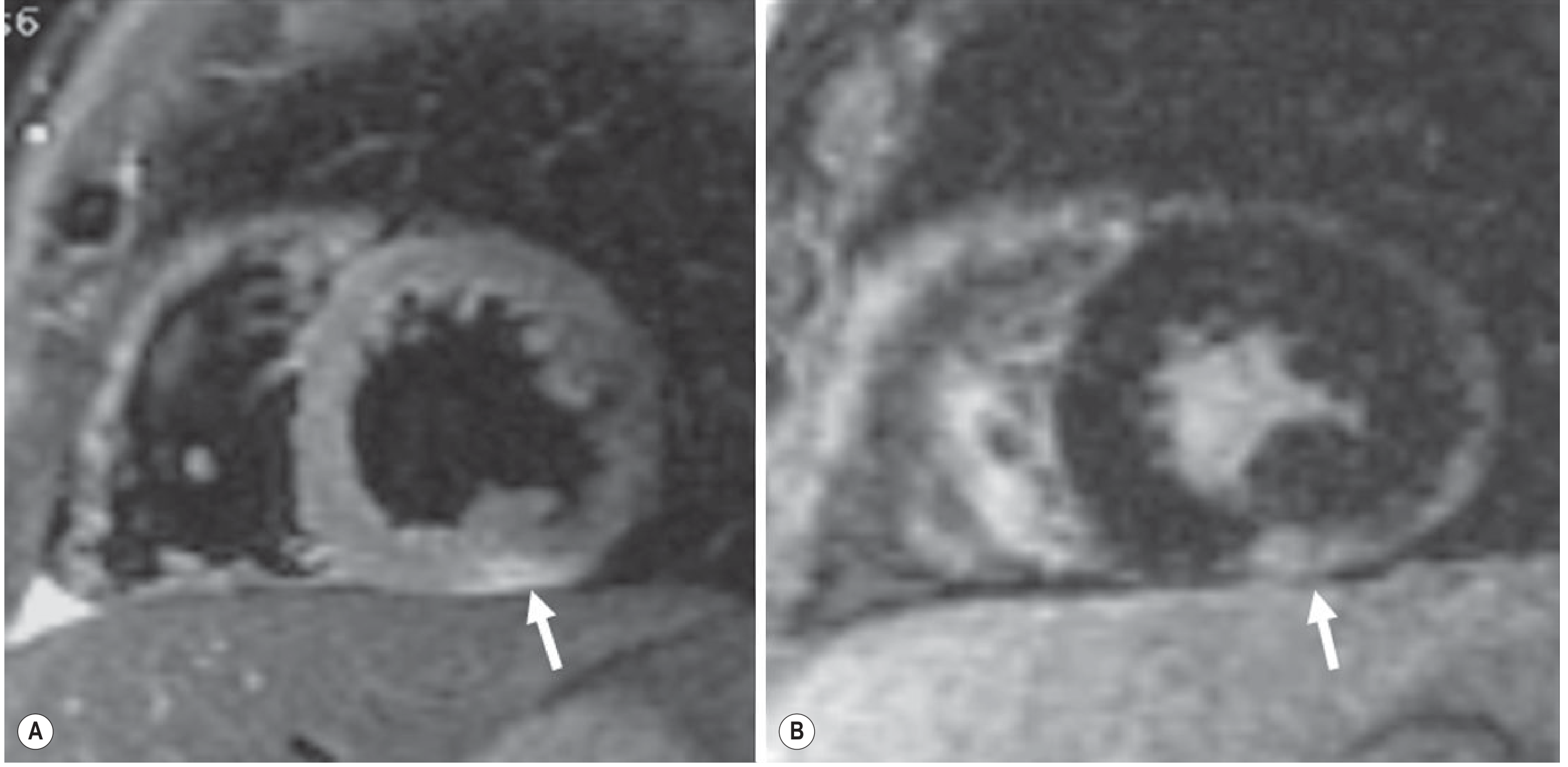
Fig: Acute Myocarditis CMR. (A) T2 STIR: subepicardial edema (arrow) inferior wall. (B) LGE: non-ischemic pattern. - Grainger & Allison Diagnostic Radiology
Step 6: Endomyocardial Biopsy (EMB) - Gold Standard
Still the definitive test, but reserved for specific indications due to sampling error and low sensitivity.
AHA/ACC Indications for EMB:
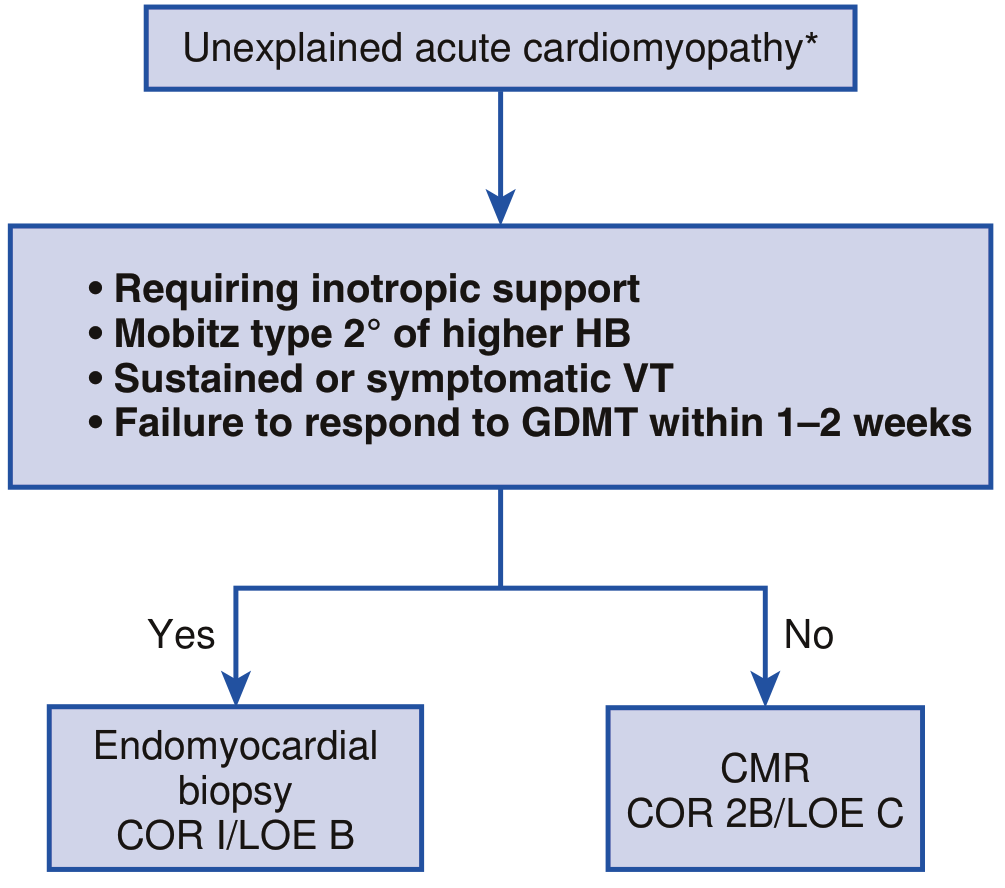
EMB is indicated (Class I) when:
- Requiring inotropic support
- Mobitz type 2° or higher heart block
- Sustained or symptomatic VT
- Failure to respond to guideline-directed medical therapy (GDMT) within 1-2 weeks
- Features suggesting systemic disease (amyloidosis, sarcoidosis, hemochromatosis)
Modern EMB analysis uses:
-
Conventional H&E + Dallas criteria
-
Immunohistochemistry - subtypes of infiltrating lymphocytes, abnormal cellular adhesion molecule expression
-
PCR/RT-PCR on extracted RNA/DNA - for viral genome detection
-
Immunofluorescence - immune complex deposition (in SLE)
-
Goldman-Cecil Medicine, p. 512
-
Grainger & Allison Diagnostic Radiology, p. 331
-
Braunwald's Heart Disease, Figure 55.7
8. Special Subtypes
Giant Cell Myocarditis (GCM)
- Rare, idiopathic, often associated with autoimmune diseases and thymoma
- Fulminant course - high mortality without treatment
- Histology: multinucleated giant cells, diffuse inflammation with eosinophils
- Requires combined immunosuppression (cyclosporine + steroids ± azathioprine)
- May need transplantation; disease can recur in transplanted heart
Chagas Disease (Trypanosoma cruzi)
- Most common infective myocarditis worldwide (~6 million infected in Latin America)
- ~300,000 infected in USA (immigration)
- Acute phase: Sometimes causes severe myocarditis, 10% die; often unrecognized
- Chronic phase (10-20 years later): Progressive CHF, RBBB + left anterior hemiblock, PVCs, apical aneurysm, VT, sudden death
- VT mechanism: scar-related reentry from inferolateral LV (RBBB + right axis morphology)
Lyme Myocarditis
- Occurs in ~5% of Lyme disease patients
- Primarily manifests as self-limited conduction system disease (AV block)
- Frequently requires temporary pacemaker
Immune Checkpoint Inhibitor (ICI) Myocarditis
- Increasingly recognized with cancer immunotherapy (PD-1/PD-L1/CTLA-4 inhibitors)
- Fulminant presentation common; high mortality (~40-50%)
- Requires immediate immunosuppression with high-dose corticosteroids + stopping ICI
COVID-19 / Post-mRNA Vaccine Myocarditis
- Vaccine: predominantly males <30 years, after 2nd dose, within 7 days
- Most resolve uneventfully with conservative management
- SARS-CoV-2 infection itself also causes lymphocytic myocarditis
9. Management
A. General Supportive Care (All Patients)
-
Bed rest - restrict strenuous physical activity for at least 3-6 months (competitive sports contraindicated)
-
Heart failure guideline-directed medical therapy (GDMT):
- ACE inhibitor / ARB - for LV dysfunction
- Beta-blockers - for HF with reduced EF
- Diuretics - for volume overload / congestion
- MRA (spironolactone/eplerenone) - if EF <35%
-
NSAIDs - useful for pericarditic chest pain; colchicine as adjunct
- Note: NSAIDs may worsen myocarditis in experimental models - use cautiously in pure myocarditis
-
Anticoagulation - if LV thrombus, AF, or severe LV dysfunction (EF <30%)
B. Hemodynamic Support (Fulminant)
- Vasopressors/inotropes - norepinephrine, dobutamine
- Intra-aortic balloon pump (IABP)
- Ventricular assist devices (VADs) - temporary (Impella, TandemHeart, ECMO)
- Permanent VAD as bridge to recovery or transplantation
C. Immunosuppressive Therapy
This is the most debated area. Current evidence:
| Situation | Recommendation |
|---|---|
| Routine acute viral myocarditis | NOT recommended (Myocarditis Treatment Trial showed no benefit) |
| Giant cell myocarditis | STRONGLY indicated - cyclosporine + prednisone ± azathioprine |
| Autoimmune (virus-negative) myocarditis | Beneficial - prednisone + azathioprine (anti-cardiac antibodies present, no viral genome) |
| SLE/PM-DM myocarditis | Effective immunosuppression improves outcomes |
| Eosinophilic/Hypersensitivity | Discontinue offending drug + corticosteroids |
| ICI-associated myocarditis | High-dose IV methylprednisolone + stop ICI |
| Sarcoid myocarditis | Corticosteroids |
Key trial: Myocarditis Treatment Trial (MTT) - 111 biopsy-proven patients randomized to prednisone + azathioprine or cyclosporine vs placebo. Both groups improved LVEF by ~9% - immunosuppression offered no additional benefit in unselected patients. This underscores the need to identify virus-negative, autoimmune subgroups first.
D. Antiviral Therapy
- No proven benefit currently for viral myocarditis in clinical trials
- Theoretical basis: if viral persistence drives inflammation, antivirals could help
- HIV myocarditis: highly active antiretroviral therapy (HAART)
E. Arrhythmia Management
- PVCs/NSVT: beta-blockers; antiarrhythmic drugs if needed
- AV block: temporary pacing (Lyme resolves spontaneously)
- ICD: Consider for:
- Sustained VT + depressed LV function
- LGE on CMR (arrhythmic risk marker)
- Inducible VT on EP testing
- Catheter ablation for recurrent VT: Challenging due to varied scar locations; recurrence rates >50%
F. Cardiac Transplantation
- Last resort for refractory end-stage heart failure
- Note: GCM can recur in the transplanted heart
10. Prognosis
| Clinical Scenario | Prognosis |
|---|---|
| Myopericarditis + preserved LV function | Excellent - most recover fully |
| Acute/fulminant myocarditis | Paradoxically better long-term survival if acute phase survived |
| Acute DCM from myocarditis | Intermediate - ~15% risk of death/transplantation |
| Giant cell myocarditis | Poor without aggressive immunosuppression |
| Children with acute myocarditis | LV recovery extends up to 8 years; ~30% risk death/transplant |
| DCM with LGE on CMR | Higher arrhythmic event risk |
| Persistent viral genomes on EMB | Associated with poorer outcome |
| Anti-cardiac autoantibodies present | May predict response to immunosuppression |
Long-term risk: Even after apparent clinical resolution, patients face risk of late HF due to diastolic dysfunction years later.
11. Summary Flow - Diagnostic Approach
Young patient + chest pain / HF / arrhythmia / prodromal viral illness
        ↓
ECG + Troponin + Echo
        ↓
Exclude ACS (coronary angiography if needed - normal coronaries in myocarditis)
        ↓
Cardiac MRI (Lake Louise Criteria)
        ↓
If hemodynamically unstable / no GDMT response / high-grade AV block / VT
        ↓
Endomyocardial Biopsy → Dallas criteria + Immunohistochemistry + PCR
        ↓
Subtype-directed treatment
Sources
- Braunwald's Heart Disease: A Textbook of Cardiovascular Medicine (Braunwald's)
- Goldman-Cecil Medicine International Edition (Goldman-Cecil)
- Robbins & Kumar Basic Pathology 10e (Robbins)
- Grainger & Allison's Diagnostic Radiology
- Fuster & Hurst's The Heart, 15th Edition
- Firestein & Kelley's Textbook of Rheumatology
This is a shared conversation. Sign in to Orris to start your own chat.