
Cushing’s syndrome
"Cushing syndrome" diagnosis treatment
python3 -c " import pdfplumber pdf_path = '/home/daytona/workspace/attachments/aceec4f9-886b-44d0-b43e-7db51d503f7f/Part 24 -The Endocrine System - Nelson 2024 (1).pdf' with pdfplumber.open(pdf_path) as pdf: print(f'Total pages: {len(pdf.pages)}') # Search for Cushing pages for i, page in enumerate(pdf.pages): text = page.extract_text() or '' if 'Cushing' in text or 'cushing' in text.lower(): print(f'Page {i+1}: Cushing found') "
Cushing syndrome clinical features moon face buffalo hump
python3 << 'EOF' import pdfplumber pdf_path = '/home/daytona/workspace/attachments/aceec4f9-886b-44d0-b43e-7db51d503f7f/Part 24 -The Endocrine System - Nelson 2024 (1).pdf' with pdfplumber.open(pdf_path) as pdf: print(f'Total pages: {len(pdf.pages)}') cushing_pages = [] for i, page in enumerate(pdf.pages): text = page.extract_text() or '' if 'Cushing' in text or 'cushing' in text.lower(): cushing_pages.append(i+1) print(f'Cushing pages: {cushing_pages}') EOF
python3 -c " import pdfplumber, sys pdf_path = '/home/daytona/workspace/attachments/aceec4f9-886b-44d0-b43e-7db51d503f7f/Part 24 -The Endocrine System - Nelson 2024 (1).pdf' with pdfplumber.open(pdf_path) as pdf: print(len(pdf.pages)) " 2>&1 | head -5
python3 -c " import pdfplumber pdf_path = '/home/daytona/workspace/attachments/aceec4f9-886b-44d0-b43e-7db51d503f7f/Part 24 -The Endocrine System - Nelson 2024 (1).pdf' with pdfplumber.open(pdf_path) as pdf: for i in range(len(pdf.pages)): text = pdf.pages[i].extract_text() or '' if 'Cushing' in text: print(f'=== PAGE {i+1} ===') print(text[:3000]) print() " 2>&1
python3 -c " import pdfplumber pdf_path = '/home/daytona/workspace/attachments/aceec4f9-886b-44d0-b43e-7db51d503f7f/Part 24 -The Endocrine System - Nelson 2024 (1).pdf' with pdfplumber.open(pdf_path) as pdf: # Check pages 100-130 for Cushing content (endocrine chapter) for i in range(99, 130): if i >= len(pdf.pages): break text = pdf.pages[i].extract_text() or '' if 'Cushing' in text: print(f'=== PAGE {i+1} ===') print(text[:2000]) " 2>&1
python3 -c " import pdfplumber pdf_path = '/home/daytona/workspace/attachments/aceec4f9-886b-44d0-b43e-7db51d503f7f/Part 24 -The Endocrine System - Nelson 2024 (1).pdf' with pdfplumber.open(pdf_path) as pdf: # Chapter 619 is the main Cushing chapter - pages 121-123 based on our search for i in [120, 121, 122]: text = pdf.pages[i].extract_text() or '' print(f'=== PAGE {i+1} ===') print(text) print() " 2>&1
Cushing's Syndrome
Epidemiology & Etiology
| Category | Cause | Frequency |
|---|---|---|
| Exogenous | Iatrogenic glucocorticoid use | Most common overall |
| ACTH-dependent | Cushing disease (pituitary corticotroph microadenoma) | ~70–75% of endogenous |
| ACTH-dependent | Ectopic ACTH syndrome (neuroendocrine tumors, bronchogenic carcinoma) | ~10% of endogenous |
| ACTH-dependent | Ectopic CRH syndrome | <1% |
| ACTH-independent | Adrenal adenoma | ~90% of primary adrenal |
| ACTH-independent | Adrenocortical carcinoma (ACC) | <10% of primary adrenal |
| ACTH-independent | Bilateral macro/micronodular hyperplasia (PPNAD, BMAH) | Rare |
Pathophysiology
- Upregulation of gluconeogenesis, lipolysis, and protein catabolism
- Excess cortisol overwhelms renal 11β-HSD2, allowing mineralocorticoid effects → hypertension, hypokalemia, edema
- Suppression of gonadotropins → hypogonadism/amenorrhea
- Suppression of the hypothalamic-pituitary-thyroid axis → ↓ TSH
Clinical Features
Classic Signs & Symptoms
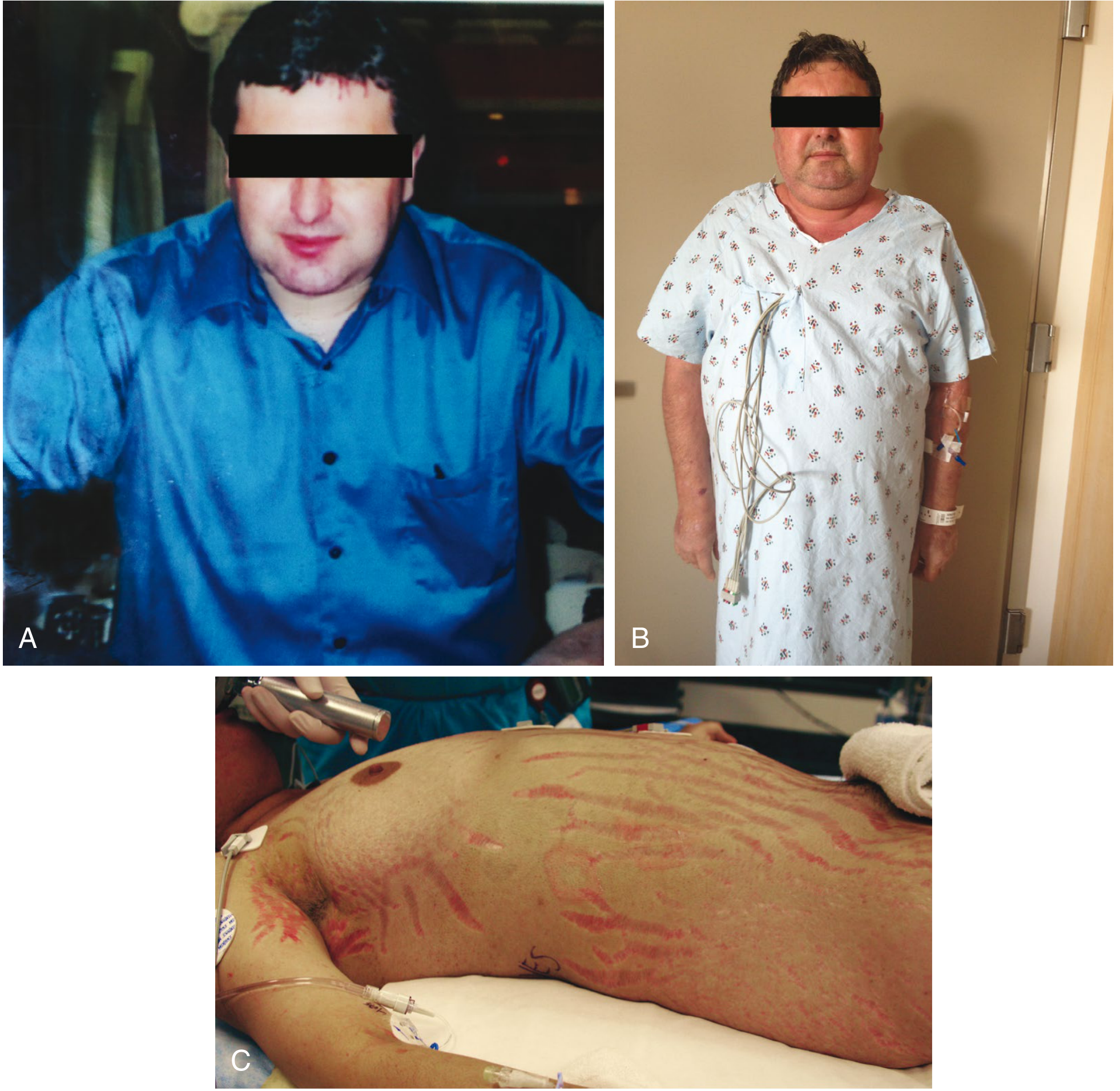
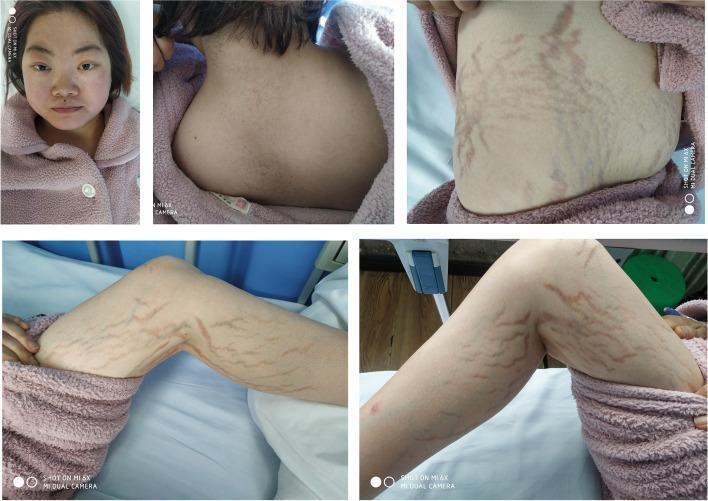
- Broad (>1 cm), violaceous/purplish striae (see image below)
- Proximal myopathy — difficulty rising from a chair without using hands
- Skin thinning with easy bruising
- Pathologic fractures (osteoporosis) at young age
- Central/truncal obesity with thin limbs
- Moon facies (rounded, plethoric face)
- Dorsocervical fat pad ("buffalo hump")
- Supraclavicular fat pads
- Hypertension (present in >70% of cases)
- Hyperglycemia / type 2 diabetes
- Hirsutism, acne
- Hypogonadism, menstrual irregularities
- Hyperpigmentation of knuckles, scars, pressure areas (from excess ACTH/POMC products)
- More rapid onset: edema, severe hypokalemia, hypertension
- Deep vein thrombosis and pulmonary embolism (hypercoagulable state)
- Psychiatric symptoms: anxiety, depression, psychosis
- Increased cardiovascular mortality (5× excess) if untreated
- Opportunistic/fungal infections
Pediatric Features (Nelson 2024 — Chapter 619)
| System | Manifestations |
|---|---|
| Dermatologic | Facial plethora, acne, easy bruising, moon facies, hirsutism, violaceous striae (unusual <7 yr) |
| Growth | Growth deceleration + weight gain; short stature (key differentiator from simple obesity) |
| Cardiovascular | Hypertension, coagulopathy |
| Gonadal | Amenorrhea, virilization, gynecomastia |
| Neurologic | Headaches |
| Metabolic | Impaired glucose tolerance, diabetes, nephrolithiasis, fractures |
| Psychologic | Depression, anxiety, irritability, fatigue |
Key pediatric differentiator: Children with simple obesity are tall, while those with Cushing's are short with a decelerating growth rate. - Nelson 2024, Ch. 619
Diagnosis
Step 1 — Confirm Hypercortisolism (Biochemical Diagnosis)
| Test | Detail |
|---|---|
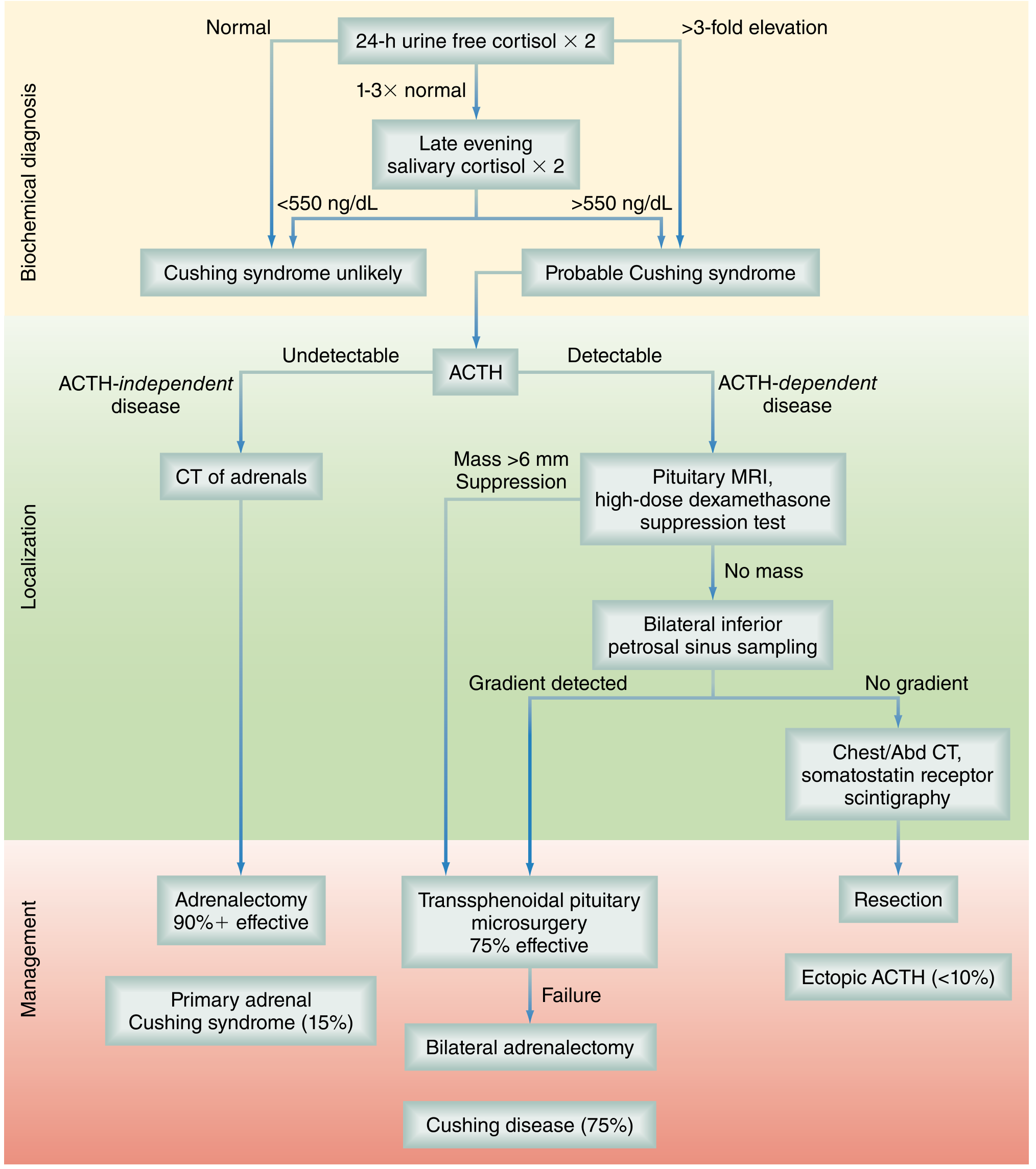
| 24-hour urinary free cortisol (UFC) | Collect at least twice; unequivocally elevated (>3× ULN) establishes diagnosis |
| Late-night salivary cortisol | Cortisol nadir disruption; >550 ng/dL has sensitivity 93%, specificity 100%. If UFC is 1–3× normal, perform two salivary measurements |
| 1-mg overnight dexamethasone suppression test (DST) | Administer 1 mg dexamethasone at 11 PM; morning cortisol <1.8 μg/dL = normal suppression |
| Midnight plasma/serum cortisol | >4.4 μg/dL strongly suggests Cushing's (Nelson 2024) |
- Pregnancy, severe depression, alcohol dependence, morbid obesity, poorly controlled diabetes, glucocorticoid resistance
Step 2 — Differential Diagnosis: ACTH-Dependent vs. Independent
| ACTH Level | Interpretation |
|---|---|
| ≤5 pg/mL (undetectable) | ACTH-independent → adrenal imaging (CT) |
| Normal/elevated | ACTH-dependent → pituitary MRI + further testing |
| Very high | Suggests ectopic ACTH syndrome |
Step 3 — Localize the Source
- Pituitary MRI (gadolinium T1): up to 40–50% of corticotroph microadenomas are MRI-negative
- High-dose dexamethasone suppression test (HDDST): 2 mg q6h × 48h — pituitary adenomas often suppress; ectopic tumors typically do not (but ~10–15% of ectopic tumors may also suppress → test has limitations)
- Bilateral inferior petrosal sinus sampling (BIPSS) with CRH: the gold standard for Cushing disease vs. ectopic ACTH
- Central/peripheral ACTH ratio >2 at baseline or >3 after CRH = Cushing disease
- No gradient → ectopic ACTH source; proceed to chest/abdomen CT, octreotide scan, or ⁶⁸Ga-DOTATATE PET/CT
- <10 pg/mL → ACTH-independent
- 10–20 pg/mL → CRH test to differentiate
-
20 pg/mL → ACTH-dependent
Diagnostic Algorithm
Treatment
Cushing Disease (Pituitary Source)
- First-line: Transsphenoidal pituitary microsurgery (endoscopic approach)
- Initial cure rate 60–80% with experienced surgeon; lower for invasive/macroadenomas
- Postoperative subnormal cortisol on day 1–2 = indicator of cure
- Long-term follow-up essential — relapse occurs in a significant proportion
- Recurrence options: Re-operation, fractionated radiotherapy, stereotactic radiosurgery, pharmacologic therapy, or bilateral adrenalectomy
ACTH-Independent (Adrenal Source)
- Adrenalectomy (laparoscopic for benign; open for suspected malignancy)
- Cure rate >90% for solitary adenoma
- Perioperative stress-dose steroids: hydrocortisone 100 mg IV q8h × 24h
- HPA axis recovery may take >1 year — glucocorticoid replacement needed until recovery
Ectopic ACTH Syndrome
- Resect the primary tumor when localized
- If tumor cannot be located: bilateral adrenalectomy or medical therapy
Medical/Pharmacologic Therapy
| Drug | Mechanism |
|---|---|
| Metyrapone | Inhibits 11β-hydroxylase (CYP11B1) — reduces cortisol synthesis |
| Ketoconazole / Levoketoconazole | Inhibits multiple steroidogenic enzymes |
| Osilodrostat | Cortisol synthesis inhibitor (FDA-approved) |
| Mitotane | Adrenolytic; cytotoxic to adrenal cortex (FDA-approved) |
| Mifepristone | Glucocorticoid receptor antagonist |
| Pasireotide | Somatostatin analog; inhibits ACTH secretion (approved for persistent Cushing disease after surgery) |
| Aminoglutethimide / Etomidate | Reserved for acute/severe cases |
Special Considerations
- Nelson syndrome: After bilateral adrenalectomy for Cushing disease, the unresected pituitary adenoma may enlarge dramatically → marked hyperpigmentation; occurs in ~25% of adults. - Nelson 2024
- Postoperative replacement: Hydrocortisone 10 mg/m²/24h in three divided doses until HPA axis recovery
- Pediatric catch-up: After treatment, substantial catch-up growth and pubertal progress occur, but adult height is often compromised and bone density remains abnormal
Genetics (Nelson 2024 — Pediatric Perspective)
| Subtype | Key Genes |
|---|---|
| Cushing disease | USP8, MEN1, CDKIs, CDKN1B/p27Kip1, AIP, DICER1 |
| PPNAD / Carney complex | PRKAR1A (chr 17q22-24), PDE8B, PDE11A, PRKACA |
| BMAH | ARMC5 (~40%), GNAS1, MEN1, FH |
| Adrenal adenoma | PRKACA (somatic), CTNNB1, MC2R |
| Ectopic ACTH | RET, MEN1 |
| McCune-Albright | GNAS (somatic, activating) |
Recent Evidence (PubMed, 2024–2026)
- A 2024 systematic review (PMID 39730909) confirmed that prolactin-adjusted BIPSS improves discrimination of Cushing disease from ectopic ACTH syndrome.
- A 2024 meta-analysis (PMID 39086899) evaluated surgical vs. conservative management of mild autonomous cortisol secretion, finding surgical benefit particularly for metabolic outcomes.
- A 2024 systematic review on PPNAD (PMID 39006359) characterized pathogenic variants in primary pigmented nodular adrenocortical disease across 210 patients.