
Worm infestation in children
Reading File
Now let me search the medical library for worm infestation in children.
Finding Sources
Finding Sources
Searching PubMed
"intestinal helminth" AND children
Finding Sources
Finding Sources
Finding Sources
Finding Sources
Reading File
Reading File
Reading File
Finding Sources
Reading File
Reading File
Reading File
Loading Image
I now have comprehensive information from Harrison's and Henry's Clinical Diagnosis. Let me compile the full answer.
Worm Infestation in Children (Intestinal Helminthiasis)
More than one billion people worldwide carry at least one species of intestinal nematode. Children, especially those in tropical and subtropical resource-limited regions, bear the highest burden. Even subclinical infections impair physical growth, cognitive development, and nutritional status.
Overview of Major Worms Affecting Children
The five principal intestinal nematodes are compared below (data from Harrison's Principles of Internal Medicine, 22e):
| Worm | Global Prevalence | Route of Infection | Location in Gut | Key Symptom |
|---|---|---|---|---|
| Ascaris lumbricoides (Roundworm) | ~730 million | Oral (egg) | Small intestine | GI obstruction, pulmonary migration |
| Hookworms (Necator, Ancylostoma) | ~440 million | Percutaneous (larva) | Jejunal mucosa | Iron-deficiency anemia |
| Trichuris trichiura (Whipworm) | ~465 million | Oral (egg) | Cecum / colon | Bloody diarrhea, rectal prolapse |
| Strongyloides stercoralis | ~100 million | Percutaneous / autoinfection | Small intestinal mucosa | Malabsorption; fatal hyperinfection in immunocompromised |
| Enterobius vermicularis (Pinworm) | ~200 million | Oral (egg) | Cecum / appendix | Perianal pruritus - most common in children |
1. Ascariasis (Roundworm)
Pathogen: Ascaris lumbricoides - the largest human intestinal nematode, up to 40 cm long.
Epidemiology: Transmitted via fecally contaminated soil/food. Younger children are most affected due to poorer oral hygiene. Eggs are remarkably resistant in the environment for years.
Life Cycle:
- Infective eggs swallowed → larvae released in intestine → invade mucosa → migrate via blood to lungs → ascend bronchial tree → swallowed → adult worms in small intestine
- Egg-to-egg cycle: 2-3 months. Adults live 1-2 years. Females produce >200,000 eggs/day.
Clinical Features:
- Most infections: asymptomatic
- Pulmonary phase (Loeffler's syndrome): cough, wheezing, eosinophilia as larvae migrate through lungs
- Intestinal phase: vague abdominal pain, malnutrition
- Heavy infection: intestinal obstruction (can be seen on plain X-ray as masses in bowel), biliary/pancreatic obstruction
Diagnosis: Characteristic eggs (65 x 45 μm) in stool microscopy; PCR increasingly used; adult worms occasionally passed per rectum or expelled through mouth/nose.
Treatment:
- Albendazole 400 mg once, OR
- Mebendazole 100 mg twice daily x 3 days (or 500 mg once), OR
- Pyrantel pamoate 11 mg/kg once (max 1 g), OR
- Ivermectin 150-200 μg/kg once
- Intestinal obstruction: nasogastric suction + piperazine instillation; surgical intervention if complete obstruction
2. Pinworm (Enterobiasis) - Most Common in Children
Pathogen: Enterobius vermicularis - ~5-13 mm long; the most common helminthic infection in children in the US, Canada, and Europe - affects all social strata.
Life Cycle: Adult worms in cecum → gravid females migrate nocturnally to perianal region → deposit up to 10,000 eggs → eggs infective within hours → hand-to-mouth transmission. Autoinfection common (perianal scratching → fingers → mouth). Life cycle: ~1 month.
Clinical Features:
- Most: asymptomatic
- Perianal pruritus (worse at night) - cardinal symptom
- Irritability, loss of sleep, enuresis (should rule out early)
- Rarely: migration to vagina, fallopian tubes, peritoneal cavity
Diagnosis: Cellophane/cellulose acetate tape test - applied to perianal region in the morning before bathing. Eggs are oval, 55 x 25 μm, flattened on one side. NOT found in routine stool examination.
Treatment:
- Mebendazole 100 mg once, OR
- Albendazole 400 mg once, OR
- Pyrantel pamoate 11 mg/kg once
- Repeat dose in 2 weeks (drugs don't kill eggs/early larvae)
- Treat all household members; wash linens in hot water/hot dryer
3. Hookworm
Pathogens: Necator americanus, Ancylostoma duodenale, A. ceylanicum
Life Cycle: Filariform larvae in soil penetrate skin (usually bare feet) → lungs → swallowed → attach to jejunal mucosa using buccal teeth/cutting plates → suck blood and villous tissue.
Clinical Features:
- Ground itch: pruritic dermatitis at larval entry site
- Loeffler-like pneumonitis during pulmonary migration
- Iron-deficiency anemia with heavy infections (main cause of disease in children)
- Hypoproteinemia, impaired growth, cognitive delay
Diagnosis: Eggs in fresh stool; larvae in old stool.
Treatment: Albendazole 400 mg once, or mebendazole 100 mg x 3 days, or ivermectin.
4. Whipworm (Trichuriasis)
Pathogen: Trichuris trichiura - adults 3-5 cm long; thin anterior portion embedded in colonic mucosa.
Clinical Features:
- Most: asymptomatic
- Heavy infections: anemia, abdominal pain, bloody/mucoid diarrhea (resembling IBD)
- Rectal prolapse in massive infections in children due to protracted tenesmus
- Impaired physical growth
Diagnosis: Characteristic lemon-shaped eggs (50 x 20 μm) in stool; adults visible on proctoscopy.
Treatment: Albendazole 400 mg x 3 days, or mebendazole 100 mg twice daily x 3 days. Adding ivermectin (200 μg/kg x 3 doses) significantly increases cure rates.
5. Strongyloidiasis
Pathogen: Strongyloides stercoralis - unique for autoinfection allowing decades-long persistence.
Key danger in children: In immunocompromised hosts (malnutrition, steroids, HIV), can cause hyperinfection syndrome with dissemination and fatal sepsis.
Treatment: Ivermectin 200 μg/kg x 2 days (more effective than albendazole). Must treat even asymptomatic cases.
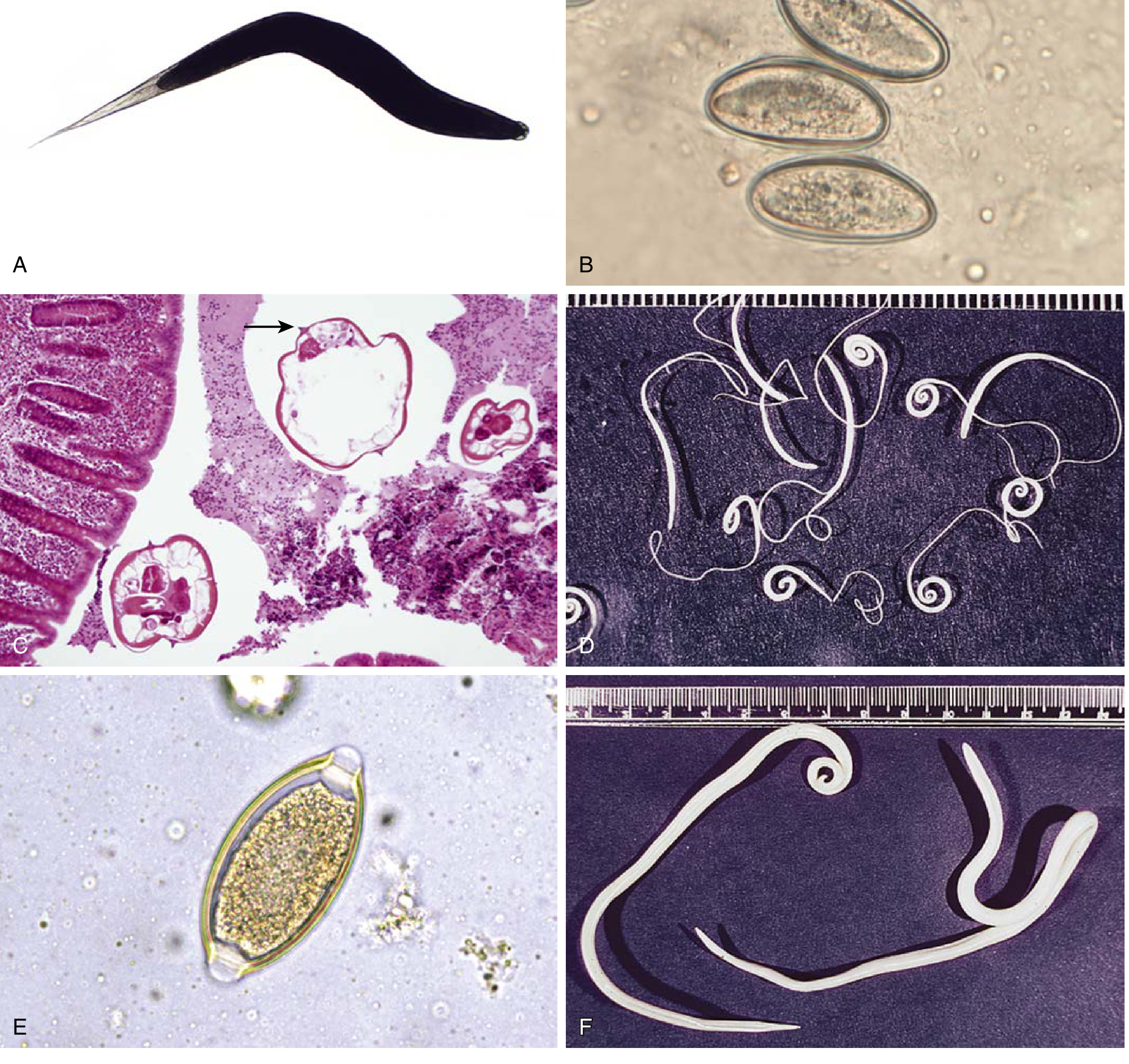
Microscopic Images of Key Parasites
General Principles for Management in Children
| Aspect | Key Points |
|---|---|
| Prevention | Hand hygiene, footwear, safe food/water, adequate sanitation |
| Mass drug administration | WHO recommends periodic deworming in endemic areas (albendazole or mebendazole) |
| Nutrition | Iron and nutritional supplementation alongside anthelminthics |
| Eosinophilia | Elevated eosinophils + IgE strongly suggest helminth infection |
| Drug safety | Benzimidazoles (albendazole, mebendazole) are contraindicated in pregnancy |
| Reinfection | Common; treat household contacts, reinforce hygiene |
Quick Drug Reference
| Drug | Ascaris | Hookworm | Whipworm | Pinworm | Strongyloides |
|---|---|---|---|---|---|
| Albendazole | ✓ | ✓ | ✓ | ✓ | ✓ |
| Mebendazole | ✓ | ✓ | ✓ | ✓ | - |
| Ivermectin | ✓ | ✓ | ✓ | - | ✓ (preferred) |
| Pyrantel pamoate | ✓ | - | - | ✓ | - |
Sources: Harrison's Principles of Internal Medicine, 22e (2025), p. 1858-1861; Henry's Clinical Diagnosis and Management by Laboratory Methods, p. 1529-1462
This is a shared conversation. Sign in to Orris to start your own chat.