
Cataract
Reading File
Now let me search the library for comprehensive cataract content in parallel.
Finding Sources
Searching PubMed
cataract surgery outcomes complications
Excellent results. Now let me read the most comprehensive sources in parallel - Kanski's (the definitive ophthalmology text) and Goldman-Cecil.
Reading File
Reading File
Good. I have the table of contents. Now let me read the core clinical content sections from Kanski's in parallel.
Reading File
Reading File
Excellent content. Now let me read the management/surgical section and cataract in systemic disease, plus fetch key images.
Reading File
Reading File
Let me now read the phacoemulsification surgical steps, complications, and Goldman-Cecil for systemic context, plus fetch key images.
Reading File
Reading File
Loading Image
Now let me read the surgical steps/phaco procedure and complications sections.
Reading File
Reading File
I now have excellent, comprehensive content. Let me also quickly read the congenital cataract section and cataract in systemic disease.
Reading File
Reading File
I now have comprehensive content. Let me compile a thorough, well-structured response.
Cataract
A cataract is any opacification of the crystalline lens. It is the most common cause of reversible visual disability worldwide, and phacoemulsification with intraocular lens (IOL) implantation is the most frequently performed surgical procedure in the world. There is no medical treatment to prevent development or progression - surgery is the only effective intervention.
Anatomy of the Lens
- Zonules hold the lens in position
- Capsule: acellular membrane enclosing all lens material
- Epithelium: cuboid cells beneath the anterior capsule; cells in the germinative zone divide continuously and differentiate into lens fibers
- Lens substance: central nucleus surrounded by cortex
- The lens doubles in volume between birth and age 70 as new fiber cells are laid down; older fibers in the centre cannot be shed and are compressed into the nucleus
Symptoms
The effect on vision depends on the type, extent, and location of opacification. Symptoms include:
- Reduced visual acuity (initially correctable with spectacles)
- Loss of contrast sensitivity
- Change in colour perception (especially impaired blue perception)
- Glare from light scattering - difficulty with night driving
- Monocular diplopia (especially from a point source of light)
- Poor night vision / difficulty in low-light conditions
Important note: Cataract never produces an afferent pupillary defect (RAPD). Its presence implies substantial posterior pole pathology.
Classification of Cataract
1. Age-Related (Acquired) Cataract
A. Posterior Subcapsular (PSC)
- Lies just in front of the posterior capsule
- Granular or plaque-like on oblique slit-lamp
- Appears black and vacuolated on retroillumination - the vacuoles are swollen migratory lens epithelial cells (Wedl/bladder cells)
- Located at the nodal point of the eye - profound effect on vision disproportionate to its size
- Patients are troubled by glare and symptoms worsen with miosis (near vision, bright sunlight)
B. Nuclear Sclerotic Cataract
- An exaggeration of normal ageing
- Often associated with myopia (increased refractive index of nucleus) - some elderly patients can read without spectacles again: "second sight of the aged"
- Characterised by a yellowish hue from urochrome pigment deposition
- Best assessed with oblique slit-lamp beam
- Advanced stages: nucleus appears brown (brunescent) or, rarely, black
C. Cortical Cataract
- Opacities start as clefts and vacuoles (cortical hydration) → typical cuneiform (wedge-shaped) or radial spoke-like opacities
- Often found initially in the inferonasal quadrant
- Glare is a common symptom
D. Christmas Tree Cataract
- Uncommon
- Polychromatic needle-like formations in the deep cortex and nucleus
E. Advanced Cataract Stages
- Immature: partial opacification
- Mature: complete opacification; nucleus turns white/dense
- Hypermature: shrunken, wrinkled anterior capsule due to water leakage
- Morgagnian: liquefied cortex with the nucleus sinking inferiorly (gravity)
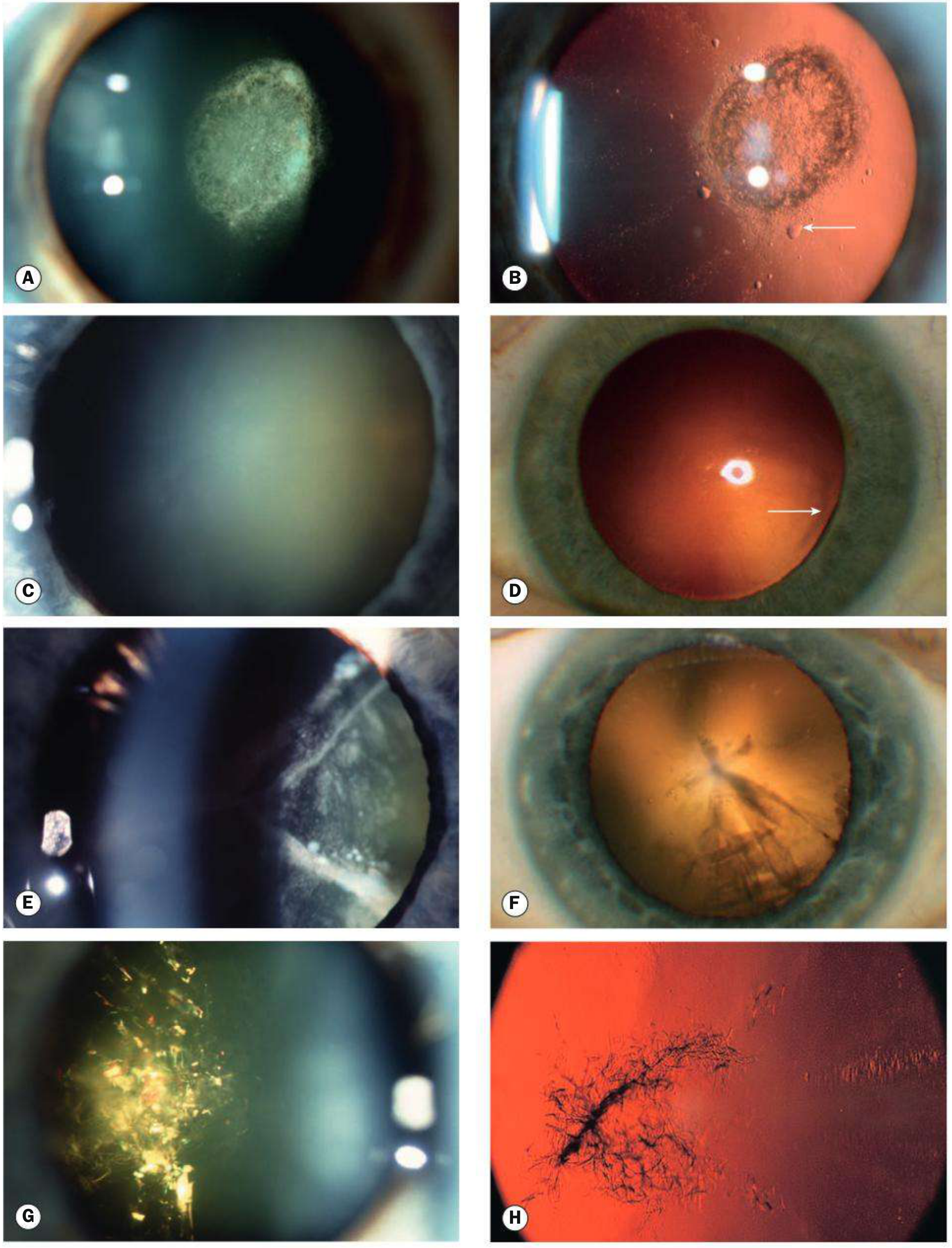
2. Cataract in Systemic Disease
| Disease | Cataract Type |
|---|---|
| Diabetes mellitus | Classic: snowflake cortical opacities in young (rare). Common: age-related nuclear sclerosis, earlier onset, rapid progression. Mechanism: hyperglycaemia → sorbitol accumulation → osmotic overhydration |
| Myotonic dystrophy | Fine iridescent cortical opacities (3rd decade) → wedge/star-shaped cortical + subcapsular opacities (5th decade); ~90% of patients affected |
| Hypocalcaemia/hypoparathyroidism | Bilateral lamellar (zonular) opacities |
| Wilson's disease | Sunflower cataract (anterior capsular copper deposits) |
| Atopic dermatitis | Anterior subcapsular "shield" cataract |
3. Secondary (Complicated) Cataract
Develops due to primary ocular disease:
- Chronic anterior uveitis: Most common cause - polychromatic lustre at posterior pole, then posterior and anterior opacities; steroids used in treatment are also causative. Progresses more rapidly in the presence of posterior synechiae
- Acute angle closure (glaukomflecken): Small anterior grey-white subcapsular opacities - focal infarcts of lens epithelium; pathognomonic of previous acute congestive angle closure
- High myopia: Posterior subcapsular opacity + early-onset nuclear sclerosis
- Hereditary fundus dystrophies (retinitis pigmentosa, Leber congenital amaurosis, gyrate atrophy, Stickler syndrome): typically posterior subcapsular
- Systemic/topical steroids: Posterior subcapsular
4. Traumatic Cataract
Includes rosette-shaped opacities following blunt trauma, or rapidly developing opacification after penetrating injury.
5. Congenital Cataract
- Can be unilateral or bilateral
- Aetiology includes: metabolic disorders (galactosaemia, Lowe syndrome, homocystinuria), intrauterine infections (rubella - classic cause of unilateral nuclear cataract), chromosomal anomalies (trisomy 21), other systemic associations
- Management requires early surgery (within weeks of birth for dense bilateral cataracts) to prevent deprivation amblyopia
Management of Acquired Cataract
Indications for Surgery
Surgery is elective and depends on:
- Visual acuity impairment interfering with daily life / lifestyle goals
- Failure of spectacle correction to provide adequate vision
- Presence of complications (phacomorphic glaucoma, phacolytic glaucoma)
In general, the worst-seeing eye undergoes surgery first, then the second eye as its cataract progresses.
Preoperative Assessment
Ophthalmic evaluation includes:
- Visual acuity (Snellen)
- Cover test (detect heterotropia/amblyopia)
- Pupillary responses (RAPD implies posterior pole pathology beyond the cataract)
- Corneal endothelial cell count (specular microscopy, pachymetry) - low counts risk decompensation
- Anterior chamber depth
- Pupil dilation (poorly dilating pupils may need intracameral mydriatics)
- Lens density assessment
- Fundus examination (AMD, diabetic changes)
- IOL biometry (A-scan ultrasonography or optical coherence-based biometry for axial length; keratometry for corneal curvature) to calculate IOL power
Medical comorbidities to manage preoperatively include diabetes (glycaemic control), hypertension (BP <170/100), recent MI (defer 3-6 months), anticoagulation status.
Surgical Technique: Phacoemulsification
This is the gold standard. Key steps:
- Corneal incision (clear corneal or scleral tunnel, typically 2.2-2.8 mm)
- Capsulorhexis - continuous curvilinear capsulotomy (CCC) creating a circular opening in the anterior capsule
- Hydrodissection - fluid injection separates the nucleus from the capsule
- Phacoemulsification - ultrasonic hollow titanium needle emulsifies the nucleus ("divide and conquer," "stop and chop," or other techniques)
- Cortical aspiration - irrigation/aspiration removes residual cortex
- IOL implantation - foldable IOL injected into the capsular bag
The phaco handpiece uses high-frequency (ultrasonic) vibration creating jackhammer, cavitation, and other effects. Two pump types exist: peristaltic (flow-based) and Venturi (vacuum-based).
Intraocular Lenses (IOLs)
Positioning
- In-the-bag (ideal): IOL sits within the capsular bag
- Sulcus (ciliary sulcus): used if posterior capsule ruptures; requires a 3-piece IOL
- Anterior chamber: requires an AC-specific lens
Materials
| Material | Properties |
|---|---|
| Hydrophobic acrylic | High refractive index, thinner lens, widely used; risk of dysphotopsia |
| Hydrophilic acrylic (hydrogel) | Superior biocompatibility; historically associated with calcification in some types |
| Silicone | Good biocompatibility; avoid in eyes likely to need silicone oil (vitreoretinal surgery) |
| PMMA (rigid) | Requires larger incision (~5-6 mm); still used in developing countries for economic reasons |
IOL Types
- Monofocal (standard): corrects for one distance, usually distance vision
- Toric: corrects for pre-existing corneal astigmatism
- Multifocal/trifocal: corrects near, intermediate, and distance - higher rates of dysphotopsia
- EDOF (Extended Depth of Focus): extended range of clear vision with reduced dysphotopsia vs. trifocals
Anaesthesia
- Most modern cataract surgery is performed under topical or subtenon (peribulbar) local anaesthesia as a day case
- General anaesthesia reserved for uncooperative patients or complex cases
Complications
Intraoperative
- Posterior capsule rupture (PCR) - most significant. Manifests as sudden change in AC depth and momentary pupillary dilatation. Management: dispersive viscoelastic, anterior vitrectomy if vitreous prolapse, IOL repositioning to sulcus or AC
- Zonular dialysis: loss of zonular support
- Suprachoroidal haemorrhage: rare, severe
Postoperative - Early
- Endophthalmitis - rare (~0.05%) but sight-threatening; presents with pain, redness, hypopyon, reduced vision; urgent intravitreal antibiotics required
- Cystoid macular oedema (CMO) - most common cause of unexplained visual loss post-cataract surgery; managed with topical NSAIDs ± steroids
- IOP spike - especially with retained viscoelastic
- Corneal oedema - usually mild/transient; higher risk with dense nuclei, pre-existing guttata, or complicated surgery
Postoperative - Late
- Posterior Capsular Opacification (PCO) - most common long-term complication
- Pearl-type PCO: Elschnig pearls - residual lens epithelial cells migrating onto the posterior capsule
- Fibrosis-type PCO: fibroblastic metaplasia of epithelial cells with contractile properties
- Soemmering ring: whitish annular/doughnut-shaped proliferation at the capsular edge
- Treatment: Nd:YAG laser posterior capsulotomy (4-5 mm opening; energy <80 mJ to reduce IOP spike)
- Retinal detachment - uncommon; risk factors include myopia, vitreous loss intraoperatively, lattice degeneration
- Dysphotopsia - positive (streaks/halos/starbursts) or negative (dark arc/shadow at temporal visual field); associated with IOL design
- Refractive surprise - residual refractive error; risk reduced by pre-operative biometry checks
- Capsulophimosis - contraction of the anterior capsulorhexis; risk with pseudoexfoliation, retinitis pigmentosa, small capsulorhexis; treat with Nd:YAG anterior capsulotomy
Special Situations
- Pseudoexfoliation syndrome: increased risk of weak zonules (phakodonesis), fragile capsule, poor mydriasis; higher complication rate
- Dense brunescent/black nucleus: may require extracapsular cataract extraction (ECCE) rather than phaco
- Cornea guttata: soft-shell OVD technique to protect endothelium
- Diabetic patients: monitor for worsening of diabetic macular oedema post-surgery
Femtosecond Laser-Assisted Cataract Surgery (FLACS)
Standard phacoemulsification provides results as good as femtosecond laser-assisted treatment (Goldman-Cecil). FLACS can assist with corneal incisions, capsulorhexis, and lens fragmentation, but does not offer a clear superiority over manual phaco in most settings.
Prognosis
Excellent for vision restoration. The degree of improvement depends on the functional status of the retina. Cataracts tend to develop asymmetrically between eyes.
Sources: Kanski's Clinical Ophthalmology: A Systematic Approach, 10th ed. | Goldman-Cecil Medicine, International Edition
Recent evidence (2024-2025): A Cochrane meta-analysis (PMID 38984608) compared trifocal vs. EDOF IOLs; EDOF lenses offer comparable or better distance vision with less dysphotopsia in some settings. A systematic review (PMID 39806338) confirmed dry eye disease is a significant post-cataract surgery complication requiring proactive management.
This is a shared conversation. Sign in to Orris to start your own chat.