
I have my university exam of 1 st year of subject physiology These are the important questions give me answer of each question "Secondary active transport. " Follow University exam pattern Use easy language
Reading File
Now let me search the medical library for secondary active transport content.
Finding Sources
Finding Sources
Excellent! Found great content in multiple physiology textbooks. Let me read the most relevant sections now.
Reading File
Reading File
Reading File
I have excellent content from three standard physiology textbooks (Costanzo, Guyton & Hall, Ganong). Let me also read a bit more from Guyton & Hall for the co-transport of glucose diagram section, and fetch the key diagram image.
Reading File
Loading Image
Loading Image
I now have comprehensive, high-quality content from three major physiology textbooks plus excellent diagrams. I can now write a complete university exam-style answer.
Secondary Active Transport
[University Exam Answer - 1st Year Physiology]
Definition
Secondary active transport is a type of active transport in which two or more solutes are transported together using a carrier protein. One solute (usually Na+) moves downhill (along its electrochemical gradient), and this energy is used to push another solute uphill (against its electrochemical gradient).
- ATP is not used directly
- Energy comes indirectly from the Na+ concentration gradient, which was created by the Na+-K+ ATPase pump (which does use ATP)
"The name secondary active transport refers to the indirect utilization of ATP as an energy source."
- Costanzo Physiology, 7th Ed.
How the Na+ Gradient is Created (The Basis of Energy)
The Na+-K+ ATPase pump (primary active transport) continuously pumps:
- 3 Na+ OUT of the cell
- 2 K+ INTO the cell
This keeps Na+ concentration high outside and low inside the cell. This concentration difference = a storehouse of potential energy. When Na+ is "allowed" to flow back in, it drags other substances with it.
Types of Secondary Active Transport
There are two types, based on direction of movement:
1. Cotransport (Symport)
Both Na+ and the other solute move in the same direction (usually both into the cell).
Examples:
| Transporter | Location | What is co-transported |
|---|---|---|
| SGLT1 (Na+-glucose) | Small intestine, Renal proximal tubule | Glucose |
| Na+-amino acid | Small intestine, Renal tubule | Amino acids |
| Na+-K+-2Cl- (NKCC2) | Thick ascending limb of loop of Henle | K+, Cl- |
Mechanism (Na+-Glucose Cotransport):
- The carrier protein (SGLT1) has two binding sites on its outer surface - one for Na+ and one for glucose
- Na+ (high outside) and glucose both bind to the carrier
- The carrier changes shape (conformational change) and releases both Na+ and glucose inside the cell
- Na+ is then pumped back out by Na+-K+ ATPase
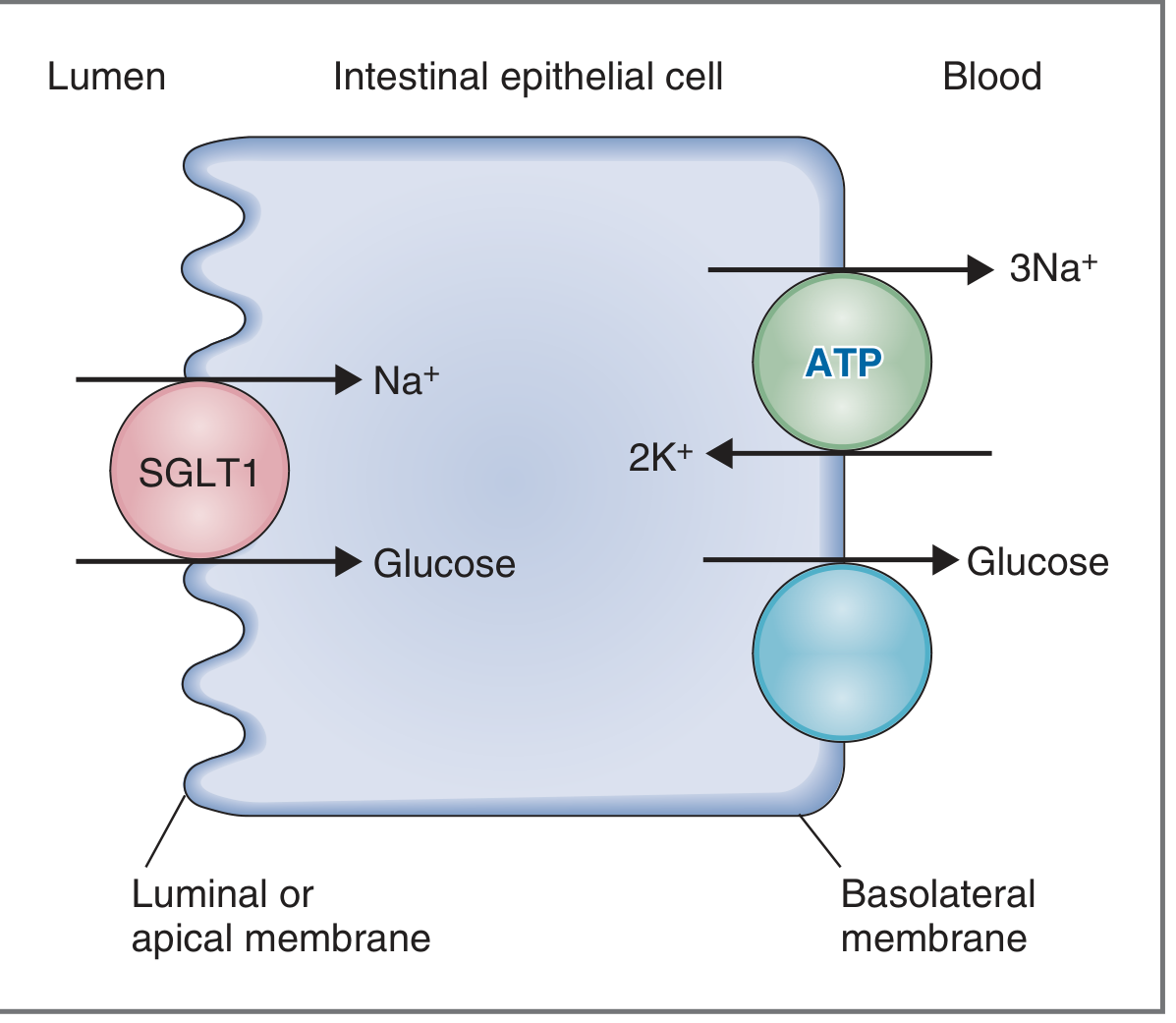
Fig: Na+-glucose cotransport (SGLT1) in an intestinal epithelial cell. Na+ and glucose enter together via SGLT1 on the luminal side; Na+ is then pumped out by Na+-K+ ATPase on the basolateral side. (Costanzo Physiology)
2. Countertransport (Antiport / Exchange)
Na+ moves in one direction (into the cell) and the other solute moves in the opposite direction (out of the cell).
Examples:
| Transporter | Substances Exchanged | Location |
|---|---|---|
| Na+-Ca2+ exchanger (NCX) | Na+ in, Ca2+ out | Most cell membranes, heart muscle |
| Na+-H+ exchanger (NHE) | Na+ in, H+ out | Renal proximal tubule |
Mechanism:
- Na+ binds to the outer surface of the carrier
- The substance to be countertransported (e.g., Ca2+) binds to the inner surface
- Conformational change occurs - Na+ moves in, the other substance moves out
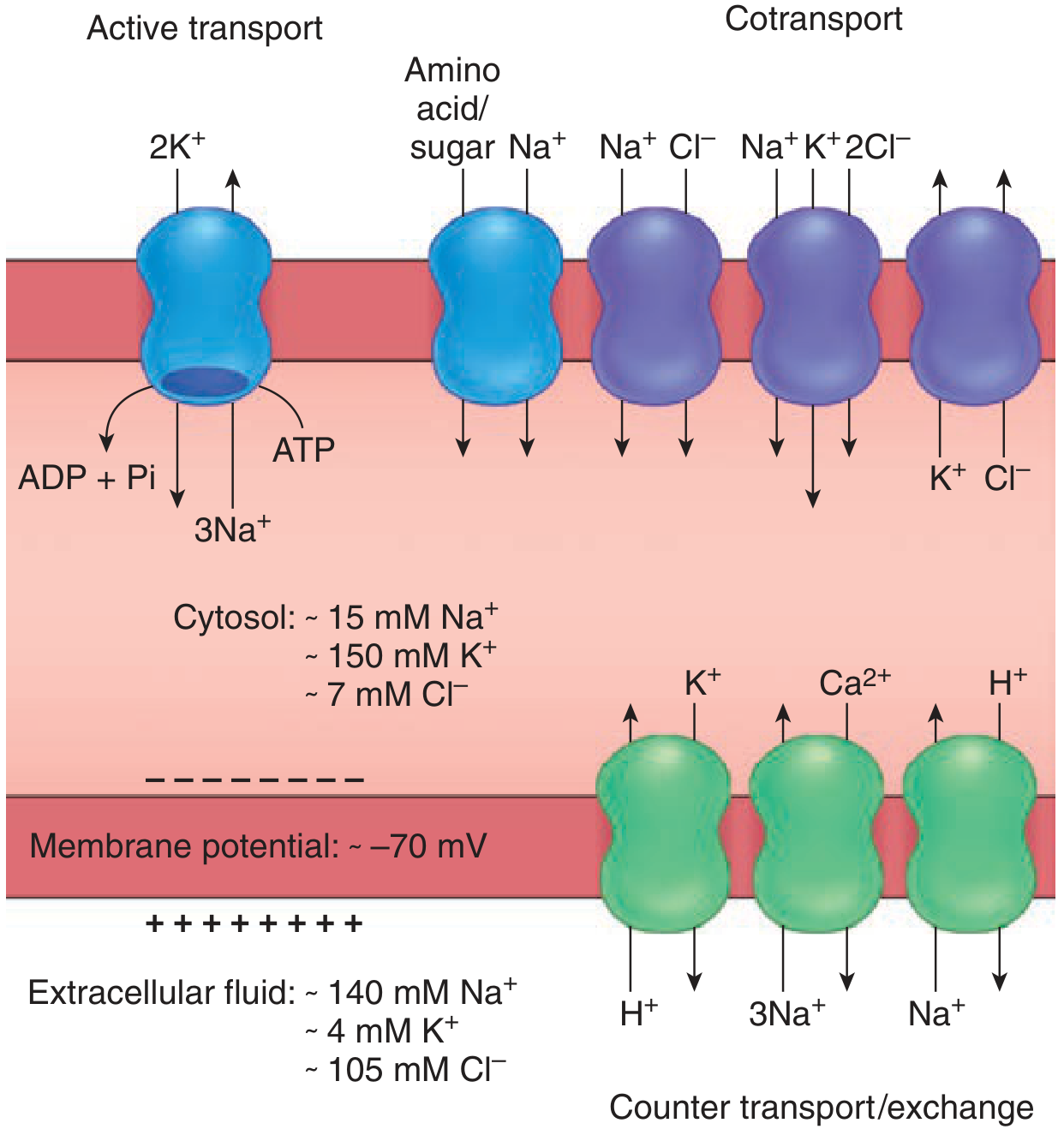
Fig: Composite diagram showing cotransport (top, purple) and countertransport/exchange (bottom, green) as secondary effects of Na+-K+ ATPase activity. (Ganong's Review of Medical Physiology, 26th Ed.)
Difference Between Primary and Secondary Active Transport
| Feature | Primary Active Transport | Secondary Active Transport |
|---|---|---|
| Energy source | ATP directly | Na+ gradient (indirectly from ATP) |
| Example | Na+-K+ ATPase, Ca2+ pump | SGLT1, Na+-H+ exchanger |
| Uses carrier protein | Yes | Yes |
| Transports against gradient | Yes | Yes (for the "uphill" solute) |
Effect of Inhibiting Na+-K+ ATPase
If Na+-K+ ATPase is blocked (e.g., by ouabain):
- Na+ is no longer pumped out
- Intracellular Na+ rises
- The Na+ gradient across the membrane decreases
- Therefore, all secondary active transport processes are also reduced, because they depend on this gradient for their energy
Clinical Significance / Examples
- Intestinal glucose absorption - Na+-glucose cotransport (SGLT1) in small intestine absorbs dietary glucose into the bloodstream. This is the basis for Oral Rehydration Therapy (ORT) in diarrhea - glucose in ORS promotes Na+ absorption, and water follows.
- Renal glucose reabsorption - In the renal proximal tubule, SGLT2 reabsorbs ~90% of filtered glucose. SGLT2 inhibitors (e.g., dapagliflozin) block this and are used as diabetic drugs.
- Na+-H+ exchange in the proximal tubule - important in acid-base balance (bicarbonate reabsorption).
- Na+-Ca2+ exchange in the heart - important in cardiac muscle contraction and relaxation.
Summary Points (Quick Revision)
- Secondary active transport = indirect use of ATP
- Energy comes from the Na+ gradient (made by Na+-K+ ATPase)
- Two types: Symport (same direction) and Antiport (opposite direction)
- Key example: Na+-glucose cotransport (SGLT1) in gut and kidney
- Blocking Na+-K+ ATPase with ouabain reduces all secondary active transport
- Accounts for absorption of glucose, amino acids, and regulation of Ca2+ and H+ in body
Sources: Costanzo Physiology 7th Ed. | Guyton & Hall Textbook of Medical Physiology | Ganong's Review of Medical Physiology 26th Ed.
I have my university exam of 1 st year of subject physiology These are the important questions give me answer of each question "Cardiac output. " Follow University exam pattern Use easy language
Finding Sources
Finding Sources
Reading File
Finding Sources
Finding Sources
Reading File
Finding Sources
Reading File
Finding Sources
Reading File
Finding Sources
Your credits are exhausted. You can purchase a top-up or subscribe to a plan to continue using Orris. If you're already subscribed, your daily credits will reset tomorrow.
This is a shared conversation. Sign in to Orris to start your own chat.