
Ecg ko smjhao with example of 10 common heart disease with diagram
Reading File
Finding Sources
Searching the Web
ECG interpretation 10 common heart diseases diagram explained
Finding Sources
Loading Image
Reading File
Searching the Web
ECG patterns normal sinus rhythm atrial fibrillation MI heart block VT diagrams labeled
Finding Sources
Loading Image
Finding Sources
Searching the Web
ECG labeled diagram STEMI atrial fibrillation ventricular tachycardia complete heart block hypertrophy
Loading Image
Finding Sources
Reading File
Searching the Web
ECG normal sinus rhythm PQRST waves labeled diagram cardiac cycle
Loading Image
Loading Image
Ab mere paas enough information hai - textbooks se aur diagrams se - ek comprehensive answer dene ke liye. Let me compile everything.
ECG (Electrocardiogram) - Poori Samajh Hindi Mein
ECG Kya Hota Hai?
ECG ek test hai jo heart ki electrical activity ko paper par lines ki shakal mein record karta hai. Heart mein electricity SA Node se shuru hoti hai, AV Node se guzarti hai, Bundle of His, Bundle Branches aur Purkinje Fibers se hoti hui puri heart mein failti hai. Yahi electricity ECG par waves ke roop mein dikhti hai.
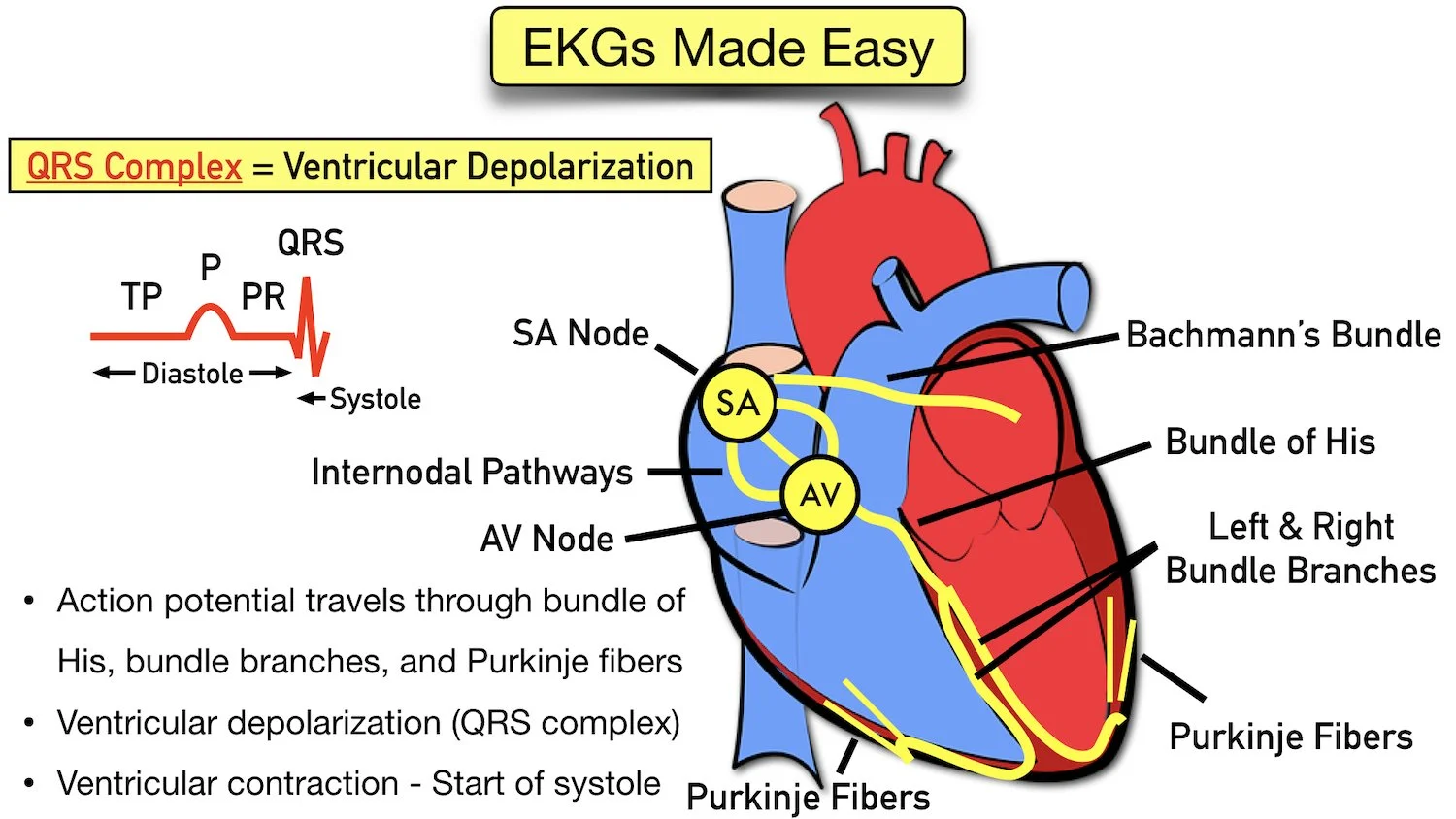
ECG Ki Waves - PQRST
| Wave / Interval | Kya Dikhata Hai | Normal Duration |
|---|---|---|
| P Wave | Atria ka depolarization (sikondi) | 0.06-0.12 sec |
| PR Interval | SA node se AV node tak signal ka safar | 0.12-0.20 sec |
| QRS Complex | Ventricles ka depolarization (sikondi) | <0.12 sec |
| ST Segment | Ventricles ke sikonchne ke baad ka resting phase | Isoelectric (flat) |
| T Wave | Ventricles ka repolarization (relaxation) | Upright, rounded |
| QT Interval | Total ventricular activity | 0.36-0.44 sec |
Normal Sinus Rhythm Kaisa Dikhta Hai?
- Har QRS se pehle ek P wave hoti hai
- HR = 60-100 bpm
- Regular rhythm
- PR interval 0.12-0.20 sec
- QRS < 0.12 sec (narrow)
10 Common Heart Diseases - ECG Patterns
1. STEMI (ST-Elevation Myocardial Infarction) - Dil Ka Daura
Kya hota hai: Coronary artery bilkul band ho jaati hai, heart muscle ko khoon nahi milta.
ECG mein kya dikhta hai:
- Hyperacute T waves - pehli nishani, tall aur broad T waves
- ST Segment Elevation - J-point pe uthaan (>1mm consecutive leads mein, V2-V3 mein >2mm)
- Pathological Q waves - purana infarction ki nishani (>25% of R wave height)
- Reciprocal ST depression - opposite leads mein
Leads ka rule: Infarction jis wall mein ho, wahan ST elevation dikhegi:
- Inferior MI → Leads II, III, aVF
- Anterior MI → V1-V4
- Lateral MI → I, aVL, V5-V6
Normal:   ___/\___
STEMI:    ___/‾‾‾\___  (ST upar uth gaya)
Old MI:   _Q/\___  (Q wave aa gayi)
Source: ROSEN's Emergency Medicine - "Per the Fourth Universal Definition of Myocardial Infarction, ECG findings consistent with STEMI include new ST elevation of greater than 1 mm in at least two contiguous leads"
Ischemia ECG patterns reference diagram:

2. Atrial Fibrillation (A-Fib)
Kya hota hai: Atria chaotically (bina order ke) depolarize hote hain - "bag of worms" jaisi activity.
ECG mein kya dikhta hai:
- P waves absent - irregular fibrillatory baseline (f waves, 350-600/min)
- Irregularly irregular RR interval - koi pattern nahi
- Narrow QRS (jab tak aberrant conduction na ho)
- Heart rate: 60-170 bpm (ventricular)
Normal:  P-QRS-T  P-QRS-T  P-QRS-T  (regular)
A-Fib:   ~~~QRS~~~~~~QRS~QRS~~~~QRS~  (no P, irregular)
3. Atrial Flutter
Kya hota hai: Atria 250-350 bpm ki speed se depolarize hote hain ek reentrant circuit mein.
ECG mein kya dikhta hai:
- Sawtooth/Zigzag baseline - "flutter waves" ya "F waves" (lead II, III, aVF mein)
- Regular atrial rate ~300 bpm
- 2:1 ya 4:1 AV block - typically ventricular rate 150 bpm (2:1) ya 75 bpm (4:1)
F waves: /\/\/\/\/\/\/  (sawtooth pattern)
QRS:     mein se har 2nd ya 4th F ke baad
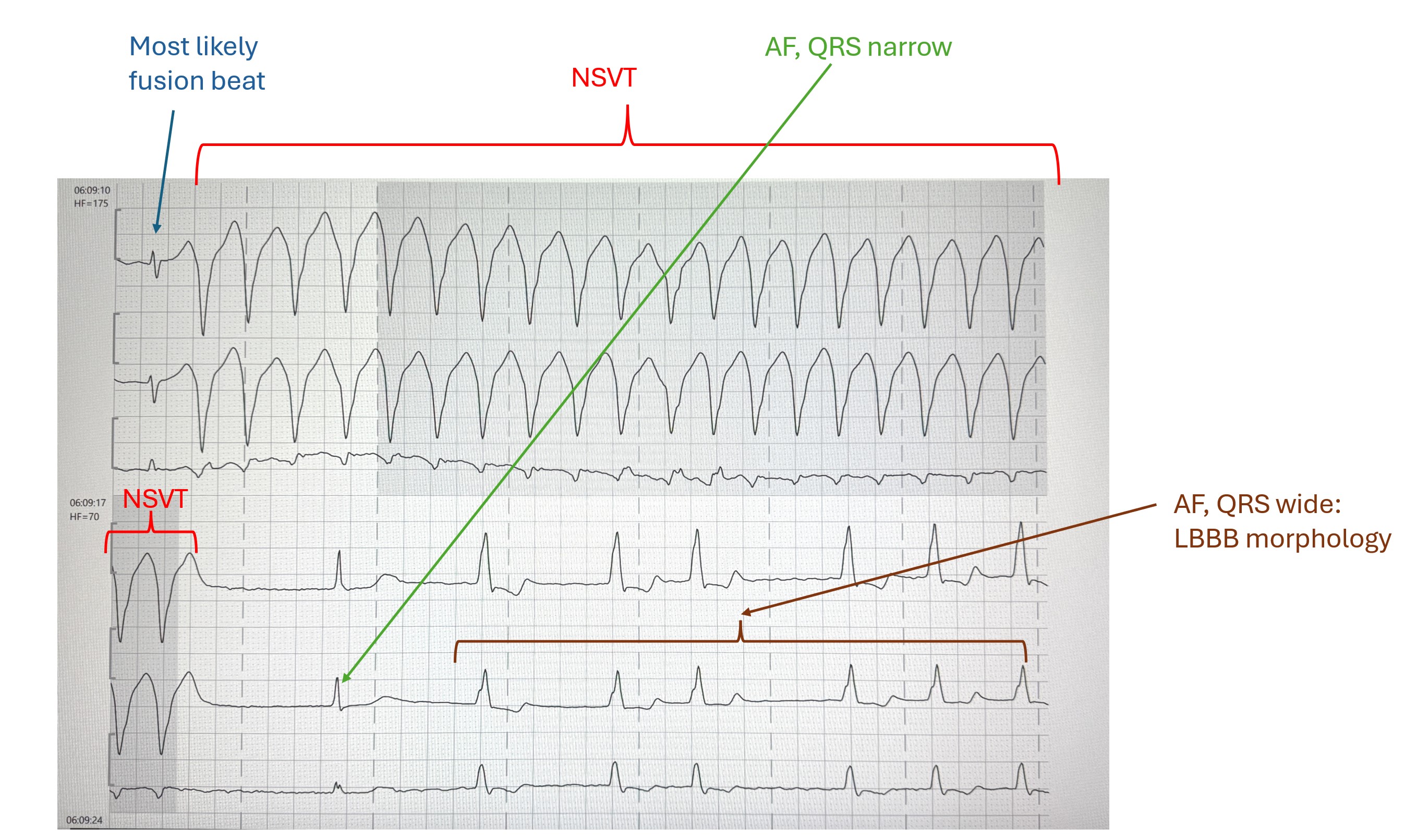
4. Ventricular Tachycardia (VT)
Kya hota hai: Ventricle mein ek ectopic focus ya reentrant circuit bahut tezi se firing karta hai.
ECG mein kya dikhta hai:
- Wide QRS complex (>0.12 sec) - bizarre shape
- Rate 100-250 bpm
- Regular rhythm
- AV dissociation - P waves alag se chal rahi hain, QRS se unrelated
- Fusion beats aur capture beats VT ki confirm karte hain
Normal QRS:  /\   /\   /\
VT QRS:      /‾‾\_  /‾‾\_  /‾‾\_  (wide, bizarre)
5. Ventricular Fibrillation (V-Fib)
Kya hota hai: Ventricles chaotically depolarize hote hain - cardiac arrest - no effective contraction.
ECG mein kya dikhta hai:
- No recognizable QRS, P, or T waves
- Completely chaotic irregular undulations
- Coarse V-Fib: amplitude >0.2 mV
- Fine V-Fib: amplitude <0.2 mV (deteriorating, near-asystole)
V-Fib: ~∿~∿~∿∿∿~∿~∿~ (completely chaotic)
EMERGENCY - turant CPR + Defibrillation zaroori!
6. Complete Heart Block (3rd Degree AV Block)
Kya hota hai: Atria aur ventricles ke beech signal bilkul nahi jaata - dono apni apni speed se chal rahe hain.
ECG mein kya dikhta hai:
- P waves aur QRS complex completely dissociated - koi relationship nahi
- Atrial rate (P waves): normal 60-100 bpm
- Ventricular rate (QRS): slow junctional escape 40-60 bpm ya ventricular escape 20-40 bpm
- Wide QRS agar ventricular escape, narrow agar junctional escape
- More P waves than QRS complexes
P:   P.....P.....P.....P.....P.....P  (faster)
QRS:  QRS..........QRS..........QRS   (slower, independent)
Source: Braunwald's Heart Disease - "Third-Degree (Complete) Atrioventricular Block"
Bundle Branch Blocks & Fascicular Blocks diagram:

7. Right Bundle Branch Block (RBBB)
Kya hota hai: Right bundle branch mein signal nahi jata, right ventricle late activate hota hai.
ECG mein kya dikhta hai:
- Wide QRS >0.12 sec
- rSR' pattern in V1-V2 ("rabbit ears" - M shape)
- Broad, slurred S wave in leads I, V5, V6
- Secondary ST-T changes
Mnemonic: "MaRRoW" - M shape in Right lead (V1), W shape in Left lead (V6) - RBBB
8. Left Bundle Branch Block (LBBB)
Kya hota hai: Left bundle branch mein signal nahi jaata - STEMI ki diagnosis mushkil ho jaati hai.
ECG mein kya dikhta hai:
- Wide QRS >0.12 sec
- Broad, notched R wave in V5, V6, I, aVL (clumsy R)
- Deep S wave or QS complex in V1-V2
- Secondary ST-T changes (ST opposite to QRS direction)
Mnemonic: "WiLLiaM" - W shape in V1, M shape in V6 - LBBB
New LBBB = consider STEMI until proven otherwise (Sgarbossa criteria use karein)
9. Left Ventricular Hypertrophy (LVH)
Kya hota hai: Left ventricle ki muscle moti ho jaati hai (hypertension, aortic stenosis se).
ECG mein kya dikhta hai:
- Tall R waves in left-sided leads (V5, V6, I, aVL)
- Deep S waves in right-sided leads (V1, V2)
- Sokolow-Lyon criteria: S in V1 + R in V5 or V6 >35 mm
- ST depression aur T wave inversion in lateral leads ("strain pattern")
- Left axis deviation
V1: \/ (deep S) V5: /‾\ (tall R)
10. Wolff-Parkinson-White (WPW) Syndrome
Kya hota hai: Atria aur ventricles ke beech ek extra conduction pathway (Bundle of Kent) hota hai jo signal ko shortcut se bhejta hai.
ECG mein kya dikhta hai:
- Short PR interval (<0.12 sec) - signal shortcut le raha hai
- Delta wave - QRS ke shuru mein slow slurring upstroke (pre-excitation)
- Wide QRS (>0.12 sec) - delta wave ki wajah se
- Pseudo-ST changes aur T wave abnormalities
- Paroxysmal SVT, A-Fib ke episodes
Normal:  flat PR, then /\
WPW:     short PR, then _/‾\ (delta slur before R)
Quick Reference Summary Table
| Condition | P Waves | PR Interval | QRS Width | Key Finding |
|---|---|---|---|---|
| Normal Sinus | Present, regular | 0.12-0.20s | Narrow | Everything normal |
| STEMI | Present | Normal | Narrow | ST elevation |
| Atrial Fibrillation | Absent (fibrillatory) | None | Narrow | Irregularly irregular |
| Atrial Flutter | Sawtooth (F waves) | 2:1/4:1 | Narrow | Sawtooth baseline |
| VT | Dissociated | None | Wide | Fast, wide, regular |
| V-Fib | Absent | None | None | Chaotic, no QRS |
| Complete Heart Block | Present (more) | None | Wide/Narrow | P-QRS dissociation |
| RBBB | Present | Normal | Wide | rSR' in V1 |
| LBBB | Present | Normal | Wide | Broad R in V5-V6 |
| LVH | Present | Normal | Narrow | Tall R + deep S |
| WPW | Present | Short | Wide | Delta wave |
ECG Padhne Ka Systematic Approach (RRIQA)
- Rate - HR calculate karein (300 ÷ big squares between R-R)
- Rhythm - Regular hai ya irregular?
- Intervals - PR, QRS, QT normal hain?
- Q waves - Pathological Q waves?
- Axis - Normal, left deviation, right deviation?
- ST-T changes - Elevation, depression, inversion?
Sources: Braunwald's Heart Disease (Textbook of Cardiovascular Medicine), ROSEN's Emergency Medicine, Tintinalli's Emergency Medicine
This is a shared conversation. Sign in to Orris to start your own chat.