Here is your comprehensive, evidence-based review of Croup (Acute Laryngotracheobronchitis) for DNB/MD Pediatrics:
CROUP (ACUTE LARYNGOTRACHEOBRONCHITIS)
A Comprehensive Evidence-Based Review for DNB/MD Pediatrics Residents
Sources: Cummings Otolaryngology (7e), Scott-Brown's Otorhinolaryngology (Vol 2), Rosen's Emergency Medicine (9e), Barash Clinical Anesthesia (9e), UCSF/Lurie/CHOC/Dell Children's 2024-2025 Guidelines, PubMed systematic reviews (PMID 34397099, 37916233)
1. DEFINITION AND EPIDEMIOLOGY
Definition: Croup (acute laryngotracheobronchitis) is an acute viral inflammatory condition involving the larynx, trachea, and bronchi, characterized by the clinical triad of hoarse voice, seal-like barking cough, and inspiratory (or biphasic) stridor, often with varying degrees of respiratory distress.
Epidemiology:
- Most common infectious cause of stridor and acute upper airway obstruction in children - accounts for >90% of all pediatric stridor cases
- Annual incidence: 1.5-6% in children under 6 years
- Age: Primarily 6 months to 3 years; peak at ~2 years; rare after 6 years
- Sex: Boys more commonly affected than girls (M:F ~1.4:1)
- Seasonality: Late autumn and winter (coincides with parainfluenza type 1 biennial epidemics in odd-numbered years); minor February peak also documented
- 3-5% of children have at least one episode during childhood
- Hospital admission required: 6-10% of cases
- Critical care services required: 3-10%
- Mortality: Extremely rare (~1 in 30,000 cases)
2. ETIOLOGY
Viral Causes (>95% of cases)
| Virus | Proportion | Notes |
|---|
| Parainfluenza virus type 1 | ~50-75% | Classic cause; biennial autumn epidemics |
| Parainfluenza virus type 2 | 10-15% | Milder disease |
| Parainfluenza virus type 3 | 10-15% | Year-round; younger infants |
| Respiratory Syncytial Virus (RSV) | 5-10% | More bronchiolitic features |
| Influenza A and B | 5% | More severe clinical course than parainfluenza |
| Rhinovirus | <5% | |
| Adenovirus | <5% | |
| Metapneumovirus | Emerging | Increasing detection |
| Coronavirus (including SARS-CoV-2 Omicron) | Emerging | Omicron BA.2 caused severe/life-threatening croup (PMID 35726145) |
| Bocavirus | Rare | Reported in Korea |
| Measles virus | Rare | Consider in unvaccinated children |
| Varicella | Rare | |
| HSV | Rare | |
| Mycoplasma pneumoniae | Rare | |
Bacterial Causes (uncommon)
- Bacterial tracheitis (membranous croup): Staphylococcus aureus (most common), Streptococcus pyogenes, Moraxella catarrhalis, H. influenzae - produces pseudomembranes; far more toxic picture
- Bacterial superinfection following viral croup may occur with H. influenzae or S. aureus
🔴 MUST REMEMBER: Influenza-associated croup is clinically more SEVERE than parainfluenza-associated croup. SARS-CoV-2 Omicron variant is a new etiology of severe croup - added to practice awareness since 2022.
3. RISK FACTORS
- Age 6 months to 3 years (subglottis anatomically narrow)
- Male sex
- Pre-existing subglottic or tracheal narrowing (congenital subglottic stenosis)
- Chronic lung disease
- Airway hyperreactivity / atopy (inhalant or food allergies)
- Gastroesophageal reflux disease (GERD) - associated with recurrent croup
- Unvaccinated status (for measles-associated croup)
- Previous history of intubation (acquired subglottic stenosis risk)
- Low socioeconomic status / crowded living conditions
4. RELEVANT ANATOMY AND PATHOPHYSIOLOGY
Why the Subglottis is the Critical Site
- The subglottis (immediately below the vocal cords) is the narrowest part of the pediatric airway
- It is surrounded by the cricoid cartilage, the only complete cartilaginous ring in the trachea
- This rigid, non-expanding ring prevents outward expansion of inflammatory edema - all swelling is directed inward, reducing the airway lumen
- In an 18-month-old child with a subglottic diameter of ~6.5 mm, just 1 mm of edema reduces cross-sectional area by approximately 50%
Why Stridor Occurs - Poiseuille's Law
- Airflow through a tube is proportional to the 4th power of the radius (Poiseuille's law for laminar flow)
- A 50% reduction in radius = 16-fold reduction in airflow
- As airway diameter decreases, turbulent flow replaces laminar flow, producing the characteristic high-pitched inspiratory stridor
- Stridor does NOT occur until obstruction is already significant (>50% luminal compromise) - hence its presence indicates meaningful obstruction
- Biphasic stridor indicates more severe, near-complete obstruction
Pathophysiological Sequence
Viral infection (nasopharynx) → Spread to larynx & trachea → Mucosal inflammation
→ Edema of subglottic mucosa → Narrowing of subglottis (narrowest, rigid ring)
→ Increased airway resistance → Turbulent airflow → STRIDOR
→ Increased work of breathing → Fatigue → Respiratory failure (severe disease)
Histology: Inflammatory changes throughout airway: mucosal hyperemia, edema, fibrinous exudate, cellular infiltration (predominantly mononuclear cells)
5. CLINICAL FEATURES AND TYPICAL PROGRESSION
Prodromal Phase (Days 1-2)
- Low-grade fever
- Coryza, nasal congestion
- Mild sore throat
- Symptoms of upper respiratory tract infection
Acute Phase (Day 2-3 onwards)
Classic Triad:
- Hoarse voice (laryngeal involvement)
- Seal-like / dog-like barking cough (pathognomonic - harsh, resonant, resembles a seal barking)
- Inspiratory stridor (subglottic obstruction)
Additional features:
- Variable fever (low to moderate; high fever should prompt consideration of bacterial tracheitis or epiglottitis)
- Tachypnea, tachycardia (proportional to obstruction severity)
- Subcostal/intercostal retractions (increased work of breathing)
- Symptoms worse at NIGHT (circadian variations in airway tone, posture, secretions)
- Symptoms worsen with agitation/crying (increased airflow demands)
- Children are NOT toxic in appearance (distinguish from epiglottitis)
- No drooling, no dysphagia, no preference for "tripod" position
Typical Duration
- Cough: average 3 days
- All symptoms typically resolve within 4-7 days
- 50% improve within 24 hours; most recover within 4 days
- 80% resolve within 2 days
Red Flags for Severe Disease
- Biphasic stridor (both inspiratory AND expiratory)
- Stridor at rest
- High fever (suspect bacterial tracheitis)
- Toxic appearance
- Drooling / dysphagia (suspect epiglottitis)
- Cyanosis
- Decreased level of consciousness
- Oxygen desaturation
- Absence of response to standard treatment (consider alternate diagnosis)
6. DIFFERENTIAL DIAGNOSIS OF STRIDOR
High-Yield Comparison Table
| Feature | Viral Croup | Epiglottitis | Bacterial Tracheitis | Retropharyngeal Abscess | Peritonsillar Abscess | Foreign Body Aspiration | Diphtheria | Laryngomalacia | Vocal Cord Paralysis | Anaphylaxis |
|---|
| Age | 6 mo-3 yr | 1-8 yr (now any age) | 6 mo-8 yr | 1-5 yr | School age / adolescent | 6 mo-3 yr | Any | Birth-18 mo | Newborn-infant | Any |
| Onset | Gradual (days) | Rapid (hours) | Rapid (after URI) | Gradual | Gradual | Sudden | Gradual | From birth | From birth | Acute (minutes) |
| Prodrome | URI symptoms | None / mild URI | URI symptoms | URI symptoms, neck pain | Sore throat | None | Insidious illness | None | None | Allergen exposure |
| Fever | Low-grade / none | HIGH (>38.5°C) | HIGH | Usually high | Moderate | None | Low-grade | None | None | None |
| Cough | Barky, seal-like | Absent | Productive, barky | Muffled | Muffled | Paroxysmal | Brassy ("croup-like") | May be present | Present | Wheezing |
| Stridor | Inspiratory (rest or exertion) | Inspiratory | Biphasic | Variable | Variable | Inspiratory or biphasic | Inspiratory | Inspiratory (softens prone) | Inspiratory | Inspiratory ± wheeze |
| Voice/Cry | Hoarse | Muffled "hot potato voice" | Hoarse | Muffled | "Hot potato" muffled | Normal/absent | Hoarse, weak ("bull neck") | Normal | Weak, abnormal | Normal |
| Drooling | No | YES | May be present | YES | YES | No | No | No | No | No |
| Dysphagia | No | YES | Yes (secretions) | YES | YES | No | Oropharyngeal | No | No | No |
| Toxic appearance | NO | YES | YES | Variable | Variable | No | Moderately toxic | No | No | Variable |
| Posture | Prefers parent's arms | Tripod (sitting forward) | Variable | Neck extension | No preference | No preference | No preference | Better prone | No preference | Upright |
| X-ray finding | Steeple sign (subglottic narrowing) | Thumb sign (enlarged epiglottis) | Subglottic narrowing; irregular tracheal wall; pseudomembranes | Widened prevertebral soft tissue | Normal | Radiopaque foreign body (if metallic) | Pseudomembrane | Normal | Normal | Normal |
| Treatment | Dexamethasone, Epinephrine | Airway + IV antibiotics | Airway + IV antibiotics | Surgical drainage + antibiotics | Surgical drainage + antibiotics | Bronchoscopic removal | Antitoxin + antibiotics | Supportive, supraglottoplasty in severe | Treat cause | Epinephrine, antihistamine |
| Key distinguishing feature | Barky cough, no toxicity, URI prodrome | Rapid onset, toxic, tripod, no cough | Toxic, fails croup treatment, membranes on scope | Neck stiffness, bulging posterior pharynx | Uvula deviated, fluctuant tonsil | Sudden onset, no fever, unilateral decreased breath sounds | Grey pseudomembrane that bleeds on scraping | Inspiratory stridor since birth, improves prone | Abnormal cry since birth | Urticaria, history of allergen exposure |
🔴 EXAM PEARL: The single most important distinction: DROOLING + TOXIC APPEARANCE + NO BARKY COUGH = EPIGLOTTITIS (airway emergency - do NOT examine throat, do NOT lie child flat)
7. CLASSIFICATION OF SEVERITY
A. Westley Croup Score
The most widely used validated scoring system, with 5 clinical parameters. Total possible score = 17.
| Parameter | Score |
|---|
| Inspiratory Stridor | |
| None | 0 |
| When agitated/crying | 1 |
| At rest | 2 |
| Chest Wall Retractions | |
| None | 0 |
| Mild | 1 |
| Moderate | 2 |
| Severe | 3 |
| Air Entry | |
| Normal | 0 |
| Mildly decreased | 1 |
| Markedly decreased | 2 |
| Cyanosis | |
| None | 0 |
| With agitation | 4 |
| At rest | 5 |
| Level of Consciousness | |
| Normal / Appropriate | 0 |
| Depressed | 5 |
Scoring Interpretation:
- Mild: Score 0-2 (some sources: <3)
- Moderate: Score 3-7 (some sources: 3-8)
- Severe: Score 8-11
- Impending respiratory failure: Score ≥12
Note: Score correlates with tracheal lumen diameter on radiology. The score is widely used in research but interobserver variance limits daily clinical use.
B. Clinical Severity Classification (More Practical)
| Severity | Clinical Features | % of Cases |
|---|
| Mild | Occasional barky cough; no audible stridor at rest; stridor only with agitation/crying; no or mild retractions; child comfortable, well-hydrated, normal mental status | ~85% |
| Moderate | Frequent barky cough; audible stridor at rest; retractions (subcostal/intercostal) at rest; tachypnea; child distressed but alert, interactive, comforted by parents; hypoxia rare | ~15% |
| Severe | Prominent stridor at rest; marked retractions (subcostal, intercostal, suprasternal); significant distress; decreased air entry; tachycardia; may have hypoxia | <1% |
| Impending Respiratory Failure | Stridor decreasing or absent (exhaustion - BAD SIGN!); severe retractions or paradoxical chest movement; cyanosis; listless/obtunded; poor aeration bilaterally; severe hypoxia | <0.1% |
🔴 CRITICAL PITFALL: Decreasing stridor in a deteriorating child does NOT mean improvement - it may indicate exhaustion and impending respiratory arrest (airway too narrow for stridor to be audible). Always assess in conjunction with mental status and work of breathing.
8. DIAGNOSTIC APPROACH
History
- Age (peak 6 months - 3 years)
- Duration: acute onset of barky cough (usually 1-3 day URI prodrome)
- Symptoms: character of cough, presence/type of stridor, hoarseness, fever, drooling
- Time course: gradual (viral) vs. rapid (epiglottitis/bacterial tracheitis)
- Vaccination history (measles, Hib vaccines)
- Previous episodes (recurrent croup → consider subglottic stenosis, GERD, allergy)
- Possible foreign body ingestion/aspiration
- Allergies, medications (anaphylaxis)
- Response to previous treatment
Physical Examination
Always assess in order:
- General appearance: toxic vs. non-toxic; level of consciousness
- Work of breathing: retractions (type and severity), tachypnea
- Stridor: inspiratory only vs. biphasic; at rest vs. with agitation
- Air entry bilaterally
- Heart rate, SpO2 (if feasible without distressing child)
- Color: pink vs. pallor vs. cyanosis
- Voice quality: hoarse (croup) vs. muffled (epiglottitis/peritonsillar)
⚠️ BEDSIDE TIP: Minimize examination of the oropharynx in moderate-severe croup; any distress/agitation worsens obstruction. NEVER force the child to lie flat or hold them against their will.
Investigations
For typical viral croup: NONE REQUIRED
- Diagnosis is purely clinical
- Radiographs do NOT change management in typical croup
- Viral testing is NOT routinely recommended
- Laboratory tests (CBC, CRP) are NOT routinely indicated
When to consider investigations:
- Atypical presentation (infant <6 months, unusually severe, fails standard treatment)
- Diagnostic uncertainty (rule out epiglottitis, foreign body, bacterial tracheitis)
- Frequent recurrent episodes (consider endoscopy)
- Immunocompromised patient
Role of Neck X-ray and the Steeple Sign
Indications for AP neck/chest X-ray:
- Diagnostic uncertainty (? epiglottitis vs. croup vs. FB)
- Severe disease not responding to treatment
- Atypical features
- NOT routine for typical croup
Steeple Sign (Pencil-tip Sign):
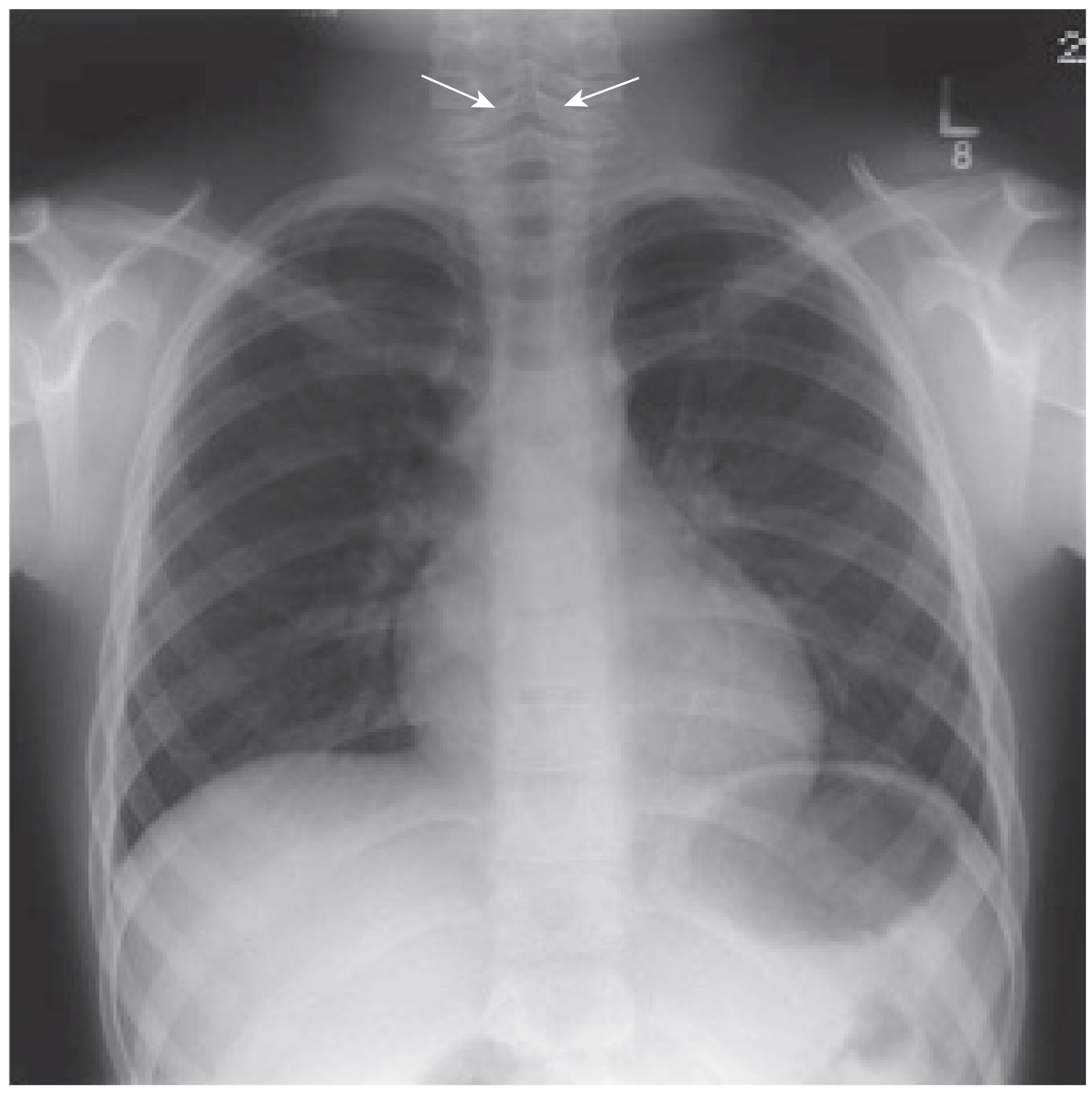
AP chest X-ray showing the classic 'Steeple sign' or 'pencil-tip sign' - narrowing of the subglottic tracheal air column (arrows) due to mucosal edema in croup. [Scott-Brown's Otorhinolaryngology, Vol 2]
- Appearance: Loss of normal "shouldering" of subglottis; tracheal air column tapers to a symmetric point ("steeple" or "church steeple" shape) or "pencil tip"
- View: Anteroposterior (AP) - best view
- Steeple sign is ABSENT in 50% of croup cases
- Steeple sign is NOT pathognomonic - may be seen in normal children
- In epiglottitis: AP shows "thumb sign" (enlarged, rounded epiglottis); lateral shows obliteration of vallecula
Flexible laryngoscopy: Reserved for atypical cases, diagnostic uncertainty, or recurrent/persistent croup. Must be done with extreme caution in moderate-severe cases - risk of precipitating acute airway obstruction.
9. EVIDENCE-BASED MANAGEMENT ACCORDING TO SEVERITY
General Principles (All Severities)
- Keep child CALM - agitation worsens obstruction
- Keep child WITH PARENT/CAREGIVER at all times
- Minimize unnecessary procedures and examinations
- Avoid separating child from caregivers
- Avoid sedatives (risk of respiratory depression)
- Position of comfort (upright, in parent's lap)
- Pulse oximetry: only if it does not distress child; NOT routinely recommended
MILD CROUP (Westley Score 0-2; Intermittent barky cough, no stridor at rest)
- Reassurance of parents and child
- Dexamethasone 0.15 mg/kg oral (single dose; max 10-16 mg) - evidence supports use even in mild croup (reduces return visits, duration, subsequent severity)
- Note: Some guidelines (UCSF 2024) recommend dexamethasone for ALL patients with croup regardless of severity
- Discharge home with return precautions
- No nebulized epinephrine required
- No humidified air/steam - not evidence-based
- Education: symptoms worsen at night, return if: stridor at rest, increased work of breathing, worsening distress
MODERATE CROUP (Westley Score 3-7; Stridor at rest, retractions)
- Minimize agitation; allow child to remain with parent
- Dexamethasone 0.6 mg/kg oral or IM (max 10-16 mg) - single dose
- Nebulized Epinephrine (racemic or L-epinephrine) - see drug section for doses
- Oxygen: only if SpO2 <90-92% (significant hypoxia in moderate croup is RARE; if present, consider alternate diagnosis)
- Observe in ED for minimum 2 hours after epinephrine administration
- If improved after 2-hour observation: discharge with return precautions
- If not improved or worsening: consider repeat epinephrine dose, admit
SEVERE CROUP (Westley Score 8-11; Marked stridor/retractions at rest, distressed)
- Urgent intervention required; minimize agitation
- Nebulized Epinephrine - administer immediately
- Dexamethasone 0.6 mg/kg IV/IM if cannot take orally
- Supplemental Oxygen if SpO2 <90-92%
- Consider HFNC or Heliox if available
- Observe for 4-6 hours minimum; admit if any persistent symptoms
- PICU involvement; prepare for potential intubation
- Repeat nebulized epinephrine every 20-30 minutes if needed
IMPENDING RESPIRATORY FAILURE (Westley Score ≥12; Hypoxia, altered sensorium, absent/decreasing stridor)
- Immediate airway management priority
- Call anesthesia/PICU immediately
- Intubation - see indications below
- Controlled intubation in OR preferred (spontaneous breathing maintained if possible)
- Nebulized epinephrine as a temporizing measure while preparing for intubation
- High-flow oxygen, CPAP/HFNC if available
- IV access; IV dexamethasone 0.6 mg/kg
- Do NOT agitate the child while preparing for intubation
10. DETAILED DISCUSSION OF MEDICATIONS
A. DEXAMETHASONE (First-Line Steroid)
| Parameter | Details |
|---|
| Class | Long-acting glucocorticoid |
| Mechanism | Anti-inflammatory: reduces mucosal edema in subglottis; decreases capillary permeability; stabilizes cell membranes |
| Dose - Mild | 0.15 mg/kg oral (single dose) |
| Dose - Moderate/Severe | 0.6 mg/kg oral/IM/IV (single dose) |
| Maximum Dose | 10-16 mg (most guidelines use max 10 mg; Dell Children's 2024 = 16 mg) |
| Route | Oral preferred (equally effective as IV/IM); IV form CAN be given orally (more concentrated) |
| Onset of Action | ~2-4 hours |
| Duration of Action | ~24-72 hours (biological half-life ~36-54 hours) - single dose usually sufficient |
| Repeat dose? | NOT routinely given; consider repeat at 24 hours only if symptoms persist |
| Evidence | Strong - Level 1A; reduces severity, ED returns, hospital admissions, intubations, and need for epinephrine |
| Comparison | 0.15 mg/kg as effective as 0.6 mg/kg in mild-moderate croup; severe disease may benefit from higher dose |
| Prednisolone | Less evidence than dexamethasone; higher return visit rate (9.6% dexamethasone vs 29.7% prednisolone in one study) |
🔴 EXAM PEARL: The IV formulation of dexamethasone (4 mg/mL) can be given ORALLY - no need for injection in most cases. Oral administration is as effective as IV/IM.
B. NEBULIZED BUDESONIDE
| Parameter | Details |
|---|
| Dose | 2 mg (2 mL of 1 mg/mL solution) via nebulizer |
| Mechanism | Inhaled glucocorticoid - reduces local subglottic inflammation |
| Onset | ~1-2 hours |
| Efficacy | Effective; comparable to oral dexamethasone |
| Disadvantage | More expensive; requires nebulizer; not routinely used |
| Use | Alternative when oral/IV dexamethasone is not tolerated |
C. NEBULIZED EPINEPHRINE (ADRENALINE) - HIGH-YIELD DRUG
Racemic Epinephrine vs. L-Epinephrine
| Feature | Racemic Epinephrine | L-Epinephrine (Adrenaline) |
|---|
| Composition | 50:50 mixture of D- and L-isomers | L-isomer only |
| Concentration | 2.25% solution | 1:1000 (1 mg/mL) |
| Dose | 0.05 mL/kg (max 0.5 mL) of 2.25% in 3 mL NS | 0.5 mL/kg of 1:1000 (max 5 mL) |
| Administration | Via nebulizer mask | Via nebulizer mask |
| Availability | Not available everywhere (limited in India/resource-limited settings) | Universally available |
| Efficacy | Equivalent efficacy | Equivalent to racemic |
| Preferred | Classically preferred in North America | Preferred when racemic not available; equally effective |
L-Epinephrine (1:1000) - Indian/Resource-Limited Practice:
- Dose: 0.5 mL/kg of 1:1000 solution (max 5 mL) diluted in 3 mL NS
- Some protocols: flat dose of 5 mL of 1:1000 nebulized (for children > ~10 kg)
Mechanism of Action
- Alpha-1 adrenergic effect: vasoconstriction → reduces mucosal congestion and edema
- Beta-2 adrenergic effect: bronchodilation (minor role in croup)
- Net effect: rapid reduction in subglottic edema → rapid relief of obstruction
Pharmacokinetics in Croup
| Parameter | Details |
|---|
| Onset | 15-30 minutes |
| Peak effect | ~30 minutes |
| Duration | 2 hours (racemic); L-epinephrine may have slightly longer effect |
| Rebound phenomenon | Return to pre-treatment severity after ~2 hours - does NOT worsen beyond baseline |
🔴 CRITICAL EXAM POINT - REBOUND PHENOMENON:
- After nebulized epinephrine, symptoms may return to PRE-TREATMENT baseline at ~2 hours
- This was historically thought to be a worsening/"rebound" - it is NOT
- Current evidence: there is NO true rebound below baseline (UCSF CDSS guidelines, 2024)
- Observation for minimum 2 hours post-epinephrine is therefore required before discharge
- If symptoms resolve and patient is stable after 2 hours of observation → safe to discharge
- Multiple doses may be required in severe cases; ≥4 doses in 8-12 hours should prompt consideration of alternative diagnosis
When to Observe After Epinephrine
- Minimum 2 hours observation after last dose before discharge consideration
- 3-4 hours in more severe cases or if close follow-up uncertain
D. OXYGEN THERAPY
- Indication: SpO2 <90% (some protocols <92%)
- IMPORTANT: Hypoxia in croup is UNCOMMON in mild or moderate disease
- Significant hypoxia should prompt consideration of an alternative diagnosis or concurrent lower airway disease
- Delivery: blow-by, face mask, or nasal prongs (least distressing method)
- Continuous pulse oximetry NOT routinely recommended (distresses child)
E. HIGH-FLOW NASAL CANNULA (HFNC) AND CPAP
| Modality | Indication in Croup |
|---|
| HFNC | Severe croup with significant respiratory distress; bridge to intubation; when oxygen alone insufficient; increasing evidence as rescue therapy |
| CPAP | Severe croup or impending failure; reduces work of breathing by providing positive airway pressure that stents open the obstructed subglottis |
| Heliox | Low-density helium-oxygen mixture (70:30 or 80:20); reduces turbulent flow; Cochrane 2021 (PMID 34397099): insufficient data to support routine use; may be considered as bridge while awaiting other treatments |
F. INDICATIONS FOR INTUBATION AND MECHANICAL VENTILATION
Absolute Indications:
- Respiratory arrest or near-arrest
- Progressive hypoxia despite maximal non-invasive therapy (SpO2 persistently <90%)
- Decreasing level of consciousness / severe exhaustion
- Complete airway obstruction
Relative/Clinical Indications:
- Failure of 2-3 doses of nebulized epinephrine
- Severe disease with worsening despite dexamethasone and epinephrine
- Inability to maintain airway patency
Intubation Technique (High-Yield for Exam):
- Controlled intubation in operating room (OR) preferred
- Spontaneous breathing maintained (inhalational induction with sevoflurane preferred)
- Endotracheal tube size: at least 0.5-1 mm SMALLER than estimated for age (subglottic narrowing)
- Have a range of tube sizes available (0.5-1 mm smaller than expected)
- Extubation: when air leak is detected around tube
- If no air leak after 5-7 days: endoscopic airway evaluation indicated
G. TREATMENTS WITHOUT EVIDENCE (OUTDATED PRACTICES)
| Treatment | Evidence Status | Current Recommendation |
|---|
| Antibiotics | No role in viral croup (>95% viral etiology) | NOT recommended unless bacterial tracheitis or secondary bacterial infection suspected |
| Bronchodilators (Salbutamol) | No evidence of benefit in croup | NOT recommended |
| Mucolytics | No evidence | NOT recommended |
| Steam inhalation / hot steam | Cochrane meta-analyses: no significant benefit proved; potential burn hazard | NOT recommended; DISCOURAGE as it may cause scalds |
| Cool mist / humidified air | Meta-analyses: no significant benefit proved | NOT recommended as routine; no evidence basis |
| Cough syrups | No evidence | NOT recommended |
| Sedatives | Risks respiratory depression | CONTRAINDICATED |
| Chloral hydrate 30 mg/kg | Only if sedation absolutely necessary (rarely justified) | Avoid |
🔴 COMMON PITFALL: Steam inhalation is still widely practiced in India and resource-limited settings. It has NO evidence of benefit and carries a real risk of scalds/burns. Educate parents to stop this practice.
11. ADMISSION CRITERIA, PICU INDICATIONS, DISCHARGE CRITERIA, AND FOLLOW-UP
Admission Criteria
- Severe croup (Westley ≥8)
- Persistent moderate croup after dexamethasone and epinephrine
- Continued stridor at rest despite therapy
- Need for supplemental oxygen
- Inadequate oral hydration
- Age <6 months (higher risk of severe disease)
- Atypical presentation / concern for alternative diagnosis
- Social factors: inability to return to care if worsens, caregiver unable to recognize warning signs
- History of intubation or previous severe croup episode
PICU Indications
- Persistent severe croup despite full ED therapy
- Impending or actual respiratory failure
- Requirement for intubation and mechanical ventilation
- Hemodynamic instability
- SpO2 persistently <90% despite oxygen therapy
Discharge Criteria
All of the following must be met:
- No stridor at rest
- No/minimal chest wall retractions
- Normal (or near-normal) mental status
- Normal color; SpO2 adequate
- No severe airway obstruction signs
- Taking oral fluids
- Noticeable improvement after at least 2 hours of observation
- Parents understand return precautions and able to access care
Discharge Instructions (Return Precautions)
Parents instructed to return if:
- Stridor occurs or worsens at rest
- Increased work of breathing
- Croupy cough lasts >14 days
- Child becomes listless/unresponsive
- Cyanosis
Follow-Up
- Routine follow-up at 24 hours recommended
- Recurrent croup (≥3 episodes): refer for further evaluation (laryngoscopy, pH probe study for GERD)
12. COMPLICATIONS
| Complication | Details |
|---|
| Respiratory failure | Rare; <0.1% of cases; requires intubation |
| Secondary bacterial infection | Bacterial tracheitis (Staph aureus most common) |
| Post-intubation subglottic stenosis | Risk with prolonged/traumatic intubation |
| Pulmonary edema | Negative-pressure pulmonary edema from severe obstruction (rare) |
| Cor pulmonale | Very rare; chronic severe obstruction |
| Scalds from steam inhalation | Preventable complication of unsafe home remedy |
| Death | ~1 in 30,000 cases; extremely rare with modern management |
13. PROGNOSIS
- Croup is overwhelmingly a self-limited illness
- 85% have mild disease managed at home
- 50% improve within 24 hours; most within 4 days
- Hospitalization: 6-10%; Critical care: 3-10% of hospitalized
- Mortality: ~1 in 30,000
- Recurrent croup (5% of children): associated with atopy, GERD, congenital subglottic narrowing
- History of croup doubles the odds of subsequent asthma and wheezing
- Long-term prognosis: excellent; no lasting respiratory sequelae in the vast majority
14. RECENT UPDATES AND CHANGES IN MANAGEMENT (2022-2025)
-
SARS-CoV-2 Omicron as a croup etiology: The BA.2 subvariant has been associated with severe and life-threatening croup in children (PMID 35726145, 2022). COVID-19-associated croup should be considered in unvaccinated or recently COVID-exposed children.
-
Dexamethasone for ALL severities: UCSF and other major centers' 2024 guidelines now recommend dexamethasone for ALL patients with croup regardless of severity (even mild), citing evidence of reduced return visits and disease burden.
-
Abandonment of "rebound" observation myth: Current guidelines clarify that nebulized epinephrine does NOT cause a rebound BELOW baseline severity. The 2-hour observation is to ensure improvement is maintained, not to watch for a paradoxical worsening.
-
No routine X-rays: Major centers explicitly de-emphasize X-ray use; Rosen's and UCSF guidelines 2024 state radiographic studies do not change management and are not sensitive or specific.
-
Heliox - Limited role: Cochrane systematic review (PMID 34397099, 2021) found insufficient data to support routine heliox use; it may serve as a bridge in severe cases.
-
HFNC emerging evidence: Growing use of HFNC in severe croup as a non-invasive modality to reduce work of breathing before intubation.
-
Continuous pulse oximetry NOT routinely recommended: Major institutions caution that routine oximetry monitoring distresses the child and worsens symptoms; reserve for severe disease only.
-
COVID-19 impact on seasonality: Parainfluenza seasonality has been disrupted; rhinovirus and SARS-CoV-2 now contribute to year-round croup presentations.
15. EMERGENCY DEPARTMENT MANAGEMENT ALGORITHM
CHILD PRESENTS WITH BARKY COUGH, STRIDOR, HOARSENESS
                         |
            ┌────────────────────────┐
            │  Is this CROUP?        │
            │  Rule out:             │
            │  • Epiglottitis        │
            │  • Foreign body        │
            │  • Bacterial tracheitis│
            └────────────────────────┘
                         |
         Atypical features? → Investigate / Senior review
                         |
              ASSESS SEVERITY
     (Westley Score + Clinical Assessment)
                         |
    ┌────────────────────┼────────────────────┐
    |                    |                    |
 MILD               MODERATE              SEVERE/
(Score 0-2)        (Score 3-7)          IMPENDING FAILURE
    |                    |              (Score ≥8/≥12)
    |                    |                    |
Reassurance         Minimize           EMERGENCY:
Dexamethasone       agitation          Call PICU/Anaesthesia
0.15-0.6 mg/kg                         ↓
oral x1 dose        Dexamethasone      O2, IV access
                    0.6 mg/kg          Neb. Epinephrine
Discharge with      oral/IM x1         Dexamethasone
return              dose               0.6 mg/kg IV/IM
precautions                            ↓
                    Neb. Epinephrine   Consider HFNC/CPAP
                    (racemic/L-epi)    ↓
                         |             Prepare for
                    Observe 2 hrs      intubation if:
                         |             • No improvement
                  ┌──────┴──────┐      • SpO2 still <90%
                  |             |      • Altered sensorium
               Improved    Not improved
                  |             |
              Discharge    Repeat epi;
              (if meets    Admit / PICU
              criteria)
16. IMPORTANT MNEMONICS
Etiology - "PAIR M"
- P - Parainfluenza (types 1, 2, 3) - MOST COMMON
- A - Adenovirus
- I - Influenza A and B (more SEVERE)
- R - RSV (Respiratory Syncytial Virus), Rhinovirus
- M - Measles, Metapneumovirus, Mycoplasma (rare)
Clinical Triad - "BHS"
- B - Barky seal-like cough
- H - Hoarse voice
- S - Stridor (inspiratory)
Management by Severity - "DOME"
- D - Dexamethasone (all severities)
- O - Oxygen (if SpO2 <90%)
- M - Minimize disturbance/agitation
- E - Epinephrine nebulized (moderate-severe)
Westley Score Parameters - "SCACI"
- S - Stridor (0-2)
- C - Chest retractions (0-3)
- A - Air entry (0-2)
- C - Cyanosis (0-5)
- I - Intelligence/consciousness level (0-5)
Differentiating Croup vs. Epiglottitis - "CROUP vs. DROOL"
- CROUP: Cough barky, Rhino prodrome, Own quiet position (upright), Unwell mildly, Parainfluenza
- DROOL: Drooling, Rapid onset, Obstruction severe, Older child (post-Hib era), Leaning forward (tripod)
17. HIGH-YIELD SUMMARY TABLES
Table 1: Drug Doses Quick Reference
| Drug | Dose | Route | Max Dose | Onset | Duration |
|---|
| Dexamethasone | 0.15 mg/kg (mild) OR 0.6 mg/kg (mod/severe) | Oral (preferred); IM/IV if unable | 10-16 mg | 2-4 hours | 24-72 hours |
| Racemic Epinephrine | 0.05 mL/kg of 2.25% in 3 mL NS | Nebulized | 0.5 mL | 15-30 min | 2 hours |
| L-Epinephrine (1:1000) | 0.5 mL/kg of 1:1000 in 3 mL NS | Nebulized | 5 mL | 15-30 min | 2 hours |
| Nebulized Budesonide | 2 mg (2 mL of 1 mg/mL) | Nebulized | 2 mg | 1-2 hours | 12-24 hours |
| Oxygen | As needed | Blow-by/mask/nasal prongs | N/A | Immediate | Continuous |
Table 2: Severity-Management Summary
| Severity | Westley Score | Key Feature | Dexamethasone | Epinephrine | Oxygen | Disposition |
|---|
| Mild | 0-2 | Barky cough only; no stridor at rest | 0.15-0.6 mg/kg oral | No | No | Discharge |
| Moderate | 3-7 | Stridor at rest; retractions | 0.6 mg/kg oral/IM | Yes | If SpO2 <90% | Observe 2h; discharge if improved |
| Severe | 8-11 | Marked stridor; marked retractions; distress | 0.6 mg/kg IV/IM | Yes (repeat PRN) | Yes | Admit; PICU consider |
| Impending failure | ≥12 | Hypoxia; altered sensorium; decreasing stridor | 0.6 mg/kg IV | Yes (temporizing) | Yes; HFNC/CPAP | PICU; prepare intubation |
18. DNB/MD EXAMINATION PEARLS, VIVA QUESTIONS, AND HIGH-YIELD MCQs
Must-Remember Facts (Viva/Theory)
🔴 TOP 10 MUST-REMEMBER FACTS:
- Croup is the MOST COMMON infectious cause of stridor in children (>90% of stridor cases)
- Most common causative agent: Parainfluenza virus type 1
- Classic triad: BARKY cough + HOARSENESS + INSPIRATORY STRIDOR
- Children with croup do NOT drool, do NOT look toxic, do NOT prefer tripod position - distinguish from epiglottitis
- Steeple sign may be ABSENT in 50% of croup; X-ray is NOT routinely needed
- Stridor does NOT occur until >50% reduction in airway cross-sectional area
- Decreasing stridor + worsening child = EXHAUSTION (emergency) - NOT improvement
- Dexamethasone oral is as effective as IV/IM; IV formulation CAN be given orally
- There is NO true rebound below baseline after nebulized epinephrine
- Steam inhalation has NO evidence and carries burn risk - discourage actively
Viva Questions with Model Answers
Q1: Why does croup predominantly affect the subglottis?
A: The subglottis is the narrowest part of the pediatric airway AND is encircled by the only complete cartilaginous ring (cricoid). Any edema cannot expand outward, so it reduces the lumen. By Poiseuille's law, even 1 mm of edema in a 6.5 mm subglottis reduces the cross-sectional area by ~50%, dramatically increasing resistance.
Q2: Why is dexamethasone preferred over prednisolone?
A: Dexamethasone has greater anti-inflammatory potency, a single dose is sufficient (long biological half-life), it can be given orally as a single dose, and studies show significantly lower return visit rates compared to prednisolone (9.6% vs 29.7% in one RCT).
Q3: How do you distinguish croup from epiglottitis at the bedside?
A: Croup: gradual onset, barky cough, hoarseness, no drooling, non-toxic, no dysphagia, URI prodrome, age 6 months-3 years. Epiglottitis: rapid onset (hours), NO barky cough, muffled voice, drooling, TOXIC appearance, severe dysphagia, tripod position, age now any (post-Hib vaccine era).
Q4: What is the rebound phenomenon with nebulized epinephrine and how do you manage it?
A: Historically, "rebound" referred to return of croup symptoms 2-3 hours after epinephrine as its effect waned. Current evidence shows symptoms return to PRE-TREATMENT baseline (not below). Management: observe for 2 hours minimum; if stable with no stridor at rest → safe to discharge. True worsening below baseline does not occur.
Q5: What is bacterial tracheitis and how does it differ from croup?
A: Bacterial tracheitis (membranous/pseudomembranous croup) is most commonly caused by Staphylococcus aureus. The child is TOXIC, fails to respond to standard croup treatment, has HIGH fever, and on laryngoscopy/bronchoscopy shows pseudomembranes in the trachea. Management requires IV antibiotics (anti-staphylococcal) and often intubation.
Q6: What is the Westley score and what is the maximum score?
A: Westley score assesses 5 parameters: inspiratory stridor (0-2), chest retractions (0-3), air entry (0-2), cyanosis (0-5), level of consciousness (0-5). Maximum score = 17. Mild: 0-2; Moderate: 3-7; Severe: ≥8; Impending failure: ≥12.
Q7: When would you NOT recommend X-ray in croup?
A: Typical viral croup with classic clinical features does NOT require X-ray. Imaging should be reserved for atypical presentations, diagnostic uncertainty, failure to respond to treatment, or suspicion of alternative diagnosis (epiglottitis, foreign body, retropharyngeal abscess).
Q8: What ETT size do you use for intubation in croup?
A: Use an ETT 0.5-1 mm SMALLER than the size estimated for the child's age (to accommodate subglottic narrowing). Have multiple sizes ready. Extubate when an air leak is detectable.
High-Yield MCQs
MCQ 1: Most common cause of acute stridor in children?
- (A) Epiglottitis (B) Viral Croup ✓ (C) Foreign body aspiration (D) Bacterial tracheitis
MCQ 2: Most common causative virus in croup?
- (A) RSV (B) Influenza A (C) Parainfluenza type 1 ✓ (D) Rhinovirus
MCQ 3: First-line treatment for moderate croup?
- (A) IV antibiotics (B) Nebulized salbutamol (C) Oral dexamethasone + nebulized epinephrine ✓ (D) Humidified air
MCQ 4: The Steeple sign in croup represents:
- (A) Widened prevertebral space (B) Enlarged epiglottis (C) Subglottic narrowing ✓ (D) Retropharyngeal widening
MCQ 5: Dose of nebulized L-epinephrine (1:1000) in croup?
- (A) 0.05 mL/kg (B) 0.5 mL/kg (max 5 mL) ✓ (C) 5 mL/kg (D) 1 mL/kg
MCQ 6: Which statement about dexamethasone in croup is TRUE?
- (A) IV form cannot be given orally (B) Dose must be repeated daily for 3 days (C) It is ineffective in mild croup (D) Single oral dose is as effective as IV/IM ✓
MCQ 7: Observation period after nebulized epinephrine before discharge?
- (A) 30 minutes (B) 1 hour (C) 2 hours ✓ (D) 6 hours
MCQ 8: A 2-year-old with croup has decreasing stridor and is becoming less responsive. The next step is:
- (A) Discharge (improvement noted) (B) Repeat chest X-ray (C) Urgent airway management - impending failure ✓ (D) Start antibiotics
MCQ 9: Which is NOT a recognized treatment for croup?
- (A) Dexamethasone (B) Nebulized racemic epinephrine (C) Steam inhalation ✓ (D) Nebulized budesonide
MCQ 10: Bacterial tracheitis is most commonly caused by:
- (A) H. influenzae type B (B) Streptococcus pneumoniae (C) Staphylococcus aureus ✓ (D) Moraxella catarrhalis
QUICK REFERENCE CARD (High-Yield Tables)
Etiology Memory Table
| Category | Agent | Notes |
|---|
| Most common | Parainfluenza 1 | ~50-75%; autumn |
| Severe croup | Influenza A/B | More severe than PIV |
| New emerging | SARS-CoV-2 Omicron | Severe croup; 2022 onwards |
| Uncommon viral | RSV, Rhinovirus, Adenovirus, Metapneumovirus | |
| Rare | Measles, Varicella, HSV, Mycoplasma | Immunocompromised |
| Bacterial | S. aureus (tracheitis) | Toxic; membranes |
Common Pitfalls Table
| Pitfall | Reality |
|---|
| Decreasing stridor = improving | WRONG - may indicate exhaustion/near-failure |
| X-ray needed in every croup case | WRONG - clinical diagnosis; X-ray not routine |
| Must give IV dexamethasone in hospital | WRONG - oral equally effective |
| Rebound = worsening below baseline | WRONG - returns to pre-treatment, not below |
| Steam inhalation helps | WRONG - no evidence; risk of burns |
| Antibiotics help viral croup | WRONG - no role |
| Humidified air is effective | WRONG - meta-analyses: no significant benefit |
| Normal steeple sign rules out croup | WRONG - absent in 50% of cases |
| Pulse oximetry required for all | WRONG - avoid if it distresses the child |
Sources: Cummings Otolaryngology Head and Neck Surgery 7e, Scott-Brown's Otorhinolaryngology Vol 2, Rosen's Emergency Medicine 9e, Barash Clinical Anesthesia 9e; UCSF Benioff Children's Consensus Guidelines 2024; Dell Children's Hospital Croup Guideline June 2024; Children's Minnesota Croup Guideline Rev 6/25; CHOC Croup Care Guideline; Ann & Robert H. Lurie Children's Hospital Algorithm (Updated July 2025); PubMed: Moraa et al. Cochrane 2021 (PMID 34397099), Park et al. 2022 (PMID 35726145), Garzon Mora et al. 2023 (PMID 37916233)