
Feeding of neonate born to hiv positive mother according to cloherty and Indian guidelines
I'll read the medical library skill first, then search for relevant content in parallel.
Reading File
Now let me search for relevant content in parallel across the library:
Finding Sources
Finding Sources
Finding Sources
Finding Sources
Finding Sources
Searching the Web
feeding neonate born to HIV positive mother Cloherty guidelines 2024
Cloherty's Manual isn't directly in the library. Let me search for it by a different term and also search for Indian NACO guidelines:
Finding Sources
Searching the Web
Cloherty Manual Neonatal Care HIV positive mother infant feeding recommendations
Searching the Web
India NACO NVBDCP guidelines 2023 2024 infant feeding HIV positive mother breastfeeding
Excellent - I have good data. Let me now extract the full NACO guidelines and Cloherty PDF for detailed content:
Reading Web Page
https://blk-pediatric-practice.com/wp-content/uploads/2022/0…
Finding Sources
Reading File
I now have comprehensive information to deliver a well-structured answer. Let me compile everything.
Feeding of Neonate Born to HIV-Positive Mother
Cloherty's Manual of Neonatal Care (7th Edition) - Key Recommendations
Core principle: In the United States and high-income countries, the CDC recommends that women who test positive for HIV should avoid breastfeeding entirely, because safe formula-feeding alternatives are available and breastfeeding increases the rate of perinatal HIV transmission by approximately 14%.
Specific Guidance (Cloherty 7th Ed):
1. Replacement / Formula Feeding (Preferred in High-Income Settings)
- Advise exclusive formula feeding from birth
- No breastfeeding; no mixed feeding
- Formula feeding eliminates postnatal HIV transmission risk via breast milk
2. If Breastfeeding Cannot Be Avoided (Resource-Limited Settings)
- WHO 2010 recommendations (endorsed in Cloherty): HIV-seropositive women should be offered antenatal and intrapartum maternal ART or infant prophylaxis
- Each country decides whether HIV+ women should exclusively formula feed OR breastfeed with concomitant ART
- If breastfeeding is chosen: exclusive breastfeeding for the first 6 months, with complementary foods added thereafter, and rapid weaning at 12 months
- Do NOT mix-feed (breast milk + formula together) - mixed feeding carries higher HIV transmission risk than exclusive breastfeeding
3. Antiretroviral Prophylaxis for the Infant
- Combination ARV prophylaxis for the neonate should be given regardless of feeding mode
- Zidovudine (AZT) based regimen for 4-6 weeks (standard low-risk) OR triple-drug prophylaxis for high-risk infants (e.g., mother with no antenatal ART)
- Data from Thailand showed transmission rate of only 2% using ZDV + nevirapine + exclusive bottle feeding
4. Key Contraindication Statement (Cloherty, Chapter on Breastfeeding)
"The Centers for Disease Control and Prevention recommends that women who test positive for HIV in the United States should avoid breastfeeding."
Indian (NACO) National Guidelines - Infant Feeding in HIV-Exposed Infants
India follows a context-adapted approach distinct from high-income country guidelines, recognizing that exclusive replacement feeding is not a viable public health strategy in India because:
- Safe water and sanitation may not be guaranteed
- Exclusive formula feeding increases risk of diarrhoea, pneumonia, malnutrition - negating the benefit of reduced HIV transmission
- Stigma of not breastfeeding may expose the mother's HIV status
NACO National Recommendation: Breastfeeding with Maternal ART
NACO has endorsed WHO's recommendation and provides free lifelong ART to all pregnant and lactating women since January 2014, regardless of clinical/immunological stage.
Feeding Guidelines for Infants < 6 Months:
| Option | Recommendation |
|---|---|
| Exclusive Breastfeeding (EBF) + Maternal ART | Preferred in India - Initiate within 1st hour of birth |
| Exclusive Replacement Feeding | Only if ALL 6 AFASS criteria are met (see below) |
| Mixed feeding | Strongly discouraged - highest HIV transmission risk |
Exclusive Breastfeeding means: Breast milk only - no other milk, food, drinks, or water (except vitamins/syrups/medications)
The 6 AFASS Criteria for Replacement Feeding (NACO Box 2):
Replacement feeding may be considered ONLY when ALL of the following are met:
- Safe water and sanitation are assured at household and community level
- Affordable - mother/caregiver can reliably provide sufficient replacement feeding to support normal growth
- Feasible - milk can be prepared frequently enough in a clean manner (low risk of diarrhoea/malnutrition)
- Sustainable - exclusive replacement feeding for the first 6 months can be maintained
- Family is supportive of this practice
- Access to health care offering comprehensive child health services
If any one criterion is NOT met → counsel mother to exclusively breastfeed with ART.
Breastfeeding Counselling by NACO (For Mothers Who Choose to Breastfeed):
- Initiate breastfeeding within the first hour of birth
- Practice exclusive breastfeeding for 6 months
- Introduce complementary foods at 6 months (180 days) while continuing breastfeeding
- Continue breastfeeding for at least 12 months, up to 24 months or beyond (same as general population) while on ART
- Stop breastfeeding only when a nutritionally adequate, safe diet without breast milk can be provided
Maternal ART Effect on Infant:
- Maternal ART decreases viral load in blood and breast milk
- ART in breast milk acts as pre-exposure prophylaxis (PrEP) for the infant
- Concomitant maternal ART + exclusive breastfeeding dramatically reduces postnatal transmission
Infant ARV Prophylaxis (Both Guidelines)
Regardless of feeding choice, all HIV-exposed neonates receive ARV prophylaxis:
| Risk Category | Regimen |
|---|---|
| Low risk (mother on ART, VL suppressed) | Nevirapine (NVP) syrup for 6 weeks |
| High risk (mother with no/incomplete ART, detectable VL) | Triple therapy: ZDV + 3TC + NVP for 6 weeks |
- NVP dose: 2 mg/kg/dose OD for term neonates
- Start within 6-12 hours of birth
Comparison: Cloherty vs. Indian (NACO) Guidelines
| Aspect | Cloherty (USA/High-Income) | NACO (India) |
|---|---|---|
| Preferred feeding | Exclusive formula/replacement | Exclusive breastfeeding + maternal ART |
| Breastfeeding | Contraindicated (avoid) | Recommended with ART |
| Replacement feeding | Standard of care | Only if AFASS criteria met |
| Duration | - | Breastfeed minimum 12 months |
| Mixed feeding | Avoided | Strongly discouraged |
| Infant ARV | Prophylaxis regardless | Prophylaxis regardless |
| Rationale | Safe formula universally available | Formula unsafe in resource-poor settings |
Red Book 2021 (AAP) Addendum
The Red Book 2021 states:
- All HIV-infected women should be counseled regarding breastfeeding
- HIV has been detected in human milk both as cell-free virus and cell-associated virus
- Neither maternal nor infant postpartum ART is sufficient to completely eliminate the risk of HIV transmission through breastfeeding
- HIV-infected women who choose to breastfeed should be informed of the residual risk
(Red Book 2021, p. 241)
Key Take-Away
In India, the mantra is: "Breastfeed exclusively + ensure mother is on ART" rather than replacement feeding, because the risks of not breastfeeding (malnutrition, infections) outweigh the residual HIV transmission risk when the mother is virologically suppressed on ART. In contrast, Cloherty (US guidelines) recommends avoiding breastfeeding entirely when safe formula is available, as this eliminates postnatal transmission risk completely.
What is Steroidogenesis
Steroidogenesis is the biochemical process by which steroids are synthesized from cholesterol in the body. It occurs mainly in the adrenal cortex, gonads, and placenta, producing glucocorticoids, mineralocorticoids, androgens, estrogens, and progestogens through a series of enzymatic steps involving cytochrome P450 enzymes.
Searching sources...
Reading File
Finding Sources
Finding Sources
Excellent results. Now let me read the key sections in parallel - Harper's Biochemistry (most relevant), Harrison's, and Goldman-Cecil:
Reading File
Reading File
Reading File
Let me now fetch the steroidogenesis pathway diagram images and read the ovarian/testicular steroidogenesis sections:
Loading Image
Reading File
Reading File
I now have a comprehensive steroidogenesis pathway diagram and rich textbook content. Let me compile the full answer:
Steroidogenesis
Steroidogenesis is the multi-step biochemical process by which steroid hormones are biosynthesized from cholesterol. It occurs in the adrenal cortex, gonads (testes and ovaries), and placenta, producing five classes of steroid hormones: glucocorticoids, mineralocorticoids, androgens, estrogens, and progestogens.
The Complete Steroidogenesis Pathway
(Harrison's Principles of Internal Medicine 22E, Fig. 398-1)
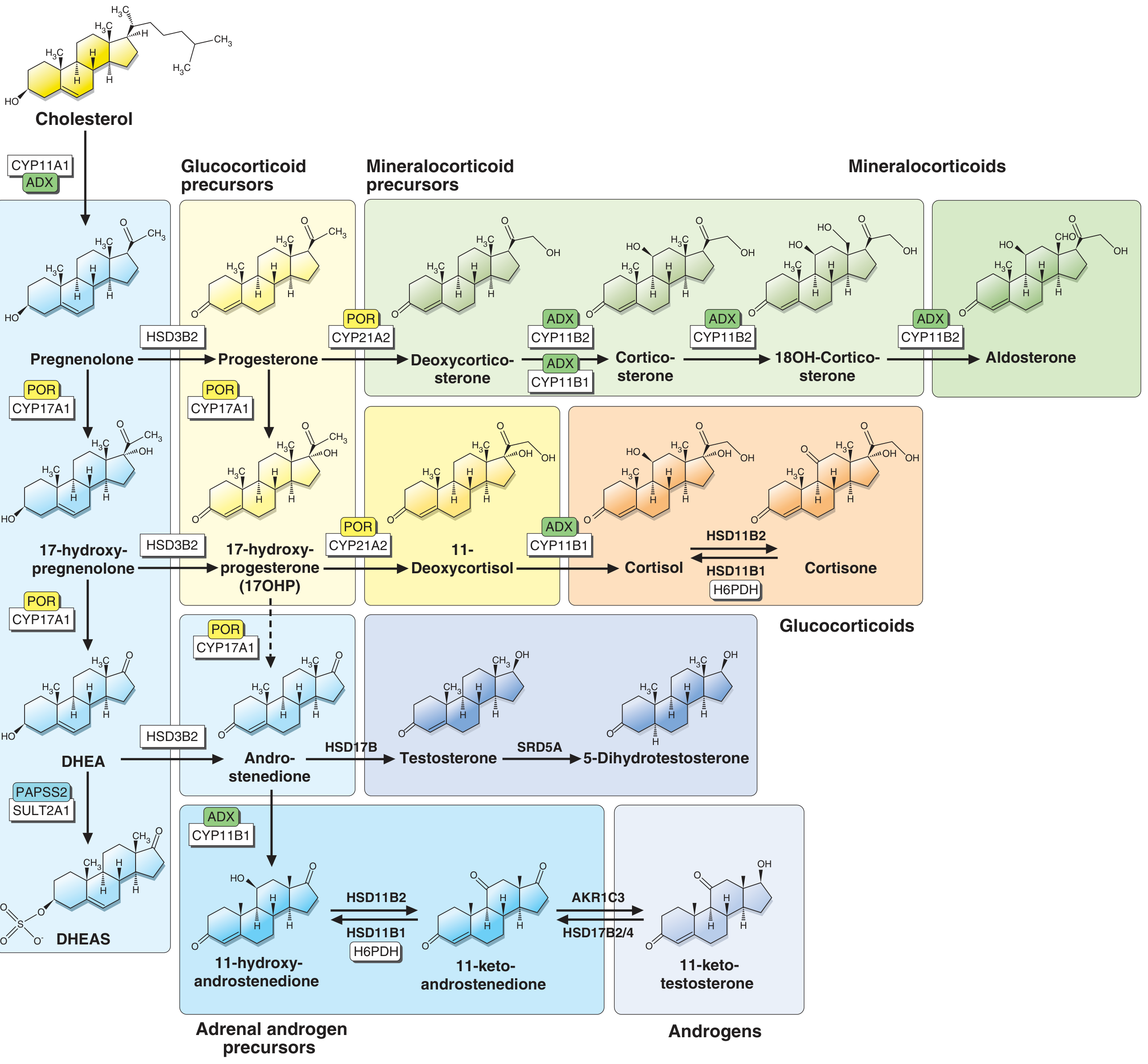
Step 1 - Cholesterol: The Universal Precursor
All mammalian steroid hormones are formed from cholesterol, which is:
- Mostly derived from plasma LDL (majority)
- A small fraction synthesized in situ from acetyl-CoA via mevalonate and squalene
- Stored as cholesterol esters in cytoplasmic lipid droplets until needed
(Harper's Illustrated Biochemistry, 32nd Ed, p. 504)
Step 2 - The Rate-Limiting Step: Cholesterol → Pregnenolone
This is the committed and rate-limiting step in steroidogenesis:
- StAR protein (Steroidogenic Acute Regulatory protein) transports cholesterol from the outer to the inner mitochondrial membrane - this is the key rate-limiting event
- CYP11A1 (P450scc - side chain cleavage enzyme) then cleaves the side chain of cholesterol at C20-C22 via sequential hydroxylations:
- First hydroxylation at C22
- Second hydroxylation at C20
- Side chain cleavage (removal of isocaproaldehyde, a 6-carbon fragment)
- Product: Pregnenolone (a 21-carbon steroid)
- StAR expression is stimulated by ACTH (in adrenals) and LH/hCG (in gonads)
"An ACTH-dependent steroidogenic acute regulatory (StAR) protein is essential for the transport of cholesterol to P450scc in the inner mitochondrial membrane." - Harper's Biochemistry
Step 3 - Three Zone-Specific Pathways in the Adrenal Cortex
Once pregnenolone is formed, it diverges into three pathways depending on the zone of the adrenal cortex:
A. Zona Glomerulosa (Outer) - Mineralocorticoid Pathway → Aldosterone
| Step | Substrate | Enzyme | Product |
|---|---|---|---|
| 1 | Pregnenolone | 3β-HSD + Δ5,4-isomerase | Progesterone |
| 2 | Progesterone | CYP21A2 (21-hydroxylase) | Deoxycorticosterone (DOC) |
| 3 | DOC | CYP11B2 (11β-hydroxylase) | Corticosterone |
| 4 | Corticosterone | CYP11B2 (18-hydroxylase / aldosterone synthase) | 18-OH-Corticosterone |
| 5 | 18-OH-Corticosterone | CYP11B2 | Aldosterone |
- Note: Zona glomerulosa lacks 17α-hydroxylase (CYP17A1), so it cannot make cortisol
- Regulated by: Renin-Angiotensin-Aldosterone (RAA) system
B. Zona Fasciculata (Middle) - Glucocorticoid Pathway → Cortisol
| Step | Substrate | Enzyme | Product |
|---|---|---|---|
| 1 | Pregnenolone | CYP17A1 (17α-hydroxylase) | 17-OH-Pregnenolone |
| 2 | 17-OH-Pregnenolone | 3β-HSD + Δ5,4-isomerase | 17-OH-Progesterone (17-OHP) |
| 3 | 17-OHP | CYP21A2 (21-hydroxylase) | 11-Deoxycortisol |
| 4 | 11-Deoxycortisol | CYP11B1 (11β-hydroxylase) | Cortisol |
- Regulated by: HPA axis (CRH → ACTH → Cortisol)
- C21 hydroxylation is necessary for both glucocorticoid and mineralocorticoid activity
C. Zona Reticularis (Inner) - Adrenal Androgen Pathway → DHEA/DHEAS
| Step | Substrate | Enzyme | Product |
|---|---|---|---|
| 1 | 17-OH-Pregnenolone | CYP17A1 (17,20-lyase activity) | DHEA |
| 2 | DHEA | SULT2A1/PAPSS2 (sulfotransferase) | DHEAS |
| 3 | DHEA | 3β-HSD | Androstenedione |
| 4 | Androstenedione | 17β-HSD | Testosterone |
- CYP17A1 is a dual-function enzyme: 17α-hydroxylase activity + 17,20-lyase activity
- The lyase activity acts only on 17α-hydroxy-containing molecules
- DHEA is a prohormone - the weak androgen converted peripherally to more potent forms
(Goldman-Cecil Medicine, p. 3359-3361)
Step 4 - Gonadal Steroidogenesis
Testicular (Leydig Cells) → Testosterone
- Stimulated by LH (not ACTH)
- Rate-limiting step is the same: StAR-mediated cholesterol transport → CYP11A1 → Pregnenolone
- Pregnenolone → Testosterone via two pathways:
- Δ5 pathway (predominant in humans): Pregnenolone → DHEA → Androstenedione → Testosterone
- Δ4 pathway: Pregnenolone → Progesterone → 17-OHP → Androstenedione → Testosterone
- Requires 5 enzyme activities in 3 proteins: 3β-HSD/Δ5,4-isomerase; 17α-hydroxylase/17,20-lyase (CYP17A1); 17β-HSD
Peripheral Conversion: Testosterone → DHT
- In skin, prostate, and external genitalia: 5α-reductase (SRD5A2) converts testosterone to 5-dihydrotestosterone (DHT), a more potent androgen
- Required for male external genitalia differentiation (weeks 8-14 of gestation)
Ovarian (Theca + Granulosa Cells) → Estrogens
- Two-cell, two-gonadotropin theory:
- Theca cells (LH-driven): Cholesterol → Androstenedione/Testosterone
- Granulosa cells (FSH-driven): Androstenedione/Testosterone → Estrone/Estradiol via aromatase (CYP19A1)
- Aromatization involves removal of the C19 methyl group and aromatization of the A ring
(Harper's Biochemistry, p. 506-507)
Key Enzymes Summary
| Enzyme | Gene | Location | Reaction |
|---|---|---|---|
| StAR protein | STAR | Mitochondrial membrane | Cholesterol transport (rate-limiting) |
| P450scc | CYP11A1 | Mitochondria | Cholesterol → Pregnenolone |
| 3β-HSD | HSD3B2 | ER | Δ5 → Δ4 steroids (all zones) |
| 17α-hydroxylase/17,20-lyase | CYP17A1 | ER | 17-hydroxylation + side chain cleavage |
| 21-hydroxylase | CYP21A2 | ER | 17-OHP → 11-Deoxycortisol; Progesterone → DOC |
| 11β-hydroxylase | CYP11B1 | Mitochondria | 11-Deoxycortisol → Cortisol |
| Aldosterone synthase | CYP11B2 | Mitochondria (zona glomerulosa) | Corticosterone → Aldosterone |
| Aromatase | CYP19A1 | ER | Testosterone → Estradiol |
| 5α-reductase | SRD5A2 | Peripheral tissues | Testosterone → DHT |
Regulatory Control
| Hormone/System | Controls |
|---|---|
| ACTH (via HPA axis) | Glucocorticoid and adrenal androgen synthesis; activates StAR and CYP11A1 |
| LH | Testicular testosterone synthesis; ovarian androstenedione (theca) |
| FSH | Granulosa cell aromatase; estradiol synthesis |
| Angiotensin II + K+ | Aldosterone synthesis (zona glomerulosa); independent of ACTH |
| Cortisol (negative feedback) | Suppresses CRH (hypothalamus) and ACTH (pituitary) |
- Adrenal cortisol secretion follows a circadian rhythm: peaks in the early morning (before awakening), lowest in the evening
- This is controlled by the hypothalamic suprachiasmatic nucleus (SCN) via pulsatile CRH release
(Harrison's Principles of Internal Medicine 22E, p. 3094)
Placental Steroidogenesis
The placenta is also a steroid-synthesizing tissue:
- Has high steroid sulfatase activity: converts DHEAS (from fetal adrenal) back to DHEA
- DHEA → Estrogens (estrone, estradiol, and estriol) via 3β-HSD and aromatase
- Estriol (E3) is unique to pregnancy - requires fetal adrenal DHEAS as substrate
(Goldman-Cecil Medicine, p. 3365)
Clinical Significance - Enzyme Deficiency Disorders
| Deficiency | Consequences |
|---|---|
| CYP21A2 (21-hydroxylase) | Most common cause of CAH; cortisol/aldosterone deficiency + androgen excess (virilization) |
| CYP11B1 (11β-hydroxylase) | Second most common CAH; hypertension due to DOC accumulation |
| CYP17A1 | Hypertension, hypogonadism, no sex steroids |
| StAR protein | Congenital lipoid adrenal hyperplasia - most severe form; inability to make any steroid hormones |
| CYP19A1 (Aromatase) | Aromatase deficiency; virilization in females, failure of epiphyseal closure in males |
| SRD5A2 (5α-reductase) | 46,XY DSD - ambiguous genitalia at birth with virilization at puberty |
Sources: Harper's Illustrated Biochemistry 32nd Ed (p. 504-507); Harrison's Principles of Internal Medicine 22E (p. 3094); Goldman-Cecil Medicine 2-Vol Set (p. 3355-3365)
This is a shared conversation. Sign in to Orris to start your own chat.