
Equipment name with two definition 1.Medical others name (old to all A2Z name)give 123.... 2.physiology with principal of equipment 2 line 3.indication 4.contraindication 5.complication and don't use pt 6.picture equipment with parts 7.parts name and use and function of equipment 8.equipment with each part placement of anatomy lande mark 9.types of equipment 10.if applicable colour code 11.sterlization of equipment 12. Procedure use equipment with vedio link youtube Reference Refers book Code blue manual guide and international trauma life support and tinnalae 9th editions and atls procedures latha ganti latest editions and Reichman’s Emergency Medicine Procedures and Miller book of anaesthetic and ROBERTS & HEDGES CLINICAL PROCEDURES in Emergency Medicine and UNDERSTANDING ANESTHETIC EQUIPMENT & PROCEDURES A PRACTICAL APPROACH Editors Dwarkadas K Baheti Vandana V Laheri
Which equipment do you want the full 12-point note on? · What output format do you want?
laryngoscope handle and blade parts Macintosh Miller
direct laryngoscopy endotracheal intubation procedure video youtube
"laryngoscopes"[MeSH Terms] AND "intubation, intratracheal"[MeSH Terms]
LARYNGOSCOPE
1. Other names (old to new, A to Z)
- Autoscope (Kirstein, 1895, the first direct laryngoscope)
- Direct laryngoscope (DL)
- Fibreoptic-light laryngoscope (cold light)
- Intubating scope / "lary" (common ward slang)
- Macintosh laryngoscope (curved blade)
- Magill, Wisconsin, Phillips, Robertshaw and Henderson blades (older straight-blade designs)
- McCoy (levering-tip) laryngoscope
- Miller laryngoscope (straight blade)
- Optical laryngoscope (Airtraq)
- Video laryngoscope (GlideScope, C-MAC, McGrath)
2. Principle
- The blade pushes the tongue into the floor of the mouth and lifts the epiglottis. This opens a line of sight from the mouth to the larynx.
- Lift the handle along its own axis, up and forward. Do not lever the blade against the teeth.
- The curved blade tip sits in the vallecula and lifts the epiglottis indirectly through the hyoepiglottic ligament.
- The straight blade tip goes under the epiglottis and lifts it directly. - Roberts & Hedges, Direct Laryngoscopy, Equipment
3. Indications
- Any situation needing a definitive emergency airway, including routine and difficult airways. - Roberts & Hedges
- Cardiac arrest, respiratory failure and trauma.
- General anaesthesia with intubation.
- Removing foreign bodies from the pharynx under direct vision.
- Placing a nasogastric tube or throat pack under vision (Magill forceps).
4. Contraindications
- Limited mouth opening
- Upper airway distortion or swelling
- Severe kyphosis
- Copious blood or secretions in the airway
5. Complications
- Dental injury (the most common injury)
- Lip, gum, tongue and pharyngeal lacerations
- Laryngeal injury and arytenoid dislocation
- Failed or oesophageal intubation, with hypoxia
- Aspiration of gastric contents
- Laryngospasm
- Sympathetic surge (raised heart rate and blood pressure, raised intracranial and intraocular pressure)
- Bradycardia in infants (vagal reflex)
- Cervical spine movement
- Cross-infection from an inadequately cleaned instrument
- Equipment failure (dim or failed light)
6. Pictures
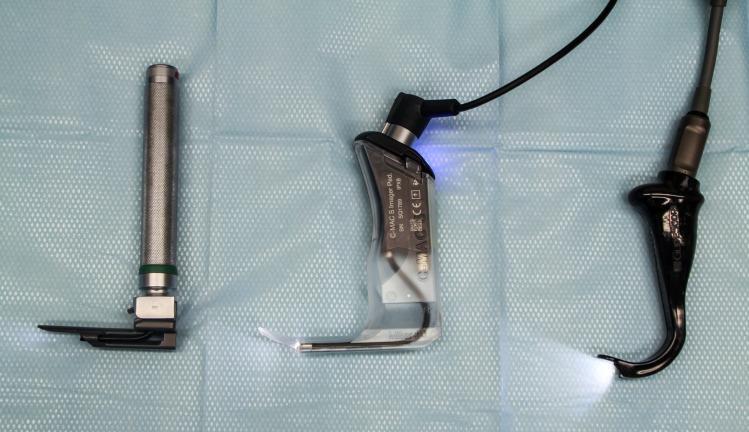
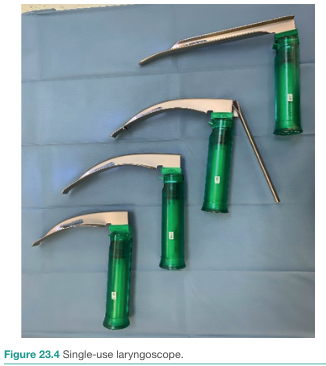
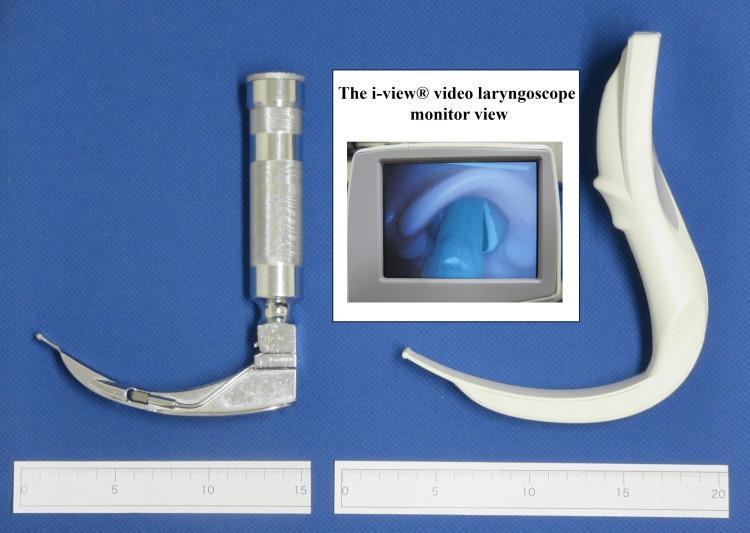
HANDLE (battery, grip)
   |__ hinge pin/bar ──► BLADE: hook-on slot > heel > spatula > web > flange > TIP
                                   light source sits near the tip, on the left of the flange
7 and 8. Parts, function, and where each sits on the body
| Part | Function | Position / anatomical landmark |
|---|---|---|
| Handle | Grip. Houses 2 batteries (C or AA) and the power contact. | Held in the left hand, outside the mouth, roughly vertical over the chest. |
| Hinge pin / hook-on fitting | Locks the blade to the handle. The blade clicks to about 90 degrees and the light switches on. | Junction between handle and blade, outside the lips. |
| Heel / base of blade | Connects to the handle. | Lies near the upper right molars or incisors. Do not use as a fulcrum. |
| Spatula | Depresses the tongue. | Lies on the tongue, in the midline or just right of it. |
| Flange | Sweeps the tongue to the left and keeps it out of the line of sight. | Right side of the mouth. |
| Web | Joins the spatula and flange and gives rigidity. | Along the blade. |
| Light (bulb or fibreoptic LED) | Lights the glottis. | Distal third of the blade, on the left side. |
| Tip, curved blade | Engages the hyoepiglottic ligament and lifts the epiglottis indirectly. | Vallecula, between the base of the tongue and the epiglottis. |
| Tip, straight blade | Lifts the epiglottis directly. | Under the laryngeal surface of the epiglottis. |
9. Types
- Curved (Macintosh): sizes 1 to 4. Size 3 is usual for adults. - Miller's Anesthesia, 10e
- Straight (Miller): sizes 0 to 4. Size 2 is usual for adults. Tintinalli notes straight blades are preferred in young children because the large epiglottis can be lifted directly.
- Other blades: Wisconsin, Phillips, Robertshaw (paediatric), McCoy (levering tip), polio (angled handle).
- Video laryngoscopes: GlideScope (hyperangulated blade), C-MAC and McGrath.
- Optical: Airtraq. - Morgan & Mikhail, 7e
- By use: reusable or single-use.
10. Colour code
- There is no single international colour code for laryngoscope blades.
- Colour coding is manufacturer specific, for example green handles on some single-use sets.
- Check the size markings on the blade, not the colour.
11. Sterilisation (general practice, not from the textbooks I retrieved)
- Clean immediately after use, before secretions dry. Use enzymatic detergent and a brush, then rinse.
- Remove batteries and bulbs before any heat process.
- Blades are semi-critical items. They need high-level disinfection or sterilisation (steam autoclave if the manufacturer allows it, ETO, or hydrogen peroxide plasma).
- Handles are wiped with a hospital-grade disinfectant, or processed like the blade if the handle is autoclavable.
- Dry, pack, store and label.
- Single-use blades and video-laryngoscope sheaths are discarded after one use.
12. Procedure: direct laryngoscopy and intubation (Roberts & Hedges)
- Preoxygenate, position the head (sniffing position) and have suction ready.
- Check the light, battery, blade size and a spare blade.
- Open the mouth with the right hand. Hold the handle in the left hand, as close to the blade as possible.
- Insert the blade at the right corner of the mouth and sweep the tongue to the left.
- Advance to the tip position. Curved blade: vallecula. Straight blade: under the epiglottis.
- Lift along the handle axis (up and forward) to expose the cords. Apply BURP (backward, upward, rightward pressure on the larynx) if the view is poor.
- Pass the tube through the cords under vision, withdraw the blade, and confirm with capnography.