
A 25 year old intern complaints of throat pain . How to manage
Reading File
Now let me search the library in parallel for throat pain/pharyngitis management.
Finding Sources
Finding Sources
Searching PubMed
"pharyngitis" AND "management"
Good - now let me read the key sections from Rosen's Emergency Medicine and Harrison's on pharyngitis management.
Reading File
Reading File
Let me read more of the Rosen's pharyngitis section and search Harrison's for the GAS/strep pharyngitis section.
Reading File
Finding Sources
Reading File
Reading File
Let me read more of the Harrison's section on treatment and the Centor criteria table.
Reading File
I now have comprehensive information to provide a thorough, evidence-based answer. Let me also fetch the management flowchart image.
Loading Image
I now have everything needed for a comprehensive, well-structured answer. Here it is:
Management of Sore Throat in a 25-Year-Old
Step 1 - Rule Out Airway Emergency First
Before anything else, assess for signs of airway compromise:
| Red Flag Sign | Suggests |
|---|---|
| Stridor, drooling, muffled/"hot potato" voice | Epiglottitis |
| Sniffing position, hypoxia | Supraglottic obstruction |
| Trismus, unilateral tonsillar bulge, uvular deviation | Peritonsillar abscess (PTA) |
| Neck rigidity, bilateral swelling | Retropharyngeal/parapharyngeal abscess |
If any of these are present: upright positioning, IV access, O₂ monitoring, ENT/anesthesia consult, and prepare for advanced airway. Do not proceed to routine workup.
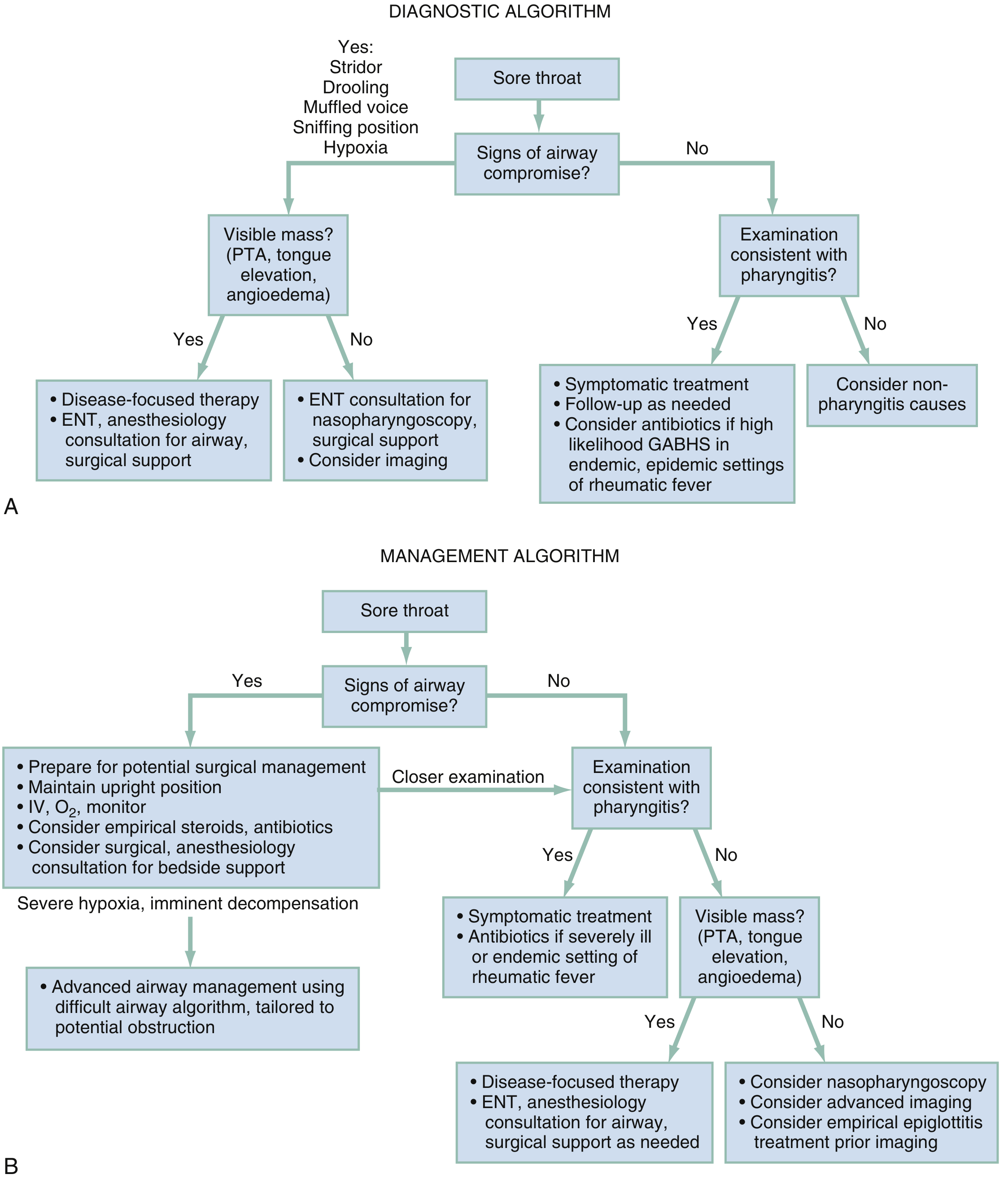
Step 2 - Identify the Likely Cause
The two most common causes in a 25-year-old are viral pharyngitis (~90%) and Group A Streptococcus (GAS) pharyngitis (~10% of adults).
Use the Centor Score to Risk-Stratify for GAS
Each feature scores 1 point:
- History of fever
- Absence of cough
- Tender anterior cervical lymphadenopathy
- Tonsillar exudate or swelling
| Score | GAS Probability | Action |
|---|---|---|
| 0 | ~2% | No testing, no antibiotics |
| 1-2 | ~5-17% | Rapid antigen test (RADT) if warranted |
| 3-4 | ~28-41% | Test and treat if positive; consider empiric Rx at score 4 |
Note: As a healthcare worker/intern, GAS risk is slightly elevated due to patient exposure. - Harrison's Principles of Internal Medicine 22E
Clues to Specific Non-Strep Causes
| Clinical Finding | Consider |
|---|---|
| Posterior cervical adenopathy, splenomegaly, petechiae on palate | Infectious mononucleosis (EBV) - common 15-35 yrs |
| Fever, rash, myalgia, new sexual partner | Acute HIV infection |
| Persistent sore throat unresponsive to penicillin, sexual risk | Gonorrhea (N. gonorrhoeae) |
| Persistent symptoms + cough | Mycoplasma pneumoniae |
Step 3 - Treatment
A. All patients with pharyngitis (regardless of cause)
- Analgesics (first-line for symptom relief): Paracetamol (acetaminophen) or NSAIDs (ibuprofen) - take around-the-clock, not just as needed, for better symptom control
- Supportive measures: Saline gargles, humidification, soft foods, tea with honey, adequate hydration
- Avoid antibiotics for viral pharyngitis - no benefit, increases resistance and adverse effects
B. Corticosteroids (for severe pharyngitis with significant dysphagia)
- Single dose dexamethasone 0.6 mg/kg (max 10 mg) orally or IM
- Reduces pain and duration in patients with marked swelling
- Not routinely recommended for uncomplicated pharyngitis by IDSA guidelines
- Harrison's notes caution: even short steroid courses carry risks of sepsis, GI bleeding, VTE within 30 days
C. Antibiotic therapy - ONLY if GAS confirmed or high clinical suspicion
First-line (no penicillin allergy):
| Drug | Dose |
|---|---|
| Penicillin V (oral) | 500 mg QID or 1000 mg BID x 10 days |
| Amoxicillin (oral) | 500 mg BID or 1000 mg OD x 10 days |
| Benzathine Penicillin G (IM) | Single dose |
Penicillin-allergic (non-anaphylactic):
- Cephalexin or cefadroxil (10-day course)
Penicillin-allergic (anaphylactic):
- Erythromycin, clarithromycin, or clindamycin
GAS has never developed resistance to penicillin. Shorter antibiotic courses are less effective for GAS - a full 7-10 days is required. - Harrison's 22E
Step 4 - When to Escalate / Refer
- Fluctuant peritonsillar mass - drain (ENT referral); peritonsillar abscess requires I&D as definitive treatment
- Symptoms persisting >5 days without improvement
- Shaking chills/rigors, neck swelling beyond lymphadenopathy, trouble swallowing, drooling
- Severe systemic illness: IV clindamycin (900 mg TID) + ceftriaxone (1g q24h) empirically, with ENT consult
- Suspected epiglottitis or deep space neck infection: imaging (CT neck with contrast) + ENT/anesthesia emergently
Summary for This Intern
Since he is 25 with no stated alarm signs, the most likely diagnosis is viral pharyngitis. The management is:
- Calculate Centor score on examination
- If Centor 0-2: symptomatic treatment only (NSAIDs/paracetamol), no antibiotics, reassure
- If Centor 3-4: perform Rapid Antigen Test; treat with Penicillin V x 10 days if positive
- Consider mono (EBV) if posterior lymphadenopathy or splenomegaly - do a monospot test; never prescribe amoxicillin/ampicillin in suspected mono (causes maculopapular rash)
- Advise rest, fluids, return if worsening or no improvement by day 5
Sources: Rosen's Emergency Medicine (9th ed.), p. 235-236; Harrison's Principles of Internal Medicine 22E (2025), pp. from Chapter 37 (Streptococcal Pharyngitis section)
This is a shared conversation. Sign in to Orris to start your own chat.