
Function of steroids
Reading File
Steroids are a class of lipid-soluble molecules that act primarily through intracellular receptors to regulate gene transcription. Their functions span metabolism, immunity, reproduction, and stress response.
Searching sources...
Finding Sources
Finding Sources
Reading File
Reading File
Reading File
Finding Sources
Finding Sources
Loading Image
Loading Image
Finding Sources
Reading File
Loading Image
Loading Image
Reading File
I now have comprehensive information from authoritative medical textbooks. Here is a detailed answer:
Functions of Steroids
Steroids are a class of lipid-derived hormones synthesized from cholesterol. They are broadly divided into:
- Glucocorticoids (e.g., cortisol)
- Mineralocorticoids (e.g., aldosterone)
- Sex steroids (androgens, estrogens, progestins)
The adrenal gland is a key site of steroid synthesis:
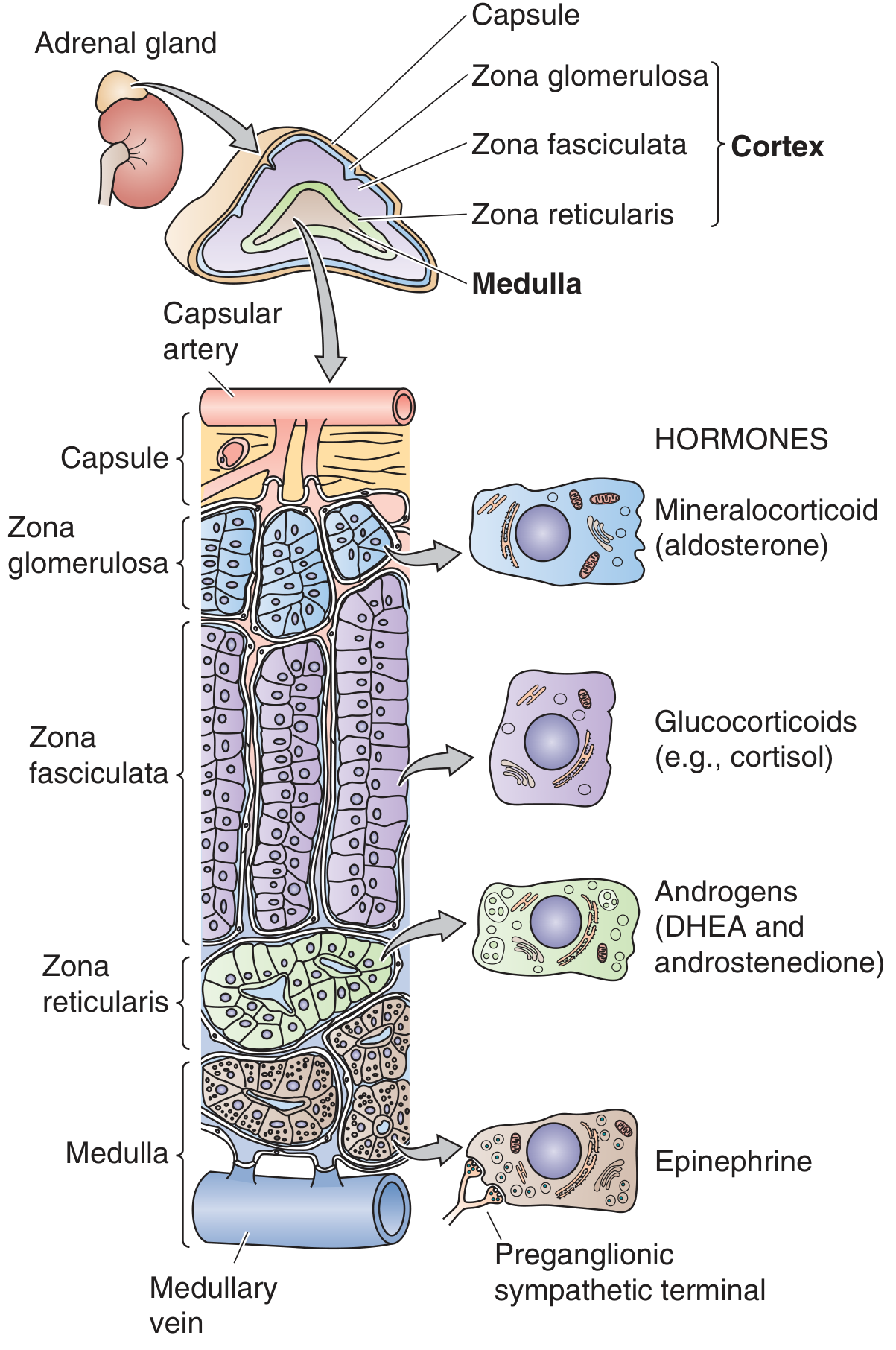
The zona glomerulosa produces aldosterone (mineralocorticoid), zona fasciculata produces cortisol (glucocorticoid), zona reticularis produces androgens (DHEA, androstenedione), and the medulla produces epinephrine.
Mechanism of Action (All Steroids)
Steroids act via a genomic mechanism - unlike peptide hormones which use surface receptors and second messengers, steroids:
- Diffuse across the cell membrane (they are lipid-soluble)
- Bind to intracellular receptor proteins in the cytosol or nucleus (each receptor has 6 domains; hormone binds in domain E near the C-terminus; DNA-binding occurs via zinc fingers in domain C)
- The hormone-receptor complex undergoes a conformational change, dimerizes, and enters the nucleus
- It binds to steroid-responsive elements (SREs) in the 5' region of target genes
- Acts as a transcription factor - regulates mRNA transcription
- New proteins are synthesized that carry out the hormone's physiologic effects
This process is slow (hours vs. minutes for peptide hormones). Steroids also have non-genomic actions that occur rapidly (within 0-3 hours).
- Costanzo Physiology, 7th Ed., p. 410
1. Glucocorticoids (Cortisol)
| Function | Details |
|---|---|
| Glucose metabolism | Enhances gluconeogenesis in the liver; mobilizes amino acids from peripheral tissues; raises blood glucose |
| Protein metabolism | Promotes protein catabolism in muscle, skin, and bone; supplies amino acids for gluconeogenesis |
| Fat metabolism | Stimulates lipolysis; fat redistribution (central obesity in excess) |
| Anti-inflammatory | Inhibits cytokine transcription, downregulates adhesion molecules and MHC expression, modifies leukocyte trafficking |
| Immunosuppressive | Induces lymphocyte apoptosis; suppresses T-cell function and antibody production |
| CNS effects | Influences mood, cognition, and behavior |
| Calcium/bone | Inhibits Ca²⁺ absorption from gut, promotes bone resorption; can cause osteoporosis in excess |
| Stress response | Primary "stress hormone" - activated by ACTH during physiological stress |
| Cardiovascular | Maintains vascular tone and blood pressure; sensitizes vessels to catecholamines |
Deficiency of glucocorticoids = Addison's disease (fatigue, hypotension, hypoglycemia)
Excess = Cushing's syndrome (central obesity, hyperglycemia, immunosuppression)
- Medical Physiology (Boron & Boulpaep), p. 1496
- Goldman-Cecil Medicine
2. Mineralocorticoids (Aldosterone)
| Function | Details |
|---|---|
| Na⁺ reabsorption | Induces synthesis of Na⁺ channels (ENaC) in renal principal cells - promotes Na⁺ (and water) reabsorption |
| K⁺ excretion | Promotes K⁺ secretion into the tubular lumen |
| Blood pressure | By retaining Na⁺ and water, increases blood volume and blood pressure |
| Acid-base | Promotes H⁺ secretion by intercalated cells, contributing to metabolic alkalosis in excess |
Excess aldosterone (hyperaldosteronism) causes hypertension and hypokalemia.
3. Sex Steroids
Androgens (Testosterone, DHEA, Androstenedione)
- Promote development of male secondary sexual characteristics (facial hair, deepening of voice, penile growth, libido)
- Anabolic effects: stimulate skeletal muscle protein synthesis
- Regulate spermatogenesis
- Adrenal androgens drive adrenarche (pubic/axillary hair before puberty)
Estrogens (Estradiol, Estrone)
- Female secondary sex characteristics (breast development, female fat distribution)
- Regulate the menstrual cycle and endometrial growth
- Maintain bone density (inhibit osteoclast activity)
- Cardiovascular protection (increase HDL, decrease LDL)
- Feedback regulation of the hypothalamic-pituitary axis
Progestins (Progesterone)
- Prepares the endometrium for implantation
- Maintains pregnancy (inhibits uterine contractions)
- Thermogenic effect (raises basal body temperature after ovulation)
4. Other Steroids
| Steroid | Function |
|---|---|
| Vitamin D (calcitriol) | Promotes intestinal Ca²⁺ absorption via synthesis of a Ca²⁺-binding protein; regulates bone mineralization |
| Bile acids | Derived from cholesterol; essential for fat digestion and absorption |
| Neurosteroids | Modulate GABA and NMDA receptor activity in the brain |
Summary Table
| Class | Example | Key Function |
|---|---|---|
| Glucocorticoids | Cortisol | Glucose regulation, anti-inflammatory, stress response |
| Mineralocorticoids | Aldosterone | Na⁺/K⁺ balance, blood pressure |
| Androgens | Testosterone | Male sex characteristics, anabolic effects |
| Estrogens | Estradiol | Female sex characteristics, bone, cardiovascular |
| Progestins | Progesterone | Pregnancy maintenance, endometrium |
| Vitamin D | Calcitriol | Ca²⁺ absorption, bone health |
Sources: Costanzo Physiology 7th Ed. | Medical Physiology (Boron & Boulpaep) | Goodman & Gilman's Pharmacological Basis of Therapeutics | Goldman-Cecil Medicine
This is a shared conversation. Sign in to Orris to start your own chat.