
Ai in forensic medicine and toxicology , virtual autopsy
I'll start with a quick answer while I research this topic in depth.
AI is transforming forensic medicine through virtual autopsy (virtopsy), image analysis, toxicology screening, and pattern recognition. Virtual autopsy uses CT/MRI imaging combined with AI to examine bodies non-invasively, preserving evidence and enabling 3D reconstruction of injuries. AI also assists in identifying cause of death, age estimation, and detecting poison signatures in mass spectrometry data.
Searching sources...
Reading File
Searching the Web
AI artificial intelligence forensic medicine toxicology virtual autopsy 2024 2025
Searching PubMed
artificial intelligence virtual autopsy forensic medicine
Now let me search the medical library and get details from key papers simultaneously.
Finding Sources
Reading Article
PMID: 40506982
Reading Article
PMID: 39941453
Reading Article
PMID: 37761359
Finding Sources
Reading Web Page
https://pmc.ncbi.nlm.nih.gov/articles/PMC12154265
Searching Images
virtual autopsy CT scan forensic postmortem imaging
I found relevant textbook content. Let me now read the key forensic medicine textbook sections on virtopsy and AI.
Reading File
Reading File
Reading File
Excellent! I found great textbook content including an image. Let me fetch that image and read more content.
Loading Image
Reading File
Finding Sources
I now have comprehensive information from textbooks, recent PubMed reviews, and web sources. Let me compile a thorough, well-structured answer.
AI in Forensic Medicine & Toxicology, and Virtual Autopsy
1. Introduction
Artificial intelligence is reshaping forensic medicine by augmenting pattern recognition, reducing human subjectivity, and enabling entirely new workflows - most strikingly through the concept of virtopsy (virtual autopsy). A landmark 2023 review in Diagnostics analyzed 113 articles and identified AI applications spanning forensic identification, ballistics, postmortem interval estimation, toxicology, crime scene reconstruction, and virtual autopsy.
2. Virtual Autopsy (Virtopsy)
Definition and Origin
The term virtopsy was coined by Prof. Richard Dirmhofer, former head of the Institute of Forensic Medicine, University of Bern, Switzerland. He described it as fully satisfying the requirement that forensic findings provide "a complete and true picture of the examined object," stored digitally and transmittable via the web for a second opinion or court presentation.
"Virtopsy or virtual autopsy is not a real autopsy involving dissection and cutting of organs. It involves imaging of the body using tools like 3D surface scan, multislice computed tomography (MSCT), and magnetic resonance imaging (MRI)."
- Parikh's Textbook of Medical Jurisprudence, Forensic Medicine and Toxicology
The Virtobot System
The complete Virtobot system (in daily use at the University of Berne since 2008) consists of:
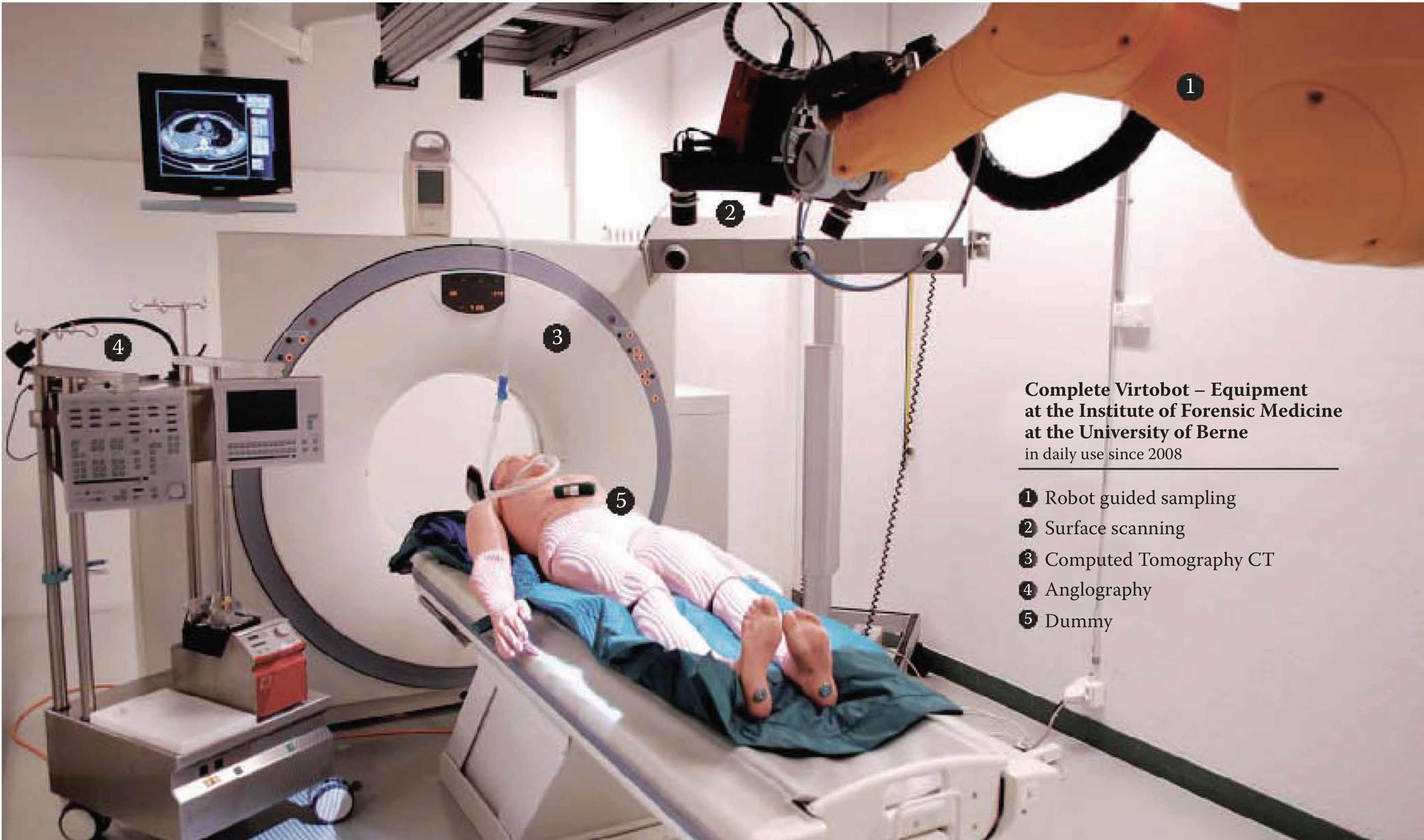
Virtobot setup: (1) Robot-guided sampling arm, (2) Surface scanning head, (3) CT scanner, (4) Angiography unit, (5) Body dummy for calibration
The four core components are:
- Robot-guided surface scanning - 3D, undistorted, colored documentation of the body surface (replaces external examination)
- Multislice spiral CT (MSCT) + MRI - layer-by-layer internal imaging in any spatial orientation (replaces internal dissection)
- Postmortem CT angiography (PMCTA) - displays the heart and vascular system, allows minimally invasive specimen retrieval
- Image/robot-guided contamination-free specimen removal - for histological, bacteriological, virological, and toxicological analysis
The objective is to convert "corpse evidence" into a permanent, archivable 3D digital model - findings can be examined repeatedly from any angle without further deterioration of the body.
Imaging Modalities in Virtopsy
According to a 2025 scoping review in Journal of Clinical Medicine (Cergan et al.) examining 49 virtopsy articles since 2002:
| Modality | Best For |
|---|---|
| PMCT | Complex osseous injuries, bullet trajectories, drowning, pneumothorax |
| PMCTA | Vascular lesions, natural death (cardiac causes) |
| PMMRI | Soft tissues, brain/spinal cord, microbleeds, laryngohyoid fractures, cardiomyopathies in young people |
| PMUS (ultrasound) | Portable alternative, field use |
3. Virtopsy vs. Conventional Autopsy
| Feature | Virtopsy | Conventional Autopsy |
|---|---|---|
| Technique | No scalpel, no dissection | Opening and dissection |
| Evidence integrity | Wounds studied without disturbing body | Body altered during examination |
| Mutilation | No mutilation, no artifacts | Dissection artifacts possible |
| Time | Less time-consuming | More time-consuming |
| Religious/cultural acceptance | More widely accepted | Hesitancy or refusal |
| Legal documentation | Digitally stored, web-transmittable, 3D printable | Physical records, photographs |
| Reproducibility | Complete data re-examinable anytime | Cannot be repeated |
Disadvantages of virtopsy: High equipment cost, limitations with metal foreign objects (artifacts on CT), inability to clearly assess color of internal organs, insufficient database for rare conditions, infection status cannot be discerned, difficulty distinguishing antemortem from postmortem wounds, color changes, and small tissue injuries.
- Parikh's Textbook of Medical Jurisprudence, Forensic Medicine and Toxicology, p. 158-159
4. AI Applications in Forensic Medicine
4.1 Forensic Identification
AI algorithms enable rapid victim identification in mass fatality events:
- Facial recognition from fragmented or decomposed remains
- Dental matching using convolutional neural networks (CNNs) applied to dental radiographs
- Anthropological analysis of skeletal morphology - deep learning models estimate age, sex, and stature from bone measurements with accuracy comparable to expert anthropologists
- DNA profile analysis - AI accelerates STR pattern matching across large databases
4.2 AI + Virtual Autopsy (The Frontier Combination)
When AI is combined with virtopsy imaging, the system can:
- Identify organ pathology, fractures, deep injuries, and inflammation by comparing scan data against trained databases
- Generate an anatomopathological diagnosis and cause-of-death opinion autonomously
- Analyze gunshot wounds by measuring entrance hole dimensions at flat bones and comparing with ballistic models to estimate bullet caliber
- Detect pulmonary emboli, coronary lesions, and vascular anomalies that may be missed under time pressure at conventional autopsy
As noted in the Diagnostics 2023 AI-forensics review:
"AI will identify pathology of an organ, fractures, deep injuries, and types of inflammation and compare it to the database... form its own opinion regarding the anatomopathological diagnosis and conclusions regarding the cause of death."
4.3 Forensic Toxicology and AI
This is one of the fastest-growing applications:
- Automated identification of toxins: AI expands the search field across millions of substances - by 2020, the Chemical Abstracts Service (CAS) database linked by AI contained >160 million organic and inorganic substances
- Mass spectrometry interpretation: Machine learning models interpret HPLC, GC-MS, and LC-MS/MS data, reducing human errors inherent in manual spectrophotometry
- Drug metabolite detection: AI identifies novel psychoactive substances (NPS) and their metabolites that may not be in standard screening panels
- Quantitative and qualitative analysis: Automated toxicology platforms provide simultaneous identification and quantitation of hundreds of compounds
- Poison pattern recognition: Neural networks trained on poisoning databases can suggest likely agents from clinical and postmortem findings
4.4 Postmortem Interval (PMI) Estimation
- Entomological AI: Deep learning identifies blowfly species and larval stages from photographs, enabling rapid PMI estimation without expert entomologists on-site
- Chemical decomposition modeling: ML algorithms analyze volatile organic compound (VOC) profiles in soil or air around remains to estimate time since death
- MRI-based tissue analysis: AI quantifies decomposition-related changes in soft tissue signal on MRI to estimate PMI more objectively
4.5 Ballistics Analysis
- Pattern recognition algorithms analyze firearm wound characteristics (entrance/exit morphology, stippling patterns, muzzle-to-target distance)
- 3D reconstruction of bullet trajectory through PMCT, assisted by AI, supports crime scene reconstruction
4.6 Crime Scene Reconstruction
- AI-driven analysis of bloodstain patterns (directionality, area of origin)
- Digital twin reconstruction - virtual 3D crime scenes created from photogrammetry + AI, allowing re-examination and courtroom visualization
4.7 Age Estimation
- AI analyzes skeletal radiographs, dental panoramic X-rays, and MRI of growth plates
- Deep learning models trained on large datasets show high accuracy for age estimation in both living individuals (immigration, criminal responsibility) and skeletal remains
5. Forensic Pathology - Histopathological AI
Digital pathology applies AI to forensic histology:
- Automated tissue classification - CNNs identify myocardial fibrosis, neuronal changes, hepatic necrosis
- Wound age estimation from histological sections - inflammatory cell profiles quantified by AI
- Cause-of-death support - pattern recognition in cardiac, pulmonary, and CNS sections
- Telepathology - remote expert consultation enabled by digitized slides, improving access in resource-limited settings
A 2025 review in Academia Medicine (Singh et al.) specifically highlighted these digital pathology-AI integration points for medico-legal practice.
6. Emerging Areas and Future Directions
A 2025 systematic review in Diagnostics (Alafer, PMID 40506982) identified four priority themes:
- Advancements in AI and imaging technologies - MDCT + AI as the near-term standard; photon-counting CT on the horizon
- Operational and financial barriers - Equipment costs remain prohibitive; AI may ultimately reduce long-term costs through efficiency
- Ethical and legal considerations - Algorithmic bias, data security, chain of custody for digital evidence, admissibility standards in different legal jurisdictions
- Interdisciplinary collaboration - Requires forensic pathologists, radiologists, AI engineers, and legal experts working jointly
The 2025 review on forensic pathology innovation (Liu NG, Fa Yi Xue Za Zhi) specifically outlines future prospects including AI-driven automated cause-of-death determination, molecular autopsy integration, and global forensic imaging networks.
7. Limitations and Challenges
- Equipment cost - A complete Virtobot suite costs millions; CT and MRI infrastructure is not universally available
- Algorithmic bias - AI trained on non-representative datasets may perform poorly across different populations (race, age, body habitus)
- Legal standards - No universal protocol for AI-generated forensic reports; admissibility varies by jurisdiction
- Infection status - Virtopsy cannot reliably detect microbial infection without supplementary sampling
- Soft tissue color - CT cannot assess tissue color (cyanosis, jaundice, lividity nuances)
- Data security - Digital forensic data must maintain chain-of-custody integrity and resist tampering
- Human oversight - AI currently supplements, not replaces, the forensic pathologist; errors in AI outputs require expert validation
Summary
AI and virtual autopsy (virtopsy) represent a convergence that is moving forensic medicine from a largely subjective, irreversible physical process toward an objective, reproducible, digitally archived science. The key technologies are MSCT, MRI, postmortem angiography, 3D surface scanning (combined in the Virtobot), and AI algorithms for pattern recognition, identification, toxin detection, and cause-of-death inference. Challenges around cost, standardization, legal admissibility, and algorithmic bias must be resolved before full adoption.
Key references:
- Piraianu et al. (2023), Diagnostics - PMID 37761359
- Cergan et al. (2025), J Clin Med - PMID 39941453
- Alafer (2025), Diagnostics - PMID 40506982
- Parikh's Textbook of Medical Jurisprudence, Forensic Medicine and Toxicology, p. 158-159
- Brogdon's Forensic Radiology, Chapter 23 (Virtopsy)
- The Essentials of Forensic Medicine and Toxicology, 36th edition, FM12.6
Use of ai in FMT
AI in FMT (Forensic Medicine & Toxicology) covers a broad spectrum - from autopsy and identification to toxicology screening and medico-legal reporting. Let me pull the latest textbook content and evidence.
Searching sources...
Finding Sources
Finding Sources
Searching PubMed
artificial intelligence forensic medicine toxicology applications
Searching the Web
use of AI in forensic medicine toxicology 2025 applications review
Excellent results. Let me now pull the detailed abstracts from the most relevant papers and extract key textbook content in parallel.
Reading Article
PMID: 41525127
Reading Article
PMID: 38767078
Reading Article
PMID: 40845323
Finding Sources
Reading Web Page
https://pmc.ncbi.nlm.nih.gov/articles/PMC12328379
Now let me get the textbook content on virtopsy, postmortem interval, and forensic identification with AI.
Finding Sources
Finding Sources
Finding Sources
Reading File
Finding Sources
Searching Images
forensic pathology AI machine learning autopsy imaging diagram
I now have comprehensive material from textbooks, a 2024 systematic review, a 2026 forensic toxicology review, and a 2025 Frontiers systematic review. Let me compile the complete, well-structured answer.
Use of AI in Forensic Medicine & Toxicology (FMT)
AI in FMT encompasses six macro-domains identified by a 2024 systematic review (Volonnino et al., PMID 38767078) after screening ~2000 articles: forensic pathology, toxicology, radiology/virtopsy, personal identification, forensic anthropology, and forensic psychiatry.
1. AI in Forensic Pathology
1.1 Virtual Autopsy (Virtopsy)
The flagship AI application in forensic pathology. The Virtobot system (University of Bern, in daily use since 2008) integrates:
- Robot-guided surface scanning - 3D colored documentation of the body surface
- Multislice CT (MSCT) - layer-by-layer internal imaging, bullet trajectory mapping
- MRI - superior for soft tissue, brain, spinal cord, microbleeds, laryngohyoid injuries
- Postmortem CT angiography (PMCTA) - vascular lesions, cardiac causes of death
When AI is layered on top of virtopsy imaging, it:
- Identifies organ pathology, fractures, inflammation by comparing against trained image databases
- Generates an autonomous anatomopathological diagnosis and cause-of-death opinion
- Measures gunshot entrance holes on flat bones and estimates bullet caliber by comparing with ballistic models
- Detects pulmonary emboli, coronary lesions, and pneumothorax missed under time pressure
"AI will identify the pathology of an organ, fractures, deep injuries, and types of inflammation and compare it to the database... process these organic changes and form its own opinion regarding the anatomopathological diagnosis and conclusions regarding the cause of death."
- Piraianu et al., Diagnostics 2023
1.2 Digital Histopathology
- CNNs (Convolutional Neural Networks) classify histological slides - identifying myocardial fibrosis, neuronal injury, hepatic necrosis
- Wound age estimation: AI quantifies inflammatory cell profiles (neutrophil-to-macrophage ratios) in wound sections more objectively than visual inspection
- Cause of death support: pattern recognition in cardiac, pulmonary, and CNS sections
- Whole-slide imaging (WSI) + deep learning enables remote consultation (telepathology) in resource-limited settings
1.3 Postmortem Interval (PMI) Estimation
Classical PMI estimation (cooling, rigor mortis, livor mortis, decomposition) is inherently imprecise - "the exact time of death cannot be fixed by any method" (Essentials of FMT, 36th Ed., p. 180). AI improves this through:
| Method | AI Enhancement |
|---|---|
| Entomology | Deep learning identifies blowfly species/instar stage from photographs without on-site entomologist |
| Body cooling (algor mortis) | ML models factor in ambient temperature, body habitus, clothing, surface - more accurate than Henssge nomogram alone |
| Decomposition imaging | MRI + AI quantifies soft tissue decomposition signal to estimate PMI objectively |
| Chemical markers | Neural networks analyze vitreous potassium, synovial fluid amino acids, volatile organic compounds |
| Livor mortis | Computer vision quantifies lividity intensity/distribution for more objective early PMI estimation |
1.4 Crime Scene Reconstruction
- Bloodstain Pattern Analysis (BPA): AI algorithms determine directionality, area of origin, impact angle from bloodstain photographs
- 3D photogrammetric reconstruction: AI converts scene photos into virtual 3D models - examinable repeatedly and presentable in court
- Gunshot wound analysis: 3D modeling reconstructs wound channels for precise measurements of entry/exit morphology and muzzle-to-target distance
2. AI in Forensic Toxicology
A landmark 2026 review (Marinelli et al., PMID 41525127) covering three decades of research identifies AI as transformative - especially for New Psychoactive Substances (NPS) detection.
2.1 Automated Analytical Platforms
- AI algorithms automate interpretation of GC-MS, LC-MS/MS, and HPLC data - reducing human error inherent in manual spectrophotometry
- By 2020, AI-linked CAS (Chemical Abstracts Service) database covered >160 million organic and inorganic substances for automated toxin identification
- Quantitative + qualitative simultaneous identification of hundreds of compounds per sample run
2.2 New Psychoactive Substances (NPS)
- Traditional screening panels miss NPS since they are not programmed in advance
- ML models trained on mass spectral libraries predict the identity and toxicity of novel compounds based on structural similarity
- Generative AI is now being explored to predict metabolite profiles of NPS before clinical encounters occur
2.3 Drug Impairment Assessment
- AI-driven analysis of driving impairment: video gait analysis + toxicology combined to correlate drug blood levels with behavioral indicators
- Prediction models for drug-driving outcomes from DRE (Drug Recognition Expert) data
2.4 Postmortem Toxicology Interpretation
- ML models handle the complexity of postmortem redistribution - correcting measured drug concentrations for expected redistribution from organs to peripheral blood
- AI distinguishes therapeutic vs. toxic vs. lethal concentration ranges accounting for individual variation (tolerance, polypharmacy, CYP polymorphisms)
2.5 Emergency Toxicology (Clinical)
A 2025 review in JMIR (PMID 40845323) highlights:
- Poison identification from clinical features: ML models take presenting signs, symptoms, and labs to suggest likely toxidrome and agent
- Outcome prediction: AI predicts need for ICU admission, antidote requirement, or dialysis in acute poisoning
- Clinical decision support systems (CDSS): real-time alerts for drug-drug interactions, toxic doses, antidote dosing
3. AI in Forensic Identification
3.1 Fingerprint Analysis
- Traditional latent fingerprint examination is subjective; AI achieves consistency and speed
- CNNs match partial, distorted, or latent prints against AFIS (Automated Fingerprint Identification System) databases with higher accuracy
- AI reduces the rate of false matches (a leading cause of wrongful convictions)
3.2 Facial Recognition
- 3D facial reconstruction from PMCT data allows identification even with advanced decomposition
- AI compares reconstructed facial models against ante-mortem photographs or CCTV footage
- Critically useful in mass disaster victim identification (DVI)
3.3 Dental Identification (Forensic Odontology)
- Deep learning models compare postmortem dental radiographs with ante-mortem records
- AI can analyze tooth morphology, restorations, root canal shapes, and bone patterns for individual matching
- A 2023 review (PMID 37634174) specifically addresses AI's role in forensic odontology for both age estimation and identity confirmation
3.4 DNA Analysis
- AI accelerates STR (Short Tandem Repeat) profile interpretation from complex mixed DNA samples
- ML handles low-copy-number (LCN) DNA and degraded samples better than manual interpretation
- Phenotypic prediction from DNA (eye/hair/skin color, facial morphology) using AI-assisted genomic models
4. AI in Forensic Anthropology
- Skeletal age estimation: ML models analyze radiographic features of pubic symphysis, sternal rib ends, and cranial sutures - more objective than scoring methods
- Sex determination: Discriminant function analysis enhanced by AI on 3D morphometric data from skulls and pelves
- Stature estimation: Regression models trained on population-specific datasets improve accuracy over traditional formulae
- Ancestry estimation: AI analyzes craniometric measurements with higher accuracy and less observer bias
- Bone weathering for outdoor PMI: ML models trained on bone surface texture/color changes provide PMI range from skeletal remains
5. AI in Forensic Radiology
- AI reads postmortem CT (PMCT) for pneumothorax, hemothorax, fracture patterns, gas embolism, foreign bodies (bullets, implants)
- Automated measurement of aortic diameter, cardiac size, liver density - quantitative data replacing subjective visual assessment
- Gunshot wound trajectory reconstruction: AI maps bullet path in 3D from entry wound to final position
- Drowning detection: Specific PMCT findings (fluid-filled sinuses, overinflated lungs, "drowning pattern") detected automatically
- Hanging/strangulation: AI detects subtle laryngohyoid fractures on CT/MRI that may be missed on gross examination
6. AI in Forensic Psychiatry
- Risk assessment for violence/reoffending: ML models integrate clinical, social, and historical data for more objective risk stratification (replacing purely clinician-based tools like HCR-20)
- Mental state evaluation: Natural language processing (NLP) analyzes interview transcripts for features of psychosis, malingering, or cognitive impairment
- Fitness to stand trial: AI-assisted cognitive screening tools assist in preliminary evaluation
- Criminal responsibility (insanity evaluation): AI support tools being explored though legal-ethical challenges remain significant
7. AI in Medico-Legal Documentation and Reporting
- Autopsy report generation: AI flags key findings, shortens lengthy documents, and ensures no findings are omitted
- Explainable AI (XAI) for court: "AI-driven forensic opinion support" systems provide cause-of-death suggestions with transparent reasoning - enabling courts to evaluate AI's logic
- NLP for medical record review: AI reviews clinical notes, death certificates, and discharge summaries to identify patterns relevant to medico-legal investigation
8. AI Technologies Used in FMT
| Technology | Application in FMT |
|---|---|
| Convolutional Neural Networks (CNN) | Image analysis: histology, CT, fingerprints, facial recognition |
| Machine Learning (ML) | PMI estimation, toxicology quantitation, risk scoring |
| Deep Learning | NPS identification, DNA analysis, bone age |
| Natural Language Processing (NLP) | Report generation, psychiatric interview analysis, record review |
| Generative AI | NPS metabolite prediction, synthetic training data |
| Expert Systems | Toxidrome identification, antidote decision support |
| Robotics + AI | Robot-guided specimen sampling in virtopsy (Virtobot) |
9. Limitations and Challenges
| Challenge | Detail |
|---|---|
| Algorithmic bias | AI trained on non-representative datasets performs poorly across races, sexes, age groups |
| Small training datasets | Forensic cases are rare; large labeled datasets hard to build |
| Legal admissibility | No universal standard for AI-generated forensic evidence in courts |
| Chain of custody | Digital forensic data integrity and tamper-resistance must be guaranteed |
| Explainability | "Black-box" AI decisions are difficult to defend under cross-examination |
| Cost | Virtopsy/PMCT infrastructure is expensive for low-resource settings |
| Ethical concerns | Privacy of biometric data, consent for AI training on deceased persons |
| Human replacement risk | AI serves as support tool - does not replace the forensic expert |
Key Takeaway
"Although machines are unlikely to replace toxicologists in the near future, toxicologists who embrace AI are expected to surpass and excel beyond their counterparts who remain resistant to such advancements."
- Marinelli et al., La Clinica Terapeutica 2026, PMID 41525127
AI in FMT is best viewed as an enhancement of expert capability - it removes subjectivity, handles data volumes no human can, and creates permanent, reproducible, court-admissible digital records. The six core areas (pathology, toxicology, radiology, identification, anthropology, psychiatry) are all progressing, with toxicology and virtual autopsy currently the most advanced.
Key references:
- Volonnino et al. (2024) Systematic Review - PMID 38767078
- Marinelli et al. (2026) Forensic Toxicology + AI - PMID 41525127
- Orsini et al. (2025) AI in Forensic Pathology - Frontiers in Medicine
- Yong et al. (2025) Emergency Toxicology - PMID 40845323
- Essentials of Forensic Medicine & Toxicology, 36th Ed. (2026), FM2.11, FM12.6
- Parikh's Textbook of Medical Jurisprudence, Q.8.2 (Virtopsy)
This is a shared conversation. Sign in to Orris to start your own chat.