
Alzhimer disease
I'll start by reading the medical library skill, then search for comprehensive Alzheimer's disease information.
Reading File
Now I'll search the medical library and PubMed in parallel for comprehensive Alzheimer's disease coverage.
Finding Sources
Searching PubMed
"Alzheimer disease"[MeSH Terms] AND treatment
Searching the Web
Alzheimer disease 2025 2026 new treatments lecanemab donanemab FDA approval
Now let me read the main neurology textbook sections on Alzheimer's disease in parallel.
Reading File
Reading File
Finding Sources
Now reading more of the main Alzheimer's section from Bradley & Daroff's Neurology for pathology, genetics, and treatment details:
Reading File
Finding Sources
Reading File
Reading File
Reading File
Finding Sources
Reading File
Reading File
Now I have comprehensive information to write a detailed response. Let me also fetch the pathology image.
Loading Image
Reading File
I now have comprehensive information from multiple authoritative sources. Here is the complete Alzheimer's Disease overview:
Alzheimer Disease - Comprehensive Overview
1. Historical Background
In 1906, Alois Alzheimer - a German psychiatrist - reported the case of a woman in her 50s with paranoia, memory loss, and aphasia. At autopsy, microscopic sections with Bielschowsky stain revealed the hallmark inclusions later known as amyloid plaques and neurofibrillary tangles (NFTs). This case summarized key clinical features that continue to define AD today. - Bradley and Daroff's Neurology in Clinical Practice
2. Epidemiology
| Parameter | Data |
|---|---|
| Prevalence (age 65+) | 11% of people |
| Prevalence in memory clinics | ~68% of dementia cases |
| Ages 65-74 | ~3% |
| Ages 85+ | ~32% |
| Incidence (65-74) | 2 new cases/1,000/year |
| Incidence (75-84) | 11 new cases/1,000/year |
| Incidence (85+) | 37 new cases/1,000/year |
| Lifetime risk (from age 45) | ~10% men, ~20% women |
AD accounts for ~70% of all dementia in the United States. The prevalence is higher in women than men - partly due to longer female lifespan. By 2060, an estimated 15 million Americans will have AD dementia. - Bradley and Daroff's Neurology in Clinical Practice
3. Pathology
Macroscopic Changes
- Early AD: brain may appear grossly normal or show hippocampal atrophy with increased volume of the inferior horn of lateral ventricles
- Advanced AD: widened sulci, increased ventricular size, atrophy in posterior temporal, parietal, and frontal lobes
Microscopic Hallmarks
Amyloid Plaques - The defining lesion of AD. These are insoluble deposits of fibrillar amyloid-beta (Aβ) surrounded by dystrophic neurites, microglial cells, and reactive astrocytes. Plaques first appear in the neocortex, then spread to the entorhinal cortex, hippocampus, and subcortical regions.
Neurofibrillary Tangles (NFTs) - Intracellular inclusion bodies containing paired helical filaments of hyperphosphorylated microtubule-associated tau protein (MAPT). NFTs begin in the entorhinal cortex, spread to the hippocampus and lateral temporal lobe, then more widely through the neocortex (Braak staging).
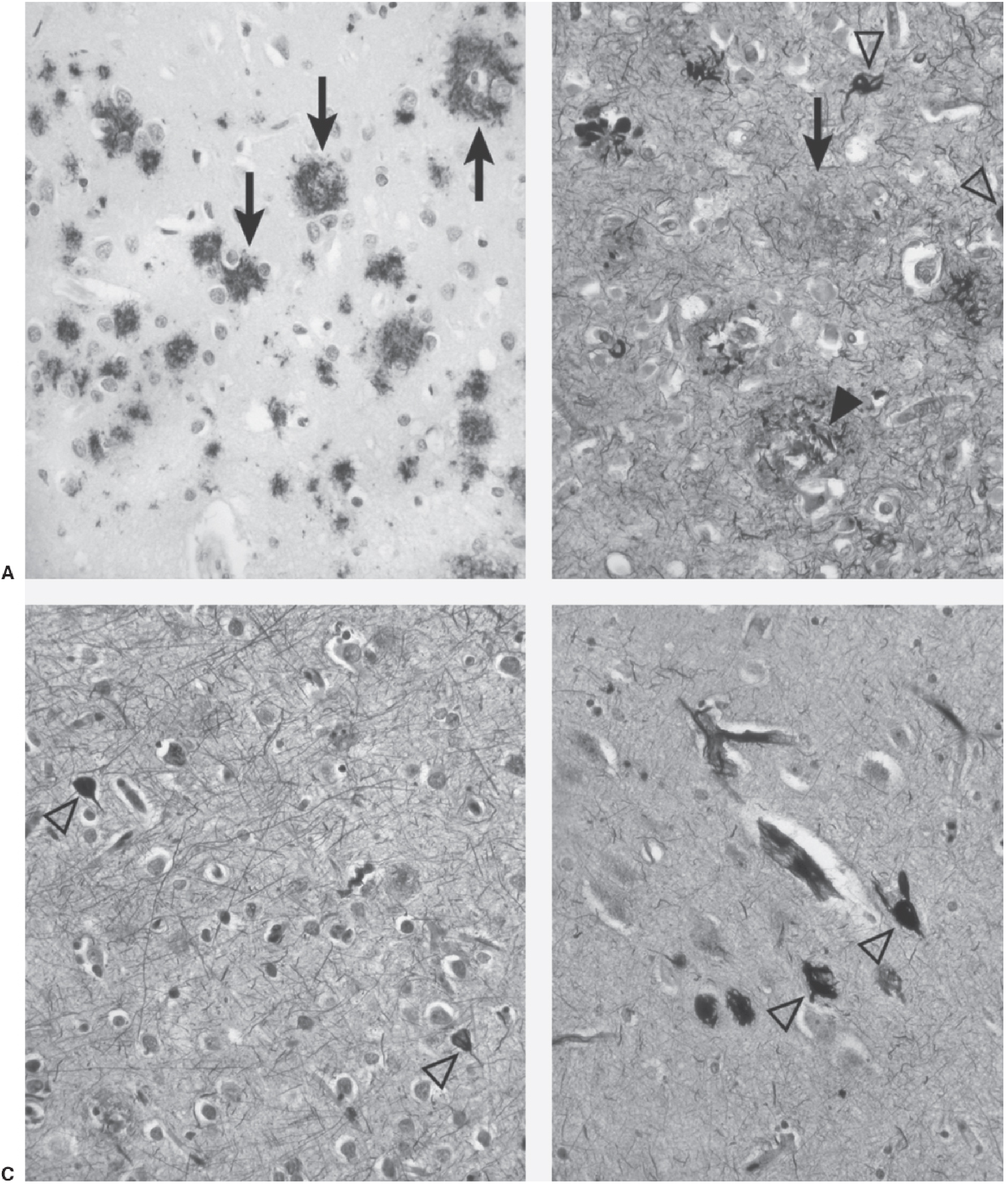
Photomicrographs of AD neuropathology showing amyloid plaques (arrows) and neurofibrillary tangles (open arrowheads). A: Advanced Braak stage VI. C: Earlier Braak stage IV. D: Isolated NFTs in normal aging without Aβ plaques. - Kaplan & Sadock's Comprehensive Textbook of Psychiatry
Important: NFTs are not pathognomonic for AD alone - they are also the principal lesion in MAPT-related frontotemporal dementias.
4. Pathophysiology
Amyloid Hypothesis
The central hypothesis holds that excessive accumulation of Aβ (especially Aβ42) triggers a cascade leading to neuronal dysfunction and death. Aβ is produced by cleavage of amyloid precursor protein (APP) by β-secretase and γ-secretase.
Cholinergic Hypothesis
Loss of cholinergic neurons in the nucleus basalis of Meynert leads to reduced acetylcholine in the cortex and hippocampus, causing memory and cognitive deficits. This is the basis for cholinesterase inhibitor therapy.
Tau Pathology
Transsynaptic spread of neurofibrillary tangle pathology to cortical association areas is a critical part of AD pathophysiology. At the time clinical symptoms develop, NFTs are already widespread.
Biomarker Timeline (DIAN Study)
CSF Aβ42 declines begin ~20 years before symptoms; Aβ-PET, brain volume loss, and CSF tau changes appear ~15 years before symptoms; FDG-PET abnormalities ~10 years before symptoms. - Bradley and Daroff's Neurology in Clinical Practice
5. Genetics
Early-Onset (<65 years), Familial (autosomal dominant - rare, <1% of all AD)
| Gene | Chromosome | Mechanism |
|---|---|---|
| APP (Amyloid Precursor Protein) | 21 | Increases Aβ42/Aβ40 ratio; mean onset ~50 years |
| PSEN1 (Presenilin 1) | 14 | Most common familial cause; part of γ-secretase complex |
| PSEN2 (Presenilin 2) | 1 | Rarest; most carriers are Volga German descent |
All three increase brain Aβ levels. Trisomy 21 (Down syndrome) patients develop AD pathology after age 40 because they carry an extra copy of the APP gene.
Late-Onset Risk Gene
APOE (Apolipoprotein E) on chromosome 19 is the most important genetic risk factor for late-onset AD:
- APOE ε4: high risk - homozygotes have ~91% lifetime risk, mean onset 68
- APOE ε3: neutral risk
- APOE ε2: protective
- ~20% of all late-onset AD is attributed to APOE ε4
TREM2 variants are also rare risk variants with an odds ratio similar to APOE ε4. - Bradley and Daroff's Neurology in Clinical Practice
The genetic component of AD overall is estimated at 58-79% (large Swedish twin study). Lifetime risk in first-degree relatives is ~39%, rising to ~54% by age 80 if both parents are affected.
6. Clinical Presentation
Stages
- Preclinical AD - Biomarker abnormalities without cognitive symptoms
- Mild Cognitive Impairment (MCI) / Prodromal AD - Objective cognitive decline not interfering with independence
- Dementia due to AD - Cognitive impairment interfering with daily function
Cognitive Features
- Episodic memory loss (cardinal feature) - rapid forgetting of new information, impaired recognition memory, intrusion errors common
- Language deficits: paraphasias, naming difficulty
- Visuospatial impairment
- Executive dysfunction (motor planning, verbal fluency)
- Anosognosia - impaired awareness of one's own deficits (very characteristic)
Note: Cognitive decline begins on average 7.5 years before clinical diagnosis.
Neuropsychiatric Features (Neuropsychiatric Inventory data)
- Apathy: 72% (most common)
- Agitation: 60%
- Anxiety: 48%
- Delusions (paranoia, infidelity) - important because they often precede physically aggressive behavior
Atypical Variants
- Posterior Cortical Atrophy - visuospatial/visual processing deficits predominate
- Logopenic Variant Primary Progressive Aphasia - word-finding difficulties
- Behavioral/Dysexecutive Variant - frontal lobe features, resembles bvFTD but apathy is more prominent (vs. hyperorality/compulsive behaviors in bvFTD)
7. Diagnosis
AT(N) Research Framework (NIA-AA 2018)
Classifies individuals by three biomarker groups:
- A - β-amyloid deposition (CSF Aβ42↓ or amyloid PET positive)
- T - Pathological tau (tau PET positive or elevated phospho-tau in CSF)
- (N) - Neurodegeneration (MRI atrophy, FDG-PET hypometabolism, elevated total tau)
Presence of both A+ and T+ = Alzheimer disease (biologically defined). A+ alone = Alzheimer pathological change.
Clinical Diagnostic Criteria (DSM-5)
- Major neurocognitive disorder due to AD
- Evidence of significant decline from a prior level in memory AND at least one other cognitive domain
- Insidious onset and gradual progression
- No evidence of other etiology
- Definitive diagnosis still requires postmortem neuropathology (plaques and NFTs in hippocampal/entorhinal regions)
Investigations
- MRI brain: Hippocampal and medial temporal lobe atrophy; better for ruling out other causes
- FDG-PET: Hypometabolism in temporo-parietal and posterior cingulate regions
- Amyloid PET: Detects Aβ deposition in vivo (Pittsburgh Compound B - [11C]-PIB; [18F]-florbetapir)
- Tau PET: Increasingly used to stage disease
- CSF: Decreased Aβ42, elevated phospho-tau and total tau
- Neuropsychological testing: Better sensitivity than MRI for tracking disease progression
8. Treatment
Symptomatic Pharmacotherapy
Cholinesterase Inhibitors (AChEIs)
Mechanism: Inhibit acetylcholinesterase → increase synaptic acetylcholine → improve cholinergic transmission.
| Drug | Dosing | Notes |
|---|---|---|
| Donepezil (Aricept) | 5 mg/day x 28 days → 10 mg/day | Once daily; no lab monitoring required; approved for all stages |
| Rivastigmine (Exelon) | 1.5 mg BID → up to 6 mg BID | Available as transdermal patch (better GI tolerability) |
| Galantamine (Razadyne) | 4 mg BID → up to 12 mg BID | Reversible AChEI; FDA caution in MCI (cardiac events) |
| Tacrine | Discontinued 2013 | Hepatotoxicity |
Common side effects: nausea, diarrhea, vivid dreams; serious: bradycardia and heart block (caution with cardiac conduction disorders).
NMDA Receptor Antagonist
- Memantine (Namenda) - Blocks NMDA receptors; also blocks 5-HT3 receptors
- FDA-approved for moderate to severe AD
- Can be combined with AChEIs for added benefit
- Side effects: rare; confusion and dizziness reported
- Note: Although memantine is commonly used in mild AD combined with AChEIs, clinical trials have not demonstrated cognitive efficacy in mild-to-moderate AD alone. - Kaplan & Sadock's Comprehensive Textbook of Psychiatry
Disease-Modifying Therapies (Anti-amyloid Monoclonal Antibodies)
A major shift in AD treatment occurred with FDA approvals of anti-amyloid agents:
| Drug | Brand | Status | Notes |
|---|---|---|---|
| Aducanumab | Aduhelm | FDA accelerated approval 2021 | Controversial; withdrawn from EU |
| Lecanemab | Leqembi | FDA traditional approval 2023 | Early symptomatic AD; reduces amyloid plaques |
| Donanemab | Kisunla | FDA traditional approval 2024 | 29% reduction in clinical decline (CDR-SB) in TRAILBLAZER-ALZ2 |
Both lecanemab and donanemab are indicated for early symptomatic AD (MCI or mild dementia with confirmed amyloid pathology). Key safety concern for both: ARIA (Amyloid-Related Imaging Abnormalities) - brain microbleeds and edema. A black-box warning for ARIA is included. APOE ε4 genetic testing is recommended before initiating these treatments.
Donanemab showed greater benefit in patients with lower tau burden and earlier disease stage (TRAILBLAZER-ALZ2, n=1,736).
Non-Pharmacological Management
- Cognitive stimulation and structured activity
- Caregiver education and support (major source of burden)
- Management of neuropsychiatric symptoms (agitation, psychosis - use antipsychotics with caution; depression - SSRIs)
- Safety planning (wandering, driving)
- Palliative care in end-stage disease
- Mediterranean diet may reduce cognitive impairment risk (2025 meta-analysis, PMID: 39797935)
9. Prognosis
- Progressive and ultimately fatal
- End-stage: patients are bedridden with severe dysphagia
- Death is commonly due to aspiration pneumonia or intercurrent infections
- Survival after diagnosis: typically 8-12 years (highly variable)
- Palliative care is important to ensure comfort and caregiver support at end of life
10. Key Recent Updates (2024-2026)
- Donanemab (Kisunla) received FDA traditional approval in 2024 - the third anti-amyloid antibody approved, marking the consolidation of disease-modifying therapy as a real clinical category
- Updated Amyloid/Tau PET appropriate use criteria published by the Alzheimer's Association and Society of Nuclear Medicine (2025, PMID: 39776249) - guide which patients should receive these scans
- LATE (Limbic-predominant Age-related TDP-43 Encephalopathy) - clinical criteria established (2025, PMID: 39807681) as an important AD mimic that should be differentiated from AD
- Precision medicine approach (combination therapies based on amyloid, tau, APOE status) is the emerging paradigm
Sources: Bradley and Daroff's Neurology in Clinical Practice | Kaplan & Sadock's Comprehensive Textbook of Psychiatry | Thompson & Thompson Genetics and Genomics in Medicine | PubMed (2025) | Alzheimer Europe / FDA announcements
This is a shared conversation. Sign in to Orris to start your own chat.