Here is the complete chapter content from Guyton and Hall Textbook of Medical Physiology, Chapter 40:
Physics of Gas Diffusion and Gas Partial Pressures
1. Molecular Basis of Gas Diffusion
All respiratory gases are simple molecules that move freely among one another by diffusion - both in the gas phase and when dissolved in body fluids and tissues.
The energy driving diffusion comes from kinetic motion of molecules. Above absolute zero, every molecule moves continuously in a straight line at high velocity, striking other molecules, bouncing off in new directions, and repeating this random movement indefinitely.
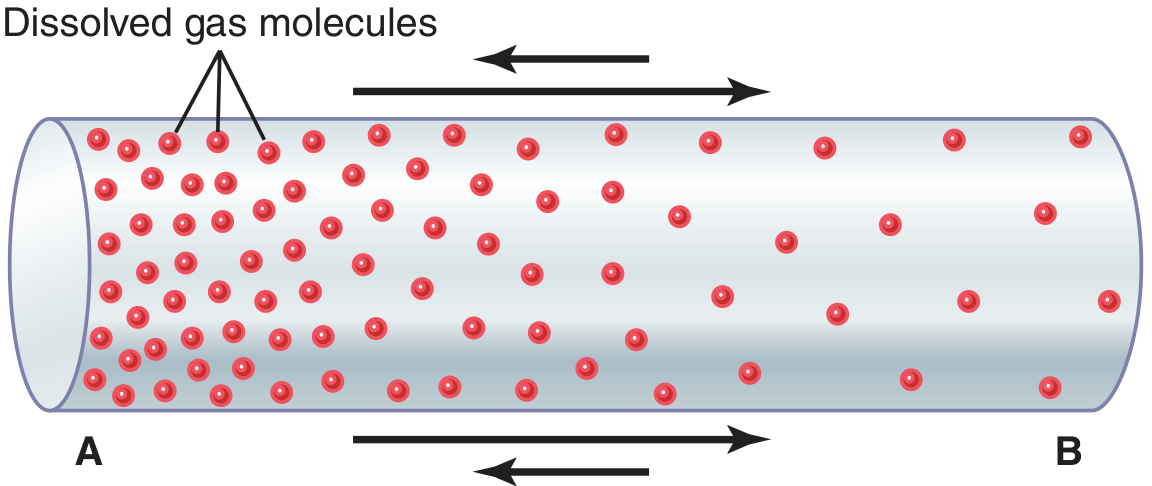
Net Diffusion Along a Concentration Gradient:
As shown above, when a high concentration exists at end A and a low concentration at end B, far more molecules diffuse from A→B than from B→A. The net diffusion is proportional to this concentration difference.
2. Partial Pressures of Individual Gases in a Mixture
Pressure is caused by the repeated impact of moving molecules against a surface, so pressure is directly proportional to the concentration of gas molecules.
In a mixture of gases, each gas exerts its own partial pressure, independent of others. Using air at sea level as an example:
| Gas | % Composition | Partial Pressure |
|---|
| Nitrogen (N₂) | 79% | 600 mm Hg |
| Oxygen (O₂) | 21% | 160 mm Hg |
| Total | 100% | 760 mm Hg |
The partial pressures are designated: PO₂, PCO₂, PN₂, PHe, etc.
The rate of diffusion of each gas is directly proportional to its own partial pressure.
3. Pressures of Gases Dissolved in Water and Tissues
Gases dissolved in body fluids also exert partial pressure because their molecules move randomly and have kinetic energy. When they encounter a cell membrane, they exert pressure just like a gas in the gas phase.
Henry's Law governs partial pressure in solution:
$$\text{Partial Pressure} = \frac{\text{Concentration of dissolved gas}}{\text{Solubility coefficient}}$$
Solubility Coefficients at Body Temperature (37°C):
| Gas | Solubility Coefficient |
|---|
| Oxygen (O₂) | 0.024 |
| Carbon dioxide (CO₂) | 0.57 |
| Carbon monoxide (CO) | 0.018 |
| Nitrogen (N₂) | 0.012 |
| Helium (He) | 0.008 |
Key point: CO₂ is more than 20 times more soluble than O₂. Therefore, for the same concentration, CO₂ exerts less than 1/20th (5%) of the partial pressure that O₂ would exert. This is why CO₂ can be rapidly cleared despite lower partial pressure differences.
Direction of net diffusion between alveoli and blood:
- O₂: partial pressure higher in alveoli → diffuses INTO blood
- CO₂: partial pressure higher in blood → diffuses OUT into alveoli
4. Vapor Pressure of Water
When air enters the respiratory passages, it is immediately humidified by evaporation from mucosal surfaces. Water molecules continuously escape from the liquid surface into the gas phase, exerting their own partial pressure - the vapor pressure of water.
| Temperature | Water Vapor Pressure |
|---|
| 0°C | 5 mm Hg |
| 37°C (body temp) | 47 mm Hg |
| 100°C | 760 mm Hg |
At body temperature, PH₂O = 47 mm Hg - this value is used in all alveolar gas calculations. It is subtracted from atmospheric pressure when calculating alveolar partial pressures.
5. Net Diffusion and the Diffusion Rate Formula
Net diffusion occurs from high partial pressure → low partial pressure. The net rate equals molecules moving forward minus molecules moving backward, proportional to the pressure difference (ΔP).
Fick's Law of Diffusion (for gases in fluids):
$$D \propto \frac{\Delta P \times A \times S}{d \times \sqrt{MW}}$$
| Symbol | Meaning | Relationship to D |
|---|
| ΔP | Partial pressure difference | ↑ ΔP → ↑ diffusion |
| A | Cross-sectional area of pathway | ↑ A → ↑ diffusion |
| S | Solubility of gas in fluid | ↑ S → ↑ diffusion |
| d | Distance of diffusion | ↑ d → ↓ diffusion |
| MW | Molecular weight | ↑ MW → ↓ diffusion |
Temperature is not included because it stays constant in the body.
6. Diffusion Through the Respiratory Membrane
The respiratory membrane (alveolar-capillary membrane) is the site where all gas exchange occurs. Its properties align perfectly with Fick's Law:
- Extremely thin (~0.6 µm) - minimizes distance (d)
- Enormous surface area (~70 m²) - maximizes area (A)
- High solubility favors CO₂ transfer especially
Source: Guyton and Hall Textbook of Medical Physiology, Chapter 40, pp. 511-513