
Glycolysis Steps with flowchart Regulation Aerobic और anaerobic glycolysis Energetics Clinical significance explain use simplest English word so ican write and point to point world university exam MBBS
Reading File
Now let me search the medical library in parallel for all the topics needed.
Finding Sources
Finding Sources
Good. Now let me read the main glycolysis sections from Lippincott (best for MBBS) and Basic Medical Biochemistry in parallel.
Reading File
Reading File
Reading File
Now let me read the detailed 10 steps and regulation from Lippincott, and the anaerobic section from Basic Medical Biochemistry:
Reading File
Reading File
Excellent data collected. Now let me read the regulation section and clinical significance from Lippincott:
Reading File
Reading File
I now have enough information from the textbooks to write a complete, exam-ready answer. Let me fetch key images to include:
Loading Image
Loading Image
I now have everything needed. Here is your complete, exam-ready glycolysis notes:
GLYCOLYSIS - Complete MBBS Exam Notes
Source: Lippincott Illustrated Biochemistry 8e, Basic Medical Biochemistry 6e, Harper's Biochemistry 32e
DEFINITION
- Glycolysis = breakdown of 1 glucose (6C) into 2 pyruvate (3C)
- Occurs in the cytoplasm of ALL cells
- Does NOT need oxygen to start
- Site: Cytosol
FLOWCHART - 10 STEPS OF GLYCOLYSIS
TWO PHASES:
- Phase 1 (Steps 1-5): Energy Investment Phase - ATP is USED (spent)
- Phase 2 (Steps 6-10): Energy Generation Phase - ATP is MADE (earned)
PHASE 1 - Energy Investment Phase (Steps 1-5)
(2 ATP are used here)
GLUCOSE (6C)
     |
     | Step 1: HEXOKINASE (muscle/most tissues)
     |         GLUCOKINASE (liver/pancreas)
     |         ATP → ADP used
     ↓
GLUCOSE-6-PHOSPHATE (G6P)
     |
     | Step 2: PHOSPHOGLUCOSE ISOMERASE
     |         (just changes shape)
     ↓
FRUCTOSE-6-PHOSPHATE (F6P)
     |
     | Step 3: PHOSPHOFRUCTOKINASE-1 (PFK-1) ← MOST IMPORTANT REGULATORY STEP
     |         ATP → ADP used
     ↓
FRUCTOSE-1,6-BISPHOSPHATE
     |
     | Step 4: ALDOLASE
     |         (splits into 2 three-carbon pieces)
     ↓
DHAP + GLYCERALDEHYDE-3-PHOSPHATE (G3P)
     |
     | Step 5: TRIOSE PHOSPHATE ISOMERASE
     |         (DHAP → G3P; now we have 2 × G3P)
     ↓
2 × GLYCERALDEHYDE-3-PHOSPHATE (G3P)
PHASE 2 - Energy Generation Phase (Steps 6-10)
(Everything happens TWICE because we have 2 × G3P)
(4 ATP made, 2 NADH made)
2 × G3P
     |
     | Step 6: GLYCERALDEHYDE-3-PHOSPHATE DEHYDROGENASE
     |         NAD+ → NADH (energy captured)
     |         + Inorganic Phosphate added
     ↓
2 × 1,3-BISPHOSPHOGLYCERATE
     |
     | Step 7: PHOSPHOGLYCERATE KINASE
     |         ADP → ATP (substrate-level phosphorylation) ×2
     ↓
2 × 3-PHOSPHOGLYCERATE
     |
     | Step 8: PHOSPHOGLYCERATE MUTASE
     |         (moves phosphate from carbon 3 to carbon 2)
     ↓
2 × 2-PHOSPHOGLYCERATE
     |
     | Step 9: ENOLASE
     |         (removes water → forms high-energy compound)
     ↓
2 × PHOSPHOENOLPYRUVATE (PEP)
     |
     | Step 10: PYRUVATE KINASE ← Regulatory step
     |          ADP → ATP ×2
     ↓
2 × PYRUVATE (final product)
THREE IRREVERSIBLE STEPS (Very Important for Exam!)
| Step | Enzyme | Mnemonic |
|---|---|---|
| Step 1 | Hexokinase / Glucokinase | Hard to reverse |
| Step 3 | Phosphofructokinase-1 (PFK-1) | Point of no return |
| Step 10 | Pyruvate Kinase | Pyruvate locked in |
Memory trick: HePP - Hexokinase, PFK-1, Pyruvate kinase = 3 irreversible steps
REGULATION OF GLYCOLYSIS
Key Rule: When energy is LOW (less ATP, more AMP/ADP) → glycolysis is TURNED ON. When energy is HIGH (lots of ATP) → glycolysis is TURNED OFF.
1. Hexokinase (Step 1) - In muscle, brain, RBC
| Inhibitor | Activator |
|---|---|
| Glucose-6-phosphate (product) | Glucose itself |
- Inhibited by its own product (feedback inhibition)
- Glucokinase (liver version): NOT inhibited by G6P - works even when glucose is very high after a meal
2. PFK-1 (Step 3) - THE MOST IMPORTANT REGULATORY ENZYME
| ACTIVATORS (turn ON) | INHIBITORS (turn OFF) |
|---|---|
| AMP, ADP (low energy signal) | ATP (high energy = stop!) |
| Fructose-2,6-bisphosphate (F-2,6-BP) - strongest activator | Citrate (TCA cycle running well = stop glycolysis) |
| Pi (inorganic phosphate) | Glucagon (indirectly lowers F-2,6-BP) |
| Insulin (raises F-2,6-BP) | Low pH (acidosis) |
F-2,6-BP is the MOST POTENT activator of PFK-1
- Insulin raises F-2,6-BP → stimulates glycolysis
- Glucagon lowers F-2,6-BP → inhibits glycolysis
3. Pyruvate Kinase (Step 10)
| ACTIVATORS | INHIBITORS |
|---|---|
| Fructose-1,6-bisphosphate (feedforward activation) | ATP |
| Alanine | |
| Glucagon (phosphorylates and inactivates liver PK) |
Summary of Regulation (Simple Table)
| Condition | Signal | Effect on Glycolysis |
|---|---|---|
| After eating (fed state) | High glucose + Insulin | INCREASED |
| Fasting | Glucagon | DECREASED |
| Exercise | AMP rises | INCREASED |
| Cell has lots of ATP | High ATP + Citrate | DECREASED |
AEROBIC vs ANAEROBIC GLYCOLYSIS
Aerobic Glycolysis (O2 is present)
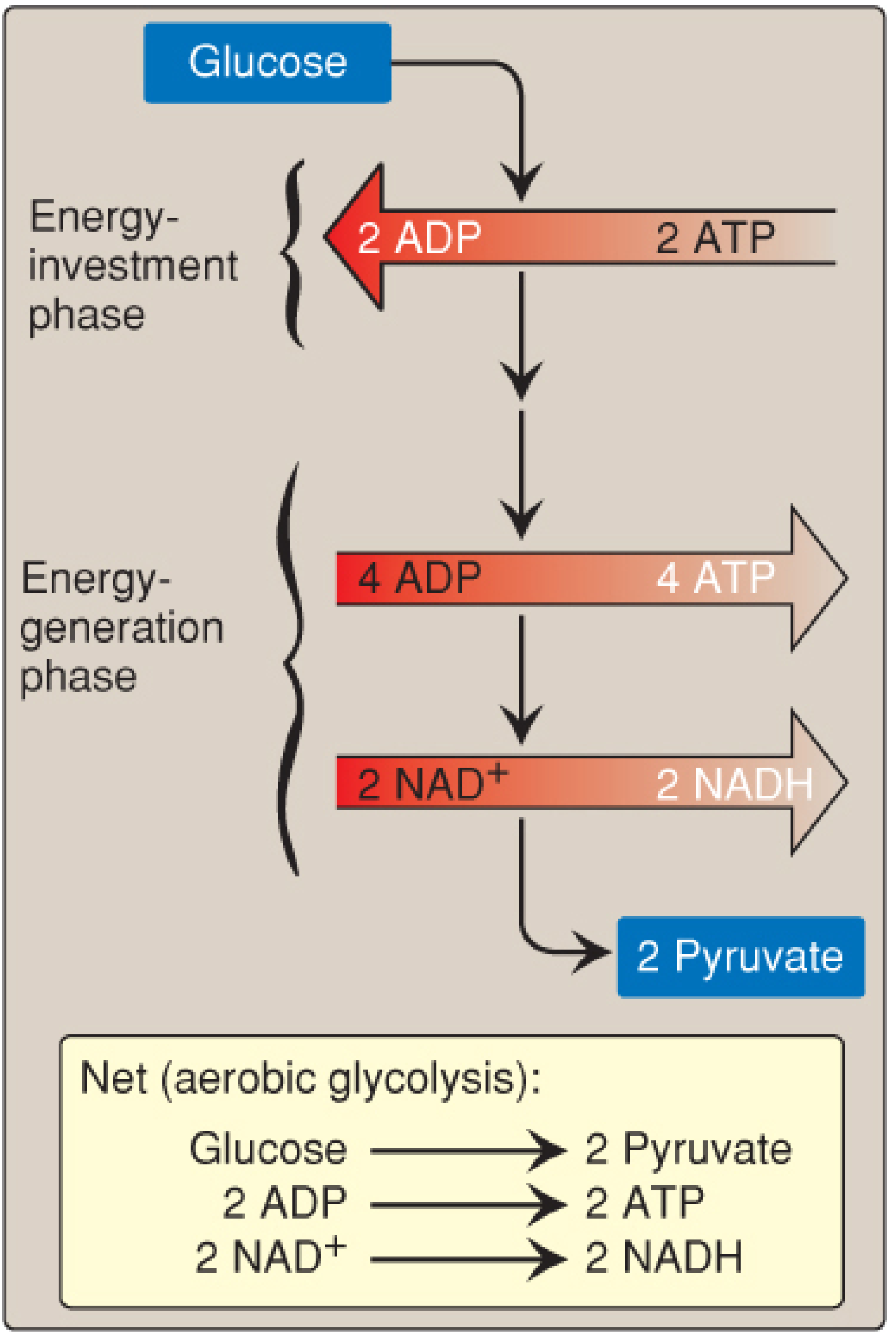
- Pyruvate enters mitochondria → converted to Acetyl CoA
- Acetyl CoA enters TCA cycle → complete oxidation to CO2 + H2O
- NADH produced in glycolysis is oxidized by the electron transport chain (ETC)
- End product: Pyruvate → CO2 + H2O
- Occurs in: All cells with mitochondria + adequate oxygen (liver, heart, brain in normal conditions)
Anaerobic Glycolysis (O2 is absent or very low)
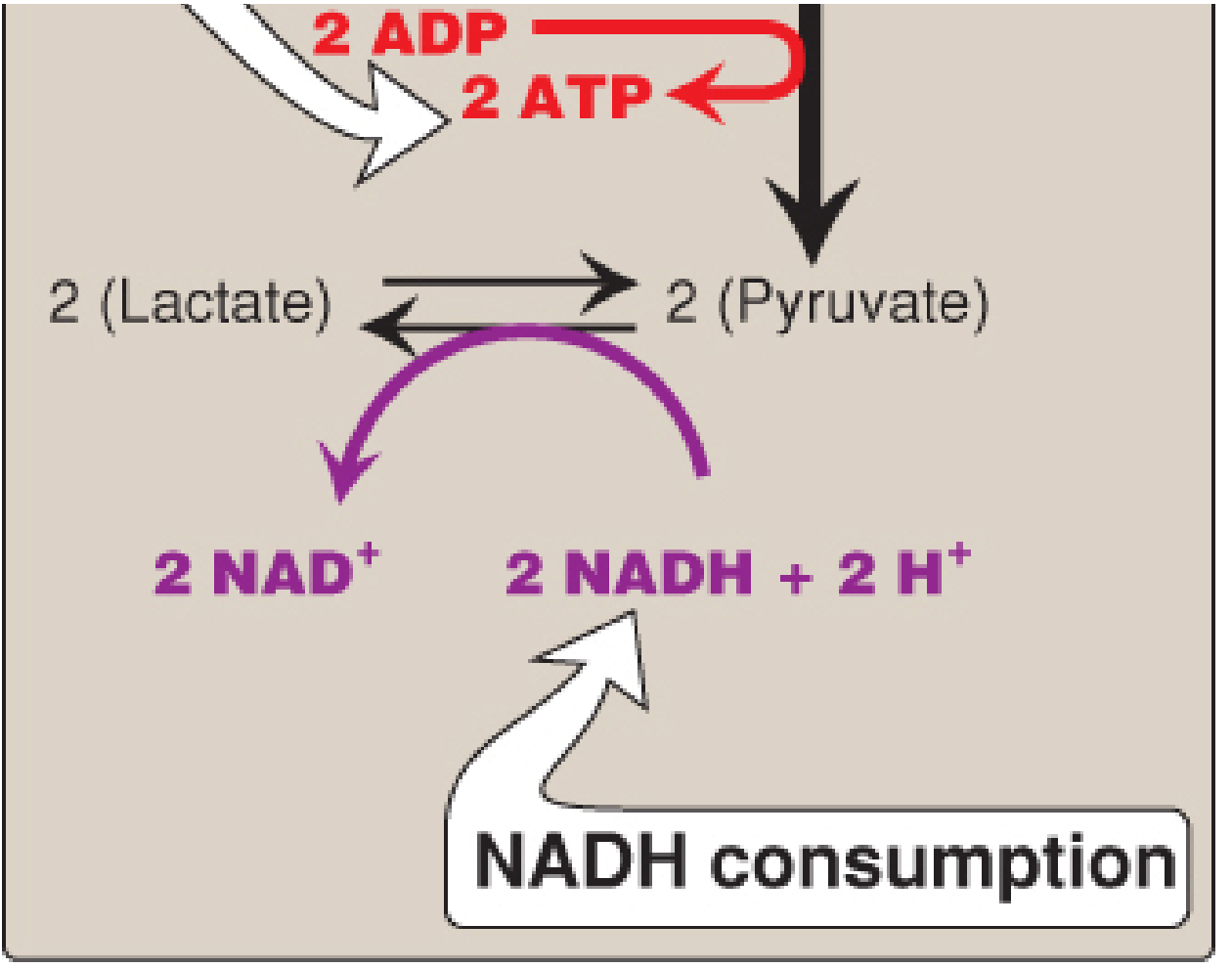
- Pyruvate CANNOT enter mitochondria (no O2 to drive the process)
- Pyruvate is converted to LACTATE by enzyme Lactate Dehydrogenase (LDH)
- This step uses up NADH → regenerates NAD+ so glycolysis can CONTINUE
- Net reaction:
Glucose + 2 ADP + 2 Pi → 2 Lactate + 2 ATP + 2 H2O + 2 H+
- Occurs in: RBCs (no mitochondria), cornea and lens of eye, white blood cells, exercising skeletal muscle, any hypoxic tissue
Comparison Table: Aerobic vs Anaerobic
| Feature | Aerobic Glycolysis | Anaerobic Glycolysis |
|---|---|---|
| O2 needed? | Yes | No |
| End product | Pyruvate → CO2 + H2O | Lactate |
| Net ATP from glycolysis alone | 2 ATP | 2 ATP |
| NADH fate | Oxidized by ETC (makes more ATP) | Used to reduce pyruvate to lactate |
| Total ATP (complete oxidation) | ~30-32 ATP | Only 2 ATP |
| Where it occurs | Cells with mitochondria | RBC, cornea, exercising muscle, hypoxic cells |
| Speed | Slower | Faster (quick energy) |
ENERGETICS OF GLYCOLYSIS
ATP Balance Sheet
Phase 1 (Investment):
- Step 1 (Hexokinase): -1 ATP used
- Step 3 (PFK-1): -1 ATP used
- Total invested = 2 ATP consumed
Phase 2 (Generation):
- Step 7 (Phosphoglycerate kinase): +2 ATP made (×2 for 2 molecules)
- Step 10 (Pyruvate kinase): +2 ATP made (×2 for 2 molecules)
- Total generated = 4 ATP
NET ATP = 4 - 2 = 2 ATP per glucose (by substrate-level phosphorylation)
NADH produced = 2 NADH (at Step 6)
Total Energy from Complete Oxidation (Aerobic)
| Stage | ATP yield |
|---|---|
| Glycolysis (substrate level) | 2 ATP |
| 2 NADH from glycolysis (via ETC, using malate-aspartate shuttle) | ~5 ATP |
| Pyruvate dehydrogenase (2 NADH) | ~5 ATP |
| TCA cycle (per glucose) | ~20 ATP |
| TOTAL | ~30-32 ATP |
Anaerobic glycolysis gives only 2 ATP. Aerobic gives ~30-32 ATP.
CLINICAL SIGNIFICANCE
1. Lactic Acidosis
- When O2 supply is low (shock, heart failure, severe infection, anemia), cells switch to anaerobic glycolysis
- Lactate builds up in blood → blood pH falls → lactic acidosis
- Signs: rapid breathing, confusion, low blood pressure
- Blood lactate level is used to monitor severity of shock and organ failure
- Normal blood lactate: <2 mmol/L; >4 mmol/L = severe lactic acidosis
2. Warburg Effect (Cancer)
- Cancer cells use anaerobic glycolysis EVEN when O2 is available - called aerobic glycolysis or Warburg effect
- Cancer cells produce lots of lactate even with oxygen present
- This is why PET scan (uses radiolabeled glucose) lights up tumors - cancer cells take up glucose rapidly
- Targeted by drugs that inhibit glycolytic enzymes in tumors
3. Hemolytic Anemia - Pyruvate Kinase (PK) Deficiency
- RBCs have NO mitochondria - they fully depend on glycolysis for ATP
- If PK is deficient → less ATP made → RBC membrane pump fails → RBC swells and bursts → hemolytic anemia
- Features: jaundice, anemia, splenomegaly
4. RBC Metabolism - 2,3-BPG (Rapoport-Luebering Shunt)
- In RBCs, a side reaction at Step 7 produces 2,3-bisphosphoglycerate (2,3-BPG)
- 2,3-BPG binds to hemoglobin → reduces oxygen affinity → hemoglobin releases O2 more easily to tissues
- Important in adaptation to high altitude and anemia
5. Glucose-6-Phosphate Dehydrogenase (G6PD) Deficiency
- G6PD is in the pentose phosphate pathway (NOT glycolysis directly), but connected
- Without G6PD, RBCs cannot protect themselves from oxidative damage
- Triggered by: antimalarial drugs (primaquine), fava beans, infections
- Causes: hemolytic anemia, jaundice, dark urine
- Common in Africans, Mediterraneans, South Asians
6. Hypoxia and Ischemia
- During heart attack or stroke, blood flow stops → O2 drops → cells switch to anaerobic glycolysis
- ATP production falls sharply → cells die
- Lactate monitoring helps doctors know how much tissue is at risk
7. Diabetes and Glycolysis
- In Type 2 diabetes, glucose enters cells poorly → glycolysis is impaired
- Glucokinase mutations cause MODY (Maturity Onset Diabetes of the Young) - Type 2 in young patients
QUICK MEMORY TRICKS
-
"Graceful Girls Pick FADS to Generate Phospho-Energy Proteins"
- G = Glucose, G6P, F6P, F1,6-BP, DHAP/G3P, 1,3-BPG, 3-PG, 2-PG, PEP, Pyruvate
- (10 intermediates = 10 steps)
-
3 irreversible enzymes = HePP: Hexokinase / glucokinase, PFK-1, Pyruvate kinase
-
PFK-1 activators = low energy state: AMP, ADP, F-2,6-BP, Pi
-
PFK-1 inhibitors = high energy state: ATP, Citrate, H+ (acidosis)
-
Anaerobic glycolysis = only 2 ATP | Aerobic = 30-32 ATP
-
RBC lives on glycolysis alone - no mitochondria
Sources: Lippincott Illustrated Reviews Biochemistry 8e, Basic Medical Biochemistry - A Clinical Approach 6e, Harper's Illustrated Biochemistry 32e
This is a shared conversation. Sign in to Orris to start your own chat.