
Front and back of arm and cubital fossae
Reading File
Now searching the medical library for anatomy of the arm (front/back compartments) and cubital fossa.
Finding Sources
Finding Sources
Finding Sources
Reading File
Finding Sources
Reading File
Finding Sources
Finding Sources
Let me search specifically for the arm compartments sections in Gray's:
Finding Sources
Reading File
Now let me get the anterior arm muscles section and the Thieme atlas section:
Reading File
Finding Sources
Reading File
Finding Sources
Reading File
Finding Sources
Now let me fetch the key images to include in the response:
Loading Image
Loading Image
Loading Image
Loading Image
I now have comprehensive information from the textbooks. Let me compile the full structured answer.
Arm Compartments and Cubital Fossa
Anterior (Front) Compartment of the Arm
The anterior compartment contains three muscles, all innervated by the musculocutaneous nerve (C5-C7), and all primarily flex the elbow and/or shoulder.
1. Biceps Brachii
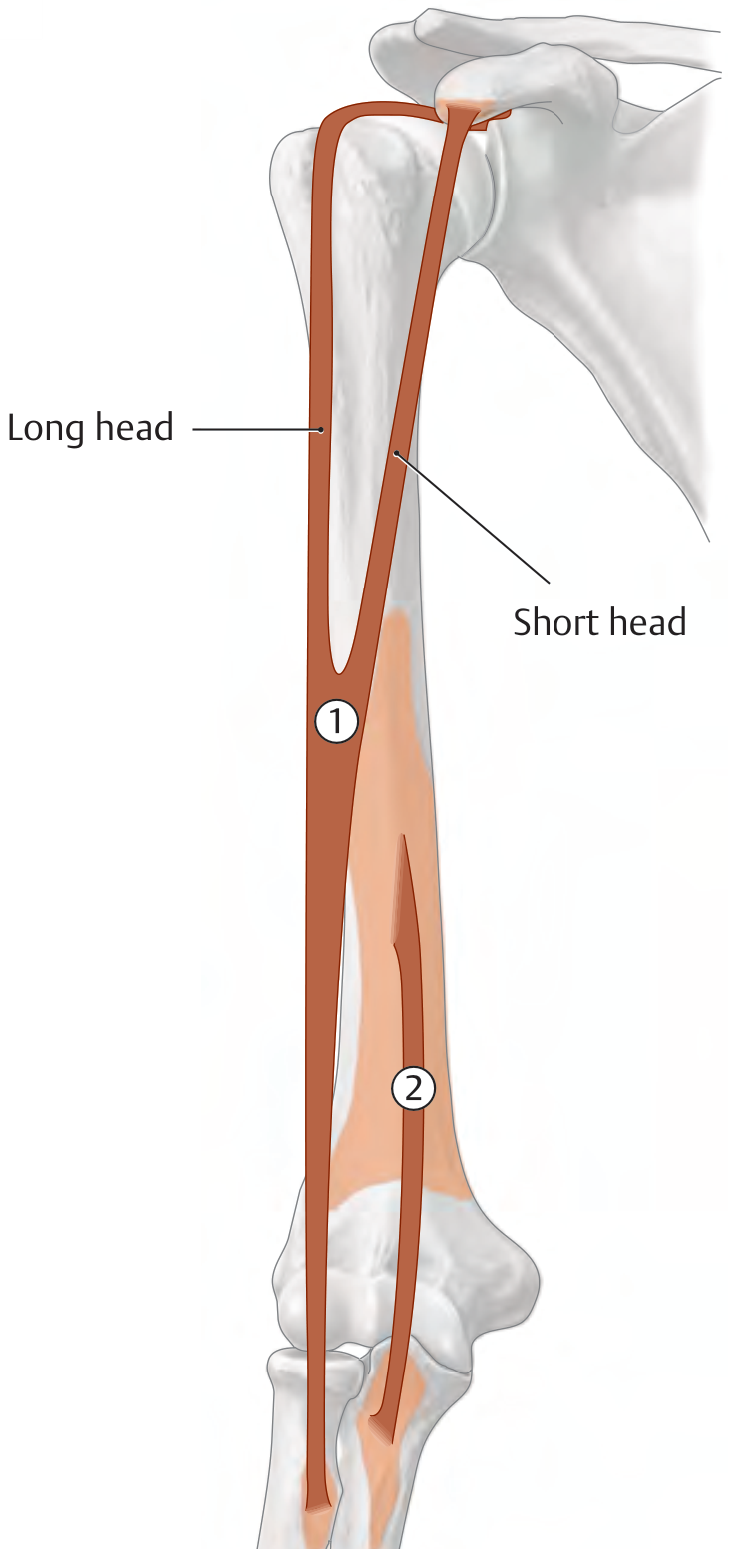
| Feature | Detail |
|---|---|
| Origin | Long head: supraglenoid tubercle of scapula; Short head: coracoid process of scapula |
| Insertion | Radial tuberosity + antebrachial fascia via bicipital aponeurosis |
| Actions | Elbow: flexion, supination (most powerful with elbow flexed); Shoulder: flexion, stabilization of humeral head |
| Innervation | Musculocutaneous nerve (C5-C7) |
Note on supination: When the elbow is flexed, the biceps tendon is almost perpendicular to the pronation/supination axis, making it the most powerful supinator in that position. When the forearm is pronated, the tendon wraps around the radius like a rope around a crank - contraction then "unwinds" it into supination.
2. Brachialis
| Feature | Detail |
|---|---|
| Origin | Distal half of the anterior surface of the humerus + medial and lateral intermuscular septa |
| Insertion | Ulnar tuberosity |
| Action | Flexion at the elbow (pure flexor - works regardless of forearm rotation) |
| Innervation | Musculocutaneous nerve (C5-C7); variable small branches from radial nerve (C5-C6) |
The brachialis is considered the "workhorse" elbow flexor because its action is independent of forearm rotation (unlike biceps, which is weakened in pronation).
3. Coracobrachialis
| Feature | Detail |
|---|---|
| Origin | Coracoid process of scapula (with short head of biceps) |
| Insertion | Medial surface of humerus (mid-shaft) |
| Actions | Shoulder flexion and adduction |
| Innervation | Musculocutaneous nerve (C5-C7), which pierces through it |
Neurovascular Supply - Anterior Compartment
- Musculocutaneous nerve (C5-C7): enters by piercing the coracobrachialis, runs between biceps and brachialis, exits laterally as the lateral cutaneous nerve of the forearm
- Brachial artery: runs on the medial side of biceps throughout the arm, ending at the cubital fossa
- Median nerve: runs alongside the brachial artery (lateral then crosses to medial by the elbow)
- Ulnar nerve: runs on the medial side, passes posterior to the medial epicondyle (does NOT enter the cubital fossa)
Posterior (Back) Compartment of the Arm
The posterior compartment contains the triceps brachii and anconeus, both innervated by the radial nerve (C6-C8).
1. Triceps Brachii
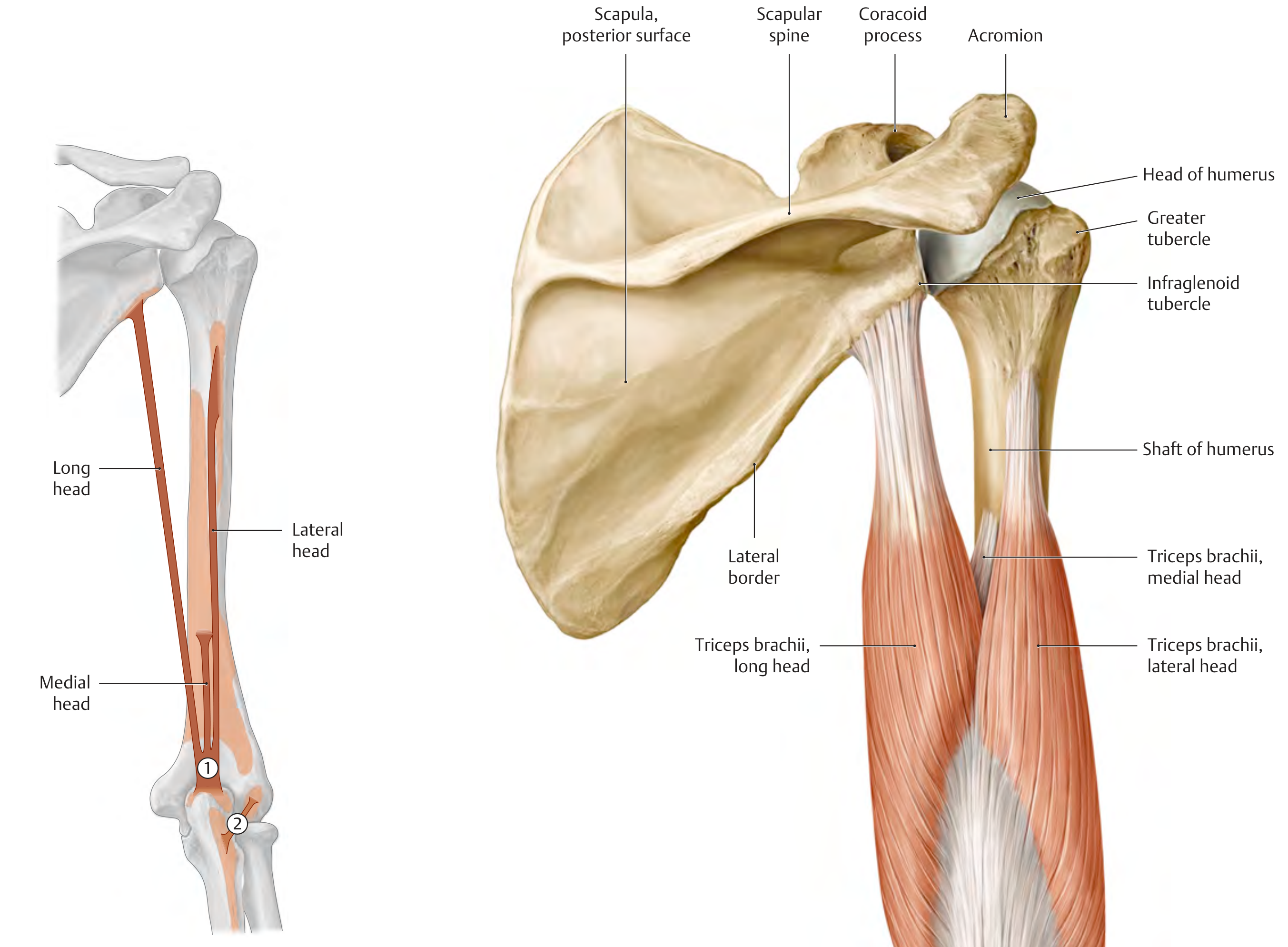
| Feature | Detail |
|---|---|
| Origin | Long head: infraglenoid tubercle of scapula; Lateral head: posterior humerus proximal to radial groove + lateral intermuscular septum; Medial head: posterior humerus distal to radial groove + medial intermuscular septum |
| Insertion | Olecranon of ulna |
| Actions | Elbow: extension (primary); Long head at shoulder: backward movement (extension) and adduction of arm |
| Innervation | Radial nerve (C6-C8) |
The radial nerve runs in the radial (spiral) groove of the humerus, between the medial and lateral heads of triceps. It then pierces the lateral intermuscular septum to enter the anterior compartment distally, emerging deep to the brachioradialis.
2. Anconeus
| Feature | Detail |
|---|---|
| Origin | Lateral epicondyle of humerus (and posterior joint capsule in some cases) |
| Insertion | Radial surface of olecranon |
| Actions | Assists elbow extension; tightens the joint capsule |
| Innervation | Radial nerve (C6-C8) |
Neurovascular Supply - Posterior Compartment
- Radial nerve (C5-C8, T1): the main nerve; runs in the spiral groove with the profunda brachii artery
- Profunda brachii (deep brachial) artery: branch of brachial artery; accompanies radial nerve in the radial groove
Cubital Fossa
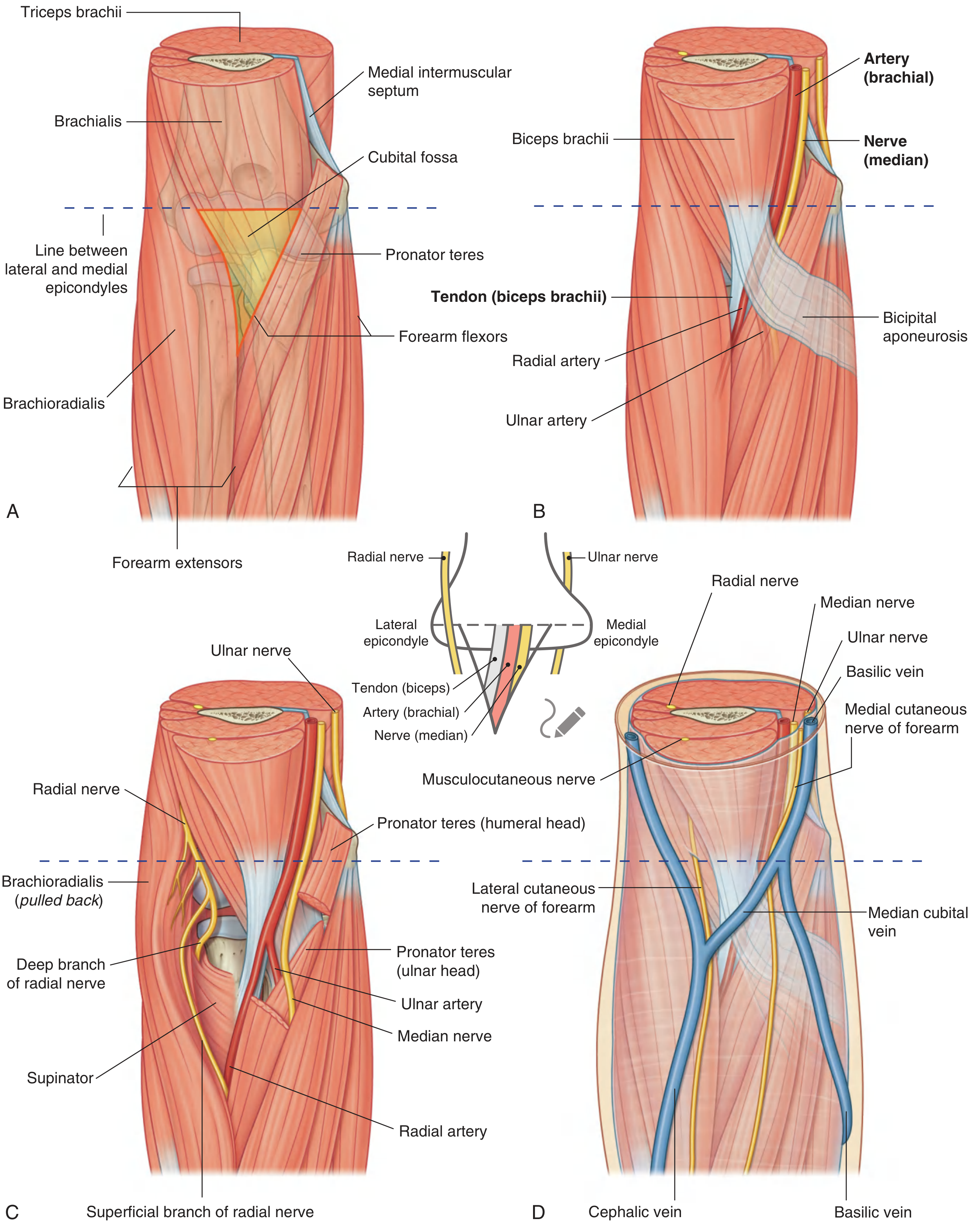

The cubital fossa is a triangular depression anterior to the elbow joint - it marks the transition between arm and forearm.
Boundaries
| Structure | Forms |
|---|---|
| Base (superior) | Imaginary horizontal line between medial and lateral epicondyles |
| Lateral border | Brachioradialis muscle |
| Medial border | Pronator teres muscle |
| Floor (bed) | Brachialis muscle (mainly) + supinator laterally |
| Roof | Skin + superficial fascia + bicipital aponeurosis (deep fascia) |
Contents (lateral to medial) - mnemonic TAN
| Structure | Notes |
|---|---|
| T - Tendon of biceps brachii | Easily palpable; the bicipital aponeurosis fans off its medial side |
| A - (Brachial) Artery | Bifurcates into radial and ulnar arteries at the apex of the fossa |
| N - (Median) Nerve | Lies just medial to brachial artery; exits by passing between ulnar and humeral heads of pronator teres |
Radial nerve - special position
The radial nerve lies just deep to the lateral margin (brachioradialis), not in the main fossa. Here it divides into:
- Superficial branch: continues into forearm deep to brachioradialis (sensory)
- Deep branch (posterior interosseous nerve): passes between the two heads of supinator to reach the posterior forearm compartment (motor)
Ulnar nerve
The ulnar nerve does not pass through the cubital fossa. It runs posterior to the medial epicondyle through the cubital tunnel, where it can be palpated against the bone. This is why compression here causes "funny bone" tingling.
Superficial veins overlying the cubital fossa
In the subcutaneous fascia above the fossa, three veins are typically visible and clinically important (venepuncture sites):
- Cephalic vein - lateral
- Basilic vein - medial
- Median cubital vein - oblique communicating vein connecting cephalic and basilic; the preferred site for venepuncture because it is relatively anchored by the bicipital aponeurosis beneath it
Summary Table: Arm Muscles at a Glance
| Muscle | Compartment | Origin | Insertion | Action | Nerve |
|---|---|---|---|---|---|
| Biceps brachii | Anterior | Supraglenoid tubercle (long); coracoid process (short) | Radial tuberosity + bicipital aponeurosis | Elbow flexion, supination; shoulder flexion | Musculocutaneous (C5-C7) |
| Brachialis | Anterior | Distal anterior humerus | Ulnar tuberosity | Elbow flexion | Musculocutaneous (C5-C7) |
| Coracobrachialis | Anterior | Coracoid process | Mid-medial humerus | Shoulder flexion + adduction | Musculocutaneous (C5-C7) |
| Triceps brachii | Posterior | Infraglenoid (long); posterior humerus (lat/med heads) | Olecranon | Elbow extension; arm adduction (long head) | Radial (C6-C8) |
| Anconeus | Posterior | Lateral epicondyle | Olecranon (radial surface) | Assists elbow extension | Radial (C6-C8) |
Sources: Gray's Anatomy for Students (9780323934237), pp. 889-890, 944-945; THIEME Atlas of Anatomy - General Anatomy and Musculoskeletal System (9781626237186), pp. 330-334
This is a shared conversation. Sign in to Orris to start your own chat.