
Why the hashimoto patient have increased risk for lymphoma
Reading File
Now let me search the medical library and PubMed in parallel for this topic.
Finding Sources
Searching PubMed
Hashimoto thyroiditis lymphoma risk mechanism
Good results from the library. Now let me get the detailed mechanistic content from Robbins and Harrison's, plus do a broader PubMed search:
Reading File
Reading File
Reading File
Searching PubMed
Hashimoto thyroiditis thyroid lymphoma
Now let me also get the Robbins section specifically on lymphoma risk in Hashimoto, and do a deeper mechanistic search:
Reading File
Finding Sources
I now have sufficient detail from authoritative sources to provide a comprehensive answer. Let me also fetch the Robbins pathogenesis image for visual context:
Loading Image
Here is a thorough, source-based answer:
Why Hashimoto's Thyroiditis Increases Lymphoma Risk
Hashimoto's thyroiditis (HT) is the most common autoimmune thyroid disease, and it carries a 70-fold increased risk of primary thyroid lymphoma compared to the general population. This risk is specific to thyroid lymphoma, particularly extranodal marginal zone B-cell (MALT) lymphoma, and less commonly diffuse large B-cell lymphoma (DLBCL). The mechanisms are well understood and involve several interrelated processes.
1. Acquired Lymphoid Tissue in a Normally Lymphocyte-Free Organ
Normally, the thyroid gland contains no organized lymphoid tissue. In Hashimoto's thyroiditis, the immune-mediated destruction of thyrocytes drives massive recruitment of lymphocytes into the gland - forming tertiary lymphoid structures with well-developed germinal centers. This creates an entirely new lymphoid compartment where none should exist, generating the cellular substrate from which lymphoma can arise. MALT lymphomas arise specifically from mucosal/extranodal sites where "acquired" lymphoid tissue has developed as a result of chronic inflammation or autoimmunity - exactly what Hashimoto's creates.
(Grainger & Allison's Diagnostic Radiology; Robbins, Cotran & Kumar Pathologic Basis of Disease)
2. Chronic Antigenic Stimulation of B Cells
The autoimmune process in HT involves sustained stimulation of autoreactive B cells by thyroid antigens (thyroglobulin, thyroid peroxidase). This chronic, unrelenting B-cell activation:
- Drives repeated rounds of B-cell proliferation
- Increases the probability of somatic mutations occurring during B-cell division and germinal center reactions
- Selects for B-cell clones that survive and proliferate in the thyroid microenvironment
Over years or decades, a malignant clone can emerge from this pool of chronically stimulated, proliferating B cells. This is the same mechanism seen in Helicobacter pylori-associated gastric MALT lymphoma and Sjögren's syndrome-associated salivary gland lymphoma.
(Grainger & Allison's; Robbins/Kumar)
3. The MALT Lymphoma Pathway
The hallmark histological lesion in MALT lymphoma is the lymphoepithelial lesion: lymphomatous cells invading the glandular epithelium of the thyroid follicles. This follows directly from the chronic inflammatory infiltrate in Hashimoto's, where lymphocytes already surround and invade follicular epithelium. The residual atrophic follicles (lined by oncocytic/Hürthle cells) are surrounded by dense lymphocytic infiltrate with germinal centers - the precursor microenvironment for MALT transformation.
In this regard, the MALT lymphoma progression sequence is:
Chronic autoimmune inflammation → acquired lymphoid tissue formation → chronic B-cell stimulation → clonal selection → MALT lymphoma → possible transformation to DLBCL
4. Pro-inflammatory Cytokine Environment
Hashimoto's thyroiditis generates a cytokine-rich environment dominated by IFN-γ, TNF-α, and IL-1, which sustain T-cell and macrophage-mediated destruction of thyrocytes. These same cytokines promote B-cell survival and can inhibit B-cell apoptosis, further favoring the accumulation of abnormal B-cell clones over time.
(Robbins, Cotran & Kumar - Fig. 24.10)
Histology of Hashimoto's Thyroiditis (The Precursor Lesion)
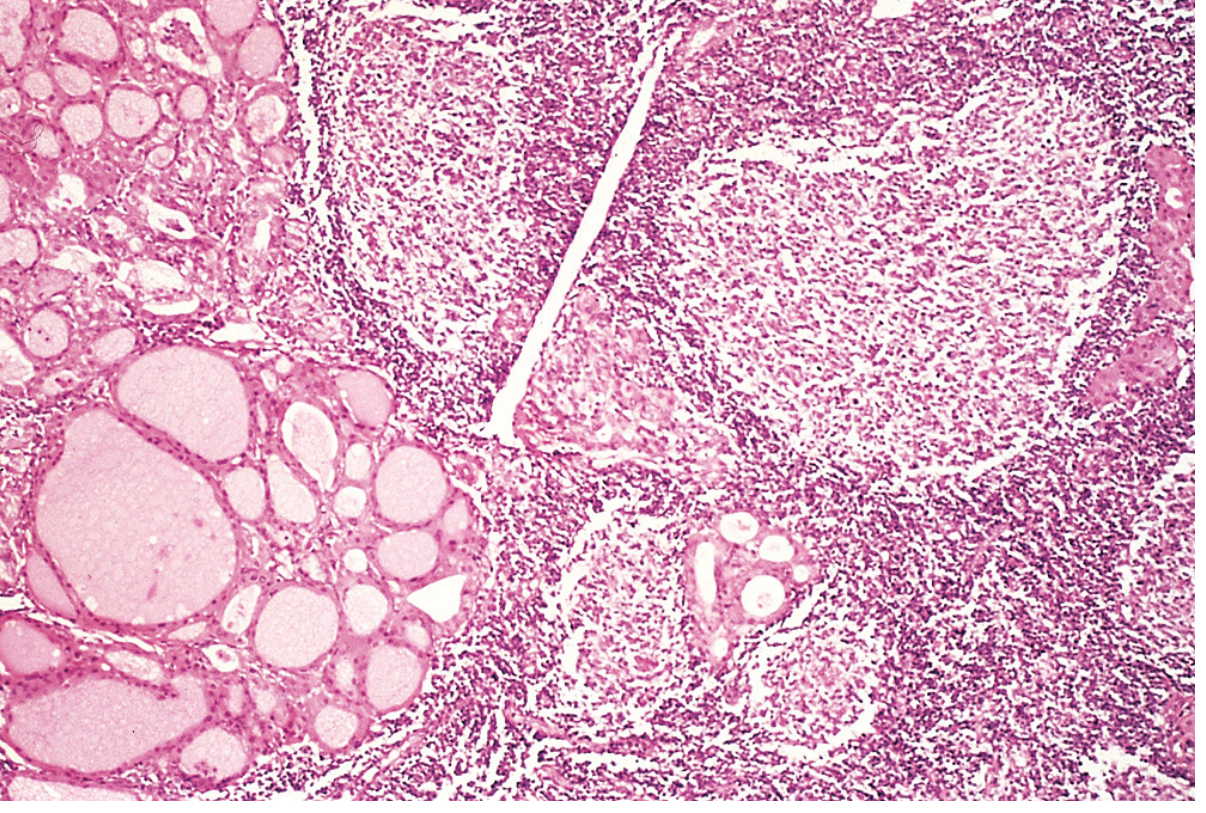
Histology of Hashimoto thyroiditis: dense lymphocytic infiltrate with germinal centers (right half), and residual thyroid follicles lined by oncocytic cells (left). This inflammatory infiltrate is the direct precursor to thyroid MALT lymphoma. - Robbins, Cotran & Kumar
Types of Lymphoma That Arise
| Type | Frequency | Notes |
|---|---|---|
| Extranodal marginal zone (MALT) | Most common in Hashimoto's background | Indolent; arises directly from Hashimoto's infiltrate |
| Diffuse large B-cell lymphoma (DLBCL) | Most common thyroid lymphoma overall | Can arise de novo or by transformation from MALT |
| Hodgkin disease, plasmacytoma | Rare |
(Cummings Otolaryngology; Harrison's 22E)
Clinical Implication
A rapidly enlarging thyroid mass in a known Hashimoto's patient must raise immediate suspicion for lymphoma and warrants urgent biopsy. This is because DLBCL grows rapidly and can compress the trachea/esophagus. The key principle: surgical resection should be avoided as initial therapy (it can spread otherwise localized disease); these tumors are often highly radiation-sensitive, and staging should guide management.
(Harrison's Principles of Internal Medicine 22E, p. 3091)
Summary: The risk stems from chronic autoimmune-driven B-cell infiltration of the thyroid, which creates an ectopic lymphoid organ subject to decades of antigenic stimulation, clonal B-cell expansion, and eventual malignant transformation - the same pathway seen in other MALT lymphoma-predisposing autoimmune conditions like Sjögren's syndrome and H. pylori gastritis.
This is a shared conversation. Sign in to Orris to start your own chat.