
Most common complications in anesthesia and treatment
Reading File
Now let me search the medical library and PubMed in parallel for anesthesia complications.
Finding Sources
Finding Sources
Searching PubMed
"anesthesia" AND "complications" AND "management"
Now let me read the most relevant textbook sections in parallel:
Reading File
Reading File
Finding Sources
Finding Sources
Excellent data. Let me pull more detailed content on key complications:
Reading File
Finding Sources
Finding Sources
Let me get a few more key sections for airway, cardiovascular complications, and the PONV algorithm image:
Reading File
Finding Sources
Finding Sources
Let me fetch the PONV algorithm image and get the laryngospasm treatment section:
Loading Image
Reading File
I now have comprehensive information from multiple authoritative textbooks. Let me compile the full answer.
Most Common Complications in Anesthesia and Their Management
Below is a systematic overview of the most common and clinically significant anesthesia complications, drawn primarily from Barash, Cullen & Stoelting's Clinical Anesthesia (9e), Miller's Anesthesia (10e), and Morgan & Mikhail's Clinical Anesthesiology (7e).
1. Airway Complications
Laryngospasm
One of the most feared intraoperative events, especially in pediatrics. Occurs when vocal cords reflexively adduct, often triggered by secretions, blood, or light anesthesia during airway manipulation.
Treatment (from Barash, Clinical Anesthesia 9e):
- Apply a well-fitted mask with 100% O2 and continuous positive pressure of 15-20 cm H2O
- Deepen anesthesia with IV propofol
- Assertive jaw thrust (also provides a painful stimulus that can break spasm)
- Suction the glottis if secretions/blood suspected
- If unresponsive: succinylcholine 1-2 mg/kg IV (or 4-5 mg/kg IM if no IV access)
Bronchospasm
Perioperative bronchospasm is common in patients with asthma/COPD, especially during induction or emergence.
Treatment (from Cummings Otolaryngology):
- Confirm adequate depth of anesthesia
- Supportive ventilation with elevated FiO2
- Short-acting β2 agonists (albuterol/salbutamol)
- Steroids, ipratropium bromide, and magnesium sulfate
Difficult/Failed Airway
The most dangerous airway scenario. Most specialty guidelines discourage repeated failed techniques - escalate to new approaches (supraglottic airway device, video laryngoscopy, awake fiberoptic intubation, surgical airway).
2. Pulmonary Aspiration
Aspiration of gastric contents into the lungs, leading to Mendelson's syndrome (chemical pneumonitis) or aspiration pneumonia. Risk is highest during induction and emergence with full stomach, reduced consciousness, or impaired laryngeal reflexes.
Prevention: NPO guidelines, rapid sequence induction (RSI) with cricoid pressure, use of H2-blockers or PPIs preoperatively.
Treatment: Supportive - supplemental O2, bronchodilators, mechanical ventilation if needed; antibiotics only if infection develops (not prophylactic).
3. Postoperative Nausea and Vomiting (PONV)
One of the most common anesthesia complications. Incidence of vomiting ~30%, nausea ~50%, and combined PONV up to 80% in high-risk patients (Schwartz's Surgery 11e).
Risk factors (Apfel score): Female sex, nonsmoker, history of PONV/motion sickness, postoperative opioid use.
Management Algorithm (Fourth Consensus Guidelines, Anesthesia & Analgesia 2020, cited in Morgan & Mikhail 7e):
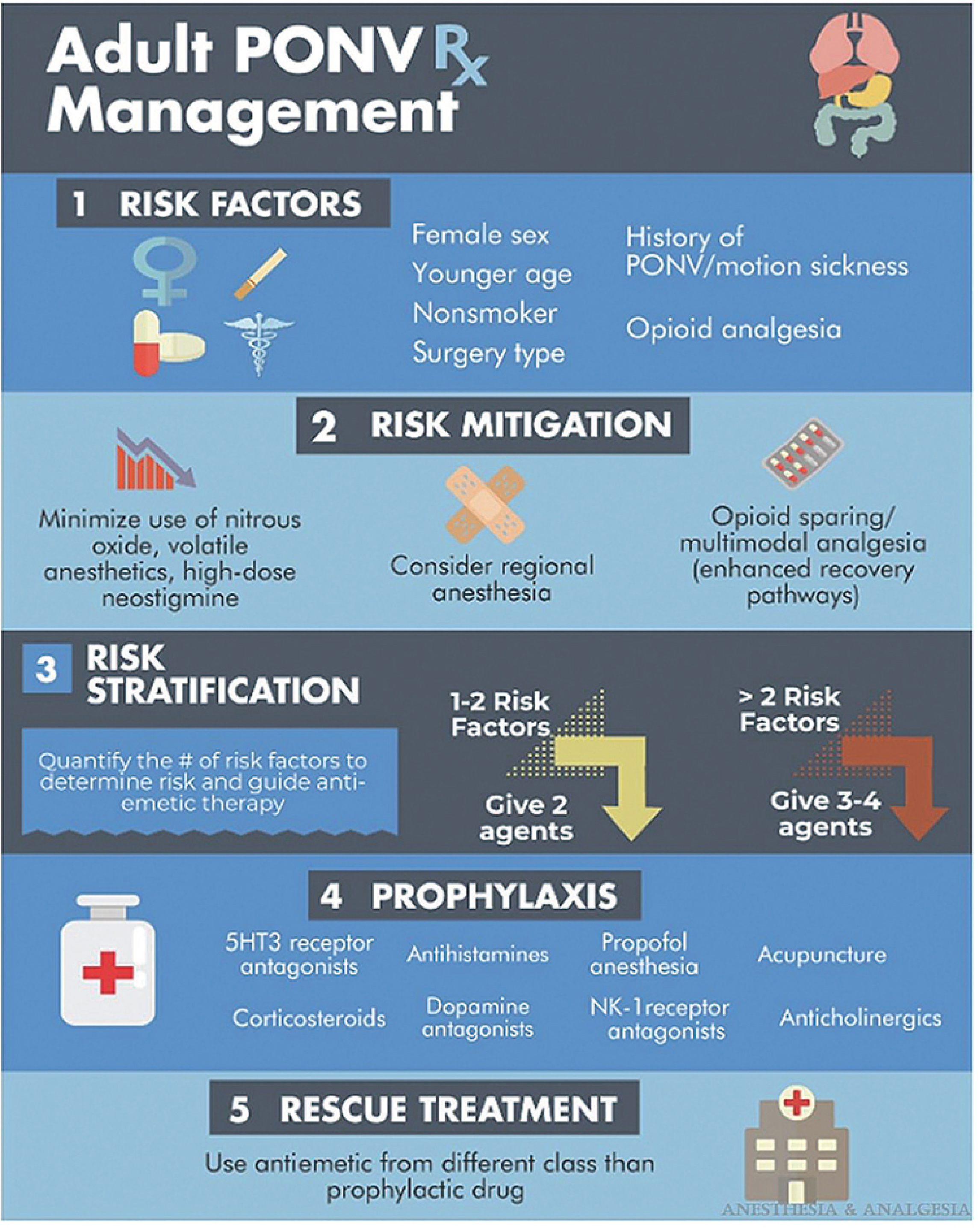
- Risk mitigation: Minimize N2O, volatile agents, high-dose neostigmine; prefer regional/TIVA; multimodal opioid-sparing analgesia
- 1-2 risk factors: Give 2 prophylactic antiemetic agents
- >2 risk factors: Give 3-4 agents
- Drugs: 5-HT3 antagonists (ondansetron), dexamethasone, NK-1 antagonists (aprepitant), dopamine antagonists (droperidol), antihistamines, scopolamine
- Rescue treatment: Use an antiemetic from a different drug class than the prophylactic agent
4. Cardiovascular Complications
Hypotension
Most common cardiovascular event under anesthesia. Causes include vasodilation from volatile agents/neuraxial block, hypovolemia, cardiac depression, or allergic reaction.
- Treatment: IV fluid bolus, vasopressors (phenylephrine, ephedrine, norepinephrine), reduce anesthetic depth, address underlying cause.
Bradycardia
Particularly dangerous in pediatric patients who depend on heart rate for cardiac output. Common causes: hypoxia, succinylcholine, dexmedetomidine, vagal stimulation.
- Treatment: Correct hypoxia first, atropine, epinephrine (if severe), isoproterenol in select cases.
5. Anaphylaxis
Severe life-threatening immune reaction. Common triggers: neuromuscular blocking agents (NMBAs), latex, antibiotics, colloids. Rate is approximately 1/10,000-20,000 anesthetics.
Treatment (from Miller's Anesthesia 10e):
- Epinephrine IM (thigh) is first-line - IV epinephrine carries higher cardiac risk and is NOT recommended as first-line
- Stop the triggering agent
- Aggressive IV fluid resuscitation
- Antihistamines (H1 + H2), corticosteroids as adjuncts
- Airway management (intubation may be needed if angioedema develops)
6. Malignant Hyperthermia (MH)
A rare but life-threatening pharmacogenetic disorder triggered by volatile anesthetic agents (halothane, sevoflurane, isoflurane, desflurane) and succinylcholine. Mechanism: uncontrolled release of calcium from sarcoplasmic reticulum in skeletal muscle.
Signs: Rapid rise in temperature, masseter rigidity, hypercapnia, tachycardia, hyperkalemia, metabolic acidosis.
Treatment (from Katzung 16e):
- Dantrolene (2.5 mg/kg IV, repeat until symptoms controlled) - the definitive treatment; reduces calcium release from SR
- Discontinue triggering agents, switch to non-triggering anesthetic
- Active cooling (ice packs, cold IV fluids, cooling blankets)
- Treat hyperkalemia (insulin/dextrose, bicarbonate)
- Monitor and treat cardiac arrhythmias, myoglobinuria (IV fluids, furosemide)
7. Awareness Under Anesthesia (Intraoperative Awareness)
Incidence ranges from 12-41 per 10,000 procedures (Barash 9e Table 4-2, multiple large studies). Risk is higher during cardiac surgery, obstetric emergencies, and when muscle relaxants are used without adequate anesthetic depth.
Prevention: Maintain adequate MAC (minimum alveolar concentration), consider BIS monitoring in high-risk patients, use TIVA when volatile delivery is uncertain.
Treatment (postoperative): Psychological support, screening for PTSD, referral for counseling/therapy.
8. Neurological Complications
Peripheral Nerve Injury
- Ulnar neuropathy: ~47/10,000 (most common nerve injured)
- Peripheral nerve block complications: ~2.9-18/10,000
- Causes: stretch, compression, ischemia, direct injection, hematoma
Prevention: Proper positioning, padding bony prominences, ultrasound-guided nerve blocks.
Post-Dural Puncture Headache (PDPH)
Most common complication of neuraxial anesthesia. Incidence of unintentional dural puncture during labor epidural: 1-1.5%; headache after large-needle dural puncture: 30-60% (Miller's 10e).
Treatment:
- Conservative first: caffeine, hydration, analgesics, bed rest
- Definitive: Epidural blood patch (10-20 mL autologous blood) - provides immediate relief in ~90%
9. Hypothermia
Inadvertent perioperative hypothermia (core temp <36°C) is very common, affecting up to 50-70% of unwarmed surgical patients.
Consequences: Coagulopathy, increased wound infection, prolonged drug metabolism, shivering (increases O2 consumption), cardiac arrhythmias.
Treatment/Prevention: Forced-air warming blankets, warmed IV fluids, operating room temperature control.
Summary Table
| Complication | Incidence | Key Treatment |
|---|---|---|
| PONV | Nausea 50%, vomiting 30% | Multimodal antiemetics (5-HT3, dexamethasone, NK-1) |
| Awareness | 12-41/10,000 | BIS monitoring; post-op psychological support |
| Peripheral nerve injury | 2.9-47/10,000 | Proper positioning; ultrasound guidance |
| PDPH | 30-60% after large-needle puncture | Epidural blood patch |
| Laryngospasm | Pediatric > adult | O2, propofol, jaw thrust, succinylcholine |
| Anaphylaxis | 1/10,000-20,000 | IM epinephrine (first-line) |
| Malignant hyperthermia | Rare (1/10,000-100,000) | Dantrolene + active cooling |
| Aspiration | 1-10/10,000 | RSI prevention; supportive O2/ventilation |
Sources:
- Barash, Cullen & Stoelting's Clinical Anesthesia, 9e - Complications tables and management protocols
- Miller's Anesthesia, 10e - Regional anesthesia complications, PDPH, anaphylaxis
- Morgan & Mikhail's Clinical Anesthesiology, 7e - PONV algorithm (based on 4th Consensus PONV Guidelines)
- Katzung's Basic and Clinical Pharmacology, 16e - Malignant hyperthermia and dantrolene
This is a shared conversation. Sign in to Orris to start your own chat.