
Levator ani vs pelvic diaphragm
The levator ani and pelvic diaphragm are closely related terms that are often used interchangeably, but there is a subtle distinction worth clarifying.
Quick answer: The levator ani is the main muscular component, while the pelvic diaphragm is the broader anatomical structure that includes the levator ani plus the coccygeus muscle (and their fascial coverings). Think of it this way: levator ani is the muscle group; pelvic diaphragm is the functional floor unit.
Searching sources...
Reading File
Finding Sources
Searching the Web
levator ani vs pelvic diaphragm anatomy difference muscles components
Reading File
Reading File
Reading File
Reading File
Loading Image
Loading Image
Here is a complete, textbook-sourced comparison of the two terms.
Levator Ani vs. Pelvic Diaphragm
The Core Distinction
The pelvic diaphragm is the broader structural unit - the complete musculofascial "floor" of the pelvis. The levator ani is the larger muscular component within it.
"The pelvic diaphragm is the muscular part of the pelvic floor... it consists of the levator ani and the coccygeus muscles."
- Gray's Anatomy for Students
"The pelvic diaphragm is a funnel-shaped fibromuscular partition that forms the primary supporting structure for the pelvic contents. It is composed of the levator ani (pubococcygeus, puborectalis, iliococcygeus) and the coccygeus muscles, along with their superior and inferior fasciae."
- Berek & Novak's Gynecology
Pelvic Diaphragm - Full Composition
| Component | Details |
|---|---|
| Levator ani | Large muscular sheet; the dominant component |
| Coccygeus (ischiococcygeus) | Triangular muscle completing the posterior part |
| Superior fascia | Covers the pelvic (superior) surface |
| Inferior fascia | Covers the perineal (inferior) surface |
Shape: funnel or bowl-shaped, attached superiorly to the pelvic walls. Its line of attachment passes between the greater and lesser sciatic foramina on each side.
Levator Ani - Three Parts
The levator ani itself is composed of three muscles, all originating from a continuous line along the inner pelvic wall:
| Part | Origin | Insertion / Course | Key Function |
|---|---|---|---|
| Pubococcygeus | Body of pubis (lateral) | Perineal body, anococcygeal body, coccyx | Supports pelvic viscera; vaginal sphincter in females |
| Puborectalis | Body of pubis (medial) | Forms a sling around anorectal junction | Maintains anorectal angle (~90°); continence mechanism |
| Iliococcygeus | Tendinous arch (arcus tendineus levator ani) in obturator fascia | Anococcygeal raphe, coccyx | Broad horizontal shelf; pelvic floor support |
Origin of all three: The attachment follows the pelvic wall from the posterior pubic body, across the obturator internus fascia as the arcus tendineus levator ani, to the ischial spine.
Coccygeus (the "other" pelvic diaphragm muscle)
- Triangular muscle lying on the sacrospinous ligament (essentially its muscular counterpart)
- Origin: tip of ischial spine
- Insertion: lateral coccyx and lower sacrum
- Completes the posterior part of the pelvic diaphragm
- Innervation: anterior rami of S3-S4
- Function: supports posterior pelvic floor; pulls coccyx anteriorly after defecation
Innervation Summary
| Muscle | Nerve Supply |
|---|---|
| Levator ani | Direct branches from S4 anterior ramus + inferior rectal branch of pudendal nerve (S2-S4) |
| Coccygeus | Branches from S3-S4 anterior rami |
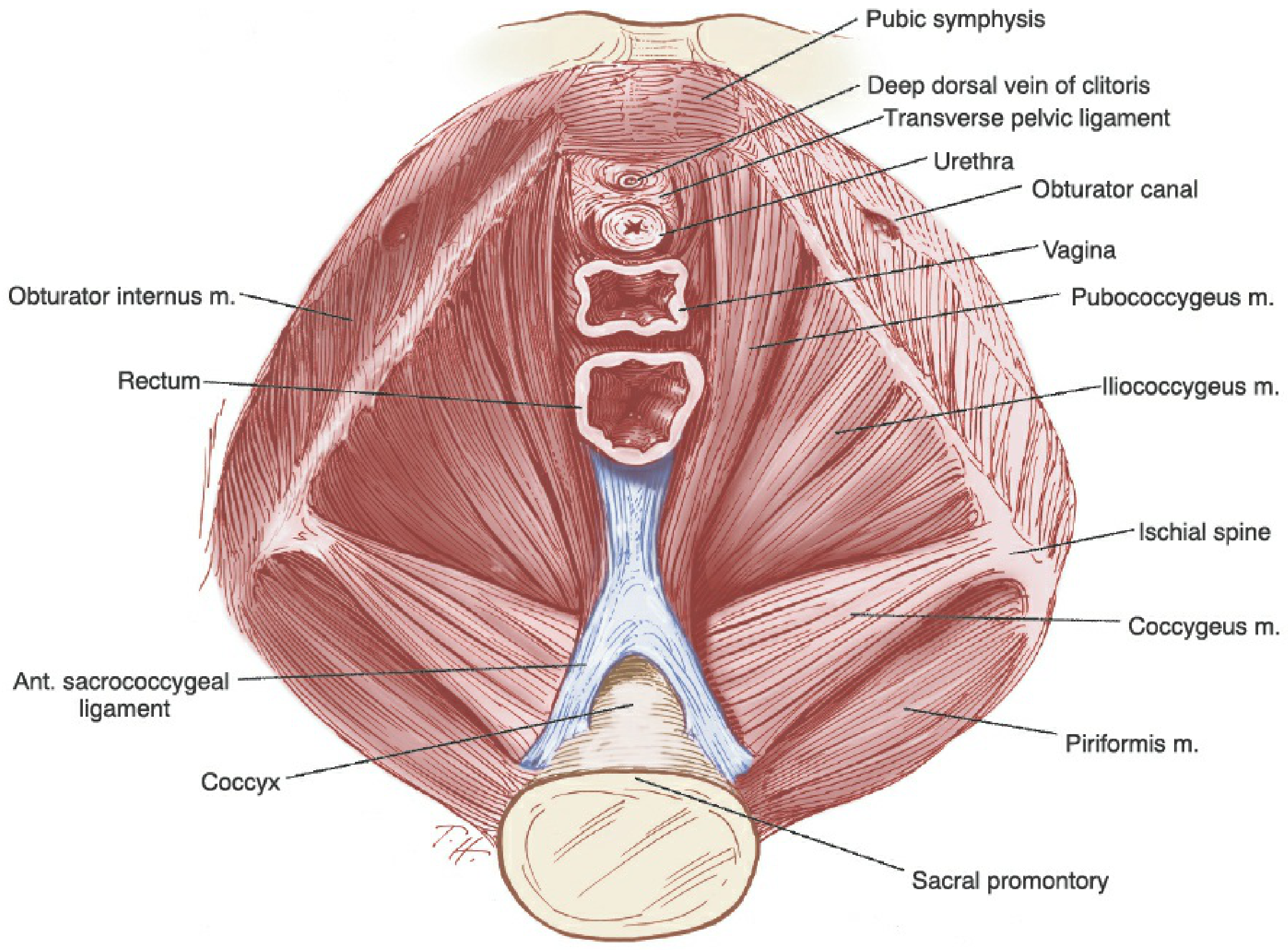
Superior View of the Pelvic Diaphragm (Female)
This illustration from Berek & Novak's Gynecology shows the full pelvic floor from above, with the levator ani components (pubococcygeus and iliococcygeus) clearly visible alongside the coccygeus and surrounding structures:
Functional Role
- The pelvic diaphragm supports the pelvic viscera (bladder, uterus/prostate, rectum) against intra-abdominal pressure
- The puborectalis sling creates the anorectal angle (~90°), acting as a "pinch valve" for continence; it relaxes to ~130-140° during defecation
- The levator ani also acts as a vaginal sphincter in females
- Forms the ceiling of the ischioanal (ischiorectal) fossa
Summary Table
| Feature | Levator Ani | Pelvic Diaphragm |
|---|---|---|
| What it is | A group of 3 muscles | The entire musculofascial pelvic floor |
| Components | Pubococcygeus, puborectalis, iliococcygeus | Levator ani + coccygeus + superior & inferior fasciae |
| Posterior completion | Does NOT include coccygeus | DOES include coccygeus |
| Shape | Funnel/bowl | Same funnel structure (it contains the levator ani) |
| Clinical use | Term used for the muscular complex | Term used for the structural/functional floor unit |
Bottom line: Every levator ani is part of the pelvic diaphragm, but the pelvic diaphragm is not just the levator ani - it also includes the coccygeus and the fascial layers covering both muscles.
Sources: Gray's Anatomy for Students; Berek & Novak's Gynecology, p. 154-156; THIEME Atlas of Anatomy - General Anatomy and Musculoskeletal System
This is a shared conversation. Sign in to Orris to start your own chat.