
Hyperhidrosis
I'll start with a quick overview while I search the medical library for detailed information.
Hyperhidrosis is excessive sweating beyond what's needed for thermoregulation. It can be primary (idiopathic, focal - affecting palms, soles, axillae, face) or secondary (generalized, due to an underlying cause like thyroid disease, diabetes, or medications). Treatment ranges from topical antiperspirants to botulinum toxin injections, iontophoresis, and surgery.
Searching sources...
Reading File
Now I'll search the medical library and PubMed in parallel for comprehensive coverage.
Finding Sources
Searching PubMed
hyperhidrosis treatment
Searching Images
hyperhidrosis sweating axillary palmar treatment diagram
Excellent - multiple textbook sections found. Let me read the most comprehensive ones in parallel.
Reading File
Reading File
Reading File
Good data on BTX treatment. Now let me get the full clinical overview including etiology, classification, pathophysiology and management ladder from Andrews' and Fitzpatrick's.
Reading File
Finding Sources
Let me read the full hyperhidrosis section from the Dermatology 5e textbook (most comprehensive) and Andrews' overview section in parallel.
Reading File
Reading File
Let me get the treatment section from Andrews' and the diagnostic criteria table from Dermatology 5e.
Reading File
Reading File
Excellent - I now have comprehensive information. Let me get the surgical/sympathectomy section from Andrews' and fetch the starch-iodine test image.
Reading File
Loading Image
I now have comprehensive information from multiple authoritative sources. Here is the complete clinical overview of Hyperhidrosis:
Hyperhidrosis
Definition
Hyperhidrosis is excessive sweating beyond what is required for thermoregulation. It affects approximately 3% of the US population and can significantly impair quality of life. - Dermatology 2-Volume Set 5e
Classification
The most widely used system divides hyperhidrosis into primary (idiopathic) and secondary types. Another classification is based on the neural source driving sweating:
| Neural Source | Type | Trigger |
|---|---|---|
| Cortical | Emotional | Stress, anxiety |
| Hypothalamic | Thermoregulatory | Heat, exercise |
| Medullary | Gustatory | Spicy food, hot liquids |
| Spinal cord | Spinal | Cord injuries/tumors |
| Local axon reflex | Local | Localized lesions |
Primary (Focal) Hyperhidrosis
Definition: Excessive sweating in localized areas (palms, soles, axillae, or face) not associated with any systemic disorder.
Key Features
- Equally affects men and women of all races
- 60-80% have a positive family history - autosomal dominant with incomplete penetrance; locus mapped to chromosome 14q
- Onset: volar (palmoplantar) type often in childhood; axillary type at or after puberty
- Occurs in cold and warm environments; stops during sleep (diurnal only - cortically driven)
- Chronic, unremitting course
Diagnostic Criteria for Primary Hyperhidrosis
(Hornberger et al., JAAD 2004)
- Focal, visible excess sweating
- Present for at least 6 months
- No apparent secondary causes
- At least 2 of the following:
- Bilateral and symmetric
- Impairs activities of daily life
- At least one episode per week
- Age of onset <25 years
- Positive family history
- Stops during sleep
Sites
- Volar (palmoplantar): Most common - ~50-60% of primary cases. Affects entire palm, sole, lateral aspects and tips of digits. Associated with pitted keratolysis of soles and foul odor.
- Axillary: 30-50% of cases. Right axilla typically produces more sweat than left (60:40). Odor (bromhidrosis) is usually absent as excessive eccrine sweat dilutes odorogenic apocrine secretions.
- Facial: Forehead, cutaneous upper lip; often triggered by emotion.
Secondary Hyperhidrosis
Caused by an underlying condition. May be localized or generalized.
Causes of Generalized Secondary Hyperhidrosis
- Endocrine: Hyperthyroidism, acromegaly, diabetes mellitus, pheochromocytoma, hypoglycemia, carcinoid syndrome, menopause, pregnancy
- Infections: Febrile illnesses
- Neurological: Parkinson disease, concussion, spinal cord transection, autonomic neuropathies
- Malignancy: Lymphoma, metastatic tumors
- Drugs: SSRIs, tricyclic antidepressants, anticholinesterases (e.g., anti-Alzheimer drugs), opioids, bladder stimulants
Special Forms
- Gustatory hyperhidrosis (Frey syndrome): Sweating of forehead, scalp, upper lip after eating; may be idiopathic or due to parotid surgery, Pancoast tumor, diabetic neuropathy. Occurs in >1/3 of patients after parotid surgery.
- Localized: Over glomus tumors, blue rubber bleb nevus syndrome, POEMS syndrome, complex regional pain syndrome
Investigation
Minor's Starch-Iodine Test - the standard method to map extent and severity of sweating prior to treatment:
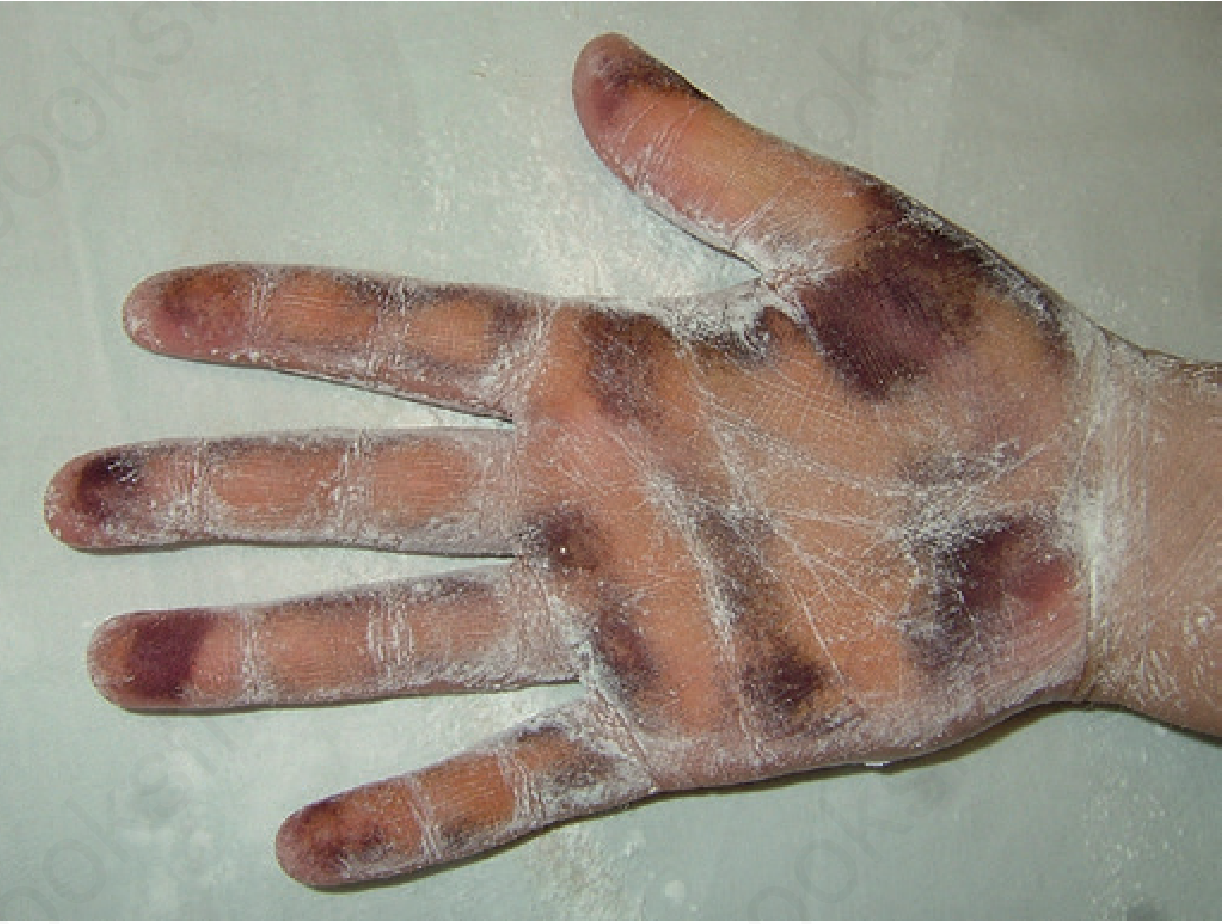
Starch-iodine test showing focal sweating areas on the palm - dark purple areas indicate active eccrine gland locations. - Andrews' Diseases of the Skin
Treatment (Step-Ladder Approach)
1. Topical Antiperspirants (First Line)
Aluminum chloride (AlCl₃) or aluminum chlorohydroxide:
- Axillae: 10-35% solution applied nightly to a very dry axilla (blow-dried), washed off in 6-8 hours; occlusion generally not required
- Palms: up to 50% concentration, with or without occlusion under plastic gloves
- Once effective, frequency can be reduced to once or twice weekly for maintenance
- Lower concentrations tried first to limit irritation
Topical glycopyrronium bromide (newer agent): A 2024 meta-analysis (PMID: 39424822) confirmed its efficacy and safety for axillary hyperhidrosis.
Sofpironium (retrometabolic anticholinergic): A 2025 systematic review (PMID: 39668771) supports its use in primary hyperhidrosis.
2. Iontophoresis
- Tap water iontophoresis (Drionic or Fischer unit)
- 20-30 minute daily or twice-daily sessions initially; maintenance intervals can extend to every 2 weeks
- Adding glycopyrrolate 0.01%, botulinum toxin, or aluminum chloride 2% to the medium may accelerate response
- Particularly useful for palmar and plantar hyperhidrosis
3. Systemic Anticholinergics
- Glycopyrrolate, oxybutynin (extended-release), propantheline bromide
- Dose titrated by patient's tolerance vs. response
- Side effects (dry mouth, urinary retention, blurred vision, constipation) often limit use; may aggravate glaucoma
- Effects last 4-6 hours; many patients reserve for social occasions rather than continuous use
Other agents: Diltiazem and clonidine have also shown some benefit.
4. Botulinum Toxin A (BTX-A) Injections
FDA-approved for axillary hyperhidrosis (US 2004; Canada 2001). Level A recommendation.
| Site | Dose | Technique | Onset | Duration |
|---|---|---|---|---|
| Axillae | 50-100 U/axilla (up to 200 U Dysport) | Intradermal, 1-2 cm grid, no anesthesia needed | 72 hrs - 1 week | 6-12 months (up to 29 months with high doses) |
| Palms | 100-150 U/palm (~50-60 injections) | Requires wrist nerve blocks (median, ulnar, radial) with 1-2% lidocaine | 5-7 days | 3-4 months |
| Soles | Similar to palms | Regional anesthesia required | Similar | Similar |
- All formulations (onaA, aboA, incoA) show similar safety and efficacy; rimaB is effective but causes more pain and systemic adverse events (xerostomia, flu-like symptoms)
- Transient hand weakness (loss of fine motor/pinch strength) is expected for several weeks post-palm injection
- Compensatory hyperhidrosis is not a clinically significant concern (unlike sympathectomy)
- Repeated treatments do not lose efficacy and may increase duration of benefit
5. Energy-Based Devices
- Microwave thermolysis (miraDry): Selective heating destroys eccrine and apocrine glands in the dermis/subdermis. High patient satisfaction; side effects include transient edema, erythema, pain, and longer-term fibrous bands or muscle weakness
- Radiofrequency via microneedles and laser treatment: Appear effective; require more evidence
6. Surgical Options
Axillary hyperhidrosis:
- Excision of the most active sweating area + undercutting and subcutaneous resection of sweat glands (1-2 cm each side) - virtually always effective
- Liposuction or surgical ultrasonic aspiration of the glands
- In a comparative trial, BTX-A was superior to suction-curettage surgery
Upper Thoracic Sympathectomy (for palmar - last resort):
- Endoscopic clipping or electrocautery at T3-T5 levels
- Complications (<2% acute): chronic pain, pneumothorax, hemothorax, bleeding, Horner syndrome
- Compensatory hyperhidrosis occurs in up to 1 in 3 patients and can be as debilitating as the original condition - this is the major deterrent
- Gustatory hyperhidrosis is also a known post-operative sequela
Complications & Comorbidities
- Pitted keratolysis of hyperhidrotic soles (bacterial maceration)
- Tinea pedis / intertrigo: Moisture promotes fungal and bacterial infections
- Contact dermatitis: From topical agents
- Psychological impact: Significant social anxiety, occupational impairment, and quality of life reduction
- Hailey-Hailey disease: Sweating exacerbates this genodermatosis; BTX-A into lesional skin (100 U, 2 U/cm²) can produce clinical improvement
Key Points Summary
| Feature | Primary | Secondary |
|---|---|---|
| Distribution | Focal (palms, soles, axillae) | Localized or generalized |
| Timing | Diurnal (stops at night) | May occur at night |
| Family history | 60-80% | Not typical |
| Cause | Idiopathic (cortical) | Systemic disease/drug |
| First-line Rx | Topical AlCl₃ | Treat underlying cause |
Sources: Andrews' Diseases of the Skin, p. 892-893 | Dermatology 2-Volume Set 5e, p. 777-778 | Fitzpatrick's Dermatology Vol. 1-2, p. 3957 | Recent systematic reviews: PMID 39424822, PMID 39668771
This is a shared conversation. Sign in to Orris to start your own chat.