
Clinical findings in downsyndrome
Reading File
Down syndrome (trisomy 21) features a constellation of dysmorphic features, intellectual disability, and systemic complications. Let me pull comprehensive details from the medical library.
Searching sources...
Finding Sources
Finding Sources
Now let me read the most detailed sections - Robbins Pathology and Thompson & Thompson Genetics, which will have the best clinical descriptions.
Reading File
Reading File
Excellent detail from both sources. Let me also grab the Goldman-Cecil Medicine entry and look for any available clinical images.
Reading File
Finding Sources
I found clinical images in Robbins. Let me read that section and grab the images.
Reading File
Reading File
I have the image URLs. Let me fetch them for display alongside the detailed clinical content I've gathered.
Loading Image
Loading Image
I now have all the information needed for a comprehensive, well-illustrated answer. Here it is:
Clinical Findings in Down Syndrome (Trisomy 21)
Incidence: ~1 in 700 live births | Karyotype: 47,XX/XY,+21 (trisomy); also translocation and mosaic forms
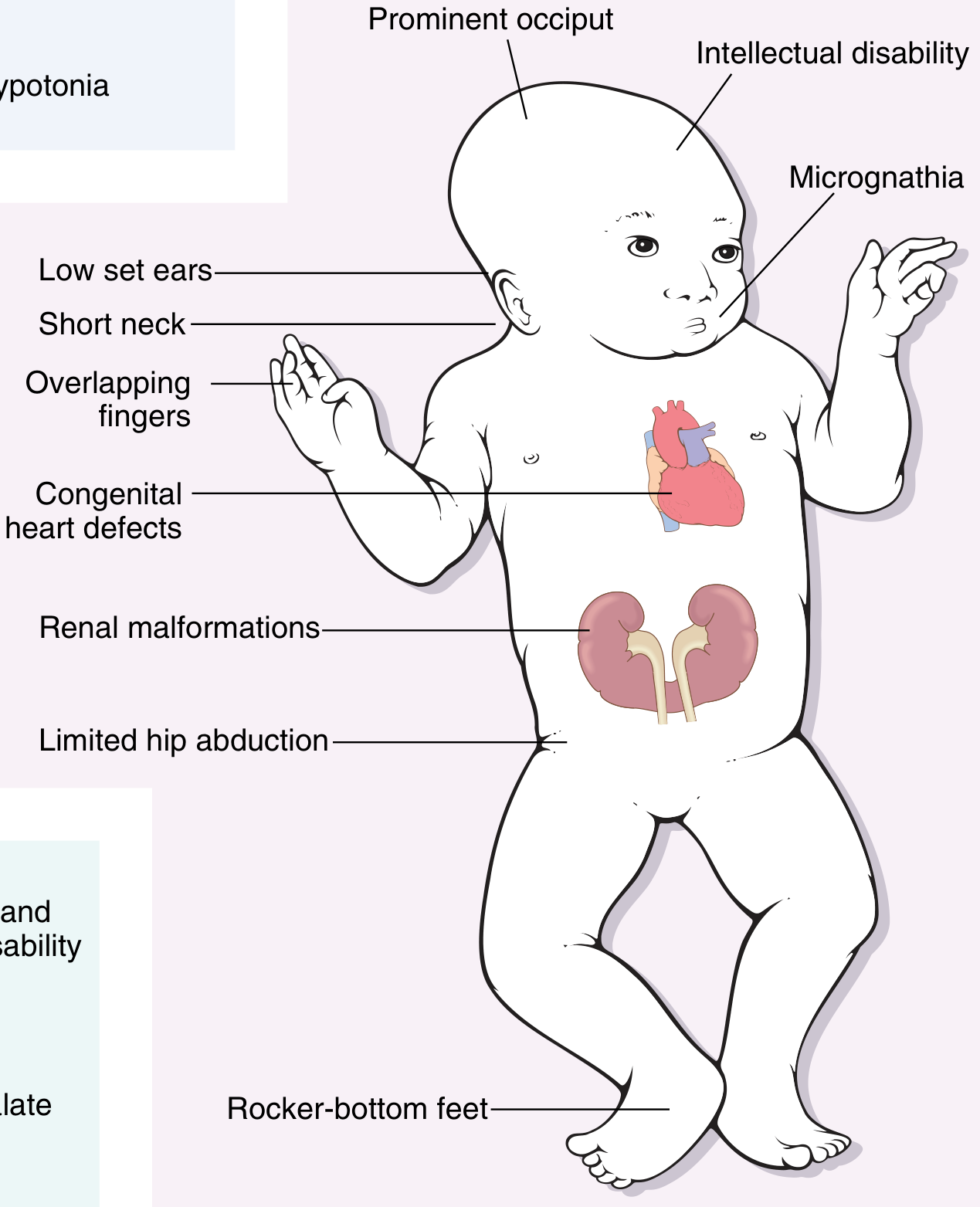
1. Dysmorphic Facial Features
The classic facial features are usually recognizable at birth:
| Feature | Description |
|---|---|
| Flat facial profile | Depressed nasal bridge with flat midface |
| Oblique palpebral fissures | Upward-slanting eye openings |
| Epicanthic folds | Skin fold over the inner corner of each eye |
| Brushfield spots | Speckled iris (white/grey spots) |
| Brachycephaly | Flat occiput, round head |
| Low-set ears | Small, dysplastic pinnae |
| Macroglossia | Large tongue, often protruding |
| Short neck | With loose skin on the nape |
2. Musculoskeletal / Body
- Hypotonia - often the first abnormality noticed in the newborn; generalized muscle floppiness
- Short stature - slow growth throughout childhood
- Short, broad hands with a single transverse palmar crease (simian crease)
- Fifth finger clinodactyly - incurved 5th digit
- Sandal gap - wide space between 1st and 2nd toes
- Limited hip abduction
- Atlanto-axial instability (cervical C1-C2 laxity) - risk of spinal cord compression
3. Neurological / Intellectual
- Intellectual disability - the leading single genetic cause; ranges from moderate to mild. May not be obvious in early infancy but becomes apparent by end of first year.
- Hypotonia contributes to motor delay
- Alzheimer disease - virtually all patients with trisomy 21 older than age 40 develop neuropathologic changes of Alzheimer disease; amyloid-beta precursor gene on chromosome 21 is implicated
- Behavioral phenotype: typically placid, cheerful, and cooperative in childhood; may become more behaviorally complex in adolescence
4. Cardiovascular (Most Common Cause of Early Death)
Congenital heart disease occurs in ~40-50% of patients. Distribution:
| Defect | Frequency |
|---|---|
| Atrioventricular septal defect (AVSD) | 43% |
| Ventricular septal defect (VSD) | 32% |
| Atrial septal defect (ASD) | 19% |
| Tetralogy of Fallot | 6% |
Cardiac complications are responsible for most deaths in infancy and early childhood.
5. Gastrointestinal
- Duodenal atresia ("double bubble" sign on X-ray) - much more common than in other disorders
- Tracheo-esophageal fistula / esophageal atresia
- Hirschsprung disease (intestinal aganglionosis)
- Intestinal stenosis
6. Hematological / Oncologic
- 20-fold increased risk of precursor B-cell acute lymphoblastic leukemia (ALL)
- 500-fold increased risk of acute myeloid leukemia (AML)
- Transient myeloproliferative disorder (TMD): up to 10% of Down syndrome newborns develop peripheral leukocytosis with blasts and megakaryoblasts - usually resolves spontaneously but progresses to acute megakaryoblastic leukemia in 23-30% of cases. Caused by somatic mutations in the GATA1 gene acquired during fetal life.
7. Immunological
- Abnormal immune responses, predominantly affecting T-cell function
- Predisposition to serious infections, especially pulmonary infections
- Thyroid autoimmunity - Hashimoto thyroiditis
- Hypothyroidism develops in up to 50% of patients older than 40 years
8. Ophthalmologic
- Cataracts (congenital or early-onset)
- Refractive errors (myopia common)
- Strabismus
- Nystagmus
9. ENT / Respiratory
- Obstructive sleep apnea (OSA) - high prevalence due to midface hypoplasia, macroglossia, and hypotonia
- Hearing loss (both conductive and sensorineural)
- Recurrent otitis media
10. Urological
- Cryptorchidism
- Hypospadias
- Renal malformations
Summary Table of Key Features
| System | Key Finding |
|---|---|
| Face | Flat profile, epicanthic folds, oblique palpebral fissures |
| Neurology | Intellectual disability (moderate-mild), Alzheimer after age 40 |
| Muscle | Hypotonia (first sign at birth) |
| Hands | Single palmar crease, clinodactyly, short broad hands |
| Heart | AV septal defect (most common CHD), VSD, ASD |
| GI | Duodenal atresia, Hirschsprung disease |
| Blood | 500x risk AML, 20x risk ALL; transient myeloproliferative disorder |
| Immune | Recurrent infections, thyroid autoimmunity, hypothyroidism |
| Eyes | Cataracts, Brushfield spots |
| Ear/Airway | OSA, hearing loss |
Karyotypic Variants and Their Clinical Significance
| Type | Karyotype | Notes |
|---|---|---|
| Standard trisomy 21 | 47,XX,+21 | ~95% of cases; maternal nondisjunction; risk increases with maternal age |
| Robertsonian translocation | 46,XX,der(14;21)(q10;q10),+21 | ~4% of cases; can be familial; maternal age irrelevant |
| Mosaic | 46,XX/47,XX,+21 | ~1% of cases; milder phenotype; may have near-normal intelligence |
Prognosis: Improved medical care has extended median survival to 47-60 years (up from 25 years in 1983), though Alzheimer disease and recurrent infections remain major long-term concerns.
Sources: Robbins, Cotran & Kumar Pathologic Basis of Disease; Robbins & Kumar Basic Pathology; Thompson & Thompson Genetics and Genomics in Medicine, 9th ed.; Goldman-Cecil Medicine
This is a shared conversation. Sign in to Orris to start your own chat.