
treatment for raw opoid overdose
Naloxone (Narcan) is the primary treatment - it's an opioid antagonist that rapidly reverses respiratory depression. Give it IM, IN, or IV. Repeat every 2-3 minutes if no response. Supportive care (airway, breathing, positioning) is equally critical while waiting for naloxone to work.
Searching sources...
Reading File
Searching the Web
opioid overdose treatment naloxone guidelines 2025
Finding Sources
Searching PubMed
"opioid overdose" AND "naloxone" AND treatment
Reading File
Reading File
Reading File
Loading Image
Treatment of Opioid Overdose
Recognition - The Classic Triad
Opioid overdose presents with three hallmark signs:
- Unconsciousness / severely reduced consciousness
- Respiratory rate < 12 breaths/min (the most dangerous feature)
- Pinpoint (miotic) pupils
Other signs: cyanosis, cold clammy skin, hypotension.
Immediate Management
Step 1 - Call Emergency Services
Call emergency services (911 / 999) immediately.
Step 2 - Airway and Breathing
- Position the patient (recovery position if breathing, supine if not)
- Open airway, provide basic life support: 30 chest compressions + 2 rescue breaths
- Supplemental oxygen via bag-valve mask if available
- Endotracheal intubation if the patient cannot protect their airway
Step 3 - Administer Naloxone
Naloxone is an opioid receptor antagonist - it rapidly reverses respiratory depression, sedation, and miosis.
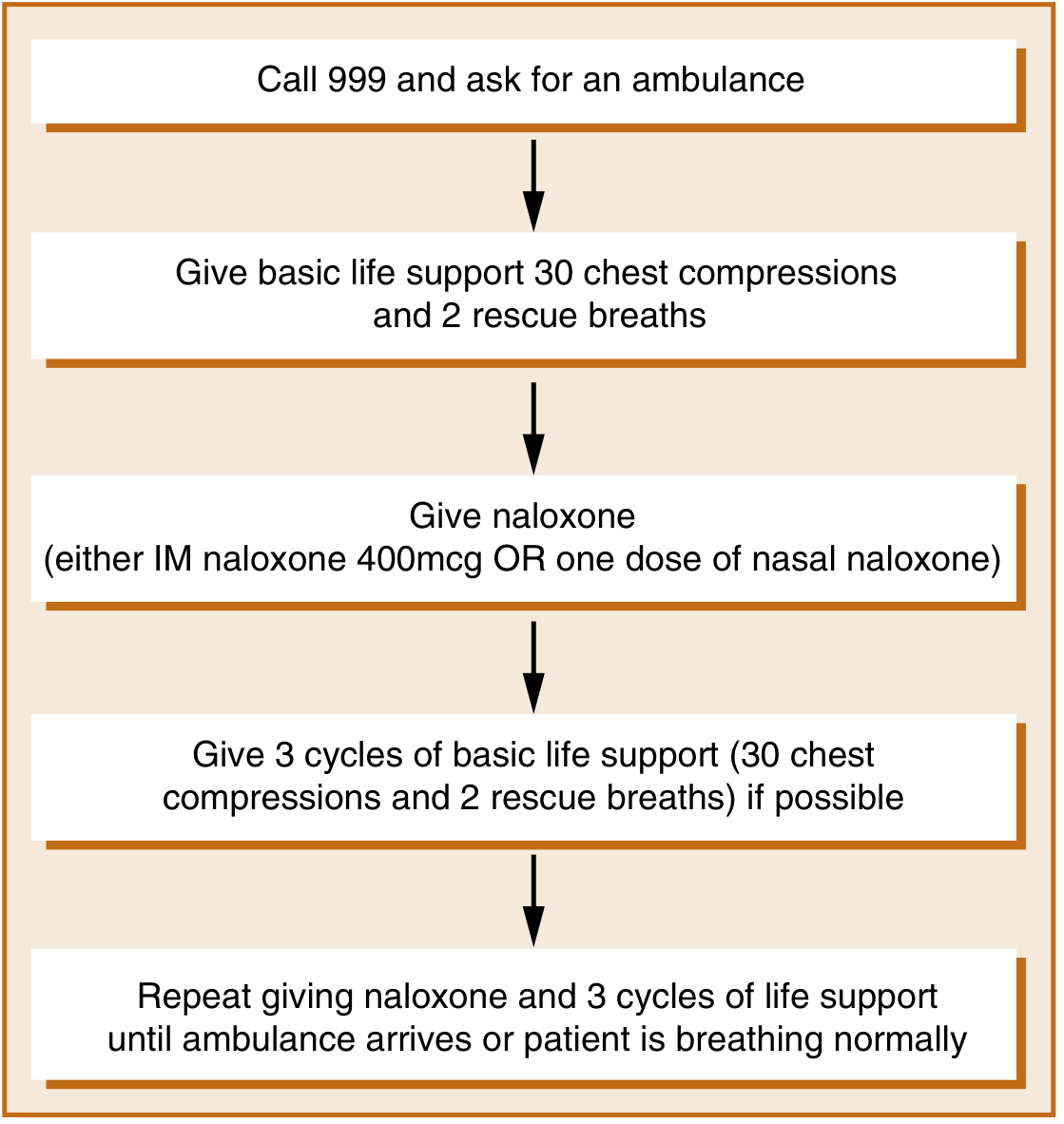
Naloxone Dosing
| Route | Dose | Notes |
|---|---|---|
| IV (preferred) | 0.2-0.4 mg | Fastest onset; titrate to restore breathing |
| IM | 400 mcg | Pre-loaded syringes; equally effective to IN |
| Intranasal (IN) | 2 mg (spray) | 2 mg/mL IN equivalent to 2 mg IM; slower onset, no needle stick risk |
| SC | 400 mcg | Use if IV/IM access is difficult |
| Apnea / arrest | 1-2 mg | Higher initial dose needed |
Repeat dosing: If no response in 2-3 minutes, repeat at 2-3 minute intervals. Signs of response = increased respiratory rate and pupil dilation.
No response after 10 mg total - reconsider the diagnosis; consider co-ingestion of alcohol, benzodiazepines, or other sedatives.
Special Considerations
Fentanyl, Buprenorphine, and Nitazenes
These have high receptor affinity and may require multiple repeated naloxone boluses. Fentanyl overdose in particular may require higher doses administered sooner compared to heroin overdose. - Miller's Anesthesia, 10e
Naloxone Half-life Problem
Naloxone has a short half-life of 60-90 minutes. If the causative opioid has a longer half-life (e.g., extended-release oxycodone, methadone), the patient can relapse into coma after naloxone wears off. In these cases: give continuous IV infusion and observe for at least 6 hours after the last naloxone dose.
Precipitated Withdrawal
Rapid, high-dose naloxone can precipitate acute opioid withdrawal - agitation, vomiting, tachycardia. The goal is NOT full alertness, but adequate ventilation:
- Target respiratory rate > 10 breaths/min
- Target SpO2 > 92%
Titrate gradually to minimize withdrawal risk.
Acute Lung Injury
Rapid reversal in patients with marked hypoventilation can rarely cause acute pulmonary edema with hypoxia, rales, and frothy secretions.
The Primary Goal
Restore adequate ventilation (RR >10/min) and oxygenation (SpO2 >92%) - NOT necessarily full alertness. - Kaplan & Sadock's Comprehensive Textbook of Psychiatry
After Stabilization
- Observe for at least 6 hours post-last naloxone dose
- Patients on long-term opioids should be prescribed take-home naloxone on discharge
- Warn about loss of tolerance after a period of abstinence
- Consider referral to opioid use disorder (OUD) treatment - MOUD (methadone/buprenorphine) significantly reduces future overdose risk
- Co-prescribe naloxone for patients on chronic opioids ≥50 MME/day or with concurrent benzodiazepine use (CDC guideline)
Sources: Maudsley Prescribing Guidelines in Psychiatry 15e (p. 523) | Kaplan & Sadock's Comprehensive Textbook of Psychiatry (p. 4270) | Miller's Anesthesia 10e (p. 2884)
This is a shared conversation. Sign in to Orris to start your own chat.