
Deglutition reflex
Reading File
Now let me search the medical library for deglutition reflex content in parallel.
Finding Sources
Finding Sources
Good. The Guyton & Hall physiology entry is the most comprehensive. Let me also search for more specific headings and read the main content simultaneously.
Finding Sources
Reading File
Good content. Let me read the continuation (esophageal stage, deglutition center, peristalsis, etc.) and fetch the diagram image in parallel.
Reading File
Loading Image
I need to read the middle section I missed (esophageal stage, deglutition center content).
Reading File
I have all the key content needed. Let me now compile a complete, well-structured answer.
Deglutition Reflex (Swallowing)
Swallowing (deglutition) is a complex coordinated act that propels a food bolus from the mouth to the stomach. It involves both voluntary and involuntary components, and requires precise neuromuscular coordination to protect the airway.
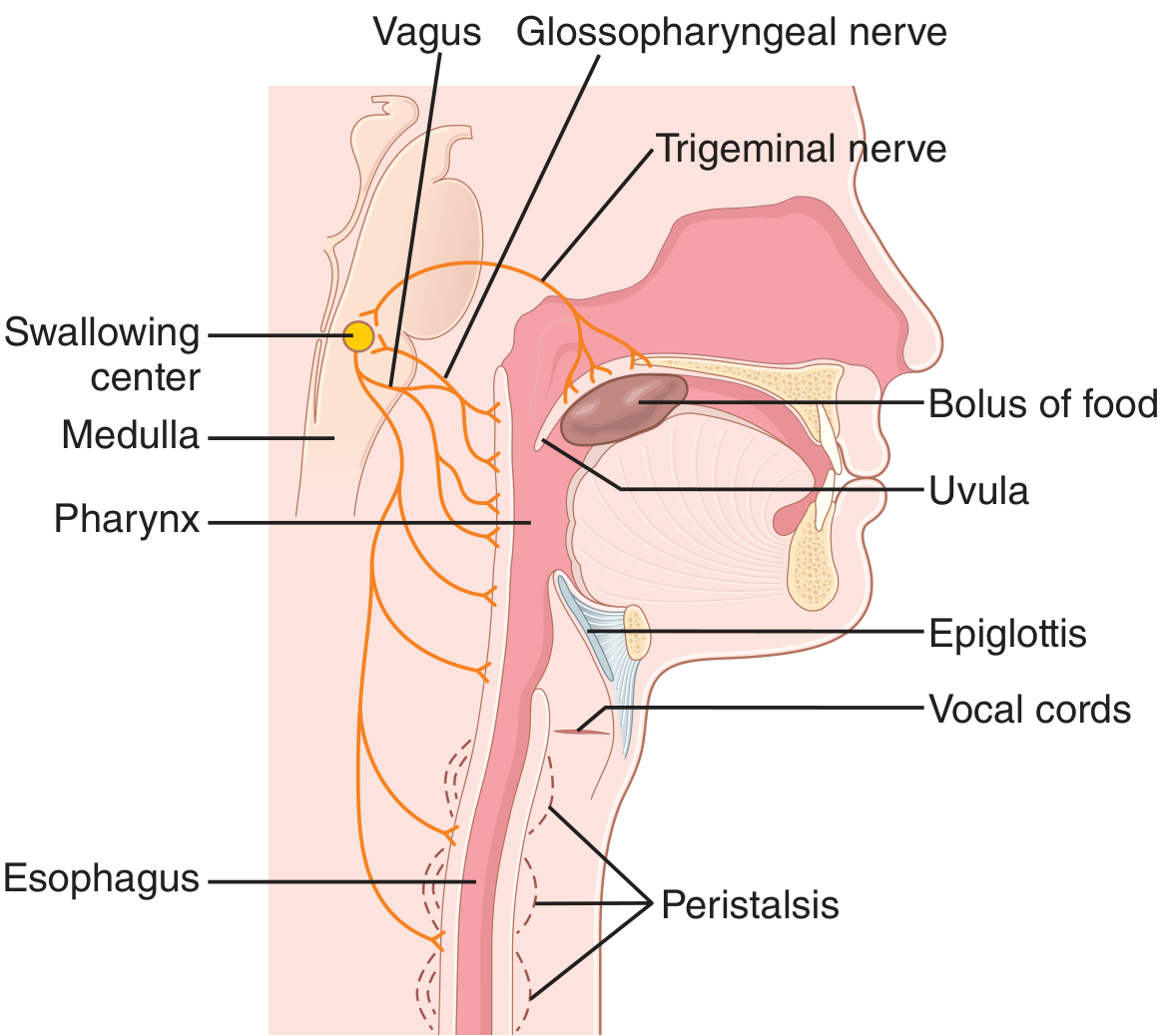
Stages of Swallowing
1. Voluntary (Oral) Stage
- Food is chewed and formed into a bolus on the tongue.
- The tongue presses upward and backward against the hard palate, squeezing the bolus into the pharynx.
- Once the bolus enters the posterior mouth and pharynx, swallowing becomes entirely automatic and cannot normally be stopped.
2. Pharyngeal Stage (Involuntary)
This is the reflex stage proper. The bolus stimulates swallowing receptor areas (epithelial mechanoreceptors) located in a ring around the pharyngeal opening, with the greatest sensitivity on the tonsillar pillars. The following events occur in rapid, automatic sequence (completed in less than 2 seconds):
| Step | Event | Purpose |
|---|---|---|
| 1 | Soft palate pulled upward | Closes posterior nares - prevents nasal regurgitation |
| 2 | Palatopharyngeal folds pulled medially | Form a sagittal slit - prevents incompletely masticated food from passing |
| 3 | Vocal cords strongly approximated; larynx pulled upward and anteriorly | Epiglottis swings backward over laryngeal opening - protects airway |
| 4 | Upper esophageal sphincter (pharyngoesophageal sphincter) relaxes | Opens esophageal entrance |
| 5 | Pharyngeal wall contracts in a peristaltic wave (superior → inferior) | Propels bolus into upper esophagus |
Key protective note: The tight approximation of the vocal cords is the most essential airway protection mechanism. The epiglottis provides a secondary guard. Destruction of the muscles approximating the vocal cords greatly increases aspiration risk.
Inhibition of Respiration
The pharyngeal stage temporarily interrupts respiration - typically for less than 6 seconds. The swallowing center actively inhibits the respiratory center of the medulla during this time.
3. Esophageal Stage (Involuntary)
The esophagus conducts food from the pharynx to the stomach via two types of peristalsis:
- Primary peristalsis: A direct continuation of the pharyngeal peristaltic wave. Travels the length of the esophagus in 8-10 seconds.
- Secondary peristalsis: Initiated by distension of the esophagus by any retained food. Continues until all food is cleared into the stomach - controlled by the intrinsic myenteric nervous system and partly by extrinsic reflexes via the vagus.
The lower esophageal sphincter (gastroesophageal sphincter) relaxes ahead of the peristaltic wave and remains relaxed until the peristaltic wave has driven food into the stomach, after which it closes tightly to prevent reflux.
Neural Control - The Deglutition (Swallowing) Center
| Component | Detail |
|---|---|
| Afferent (sensory) pathway | Trigeminal (CN V) and glossopharyngeal (CN IX) nerves carry impulses from pharyngeal receptors to the tractus solitarius in the medulla |
| Swallowing center | Located in the reticular substance of the medulla and lower pons - coordinates the entire automatic sequence |
| Efferent (motor) pathway | CN V (trigeminal), CN IX (glossopharyngeal), CN X (vagus), CN XII (hypoglossal), and some superior cervical nerves |
The sequence and timing of the swallowing reflex is stereotyped - it remains constant from one swallow to the next.
Summary Flow
Voluntary tongue movement → Bolus enters posterior pharynx
        ↓
Stimulation of tonsillar pillar receptors
        ↓
Afferents via CN V & IX → Tractus solitarius → Swallowing center (medulla/pons)
        ↓
Efferents via CN V, IX, X, XII
        ↓
Soft palate up | Larynx up + epiglottis folds | UES relaxes | Pharyngeal peristalsis
        ↓
Bolus enters esophagus → Primary/Secondary peristalsis → LES relaxes → Stomach
Clinical Relevance
- Dysphagia can arise at any stage - oral, pharyngeal (most dangerous due to aspiration risk), or esophageal.
- Damage to CN IX, X, or XII (e.g., stroke, bulbar palsy) disrupts the reflex arc.
- A depressed or absent gag reflex correlates with pharyngeal stage dysfunction.
- Aspiration pneumonia results from failure of the laryngeal/epiglottic protective mechanisms.
- Achalasia is failure of the LES to relax (esophageal stage dysfunction).
Source: Guyton and Hall Textbook of Medical Physiology, p. 788-789
This is a shared conversation. Sign in to Orris to start your own chat.