
Help me to write 5 mark answer on topic rain water harvesting community medicine from book k park mbbs 3 rd year Arrange the answer properly Highlight words or sentence Add flow chart where needed And answer should me impressive to the examiner who is my hod of community who will cheak my answer sheet as I have to write it in my university exams to score full marks
RAINWATER HARVESTING
Definition
Need / Background (Why It Is Important)
| Factor | Impact |
|---|---|
| Declining rainfall trend | Reduced natural recharge of groundwater |
| Rapid urbanization & industrialization | Increased water demand |
| Over-extraction of groundwater | Water table falling alarmingly in cities |
| Agriculture dependent on tube wells | Further depletes sub-soil water |
"The rate of water extraction is exceeding the replenishment that takes place by natural processes - mainly recharge due to rainfall." - Park
Process of Rainwater Harvesting (Step-by-Step)
RAINFALL
    |
    v
ROOFTOPS / COURTYARDS
    |
    v
PVC PIPES (divert water)
    |
    v
SOAKING PIT / FILTER PIT
(Filled in layers: Big Stones → Gravel → Sand)
    |
    v
FILTERED RAINWATER
    |
    +---> Recharged into TUBE WELL / OPEN WELL
                    |
                    v
          UNDERGROUND WATER RESERVES (Replenished)
Technical Construction of the Filter Pit
- Bottom layer - Big stones (coarse filtration)
- Middle layer - Gravel (intermediate filtration)
- Top layer - Sand (fine filtration)
Diagram from K. Park (Fig. 11)
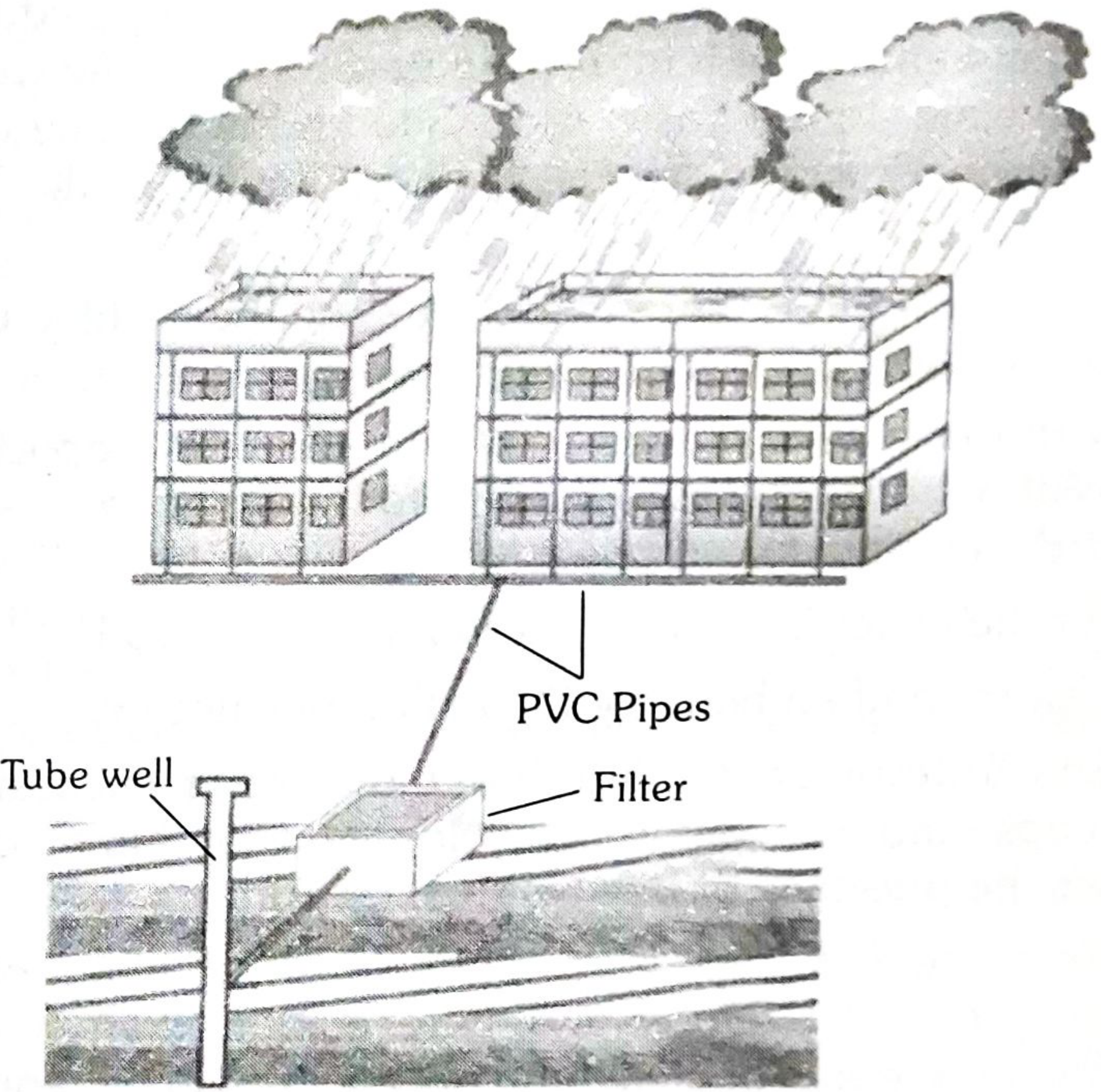
Methods of Rainwater Harvesting
- Rooftop rainwater collection - Most common and practical method; pipes divert water from roof to pits/wells
- Courtyard/surface runoff collection - Runoff from open areas diverted into soaking pits or trenches
- Diversion into existing wells - Filtered rainwater recharges open wells or tube wells directly
- Soaking pits / Recharge trenches - Dug at strategic points; allow slow percolation into aquifers
Agencies Involved
- Central Ground Water Board (CGWB) - Designs economic models for harvesting structures
- UNICEF - Technical guidance and support
- Swajaldhara Programme - Integrates rainwater harvesting with groundwater recharge for sustained drinking water supply at community level
Community Medicine Significance
| Benefit | Explanation |
|---|---|
| Prevents water scarcity | Recharges depleting groundwater in urban/semi-urban areas |
| Prevents waterborne diseases | Ensures sustained, safe water supply |
| Low-cost intervention | Simple innovative technique, economically viable |
| Reduces burden on public supply | Lessens pressure on piped water & rivers |
| Sustainable development | Aligns with WHO goal of safe water for all |
| Urban health protection | Protects communities from summer water shortages |
Water Conservation Measures (K. Park - Two Key Methods)
Key Points to Remember (Examiner-Ready Summary)
- Rainwater harvesting = conservation + recharge of groundwater
- Particularly important in urban and semi-urban areas with heavy tube well use
- Water diverted from rooftops and courtyards - NOT sent to drains
- Filter pit uses 3 layers: Big stones, Gravel, Sand
- Water reaches well via PVC pipe from bottom of pit
- Supported by CGWB, UNICEF, Swajaldhara
- Part of Water Conservation under Environmental Health in Community Medicine
Reference: Park's Textbook of Preventive and Social Medicine, Chapter on Water Conservation (Fig. 11 - Water Harvesting a Tube Well)
Help me to write 5 mark answer on topicbelow poverty line community medicine from book k park mbbs 3 rd year Arrange the answer properly Highlight words or sentence Add flow chart where needed give the answer from k park 28 edition And answer should me impressive to the examiner who is my hod of community who will cheak my answer sheet as I have to write it in my university exams to score full marks
BELOW POVERTY LINE (BPL)
Definition of Poverty Line
"The 'poverty line' is defined as the expenditure required for a daily calorie intake of 2,400 kcal per person in rural areas and 2,100 kcal per person in urban areas."
- Park's Textbook of Preventive and Social Medicine
- Rs. 328 per month - for rural areas
- Rs. 454 per month - for urban areas
Definition of Below Poverty Line (BPL)
Scale of the Problem
| Parameter | Figure |
|---|---|
| World population below $1/day (2005) | ~19% of world population |
| India's BPL population (2011-12 estimate) | ~22% (~270 million) |
| Rural poverty line (2000) | Rs. 328/month |
| Urban poverty line (2000) | Rs. 454/month |
| Calorie threshold (Rural) | 2,400 kcal/person/day |
| Calorie threshold (Urban) | 2,100 kcal/person/day |
Health Consequences of Poverty (Cycle of Poverty)
POVERTY
    |
    +---> Lack of vaccination / immunization
    |
    +---> No access to clean water & sanitation
    |
    +---> No curative drugs / health care
    |
    +---> Malnutrition & low birth weight
    |
    +---> Higher maternal mortality
    |
    +---> Low life expectancy
    |
    +---> Handicap, disability, mental illness
    |
    +---> Stress, suicide, family disintegration
    |
    +---> Substance abuse
    |
    v
WORSENING POVERTY (Vicious cycle)
"Poverty wields its destructive influence at every stage of human life - from the moment of conception to the grave." - Park
Why the Poor Have Worse Health
- Malnutrition - Poor diet and insufficient calories reduce immunity and slow recovery from illness
- Occupational hazards - Poor forced into occupations that harm their health
- Lack of healthcare access - Cannot afford curative or preventive services
- Poor living conditions - Unhealthy conditions at home and work increase disease exposure
- Limited education - Cannot access health information or protective behaviours
- When breadwinner falls ill - Others cope by working harder and reducing food consumption, which harms the entire family's health
Standard of Living and BPL
- Level of national income
- Total goods and services produced
- Size of population
- Level of education
- General price level
- Distribution of national income
Global Hunger Index (GHI) - Measuring Poverty Impact
-
PNU = Proportion of Undernourished population
-
CUW = Children Under-5 who are Underweight
-
CM = Child Mortality (under 5) percentage
-
Score of 0 = No hunger (best)
-
Score of 100 = Worst possible
Flow Chart: Poverty - Health Relationship
LOW INCOME / BPL STATUS
        |
        v
INADEQUATE FOOD + POOR NUTRITION
        |
        v
LOW IMMUNITY + STUNTING + WASTING
        |
    +---+---+
    |       |
    v       v
INCREASED   INCREASED
MORBIDITY   MORTALITY
(illness)   (deaths)
    |
    v
LOST PRODUCTIVITY + INCOME
        |
        v
DEEPER POVERTY (Vicious Cycle)
BPL and Government Health Programmes
| Programme | BPL Benefit |
|---|---|
| Janani Suraksha Yojana (JSY) | Cash assistance for institutional delivery to BPL pregnant women |
| Swachh Bharat Mission Gramin | Free household toilets for BPL households |
| National Programme for Control of Blindness | Free corrective spectacles for BPL persons |
| Indira Gandhi National Old Age Pension | Monthly pension for persons >65 yrs living BPL |
| Rashtriya Swasthya Bima Yojana (RSBY) | Health insurance coverage for BPL families |
Strategies to Reduce Poverty (Park's Approach)
- Sound economic policies must go hand-in-hand with addressing social needs of the poor
- Investments to reduce health risks among the poor
- Provision of insurance against catastrophic health care costs
- Reproductive health programmes - reduce burden of unwanted pregnancies and large families
- Gender equality and women's empowerment - key to breaking the poverty cycle
- Access to education - enables people to escape poverty
"Addressing underlying social factors can enable people to escape poverty." - Park
Key Points to Remember (Rapid Recall)
- BPL = caloric threshold: 2400 kcal/day (rural), 2100 kcal/day (urban)
- 22% of India (270 million) below poverty line - 2011-12 estimate
- Poverty affects health "from conception to the grave" (Park)
- Main consequences: no vaccination, no clean water, no drugs, high maternal mortality, low life expectancy
- GHI = (PNU + CUW + CM) / 3 - measures hunger burden
- BPL is the eligibility criterion for multiple national health schemes (JSY, SBM, IGNOAPS)
- Social + economic approaches must work together to break the poverty-disease cycle
Reference: Park's Textbook of Preventive and Social Medicine, 28th Edition - Chapter on Social Sciences and Medicine (Poverty, Standard of Living, Global Hunger Index)
Help me to write 5 mark answer on topic 'below poverty line' community medicine from book k park mbbs 3 rd year Arrange the answer properly Highlight words or sentence Add flow chart where needed give the answer from k park 28 edition And answer should me impressive to the examiner who is my hod of community who will cheak my answer sheet as I have to write it in my university exams to score full marks
BELOW POVERTY LINE (BPL)
(Park's Textbook of Preventive and Social Medicine, 28th Edition)
Definition
"The 'Poverty Line' is defined as the expenditure required for a daily calorie intake of 2,400 kcal per person in rural areas and 2,100 kcal per person in urban areas." (Park, 28th Ed.)
Poverty Line - Fixed Expenditure Threshold
| Area | Daily Calorie Requirement | Monthly Expenditure (Year 2000) |
|---|---|---|
| Rural | 2,400 kcal/person/day | Rs. 328/month |
| Urban | 2,100 kcal/person/day | Rs. 454/month |
Magnitude of the Problem
- As per 2011-12 estimate - ~22% of India's population (270 million people) were living below the poverty line
- In 2005, approximately 19% of the world's population was living below $1 per day income
"Poverty wields its destructive influence at every stage of human life - from the moment of conception to the grave." - Park
FLOWCHART 1 - The Poverty-Disease Vicious Cycle
        POVERTY (Low income / BPL status)
                      |
        +-------------+-------------+
        |             |             |
        v             v             v
  No vaccination  No clean      No drugs /
                  water &       healthcare
                  sanitation
        |             |             |
        +-------------+-------------+
                      |
                      v
         MALNUTRITION + LOW IMMUNITY
                      |
                      v
         INCREASED MORBIDITY & MORTALITY
          (High IMR, MMR, Low Life Expectancy)
                      |
                      v
         LOST PRODUCTIVITY + LOST INCOME
                      |
                      v
              DEEPER POVERTY
              (Vicious Cycle Continues)
Health Consequences of Poverty (Park)
- Babies not vaccinated - no access to immunization services
- Clean water and sanitation not provided - waterborne disease burden
- Curative drugs and treatments unavailable - no healthcare access
- Low birth weight babies - due to maternal malnutrition
- Higher maternal mortality - poor obstetric care
- Low life expectancy - cumulative disease burden
- Handicap and disability - untreated illnesses
- Mental illness, stress, suicide - socioeconomic pressures
- Family disintegration and substance abuse - social breakdown
"The poor die younger and suffer more from disability. They are exposed to greater risk from unhealthy conditions at home and at work." - Park
Why the Poor Have Worse Health - Park's Explanation
- Poor are forced into occupations that harm their health
- Malnutrition and legacy of past illness make them more likely to fall ill and slower to recover
- When a family's breadwinner becomes ill, others cope by working harder and reducing food consumption - this harms the entire family's health
- Lack of education limits access to health information and protective behaviours
FLOWCHART 2 - Determinants of Standard of Living
       STANDARD OF LIVING
               |
    +----------+----------+
    |          |          |
    v          v          v
National   Total goods  Size of
income     & services   population
    |          |          |
    +----------+----------+
    |          |          |
    v          v          v
Level of   General    Distribution
education  price      of national
           level      income
Global Hunger Index (GHI) - Measuring Poverty Impact
| Component | Full Form | Measures |
|---|---|---|
| PNU | Proportion of Undernourished | Population with insufficient calories |
| CUW | Children Under-5 Underweight | Child undernutrition |
| CM | Child Mortality under 5 | Fatal effects of poor nutrition |
- Score 0 = No hunger (best)
- Score 100 = Worst possible
BPL as Criterion for National Health Programmes
| Programme | BPL Benefit |
|---|---|
| Janani Suraksha Yojana (JSY) | Cash assistance for institutional delivery to BPL pregnant women |
| Swachh Bharat Mission Gramin | Free household toilets for BPL families |
| NPCB (Eye Care) | Free corrective spectacles for BPL persons |
| Indira Gandhi National Old Age Pension Scheme | Monthly pension for persons >65 yrs living BPL |
| Leprosy Reconstructive Surgery | Rs. 5,000/- incentive to BPL leprosy patients |
Strategies to Reduce Poverty (Park)
- Sound economic policies must go hand-in-hand with social needs of the poor
- Investments to reduce health risks among the poor
- Insurance against catastrophic health care costs
- Reproductive health programmes - reduce burden of large families and unwanted pregnancies
- Gender equality and women's empowerment - critical for breaking the poverty cycle
- Education and skill development - enables people to escape poverty
"Addressing underlying social factors can enable people to escape poverty. Sound economic policies must go hand-in-hand with addressing the social needs of the poor." - Park
Rapid Recall Box - Key Points
| Point | Fact |
|---|---|
| BPL Definition | Calorie-based expenditure threshold |
| Rural calorie threshold | 2,400 kcal/person/day |
| Urban calorie threshold | 2,100 kcal/person/day |
| Rural poverty line (2000) | Rs. 328/month |
| Urban poverty line (2000) | Rs. 454/month |
| India BPL population (2011-12) | 22% = 270 million |
| World below $1/day (2005) | 19% of world population |
| Park's quote | "Conception to the grave" |
| GHI formula | (PNU + CUW + CM) ÷ 3 |
Reference: Park's Textbook of Preventive and Social Medicine, 28th Edition - Social Sciences and Medicine; Reproductive Health and Poverty Reduction; Global Hunger Index (pp. 797-798)
Help me to write 5 mark answer on topic 'nalgonda technique' community medicine from book k park mbbs 3 rd year Arrange the answer properly Highlight words or sentence Add flow chart where needed give the answer from k park 28 edition And answer should me impressive to the examiner who is my hod of community who will cheak my answer sheet as I have to write it in my university exams to score full marks
NALGONDA TECHNIQUE
Introduction - Why Nalgonda Technique is Needed
"The National Environmental Engineering Research Institute (NEERI), Nagpur developed a technique for removing fluoride by chemical treatment. It is called the Nalgonda Technique for defluoridation of water."
- Park's Textbook of Preventive and Social Medicine, 28th Ed.
What is the Nalgonda Technique?
Endemic Fluorosis - Background (Context for the Technique)
Permissible Fluoride Level in Drinking Water:
| Parameter | Value |
|---|---|
| Permissible limit | 1.0 mg/L |
| Threshold for dental fluorosis | > 1.5 mg/L |
| Threshold for skeletal fluorosis | 3.0 to 6.0 mg/L daily |
| Crippling fluorosis risk | > 10 mg/L |
| Ideal range after defluoridation | 0.5 to 0.8 mg/L |
Endemic Areas in India:
Types of Fluorosis (Why Defluoridation is Critical)
- Occurs when excess fluoride is ingested during first 7 years of life (tooth calcification period)
- "Mottling" of dental enamel - reported at levels above 1.5 mg/L
- Teeth lose shiny appearance → chalk-white patches → turn yellow/brown/black → corroded appearance
- Best seen on upper jaw incisors; confined to permanent teeth
- Associated with lifetime intake of 3.0 to 6.0 mg/L or more
- Heavy fluoride deposition in skeleton
- At > 10 mg/L → crippling fluorosis → permanent disability
- Characterized by genu valgum and osteoporosis of lower limbs
- Reported in Andhra Pradesh and Tamil Nadu
- Associated with sorghum (jowar) as staple diet - promotes higher fluoride retention than rice
FLOWCHART 1 - How Fluorosis Develops
HIGH FLUORIDE IN DRINKING WATER
(> 1.5 mg/L)
          |
          v
   INGESTED FLUORIDE
          |
    +-----+-----+
    |            |
    v            v
During         Throughout
childhood      life
(0-7 yrs)      (>3 mg/L)
    |            |
    v            v
DENTAL        SKELETAL
FLUOROSIS     FLUOROSIS
(Mottling)    (Bone changes)
                 |
                 v
           CRIPPLING (>10 mg/L)
           PERMANENT DISABILITY
Interventions for Fluorosis - Nalgonda Technique in Context
FLOWCHART 2 - The Nalgonda Technique (Step-by-Step)
   FLUORIDE-RICH WATER (> 1.5 mg/L)
              |
              v
   STEP 1: ADD LIME (Ca(OH)₂)
   (Raises pH, initiates precipitation)
              |
              v
   STEP 2: ADD ALUM (Al₂(SO₄)₃)
   (Forms aluminium hydroxide floc)
              |
              v
   STEP 3: FLOCCULATION
   (Gentle stirring - fluoride ions adsorb
    onto alum floc)
              |
              v
   STEP 4: SEDIMENTATION
   (Floc + adsorbed fluoride settles to bottom)
              |
              v
   STEP 5: FILTRATION
   (Remaining suspended floc removed)
              |
              v
   DEFLUORIDATED WATER
   (Fluoride reduced to safe level: 0.5-0.8 mg/L)
              |
              v
   SAFE FOR DRINKING
Key Features of Nalgonda Technique
| Feature | Detail |
|---|---|
| Developed by | NEERI (National Environmental Engineering Research Institute), Nagpur |
| Named after | Nalgonda district, Andhra Pradesh |
| Chemicals used | Lime + Alum (added in sequence) |
| Mechanism | Fluoride adsorption onto alum floc |
| Process steps | Lime → Alum → Flocculation → Sedimentation → Filtration |
| Target fluoride level | Reduce to 0.5 to 0.8 mg/L |
| Cost | Moderately expensive |
| Applicable at | Water treatment plant level (community scale) |
Advantages of Nalgonda Technique
- Effective at community level - can be used at water treatment plants serving large populations
- Simple two-chemical process - lime and alum are easily available
- Removes fluoride to safe levels - reduces to 0.5-0.8 mg/L
- Prevents dental and skeletal fluorosis - public health benefit
- Developed indigenously - by NEERI, Nagpur for Indian conditions
Rapid Recall Box - Key Points
| Point | Fact |
|---|---|
| Developed by | NEERI, Nagpur |
| Named after | Nalgonda, Andhra Pradesh |
| Chemicals used | Lime + Alum (in sequence) |
| Steps | Flocculation → Sedimentation → Filtration |
| Dental fluorosis threshold | > 1.5 mg/L |
| Skeletal fluorosis threshold | > 3.0 mg/L |
| Crippling fluorosis | > 10 mg/L |
| Safe level after treatment | 0.5 - 0.8 mg/L |
| Genu valgum fluorosis - diet | Sorghum (jowar) - increases fluoride retention |
| Toothpaste warning | Fluoride toothpaste NOT recommended for children ≤6 yrs in endemic areas |
Reference: Park's Textbook of Preventive and Social Medicine, 28th Edition - Chapter: Nutritional Problems of National Importance; Section: Endemic Fluorosis - Intervention (p. 740)