
Dermoid cyst in pregnancy
I'll start by reading the medical library skill, then search for relevant content on dermoid cysts in pregnancy.
Quick Answer: A dermoid cyst (mature cystic teratoma) is the most common ovarian tumor found in pregnancy, accounting for about 20-40% of ovarian masses in pregnant women. Most are asymptomatic and discovered incidentally on ultrasound. The main concerns are torsion (most common complication), rupture, and obstruction of labor. Management depends on size, symptoms, and gestational age - small asymptomatic cysts are often observed, while large (>6cm) or symptomatic cysts may require surgical intervention, preferably in the second trimester.
Searching sources...
Reading File
Now I'll search the medical library and PubMed in parallel for comprehensive information.
Finding Sources
Finding Sources
Searching PubMed
"dermoid cyst" AND pregnancy AND ovarian
Let me search more specifically in the obstetrics/gynecology textbooks for dermoid cysts and ovarian masses in pregnancy.
Finding Sources
Finding Sources
Finding Sources
Finding Sources
Reading Article
PMID: 36410423
Now let me search both textbooks for relevant sections on dermoid/teratoma and ovarian masses in pregnancy.
Finding Sources
Finding Sources
Now let me read the key textbook sections on this topic - Robbins pathology on dermoid cysts, Berek & Novak on germ cell tumors, and Creasy & Resnik on maternal-fetal medicine.
Reading File
Finding Sources
Let me now read the pathology section on mature cystic teratoma from Robbins, and search Creasy & Resnik for the pregnancy-specific management content.
Finding Sources
Reading File
Reading File
I now have enough information from the textbooks and PubMed review to give a comprehensive answer. Let me fetch the ultrasound image and the gross pathology image to include in the response.
Loading Image
Loading Image
I now have all the information needed for a comprehensive, well-cited response. Here is the complete answer:
Dermoid Cyst (Mature Cystic Teratoma) in Pregnancy
What Is a Dermoid Cyst?
A dermoid cyst is the common name for a mature cystic teratoma, a benign germ cell tumor. It is the most common ovarian neoplasm encountered during pregnancy.
Gross pathology - the opened cyst shows hair, sebaceous material, teeth, and other tissue derivatives from multiple germ layers:
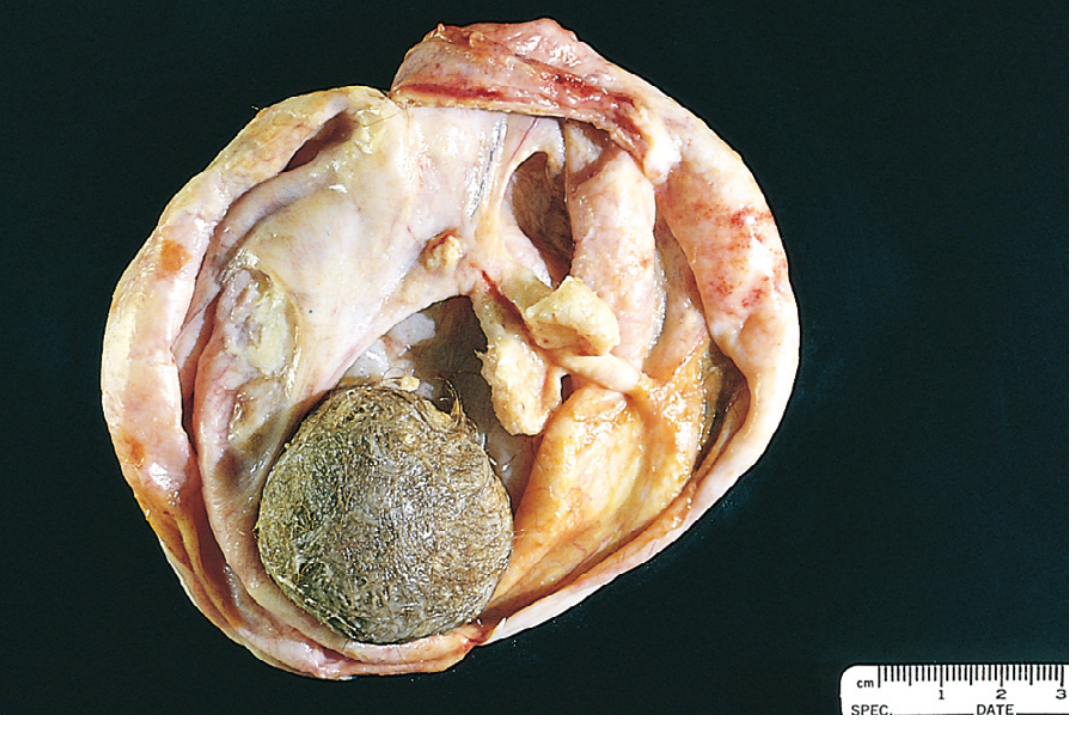
Fig. Opened mature cystic teratoma (dermoid cyst) of the ovary - Robbins Pathologic Basis of Disease
Pathology
- Cell of origin: Germ cells (ovum after first meiotic division); karyotype is almost always 46,XX
- Gross: Unilocular cyst lined by gray-white wrinkled skin; contains hair shafts, sebaceous/oily material, teeth, and areas of calcification
- Microscopy: Cyst wall of stratified squamous epithelium with underlying sebaceous glands, hair follicles, and adnexal structures. Tissues from all 3 germ layers present - cartilage, bone, thyroid, neural tissue
- Bilaterality: 10-15% are bilateral
- Malignant transformation: Occurs in ~1% - most commonly to squamous cell carcinoma; rarely thyroid carcinoma or melanoma
- Germ cell tumors constitute 15-20% of all ovarian tumors; the majority are mature cystic teratomas in females of reproductive age
(Robbins, Cotran & Kumar Pathologic Basis of Disease)
Incidence in Pregnancy
Adnexal masses are identified in pregnant patients at a rate of 2-20 per 1,000 pregnancies - approximately 2-20x more frequently than in age-matched non-pregnant women. Among adnexal masses in pregnancy that require surgical management:
| Type | Frequency |
|---|---|
| Dermoid cysts (MCT) | 32% - most common |
| Endometriomas | 15% |
| Functional cysts | 12% |
| Serous cystadenomas | 11% |
| Mucinous cystadenomas | 8% |
About 2% of adnexal masses in pregnancy are malignant, and approximately 70% of all adnexal masses spontaneously resolve during pregnancy.
(Cathcart et al., Am J Obstet Gynecol 2023 - PMID 36410423)
Ultrasound Appearance
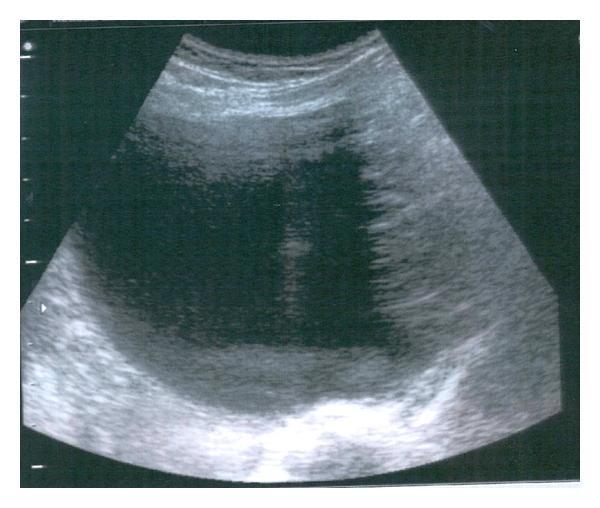
Ultrasound is the mainstay of evaluation - safe, accurate, and widely available. Dermoid cysts appear as complex adnexal masses with:
- Mixed echogenicity (hyperechoic foci from fat/calcification, hypoechoic areas)
- A "tip of the iceberg" sign from dense hyperechoic material with posterior acoustic shadowing
- Hyperechoic lines and dots ("dot-dash" pattern) from hair in sebaceous fluid
- A Rokitansky nodule (dermoid plug) may be visible
Validated scoring systems (IOTA Simple Rules, ADNEX model, Lerner, Sassone) can help risk-stratify masses in pregnancy. MRI without gadolinium is preferred when ultrasound is inconclusive and further characterization is needed.
Clinical Presentation
Most dermoid cysts in pregnancy are asymptomatic and found incidentally on first-trimester ultrasound. When symptoms occur, they are usually due to a complication:
- Torsion - most common complication; presents with acute pelvic/lower abdominal pain, nausea, vomiting. Risk is highest in early second trimester as the uterus rises and displaces the mass
- Rupture - chemical peritonitis from spillage of sebaceous contents; causes severe abdominal pain, peritoneal signs
- Obstruction of labor - if cyst is in the pouch of Douglas or lower pelvis, it can obstruct fetal descent
- Infection - rare
Management
Expectant (Observation)
Recommended for:
- Cysts <6 cm with benign ultrasound features
- Asymptomatic masses with no concern for malignancy
- Serial ultrasound monitoring throughout pregnancy
Surgical Intervention
Indicated for:
- Cysts >6 cm (high torsion risk)
- Symptoms of torsion, rupture, or acute abdomen
- Masses with features concerning for malignancy
- Masses expected to obstruct labor
Preferred approach: Laparoscopic surgery - consistently demonstrates shorter hospital stay, less postoperative pain, and evidence of lower fetal loss, preterm birth, and low birthweight compared to laparotomy.
Optimal timing: Second trimester (14-20 weeks) - balances time for spontaneous resolution, reduced risk of miscarriage vs. first trimester, and better visualization before the uterus becomes very large. However, necessary surgery should never be delayed solely due to gestational age.
Intraoperative Best Practices (Laparoscopy in Pregnancy)
| Parameter | Recommendation |
|---|---|
| Positioning | Left lateral decubitus after first trimester |
| CO₂ insufflation | <12-15 mmHg |
| Monitoring | Intraoperative maternal capnography |
| Fetal monitoring | Pre- and post-operative FHR and contraction monitoring |
| Port placement | Adjusted for uterine size and mass location |
| Thromboprophylaxis | Both mechanical and chemical |
At Term / During Labor
- If discovered to obstruct labor: Cesarean section is preferred
- Cystectomy may be performed at the time of cesarean delivery if feasible
Paraneoplastic Complications (Rare but Important)
Dermoid cysts can occasionally trigger anti-NMDAR encephalitis (inflammatory limbic encephalitis), which may present as psychiatric symptoms, seizures, or movement disorders. This may remit following removal of the tumor - especially important to consider in pregnant women with unexplained neuropsychiatric symptoms.
Ovarian dermoid cysts are also associated with warm autoimmune hemolytic anemia (AIHA) in rare cases.
Key Summary Points
| Feature | Details |
|---|---|
| Most common ovarian tumor in pregnancy | Yes - 32% of surgically managed adnexal masses |
| Incidental discovery | Most common presentation |
| Most feared acute complication | Torsion |
| Most dangerous complication | Rupture (chemical peritonitis) |
| Investigation of choice | Ultrasound (MRI if needed) |
| Observation threshold | <6 cm, asymptomatic, benign features |
| Surgery threshold | >6 cm, symptomatic, suspicious features |
| Best surgical timing | Second trimester (14-20 weeks) |
| Preferred surgical route | Laparoscopy |
| Malignant transformation risk | ~1% |
Sources:
- Robbins, Cotran & Kumar Pathologic Basis of Disease (mature cystic teratoma pathology)
- Berek & Novak's Gynecology (germ cell tumors, ovarian mass evaluation)
- Cathcart AM et al. Adnexal masses during pregnancy: diagnosis, treatment, and prognosis. Am J Obstet Gynecol 2023 (PMID 36410423) - most comprehensive recent review
This is a shared conversation. Sign in to Orris to start your own chat.